7 Best Bullhorn Alternatives for AI-Native Staffing (2026) | HireBound
 Suvam Moitra
 ·Jun 2, 2026·18 min read
Key Takeaways
- 1HireBound is the only alternative with agentic AI across sourcing, adaptive Voice AI screening, omnichannel outreach, and autonomous scheduling.
- 2Bullhorn remains the right choice for US/UK enterprise agencies with 200+ recruiters and deep Salesforce or VMS integrations already in production.
- 3Only 10% of staffing firms have agentic AI across the full workflow, yet firms using AI are 2× more likely to grow revenue according to Bullhorn's own 2026 GRID data.
- 4Recruiterflow and Vincere are strong mid-market options if your priority is CRM depth over AI automation depth.
- 5Annual applications per recruiter have increased 412% since 2022, making manual processing inside legacy ATS systems unsustainable at scale.
Bullhorn alternatives are staffing ATS and CRM platforms that agencies evaluate when their current Bullhorn workflows create more manual work than the tool eliminates. The shift is not about finding a different ATS; it is about moving from recruiter-assisted automation to agentic AI workflows that remove recruiter effort from sourcing through submission.
Why Staffing Agencies Are Looking for Bullhorn Alternatives in 2026
Staffing teams are still spending too much time on manual work, juggling clunky workflows, and trying to stitch together automation that only solves part of the process. Bullhorn's own 2026 GRID Industry Trends Report makes the case: top-performing staffing firms are four times more likely to use AI, 55% of firms report AI screening alone improved KPIs by more than 25%, and 56% of the highest-growth firms report average placement times under 10 days.
Yet only 10% of firms have implemented agentic AI across their full workflow.
That is the real gap. Bullhorn, founded in 1999, is still the benchmark for staffing CRM. It does client management, candidate tracking, and VMS integrations at enterprise scale. But the market is shifting toward platforms that don't just track candidates but autonomously source, screen, schedule, and communicate without a recruiter touching each step. The most significant shift is in screening itself: Voice AI agents that conduct structured screening conversations, learn from every interaction, and get sharper with each candidate they speak to.
According to Greenhouse's 2026 Hiring Benchmarks, applications per recruiter have increased 412% since 2022, based on an analysis of 640M+ applications across 6,000+ companies. Meanwhile, Gem's 2026 Recruiting Benchmarks Report shows recruiters are handling 93% more applications than in 2021, while teams are roughly 14% smaller. The math is simple: manual processing inside a legacy ATS cannot keep up with that volume. The alternative isn't a slightly better ATS. It's a fundamentally different workflow where AI agents handle the screening load, adapt their approach based on candidate responses, and continuously improve without being retrained by a human.
Quick Verdict: What Each Alternative Is Best For
HireBound : AI-native staffing with agentic Voice AI screening and autonomous end-to-end recruitment workflow
Recruiterflow : Small to mid-size agencies wanting clean CRM with lightweight automation
Loxo : Agencies that prioritise AI-powered sourcing and talent intelligence
Vincere : Global staffing firms that need strong CRM, front-office and back-office in one
Zoho Recruit : Agencies already in the Zoho ecosystem wanting a familiar ATS integration
CEIPAL : Staffing firms focused on VMS/MSP integrations, AI matching, and compliance
Recruit CRM : Agencies that want a simple, well-designed ATS/CRM with strong customer support
Who This Guide Is For
This guide is for staffing agency owners, recruitment founders, managing directors, delivery heads, and talent ops leaders who are comparing Bullhorn alternatives because they want a faster, cleaner way to run recruiting.
It will be most relevant if you are:
Staffing agency owners who see the revenue case for AI. Top-performing staffing firms are four times more likely to use AI, according to Bullhorn's own GRID 2026 data based on a survey of nearly 2,300 recruitment professionals worldwide. If your agency is stuck at the same placements-per-recruiter as last year, the problem is likely workflow, not effort.
Managing directors and delivery heads who are drowning in volume. Recruiters are handling 93% more applications than in 2021, while teams are roughly 14% leaner, according to Gem's 2026 Recruiting Benchmarks Report. Workflow efficiency is no longer an ops problem. It is a board-level problem.
Talent ops and recruitment ops leaders who know the automation gap is deeper than it looks. According to the State of Hiring Automation: 2026 Benchmark Report by Phenom and Aptitude Research, 94% of organisations still do not schedule interviews inline, and only 0.9% have a fully orchestrated qualification workflow. If your team is still manually scheduling after an AI tool "screens" a candidate, you've automated one step and left the bottleneck intact.
Teams already using Bullhorn or similar systems who want to know what "AI-native" actually means in practice. The gap is not just automation. It is automation depth: only 10% of firms have implemented agentic AI across their full workflow. And within that gap, the biggest missing piece is intelligent screening — AI that doesn't just filter resumes but actually talks to candidates, evaluates responses, and improves its own screening criteria over time.
High-volume staffing teams who cannot scale manually. Applications per recruiter have increased 412% since 2022 according to Greenhouse's analysis of 640M+ applications, making manual processing unsustainable at the volumes most agencies now face.
Who Should NOT Switch from Bullhorn
Bullhorn is still the right platform for specific situations. Being honest about this makes the rest of the comparison more useful.
Do not switch if you are a large enterprise staffing agency with 200+ recruiters, deep Salesforce integrations, and established VMS/MSP workflows running through Bullhorn. The workflow disruption outweighs the gains from switching, especially if your automation needs are met by Bullhorn's existing AI features and marketplace integrations.
Do not switch if your primary workflow depends on Bullhorn's VMS integrations (Fieldglass, Beeline, IQNavigator) and you cannot afford any gap in submission workflows during a transition. These integrations are mature in Bullhorn and immature or absent in most alternatives.
Do not switch if your team has heavily customised Bullhorn with third-party integrations, custom fields, and workflows built over years. The ROI case only works if AI automation savings exceed that rebuild cost within 6–12 months.
How We Evaluated These Alternatives
Before comparing individual tools, here is what we measured and why each criterion matters for a staffing agency evaluating an alternative to Bullhorn.
AI automation depth. Does the tool assist recruiters (copilot) or replace recruiter steps entirely (agentic)? A copilot that helps draft a message still requires a recruiter to review, edit, and send. An agentic system sends, screens, and schedules autonomously. Within this, the quality of the AI matters: does the screening agent learn from past conversations and adapt, or does it run the same static script every time? This is the single biggest differentiator between modern alternatives.
Candidate discovery quality. Can the platform find and surface relevant candidates from job boards, internal databases, and external sources? Or does it only work with candidates already in your pipeline?
Omnichannel and multilingual outreach. Does the platform reach candidates on the channels they actually use — Voice, messaging, email, SMS — based on geographic and demographic context? Can it conduct screening conversations in multiple languages natively? A tool locked to a single outreach channel misses candidates in every market where that channel isn't dominant.
Voice AI and adaptive screening. This is where the gap between alternatives is widest. Static screening (keyword matching, resume parsing) is table stakes. The next standard is Voice AI agents that conduct real conversations with candidates, evaluate nuanced responses, and improve their screening accuracy with every interaction. An always-learning screening model that adapts based on candidate response patterns produces better shortlists over time without any recruiter retraining.
CRM and ATS pipeline management. How well does the tool handle end-to-end candidate tracking, client management, job management, and pipeline visibility? This is Bullhorn's core strength, and any alternative needs to match or clearly explain its trade-off here.
Reporting and visibility. Can recruiters and agency leaders see defensible data on placements, time-to-fill, source effectiveness, and team performance? Data-driven decisions require data, and opaque dashboards are a dealbreaker for scaling agencies.
Evaluation Criteria: All 7 Alternatives Compared
AI Automation Depth
✅ HireBound: Agentic — fully autonomous across sourcing, screening, and scheduling. Screening agents evolve with every conversation, continuously improving candidate evaluation without manual retraining
✅ Loxo: Strong sourcing AI — proactive candidate surfacing from a 1.2-billion profile database with built-in contact data
✅ CEIPAL: AI-powered matching and ranking — automatically parses resumes, evaluates candidate skills, and ranks the most qualified applicants
⚠️ Recruiterflow / Vincere / Zoho Recruit / Recruit CRM: Basic to moderate — workflow triggers, resume parsing, and assistive features. Zoho's Zia AI assistant helps with resume parsing and candidate matching but does not act autonomously. Recruiterflow includes AI-driven workflow automation at a basic level
Candidate Discovery
✅ HireBound: Access to 500M+ candidate profiles globally through AI discovery
✅ Loxo: Strong built-in sourcing from a proprietary 1.2-billion profile talent database, professional networks, and job boards — functions as a direct alternative to LinkedIn Recruiter
✅ CEIPAL: Strong candidate matching from job boards, internal database, and VMS channels
⚠️ Recruit CRM: AI-powered sourcing and parsing with a dedicated LinkedIn Chrome extension for sourcing
⚠️ Vincere / Zoho Recruit: Moderate — depends on job board integrations and manual sourcing
⚠️ Recruiterflow: Moderate — sourcing capabilities included but not the platform's core strength
Omnichannel and Multilingual Outreach
✅ HireBound: Native omnichannel outreach across Voice, messaging, email, and SMS with multilingual support. Channel selection adapts to candidate geography and preferences
⚠️ Zoho Recruit: Email and basic messaging; broader channel coverage through the Zoho ecosystem
⚠️ Recruit CRM: Email sequencing with integrations for Google Meet, Teams, and Zoom
⚠️ CEIPAL: Email and phone-based outreach with some multilingual support
❌ Recruiterflow / Loxo / Vincere: Primarily email-based outreach
Voice AI and Adaptive Screening
✅ HireBound: Voice AI screening agents that conduct structured conversations in multiple languages, learn from every interaction, and continuously refine screening criteria. The always-learning model means screening quality improves with volume rather than degrading. Built on insights from 3M+ completed candidate conversations
❌ Recruiterflow / Loxo / Vincere / Zoho Recruit / CEIPAL / Recruit CRM: No Voice AI screening capability. Screening is manual, chatbot-based, or limited to resume parsing and AI matching
CRM and Client Management
✅ Vincere: Very strong — full front-office and back-office (timesheets, expenses, payroll, and invoicing) natively in one system
✅ Recruit CRM: Strong — highly customizable pipelines with responsive customer support, praised by users for clean UI and kanban-style management ✅ Recruiterflow: Strong — purpose-built CRM for staffing and executive search agencies with pipeline management and client tracking
✅ Loxo: Strong — unified ATS, CRM, sourcing, and outreach in one platform
✅ Zoho Recruit: Strong — deep integration with the Zoho ecosystem and built-in client portal
✅ CEIPAL: Strong — unified ATS, CRM, VMS, and workforce management
⚠️ HireBound: Growing — solid pipeline management and AI dashboard, but not yet at Vincere or Bullhorn depth for complex client billing and multi-entity management
Reporting and Visibility
✅ HireBound: AI-forward dashboard with customisation based on client requirements, plus screening intelligence data from Voice AI conversations
✅ CEIPAL: Strong compliance and staffing-specific reporting with VMS visibility
✅ Recruiterflow / Loxo / Vincere / Zoho Recruit / Recruit CRM: Good reporting with standard recruiting KPIs
The 7 Best Bullhorn Alternatives for Staffing Agencies in 2026
#1 HireBound
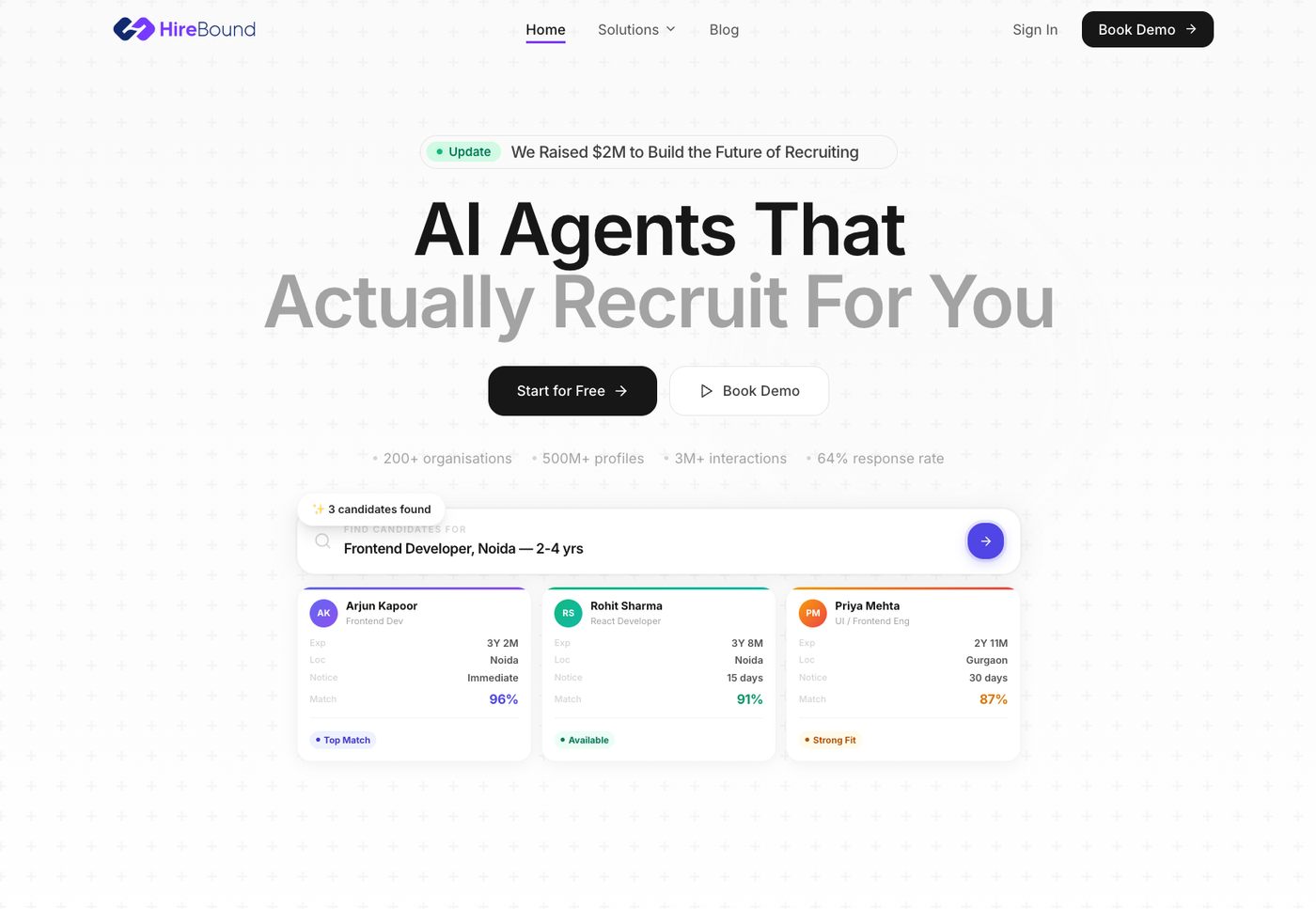
The tool is built for staffing teams that want an agentic AI recruiting workflow where screening agents learn and adapt with every candidate conversation, removing recruiter effort from sourcing through submission.
Best for: Staffing agencies that want agentic AI across the full hiring workflow with Voice AI screening that gets smarter with every interaction.
Why teams compare it to Bullhorn:
- Bullhorn requires recruiters at every step; HireBound's agentic AI handles sourcing through scheduling autonomously
- Bullhorn has no native Voice AI screening; HireBound's screening agents conduct structured conversations in multiple languages and evolve their screening criteria based on response patterns
- Bullhorn's automation is workflow-level (triggers, reminders, task routing); HireBound's automation is decision-level (the AI evaluates candidates, adapts its approach, and acts without waiting for recruiter input)
What it does well:
- Agentic AI across the full workflow: the system autonomously sources candidates from 500M+ profiles globally, screens via Voice AI and omnichannel outreach, and schedules interviews without recruiter input at each stage
- Voice AI screening agents that learn from every conversation. This is not a static phone screen with preset questions. The screening model adapts its evaluation criteria, question depth, and conversational approach based on patterns across 3M+ completed candidate conversations. The result is a screening agent that improves its shortlist quality with volume, not one that runs the same script on candidate #1 and candidate #10,000
- Multilingual Voice AI support, critical for markets where candidates do not respond to English-only outreach
- Omnichannel candidate engagement that adapts channel selection to candidate geography and preferences rather than forcing a single communication path
- AI-forward dashboard with customisation based on client requirements, giving agency leaders real-time visibility into recruiter productivity, pipeline health, and screening intelligence insights
- Trusted by 200+ organisations, with recruiters handling 3× more candidates per day versus manual processes
Trade-offs:
- CRM and client management features are growing but not yet as deep as Bullhorn or Vincere for agencies that need complex client billing, VMS integrations, or multi-entity management
- Newer platform compared to Bullhorn's 25+ years in market, which means fewer third-party marketplace integrations
- The agentic model works best at volume. Agencies hiring for 5 roles a month will not see the same ROI as agencies filling 50+ roles where the learning model has enough data to continuously improve
Who should choose HireBound: Staffing agencies and corporate HR teams doing high-volume hiring (50+ roles at a time) who want to eliminate recruiter manual work in sourcing, screening, and scheduling. Especially strong for agencies where multilingual Voice AI screening and an always-learning model are competitive advantages.
Best for: Staffing agencies that want agentic AI with adaptive Voice AI screening across the full hiring workflow.
#2 Recruiterflow
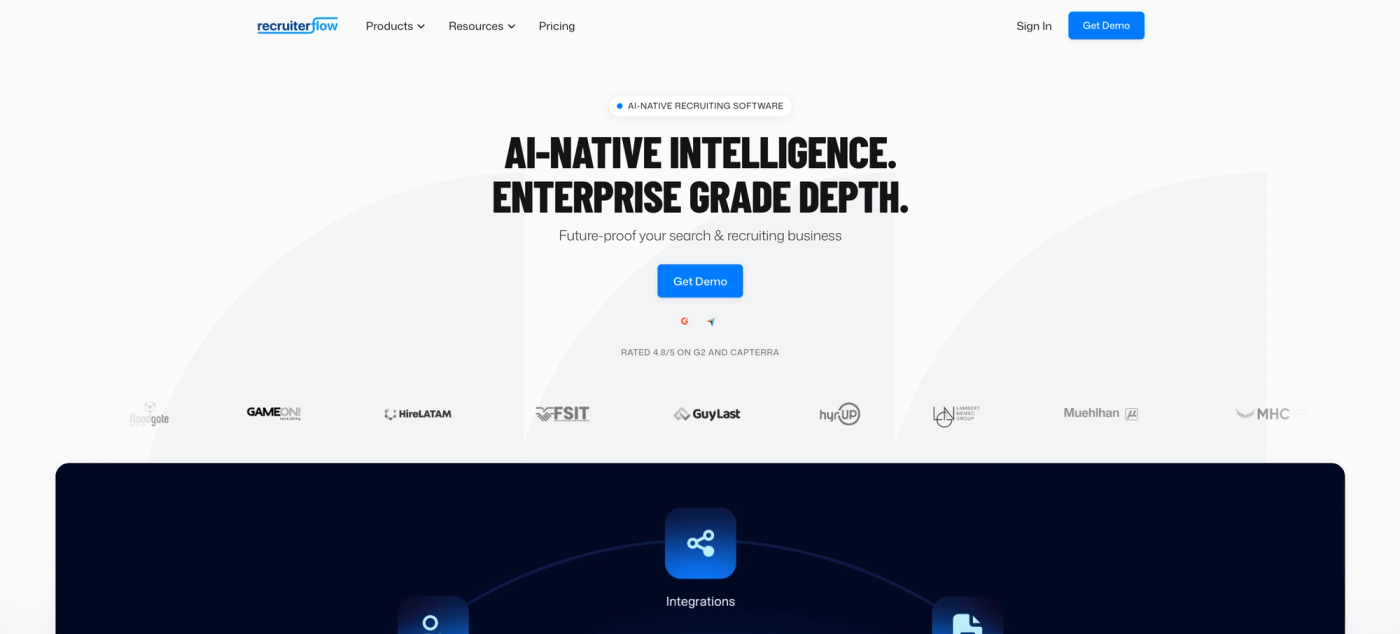
A purpose-built ATS and CRM specifically designed for staffing and executive search agencies, combining sourcing, pipeline management, and AI-driven workflow automation in one platform.
Best for: Agencies with 5–50 recruiters that want a well-designed CRM with intuitive features and fast setup.
Why teams compare it to Bullhorn:
- Bullhorn's interface is built for enterprise; Recruiterflow is lighter and faster to deploy
- Agencies frustrated by Bullhorn's complexity consistently cite Recruiterflow's UX as a strength in user reviews
- Purpose-built for staffing and executive search, not a generic ATS
What it does well:
- Clean, intuitive interface with customizable job views, NLP search, and flexible pipeline management. Users consistently highlight the user experience
- Solid CRM with client tracking, email sequencing, and business development tools
- Fast setup with guided onboarding that gets teams productive within days
Trade-offs:
- No native Voice AI screening or omnichannel outreach. Automation is limited to email sequences and workflow triggers
- Limited scalability for high-volume hiring. Recruiterflow is purpose-built for contingent and executive search, not enterprise-level bulk recruitment. Agencies processing thousands of applications at scale may encounter bottlenecks
- No adaptive or learning AI capabilities. Screening remains a manual recruiter task
Who should choose Recruiterflow: Small to mid-size agencies (under 50 recruiters) that prioritise CRM quality and user experience over AI depth. Strong for executive search and professional placement firms.
Best for: Small staffing and executive search agencies wanting a clean, purpose-built CRM without enterprise complexity.
#3 Loxo
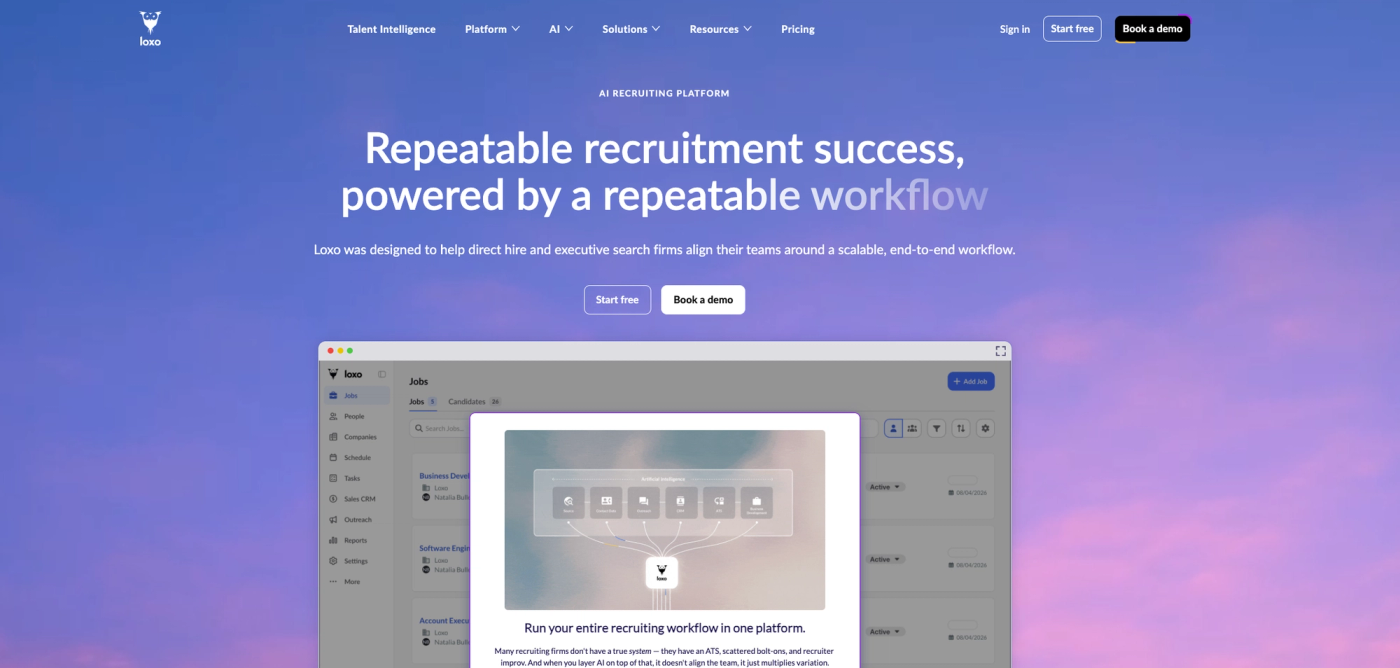
A unified AI-native Talent Intelligence Platform combining a 1.2-billion profile talent database, ATS, Recruiting CRM, and multi-channel outreach.
Best for: Agencies and talent acquisition teams that consider sourcing and talent intelligence their biggest bottleneck.
Why teams compare it to Bullhorn:
- Loxo's AI sourcing capabilities are significantly more advanced than Bullhorn's native sourcing tools
- Built-in contact data from a proprietary 1.2-billion profile database reduces dependence on LinkedIn Recruiter and separate sourcing tools
- Functions as an all-in-one system that replaces 3–4 point solutions
What it does well:
- AI-powered sourcing that automatically surfaces candidates from its proprietary database, professional networks, and job boards without bias
- Unified platform that combines ATS, CRM, sourcing, and outreach — Users praise it as a comprehensive system that streamlines daily workflows
- Strong for direct hire and executive search firms where candidate quality matters more than volume
Trade-offs:
- No Voice AI screening, no omnichannel outreach beyond email, and no multilingual support for non-English markets
- Sourcing AI is built for headhunting skilled professionals and executives. For mass frontline or blue-collar roles where candidates need to find the employer, Loxo's passive sourcing model is less suited than platforms with high-volume, bidirectional outreach
- No adaptive screening model. The AI finds candidates but does not conduct or learn from screening conversations
Who should choose Loxo: Agencies focused on professional and executive placement where sourcing quality and talent intelligence are the primary differentiators. Not ideal for bulk hiring or agencies that need Voice AI and omnichannel screening.
Best for: Agencies that need AI-driven sourcing from a massive talent database for professional-level roles.
#4 Vincere
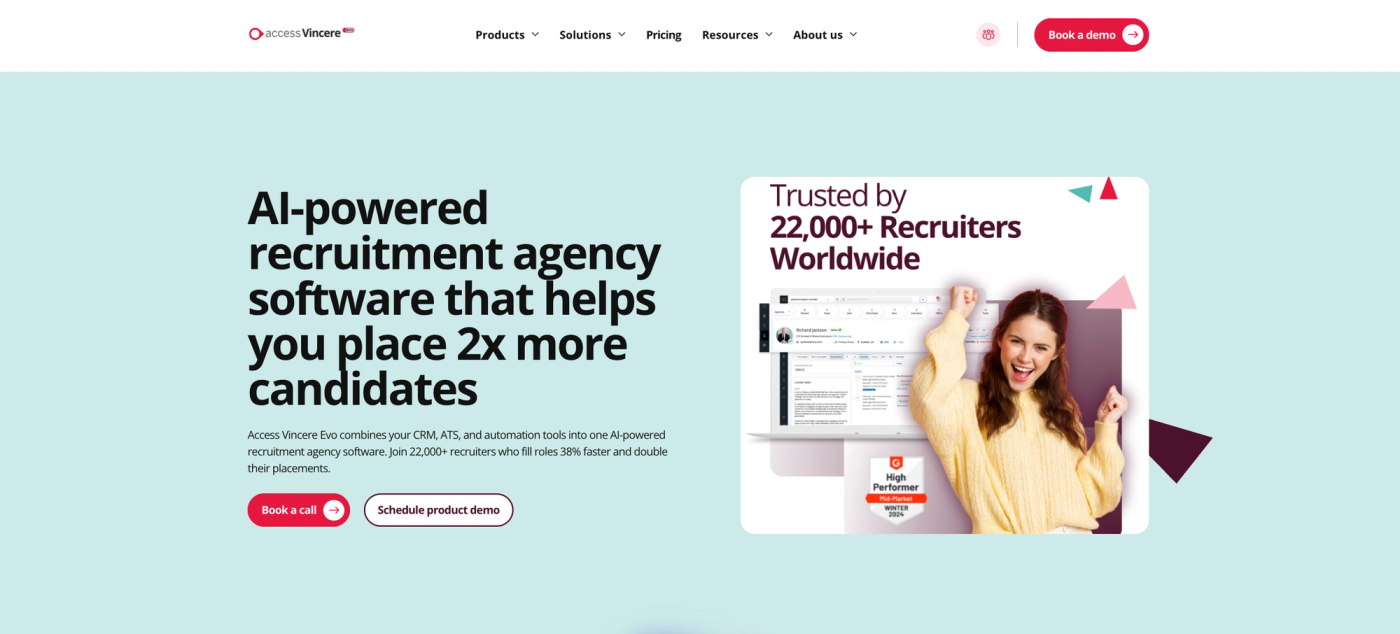
An all-in-one recruitment operating system that unites front-office ATS, CRM, and mid/back-office operations (timesheets, expenses, payroll, invoicing) natively. Now branded as Access Vincere Evo.
Best for: Global staffing firms that want a single platform for both recruitment operations and back-office management.
Why teams compare it to Bullhorn:
- Vincere handles timesheets, expenses, payroll, and invoicing natively, while Bullhorn relies on add-ons or separate systems for back-office
- Strong in APAC and UK markets with growing adoption among mid-market agencies
- Combines front-office and back-office in one system, reducing tool sprawl
What it does well:
- End-to-end staffing operations: CRM, ATS, timesheets, expenses, payroll, and invoicing natively in one platform
- Solid client management and business development tools comparable to Bullhorn's CRM
- Good analytics and reporting across the full recruitment cycle. Users praise ease of use and customer support
Trade-offs:
- AI capabilities are basic. Vincere assists with automation but does not offer agentic AI, Voice AI screening, or adaptive learning models
- Outreach is primarily email-based with no native omnichannel or multilingual screening capabilities
- Setup takes 2–4 weeks for most agencies to complete kickoff, configure custom pipelines, and train the team. Complex data migrations can extend to 4–8 weeks
Who should choose Vincere: Mid-size global staffing firms (50–200 recruiters) that need both front-office and back-office in one system. Not the right fit for agencies prioritising agentic AI or Voice AI screening.
Best for: Global staffing firms that want CRM, ATS, and back-office billing in a single platform.
#5 Zoho Recruit
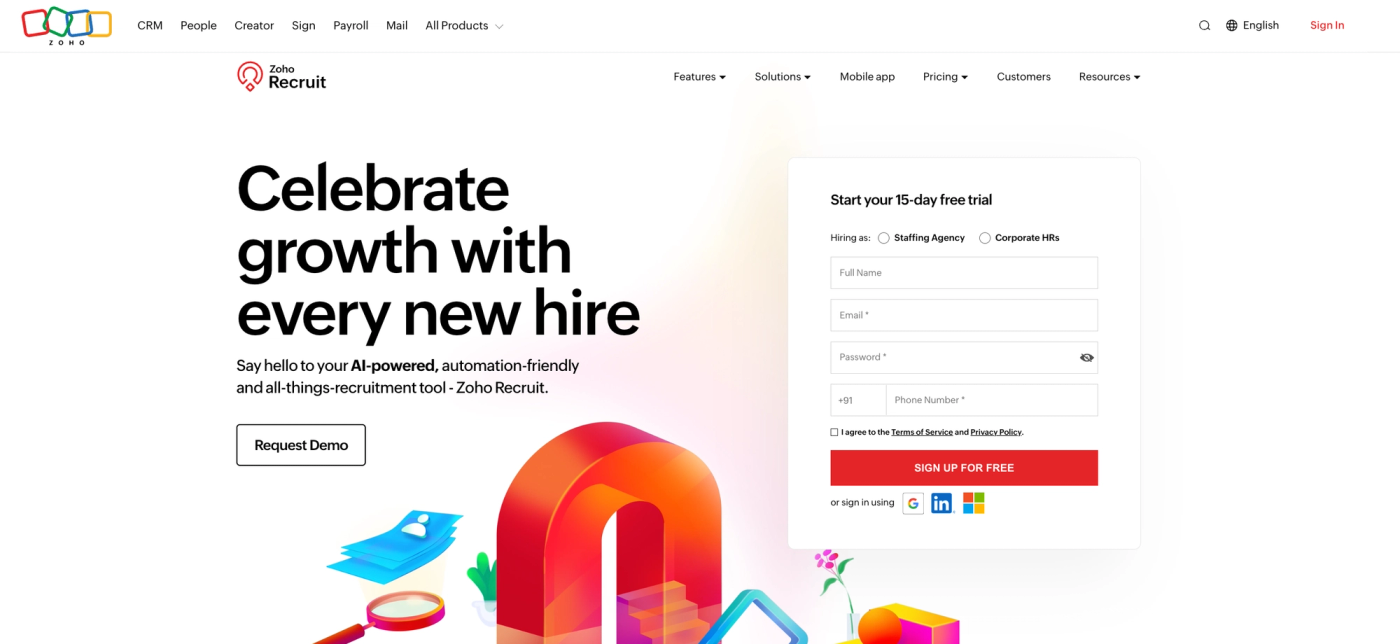
Part of the Zoho ecosystem, Zoho Recruit offers applicant tracking, recruitment CRM, resume parsing, job board posting, career sites, and reporting with deep integration across Zoho's 50+ business products.
Best for: Agencies and corporate HR teams already using Zoho CRM, Zoho Mail, or other Zoho products who want a familiar ATS integration.
Why teams compare it to Bullhorn:
- Native integration with 50+ Zoho products provides a broader business platform
- Faster setup and simpler configuration than Bullhorn
- Accessible entry point for agencies moving to structured ATS workflows for the first time
What it does well:
- Deep integration with the Zoho ecosystem (CRM, Mail, Analytics, People), valuable if your agency already uses Zoho
- Zia AI hiring assistant provides resume parsing, candidate matching, and basic workflow automation. For 2026, Zoho has placed stronger focus on Zia's AI capabilities
- Built-in client portal, career sites, and email tools in addition to core ATS functions
- Large user base with extensive community and documentation
Trade-offs:
- Zia AI is an assistant, not an agent. It helps recruiters but does not autonomously screen, schedule, or communicate. The distinction between copilot AI and agentic AI matters here
- No Voice AI screening, no adaptive learning, and no omnichannel outreach natively
- Reporting is good but not as deep as Vincere or CEIPAL for staffing-specific KPIs
- Most valuable if you are already in the Zoho ecosystem. Standalone, it is a mid-tier ATS without strong differentiation
Who should choose Zoho Recruit: Agencies or corporate HR teams already invested in the Zoho ecosystem that need an ATS with decent automation. Not the right fit for agencies that need agentic AI, Voice AI screening, or omnichannel outreach.
Best for: Agencies in the Zoho ecosystem that want a familiar ATS with AI-assisted features.
#6 CEIPAL
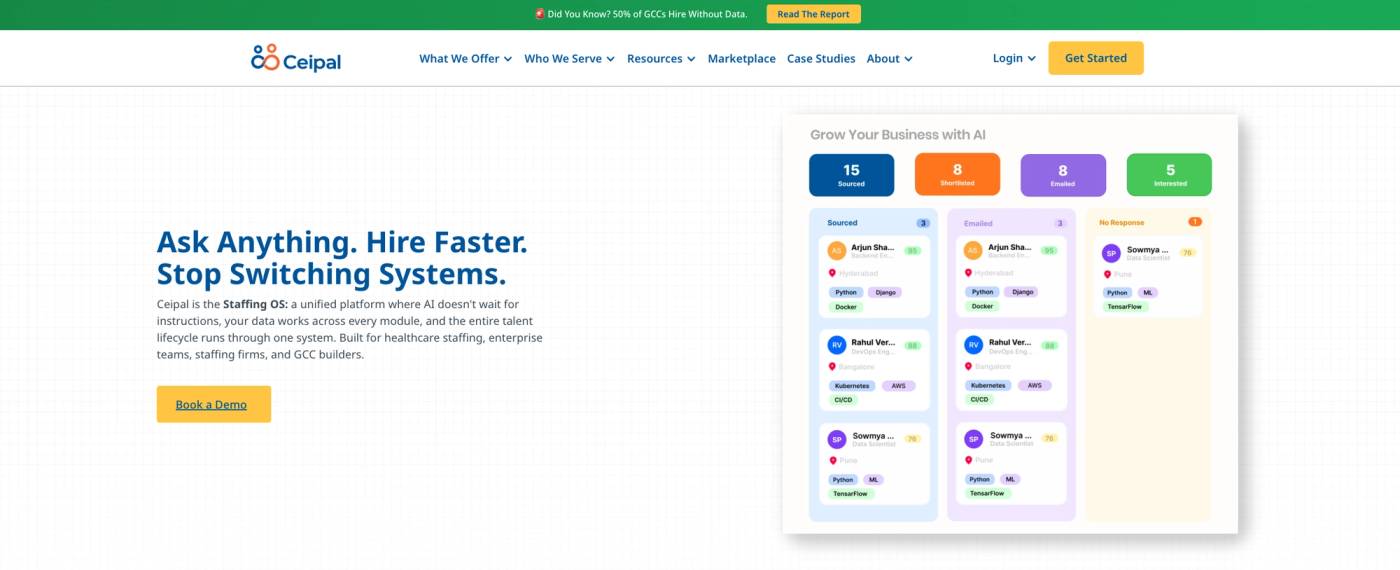
A unified talent acquisition platform built for staffing firms, MSPs, and corporate recruiters, combining ATS, VMS, and workforce management with AI-powered matching.
Best for: Staffing agencies focused on contract staffing, VMS submissions, and compliance-heavy industries.
Why teams compare it to Bullhorn:
- CEIPAL's VMS integrations are competitive with Bullhorn's and positioned for mid-market agencies
- AI-powered candidate matching and ranking are more advanced than Bullhorn's native capabilities
- Built specifically for staffing workflows with strong compliance, onboarding, and workforce management features
What it does well:
- AI-powered matching and ranking that automatically parses resumes, evaluates candidate skills, and ranks the most qualified applicants to reduce time-to-hire
- Unified platform spanning ATS, VMS, and workforce management — covers the full staffing lifecycle
- Comprehensive compliance and onboarding features. Users highlight the all-in-one setup combining ATS and CRM
Trade-offs:
- No Voice AI screening, no adaptive learning model, and limited multilingual capability
- Interface and setup can be complex. Users frequently describe the dashboard as feature-rich but initially cluttered, with a steep learning curve during onboarding. The platform rewards persistence once mastered
- Strongest in contract and temporary staffing. Less suited for permanent placement workflows
- No omnichannel outreach. Candidate engagement is primarily phone and email based
Who should choose CEIPAL: Staffing agencies doing contract and temporary staffing that need strong VMS integrations and AI matching. Well-suited for firms managing vendor relationships and compliance at scale.
Best for: Contract staffing agencies that need VMS/MSP integrations with AI-driven matching and workforce management.
#7 Recruit CRM
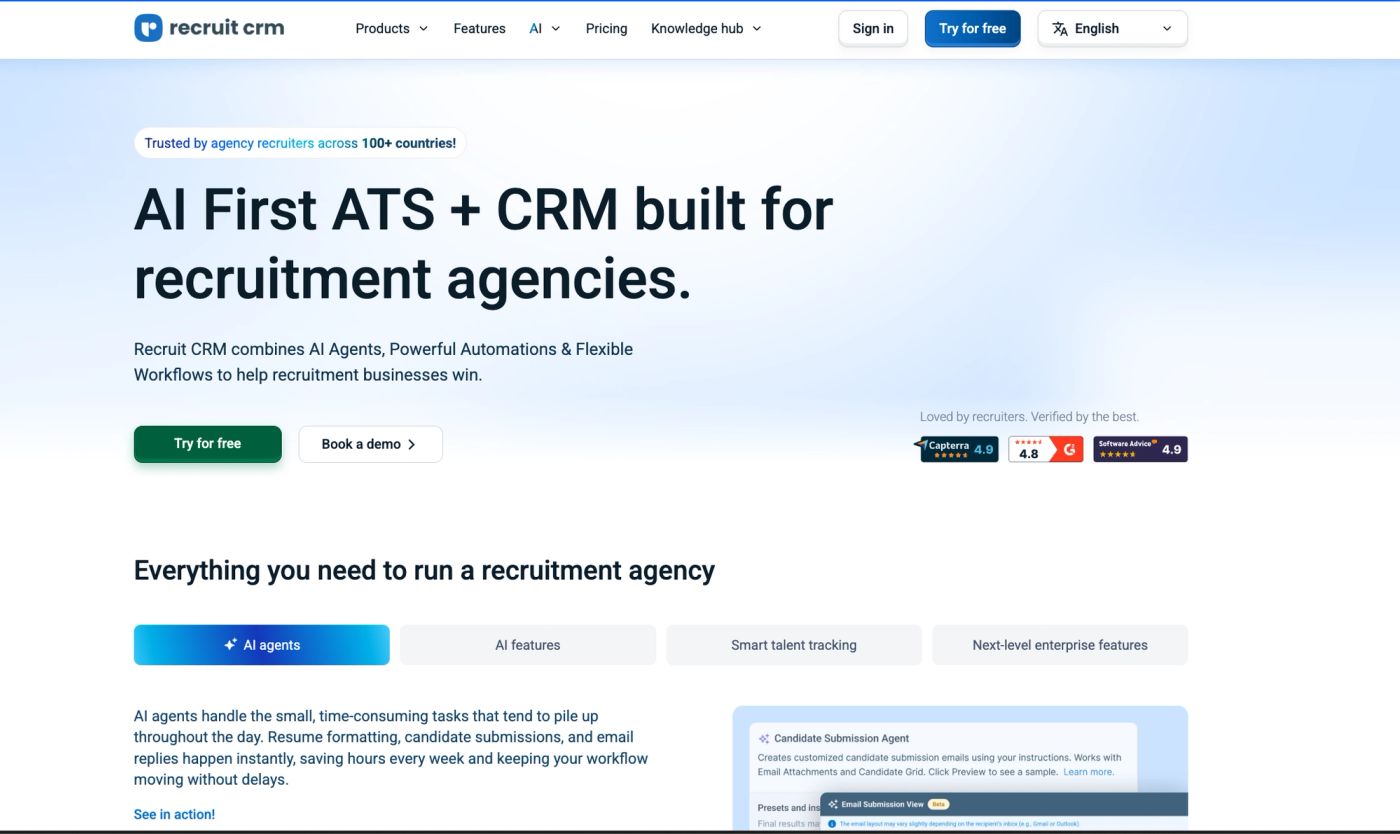
A cloud-based ATS and CRM designed specifically for staffing agencies, known for customizable pipelines, robust sourcing extensions, and responsive customer support.
Best for: Small to mid-size agencies that want a reliable, well-supported ATS/CRM without the complexity of enterprise platforms.
Why teams compare it to Bullhorn:
- Simpler setup and faster onboarding than Bullhorn, with a modern interface
- Exceptional customer support that consistently earns top ratings among tools on this list
- Covers core ATS and CRM functionality for agencies that don't need Bullhorn's enterprise feature set
What it does well:
- Highly customizable pipelines with kanban-style management that recruiters adopt quickly. Users highlight the clean UI and flexibility
- AI-powered sourcing and resume parsing with a dedicated LinkedIn Chrome extension for candidate sourcing
- Exceptional customer support — responsive onboarding, training, and ongoing assistance consistently cited as a differentiator in reviews
- Good integration ecosystem with Google Meet, Teams, Zoom, and standard job boards
Trade-offs:
- No Voice AI screening, no agentic AI, and no adaptive learning model. Automation is workflow-level (triggers, sequences), not decision-level
- Omnichannel outreach is limited. Primarily email-based with some integrations
- Newer entrant compared to more established platforms, which means less market presence but rapidly growing adoption
- Scaling beyond 100+ recruiters surfaces limitations: per-user costs strain budgets at scale, reporting tools can struggle with complex agency metrics, and some enterprise features require workarounds
Who should choose Recruit CRM: Small to mid-size agencies (10–80 recruiters) that value clean UX, fast setup, and responsive support over AI depth. A solid choice for agencies that want a modern Bullhorn replacement without needing agentic capabilities.
Best for: Mid-size staffing agencies that want a modern, highly-rated ATS/CRM with outstanding support.
Evaluating your options? See how HireBound's agentic AI compares to your current workflow. Visit hirebound.io →
The Right Tool Depends on Your Workflow
There is no single best Bullhorn alternative. The right choice depends on your agency size, your hiring volume, where your candidates are, what languages they speak, and how much of the recruiting workflow you want AI to own versus manage manually.
The biggest question to ask yourself is not "which ATS has more features?" but "how much of the screening and scheduling workflow do I want to remove from my recruiters entirely?" If the answer is "all of it," the field narrows to platforms with agentic AI and Voice AI screening agents that learn from every conversation. If the answer is "I just need a better CRM," several options on this list will serve you well.
Compare based on automation depth, agentic capability, and staffing fit. Start by mapping your current workflow end to end, identifying where recruiter time is wasted on repetitive screening and scheduling, and matching that to the tool that eliminates the most friction.


