Background Verification in India: Process, Checks and Timelines
 Devansh Dhawan
 ·Oct 28, 2026·9 min read

Key Takeaways
- 1Background verification (BGV) checks a candidate’s declared identity, education, employment, address and record against independent sources, usually after the offer and before joining.
- 2Six checks cover most roles: identity, education, employment, address, court or criminal record, and references. Add role-specific checks only where the job justifies them.
- 3Timelines in this guide are illustrative. Most delay comes from missing documents and slow past-employer replies, not from the check itself.
- 4Section 6 of the DPDP Act 2023 requires consent that is free, specific, informed, unconditional and unambiguous, and limited to the data a check needs. The Rules’ main obligations apply from 13 May 2027.
- 5A discrepancy is a prompt to ask, not a verdict. Give the candidate a chance to explain before any decision, and keep a human on the final call.
Background verification (BGV) is the process of confirming that what a candidate declared, such as identity, education, work history, address and legal record, matches independent sources. Employers in India usually run it after an offer is accepted and before the joining date. A clear result lets the offer proceed. A discrepancy triggers a review, not an automatic rejection.
This guide covers the six common checks, the process step by step, what drives timelines, and what consent and privacy law require. It also covers how to handle a failed check fairly. It is general information, not legal advice, so have counsel review your own policy.
See how HireBound supports onboarding documents and candidate follow-up: explore HireBound.
What Does Background Verification Check?
A BGV report compares a candidate’s claims against records held by others. A university confirms the degree. A former employer confirms dates and designation. A court record search shows whether a case exists.
The scope is set by the employer, not by one national standard. A back-office role may need three checks, and a role that handles cash or customer data may need more. Match the checks to the risk of the job.
The Six Common Background Checks
The table below lists the checks most Indian employers run, what each confirms, and the documents usually requested. Document lists vary by employer and by check provider, so treat them as typical, not required.
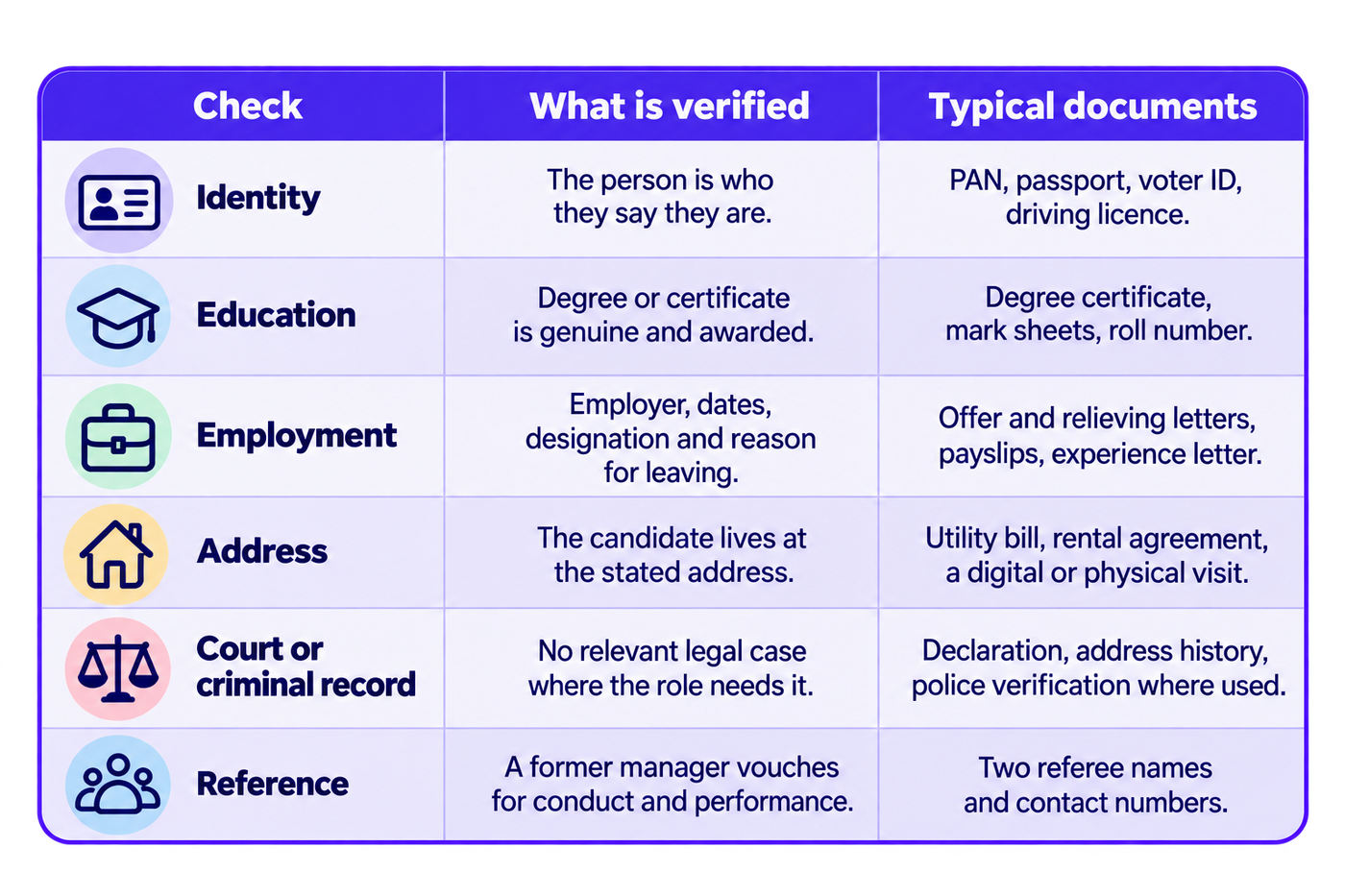
Some roles add a professional licence or financial-integrity check. Add these only when the job has a real reason, such as handling client money.
Employment and education checks tend to take longest, because they depend on third parties responding. A referee’s answer is opinion, not record, so weigh it differently.
How Does the Background Verification Process Work?
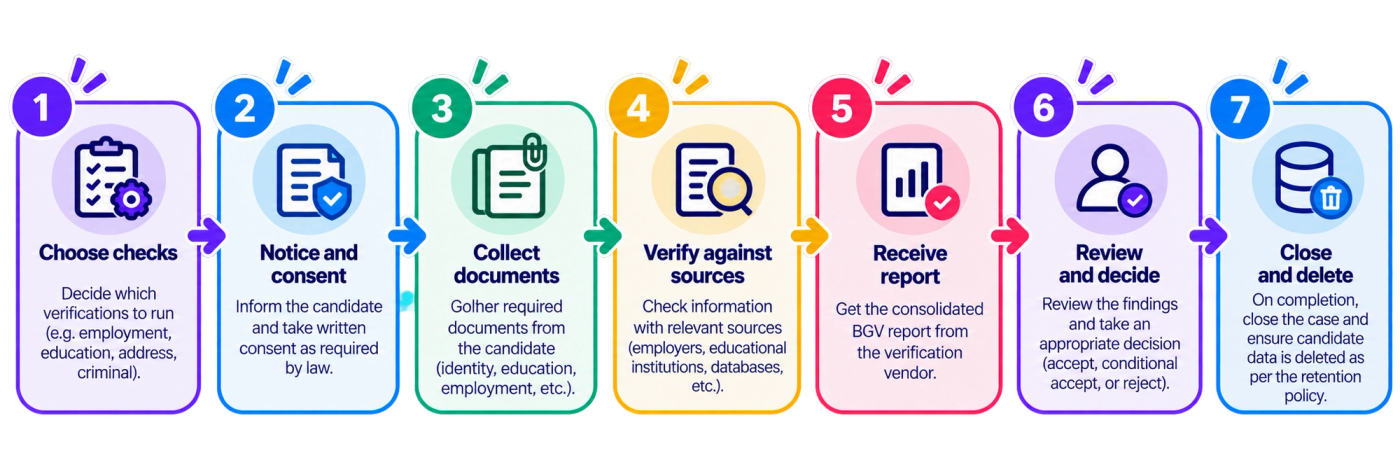
Most employers follow the same order, whether HR runs it in-house or through a verification provider.
- Decide the check package. HR sets which checks apply to the role and level, before the candidate is asked for anything.
- Tell the candidate and get consent. The candidate receives a notice that names the checks, the purpose and who will see the data. They give consent for that purpose.
- Collect documents and details. The candidate submits identity proofs, certificates, employment letters, address details and referee contacts.
- Verify against sources. The checks run in parallel: the university, past employers, address visit or digital check, and record searches.
- Receive the report. Each check comes back as clear, discrepancy or unable to verify, often with a colour status.
- Review and decide. HR reads the findings against the role. A discrepancy goes to the candidate for explanation before any decision.
- Close and delete. The result goes into the personnel file. Copies of documents that are no longer needed are deleted.
Step 3 breaks most often. Documents sit in old email accounts, and a missing relieving letter stalls the case.
Who Triggers and Pays for Background Verification?
The hiring employer triggers BGV, because the employer is the one relying on the result. HR or the talent acquisition team usually raises the request, either in-house or through an outside provider the company has appointed.
No law or official source we found sets who pays. As general practice, the employer bears the cost, since it is the party relying on the result. Charging candidates is best avoided; check it against your own policy and counsel’s advice.
The candidate gives accurate details, submits documents on time and answers queries. Agree that split before the checks begin.
How Long Does Background Verification Take?
Timelines depend on how many checks run, how fast third parties reply, and whether the candidate submits clean documents. No neutral source publishes a standard duration for India, so the ranges below are illustrative planning figures, not benchmarks.
- Identity: same day to 2 days. Blurred scans and mismatched names slow it.
- Education: 2 to 10 working days. University response time and old records are the usual cause.
- Employment: 3 to 10 working days. Delay comes when a past employer’s HR does not reply.
- Address: 2 to 7 working days. A candidate unavailable for a visit, or a rural address, adds time.
- Court or criminal record: 3 to 10 working days. The number of locations to search drives it.
- Reference: 2 to 7 working days. An unreachable referee is the main risk.
Checks run in parallel, so the whole case takes about as long as the slowest check. A clean case can finish in under a week, and a case with a slow past employer can run past two. Use these numbers to set a buffer in your offer-to-joining plan, then swap in your own turnaround data.
Our guide to time-to-hire benchmarks shows where BGV sits in the wider hiring clock. It is the stretch that most teams leave out of their own number.
Consent, Privacy and the DPDP Act
BGV means collecting identity documents, employment history and sometimes legal-record data. India’s Digital Personal Data Protection Act, 2023 (DPDP Act) governs how you handle that data. The Government notified the DPDP Rules on 13 November 2025 (G.S.R. 846(E)). Rule 1 brings most operational rules, including notice, security and retention, into force 18 months after publication, which is 13 May 2027.
You can read the DPDP Act text on MeitY’s site and PIB’s announcement of the Rules.
Three points matter for BGV.
- Consent for a stated purpose. Under Section 6, consent must be free, specific, informed, unconditional and unambiguous, and limited to the data needed for the purpose. “Background verification for this role” is a purpose. “Anything we may need” is not.
- Notice first. Section 5 says a consent request must come with, or after, a notice listing the personal data, the purpose, how the person can exercise their rights and how to complain to the Data Protection Board. For BGV, name each check and the provider who will see the data.
- Erasure. Section 8(7) requires erasing data when consent is withdrawn or once the purpose is no longer served, whichever is earlier, unless a law requires you to keep it. Your processor must erase it too. Set a retention period for BGV files and stick to it.
Section 7(i) also lists processing for employment purposes among the Act’s “legitimate uses”. Whether a given check rests on consent or on that ground is a question for counsel. Consent with a clear notice is the cautious route.
Our DPDP Act compliance checklist for recruiters covers notice wording, consent records and vendor duties in full. If a provider runs the checks, it handles the data on your behalf. Under Section 8(1), you stay responsible for compliance.
Do not ask for more than the check needs. Avoid collecting a full Aadhaar number by default.
In 2018, in Puttaswamy (II), the Supreme Court struck down Section 57 of the Aadhaar Act to the extent it let private entities use Aadhaar authentication under a contract. A 2025 amendment to the Aadhaar authentication rules created an approval route for private entities, so the position has moved since. Accept another valid identity proof where it will do, and check UIDAI’s current guidance before collecting Aadhaar in any form.
What Should You Do When a Check Fails?
A failed check is a finding, not a decision. Most discrepancies are explainable: a degree awarded under a former university name, a company that renamed itself after a merger, or a certificate with a spelling variant.
Work through it in this order.
- Classify the finding. Separate a clerical mismatch from a material misstatement, such as a degree that was never awarded.
- Ask the candidate. Share what the report found, in writing, and give a fair window to respond with proof.
- Re-verify if needed. A corrected document or a direct call to the source often resolves the case.
- Decide against the role. A material misstatement about something the job depends on is a different matter from a one-month gap in dates.
- Record the reasoning. Write down what you found, what the candidate said and why you decided as you did.
Can an employer withdraw an offer after a failed check? As general practice, offer letters often make the offer conditional on satisfactory verification, and that clause is the usual basis for withdrawal. The wording of your letter and the nature of the finding both matter, so get counsel to review the clause and the specific case before you act.
If a past employer does not respond, do not treat silence as a negative. Try another contact, accept payslips with a relieving letter, and record the effort.
Automated scoring should not decide a case alone. Section 8(3) of the DPDP Act requires completeness, accuracy and consistency of personal data likely to be used for a decision that affects the person. Keep a human on the final call and let the candidate correct a wrong record.
Where BGV Fits in the Offer-to-Joining Window
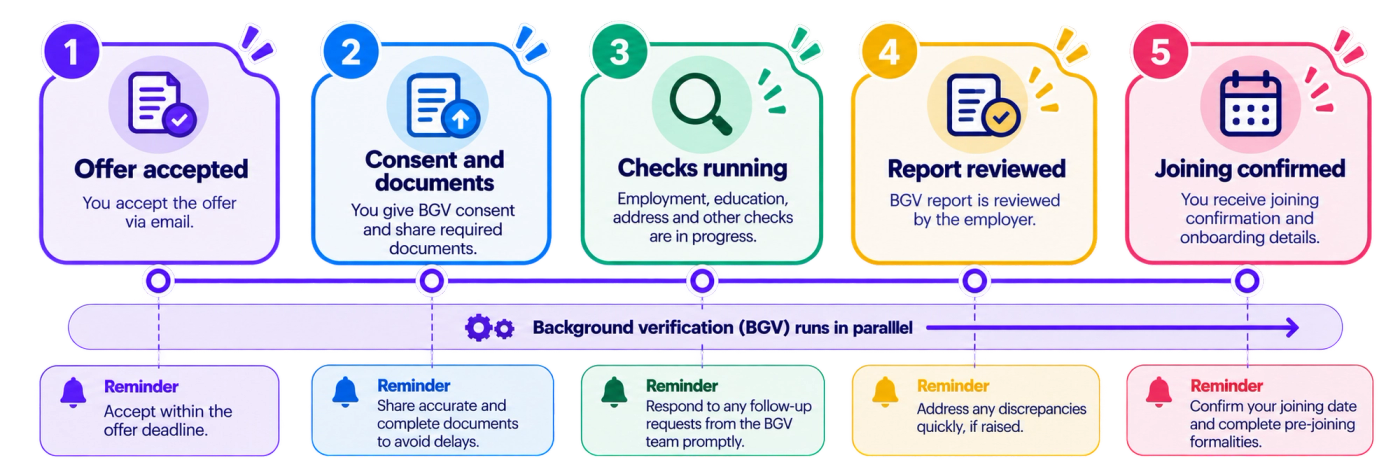
Most employers run BGV between offer acceptance and the joining date. That window is where candidates drop off, often because a better offer arrives or the silence feels long. BGV adds to the silence when documents are requested and nothing follows.
You can protect the window without rushing the checks.
- Send the document list at the moment of acceptance, not a week later.
- Tell the candidate which checks will run and how long they usually take.
- Chase missing documents on a schedule, not ad hoc.
- Update the candidate when each check closes.
- Keep the joining date flexible for cases still in progress.
Our guide to candidate drop-off explains why candidates disappear between acceptance and joining, and how to reduce it.
How HireBound Fits Into Verification and Onboarding
HireBound’s bulk-hiring offering covers compliance automation, background verification, certificate expiry alerts, labor-law tracking and audit trails. It also includes digital onboarding with document management and e-signatures. For permanent hiring, HireBound lists background-check support.
WhatsApp supports media and document exchange, which suits chasing a missing relieving letter. HireBound data shows a 64% WhatsApp response rate in India, compared with about 12% for email. Our guide to WhatsApp recruiting covers how to run that follow-up without annoying candidates.
Whichever tools you use, the decisions stay with people. HR decides which checks apply, reads the findings, and talks to the candidate about any discrepancy.
Want to see how HireBound handles onboarding documents and WhatsApp follow-up? Book a free demo →
A Practical Starting Point
Start with a short written policy: which checks apply to which roles, the consent wording, the retention period and the escalation path for a discrepancy. Then measure your own turnaround for each check over a quarter.
General information only, not legal advice. Confirm the current DPDP Act and Rules text, and UIDAI guidance, with counsel before you finalise your process.