The Real Cost of AI Recruiting Software: Total Cost of Ownership
 Devansh Dhawan
 ·Oct 6, 2026·14 min read
Key Takeaways
- 1In our two-year model for a 15-recruiter team, costs outside the subscription made up about 30% of a four-tool stack (₹8.72 lakh of ₹28.6 lakh).
- 2The cheaper stack on sticker price can be the dearer one over two years: the point-solution stack looked ₹2.12 lakh cheaper on subscriptions and ended ₹2.26 lakh more expensive.
- 3McKinsey and the University of Oxford found large IT projects run 45% over budget on average, so build a contingency line into any recruiting software budget.
- 4Indian buyers should confirm the quote is in rupees and whether 18% GST is included, since registered businesses can usually claim it back as input credit.
- 5Per-seat tools grow with headcount: adding five recruiters to a three-tool per-seat stack adds about ₹1.98 lakh a year before any other cost.
AI recruiting software total cost of ownership is the full amount an organisation pays to buy, set up, connect, run and support the tool over a fixed period, usually two to three years. It includes the subscription and every cost around it: implementation, integration, training, administration and add-ons.
Most buyers compare quotes on the subscription line alone. That line is the easiest to read and the least complete. The cost of getting a tool into daily use is often the part that surprises finance teams six months after signing.
Want one platform that screens, schedules and follows up without stitching tools together? Explore HireBound →
This report shows where costs hide, how to calculate them, and what a two-year comparison looks like in rupees for a 15-recruiter team. It ends with a budgeting checklist you can use in your next vendor review.
Executive Summary: What Does AI Recruiting Software Really Cost?
AI recruiting software costs more than its quote suggests. The gap between the quote and the true cost depends on how many tools you buy, how many systems they must connect to, and how many people need training.
Here are the headline findings from the cost model in this report:
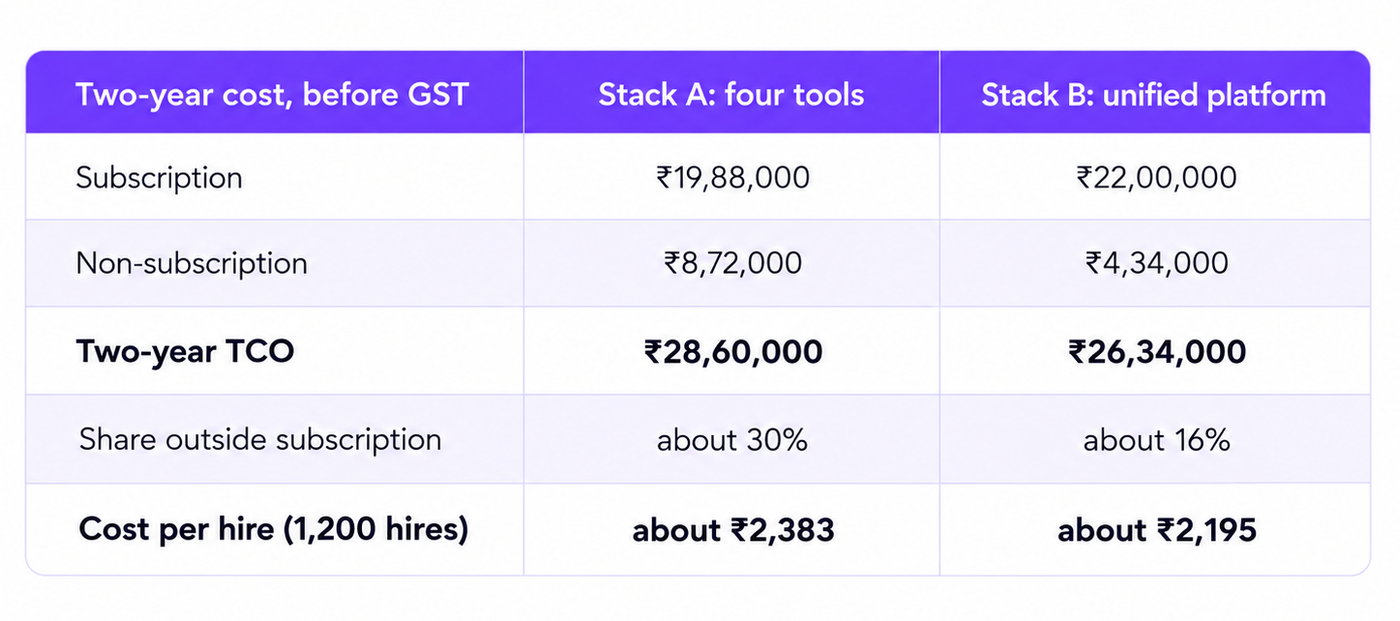
- The subscription understates the bill. In the worked example, a four-tool point-solution stack cost ₹28.6 lakh over two years, of which ₹19.88 lakh was subscription. The remaining ₹8.72 lakh, about 30%, sat in implementation, integration, training and admin.
- The sticker price can point the wrong way. The four-tool stack looked ₹2.12 lakh cheaper than a unified platform on subscription fees alone. Over two years it was ₹2.26 lakh dearer.
- Per-seat pricing scales with headcount. Every recruiter you add multiplies the cost of each per-seat tool, while flat-fee platforms absorb growth.
- Large IT projects overrun. A 2012 McKinsey study with the University of Oxford looked at more than 5,400 IT projects and found that large ones, with budgets above $15 million, ran an average of 45% over budget and delivered 56% less value than predicted. Recruiting software is smaller than most of those projects, but the lesson about contingency applies.
- Indian buyers face two extra checks. GST is charged at 18% on software subscriptions, and quotes are not always stated in rupees. Both change the number your finance team approves.
- Cost per hire is the fairest yardstick. Divide two-year TCO by hires made. In the example, that is about ₹2,383 per hire for the point-solution stack and ₹2,195 for the unified platform.
The sections below explain each number and show the arithmetic so you can rebuild it with your own figures.
How Was This Cost Model Built?
This report is a cost model, not a survey. It defines every cost category a buyer meets, sets out a formula, and applies it to a worked example with stated assumptions. All rupee figures in the example are illustrative assumptions, not vendor quotes or market averages, so replace them with your own.
Three inputs shaped the model. The first is published research on IT project cost overruns, including the McKinsey and University of Oxford study of large IT projects. The second is India’s GST rules for software services. The third is our experience working with 200+ organisations on how recruiting teams actually adopt new tools, including how long setup takes and where the hours go.
The example uses a corporate team of 15 recruiters making 600 hires a year, so 1,200 hires across two years. It assumes an average recruiter cost of ₹6,00,000 a year, which works out to about ₹300 an hour across 2,000 working hours. Prices are before GST throughout, because registered businesses can generally claim GST back as input tax credit, and the section on INR pricing covers the cash-flow effect.
Two terms keep the report consistent:
- Subscription cost: the recurring fee stated on the vendor’s quote.
- Non-subscription cost: everything else you pay, in cash or in staff time, to make the tool work.
What Is Included in the Subscription Price?
The subscription usually covers access to the software, hosting, standard support and routine updates. It rarely covers the work of making the software fit your business. Read the quote for what is named, and treat anything not named as a separate cost until the vendor confirms otherwise.
Typical inclusions are:
- Named user licences or a stated number of seats
- A defined volume of candidate conversations, screening minutes or job postings
- Standard email or chat support during business hours
- Software updates and security patches
- Access to standard reports
The exclusions, where most budget surprises start, are covered next. Ask for the full order form, not the pricing summary, before you compare anything.
What Costs Sit Outside the Subscription?
Six cost categories commonly sit outside the subscription: implementation, data migration, integration, training, add-ons and usage overage, and internal administration. Each looks small alone. Together they can add a third or more to two years of spend.
Implementation and setup
Implementation covers configuring workflows, building screening questions, loading job templates, setting up channels and testing. Some vendors bundle it. Others charge a one-time fee or bill by the day. Even when the vendor does the configuration, your team spends hours in workshops and approvals.
Data migration
If you move from an existing tracker, someone has to clean, map and load candidate records. Duplicates, missing fields and inconsistent job titles take longer than expected. In India, migration also touches personal data, so the move needs a lawful basis and a clear notice under the DPDP Act. Confirm the notice and consent position before you load records into a new system.
Integration
Recruiting software has to talk to job boards, HR systems, calendars, messaging channels and payroll. Each connection is either included, sold as an add-on, or built by your team or a consultant. Connections also need maintenance when either side changes its interface. Integration is the category most likely to be underestimated, because it grows with the number of tools rather than the number of users.
Training and change management
Training costs staff time, and staff time has a price. Fifteen recruiters spending six hours on one tool is 90 hours, or ₹27,000 at ₹300 an hour. Multiply by the number of tools and add refresher sessions when features change. A tool that recruiters avoid delivers none of its promised savings, so adoption drives the real cost.
Add-ons and usage overage
Modules such as advanced analytics, additional languages, extra channels, API access or premium support are often priced separately. Usage-based plans add another layer: exceed the included candidate conversations or screening minutes and the overage rate applies. Ask what happens in your busiest month, not your average one.
Internal administration
Someone manages user accounts, permissions, vendor invoices, renewals and support tickets. With one tool this is a few hours a month. With four tools from four vendors, it becomes a recurring task with a real owner.
How Do You Calculate Total Cost of Ownership for Recruiting Software?
Total cost of ownership is subscription fees plus one-time costs plus recurring non-subscription costs, over the period you plan to use the tool. Use a two-year window at minimum, because one-time costs dominate year one and recurring costs dominate year two.
The formula:
- Subscription: annual fee multiplied by the number of years.
- Implementation and migration: one-time vendor fees plus internal hours at your hourly rate.
- Integration: build or connector costs plus annual maintenance.
- Training: hours per user, times users, times hourly cost, plus a refresher allowance.
- Administration: hours per month spent managing the tool, at your hourly cost.
- Contingency: a percentage of the total, to cover overrun risk.
- Total: add lines one to six, then divide by hires made to get cost per hire.
For the contingency line, the McKinsey and Oxford finding is a useful reminder that large projects overrun. As planning guidance, a buffer of 10% to 15% on non-subscription costs is a sensible habit for a first rollout. Our guide to cost per hire benchmarks explains how to fold the result into your wider recruiting cost picture.
What this means for your hiring: Build the model before you talk price. When a vendor’s quote arrives, you can slot it into your own structure instead of accepting theirs.
Worked Example: A Two-Year TCO for a 15-Recruiter Team
Here is the calculation for a corporate team of 15 recruiters making 600 hires a year. The example compares a stack of four separate tools against a single unified platform. Every figure is an illustrative assumption in rupees, before GST.
Stack A: four point solutions
The team buys an applicant tracker, a scheduling tool, a screening and chat tool, and a sourcing and CRM tool.
Subscriptions per year:
- Applicant tracker: ₹1,500 per seat per month, so 15 seats is ₹2,70,000
- Scheduling tool: ₹800 per seat per month, so ₹1,44,000
- Screening and chat tool: ₹4,00,000 flat
- Sourcing and CRM tool: ₹1,000 per seat per month, so ₹1,80,000
- Annual total: ₹9,94,000
Non-subscription costs over two years:
- Implementation: ₹1,50,000 across the four tools
- Integration: ₹2,00,000 one-time build plus ₹60,000 a year in maintenance, so ₹3,20,000
- Training: 360 hours in year one (four tools, 15 people, six hours each) is ₹1,08,000, plus half that for refreshers in year two, so ₹1,62,000
- Administration: ₹1,20,000 a year for four vendors, so ₹2,40,000
Stack B: one unified platform
The team buys a single platform covering screening, scheduling, follow-up and tracking.
- Subscription: ₹11,00,000 a year flat
- Implementation: ₹2,50,000, higher because one deployment covers more workflows
- Integration: ₹50,000 for job boards and the HR system
- Training: 120 hours in year one (15 people, eight hours) is ₹36,000, plus ₹18,000 in refreshers, so ₹54,000
- Administration: ₹40,000 a year for one vendor, so ₹80,000
What the comparison shows
Sources: HireBound cost model; all figures are illustrative assumptions, not vendor quotes.
On subscription fees alone, Stack A looks ₹2.12 lakh cheaper. Once the surrounding costs are added, Stack B is ₹2.26 lakh cheaper.
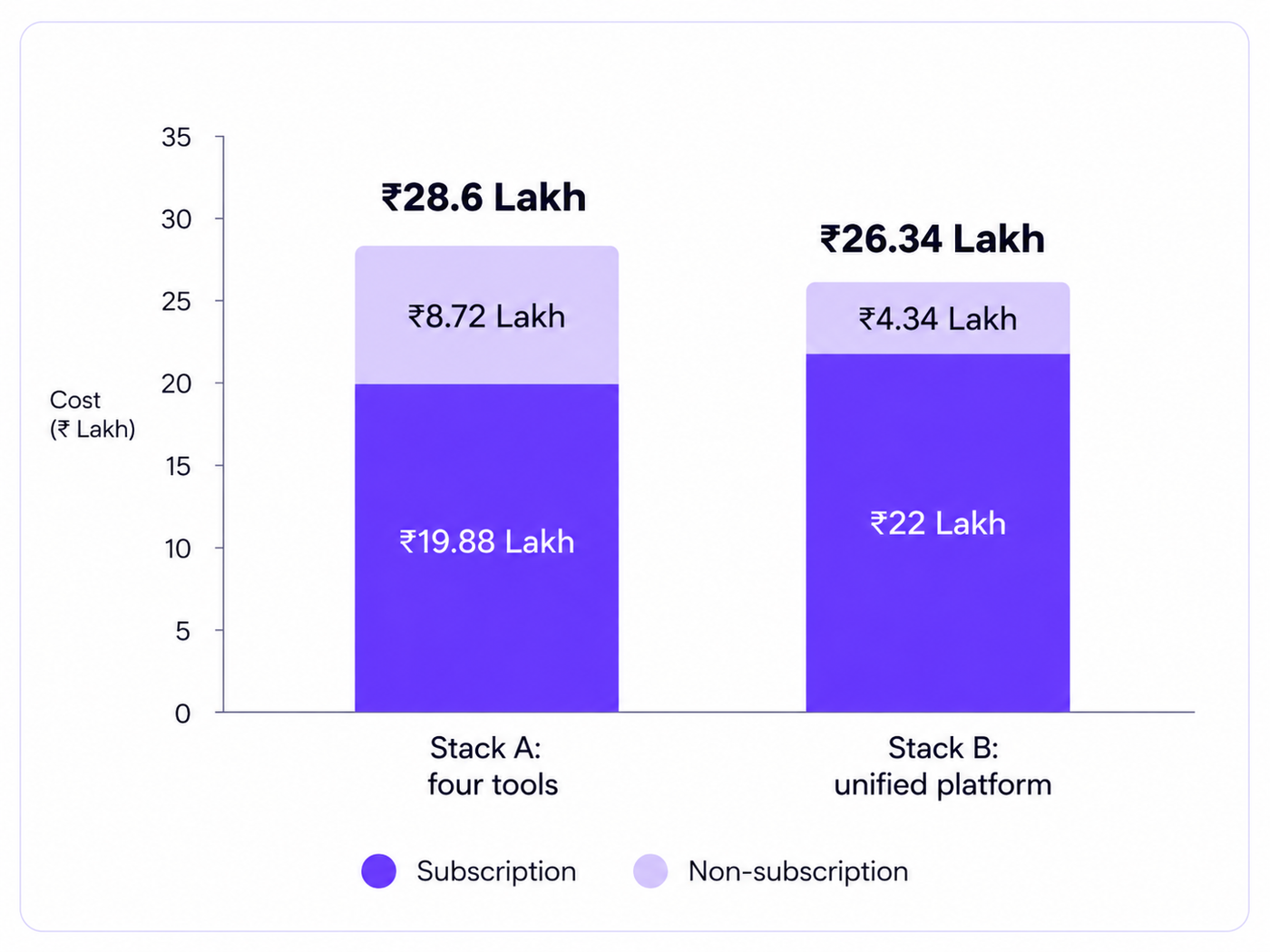
The result depends entirely on the assumptions. A cheaper set of point tools, or a pricier unified platform, could reverse it. The model shows which assumptions decide the outcome, so you can test them against real quotes.
Add a 10% contingency on non-subscription costs and the gap widens slightly, since Stack A carries more of them. Stack A adds ₹87,200 and Stack B adds ₹43,400.
What this means for your hiring: Do not compare subscriptions. Compare two-year totals, then divide by hires. The number that survives a finance review is cost per hire.
Do Point Solutions Cost More Than a Unified Platform Over Time?
They can, but not always. Point solutions win when you need one narrow capability and already have the rest covered. A unified platform wins when you would otherwise buy three or four tools and pay to connect them.
Where point solutions cost more:
- Integration multiplies. Two tools need one connection. Four tools need up to six. Each is built once and maintained forever.
- Training repeats. Every tool has its own interface and logic.
- Vendor management multiplies. Each vendor has its own renewal date, price rise and support queue.
- Data splits. Candidate records live in several places, which complicates reporting and raises the compliance burden under the DPDP Act.
Where point solutions can come out ahead:
- Best-of-breed depth. A specialist tool may outperform a platform module on one task.
- Lower entry price. One tool is cheaper than a platform if you only need one job done.
- Flexibility. You can swap one tool without replacing everything.
A unified platform is not free of trade-offs either. You depend on one vendor, a weak module cannot be swapped out on its own, and migration later is harder.
How Does Team Growth Change the Numbers?
Per-seat pricing scales with headcount, while flat-fee pricing does not. Take the three per-seat tools in Stack A. Together they cost ₹3,300 per recruiter per month, or ₹39,600 per recruiter per year.
Add five recruiters and the annual subscription rises by ₹1,98,000, before extra training and admin. Over a hiring season, that increase arrives without any change in hiring volume if you are adding recruiters to cope with a spike.
Usage-based tiers behave differently. Their cost tracks volume of conversations, screening minutes or applications instead of headcount. That suits bulk hiring, where a small team handles thousands of candidates, and hurts when a busy month pushes usage over the included allowance.
Ask every vendor two questions about growth. What happens to my bill if I add 10 users? What happens if my candidate volume doubles for a quarter? The answers often matter more than the headline price.
What this means for your hiring: Model three scenarios: current headcount, headcount plus a third, and a seasonal volume spike. A price that holds across all three is worth more than a lower price that breaks in one.
How Does INR Pricing and GST Affect the Budget in India?
Indian buyers should confirm two things on every quote: the currency and the tax treatment. Both change the amount finance approves and the amount that leaves the bank account.
GST: software subscriptions supplied to Indian customers attract GST at 18% under the software services classification. A registered business can generally claim this as input tax credit, provided the invoice carries the supplier’s GSTIN and the correct service code. The credit does not change the true cost, but it affects cash flow. On a ₹22,00,000 two-year subscription, GST is ₹3,96,000, paid upfront and recovered through credit over time.
Currency: a quote in US dollars ties your budget to the exchange rate. A rupee quote fixes the number for the contract term. If a vendor prices in dollars, ask whether it will invoice in rupees at a fixed rate, and what triggers a price revision at renewal.
Payment terms: annual prepayment is common and may earn a discount, but it puts a full year of cash at risk if the rollout stalls. Quarterly billing costs a little more and protects you.
Renewal terms: ask for a cap on renewal price increases in writing, and note the notice period for cancelling.
Also confirm where candidate data is stored and who is responsible for it. Under the DPDP Act, your organisation stays accountable for the personal data of candidates even when a vendor processes it, so the contract should say so.
What this means for your hiring: Ask for an all-in rupee quote with GST shown as its own line, a written renewal cap and a clear statement of what is included. Vendors that answer these plainly are usually the ones that will be easy to work with later.
What Should You Ask Vendors Before Signing?
Use this list in every demo, and get the answers written into the order form.
- What does implementation cost, and who does the work?
- Which integrations are included, and which carry a fee?
- What is the cost of migrating my existing candidate data?
- How many training hours do you expect for a team of my size?
- What is included in standard support, and what does premium support cost?
- Which features or languages are add-ons?
- What are the usage limits, and what is the overage rate?
- What happens to my price when I add users or increase volume?
- What is the price cap at renewal?
- What are the exit terms, and can I export all my data?
If a vendor cannot answer a question in writing, treat the item as an unknown cost and add it to your contingency.
What Does This Mean for Budgeting?
Budget for the first two years as one number, not two. One-time costs land in year one and make the launch look expensive, while year two looks cheap by comparison. A two-year view smooths the picture and prevents the wrong conclusion about payback.
Five habits keep the budget honest:
- Split the budget into subscription and non-subscription lines from the start.
- Add a 10% to 15% contingency on non-subscription costs for the first rollout.
- Count staff hours at a real hourly cost, not as free.
- Track cost per hire, not cost per licence.
- Review the model at six months, when real usage replaces assumptions.
Match spend to the problem the tool solves. If recruiters lose hours chasing candidates, the value sits in screening and follow-up automation. HireBound data shows a 64% WhatsApp response rate in India, against about 12% for email, so a tool that runs candidate contact on WhatsApp changes how many hours your team spends on outreach. Measure the saving against your current cost per hire before you sign, and again after.
For teams still deciding between an applicant tracker and a relationship-focused tool, our comparison of recruitment CRM vs ATS explains which tool solves which problem, which helps you avoid paying for overlapping features.
See a full two-year cost model for your team. Book a free demo →
Conclusions: Where Is Recruiting Software Pricing Heading?
Three shifts look likely, based on the direction of the costs above.
First, buyers will judge tools by cost per hire instead of cost per seat. As finance teams ask for the full picture, quotes that hide setup and integration costs will lose ground to quotes that show them.
Second, consolidation will continue. Teams tired of paying to connect four tools will favour platforms that cover screening, scheduling and follow-up in one place, while keeping specialist tools only where depth matters.
Third, usage-based and outcome-linked pricing will grow, especially for bulk and frontline hiring, where volume swings by season. Buyers who model their busiest month will negotiate better terms than those who quote their average.
Before your next vendor review, build the two-year model with your own numbers, then hold every quote to it.


