Fresher Interview Questions and Answers: 30 Questions With Sample Replies
 Devansh Dhawan
 ·Oct 28, 2026·11 min read

Key Takeaways
- 1Fresher interviews in India often run in three to four stages: an aptitude or online test, a technical round, an HR round and sometimes a first call by AI voice screening.
- 2NACE’s career readiness framework names eight competencies, and communication, critical thinking, teamwork and professionalism are the ones most visible in a fresher answer.
- 3Every answer can follow three parts: a direct reply in one sentence, one real example from college, and a link to the role. Aim for 45 to 60 seconds.
- 4Interviewers rarely expect work history from a fresher. They check how you think, how clearly you speak and whether your examples are true.
- 5A 24-hour plan of six to eight prepared stories, a read of the job description and one mock call covers most of what you will be asked.
Fresher interviews in India keep returning to the same questions in different words: who you are, what you studied, how you handle people and pressure, and why this company. Interviewers use them to judge clarity, honesty and attitude, because a fresher has no work record to judge.
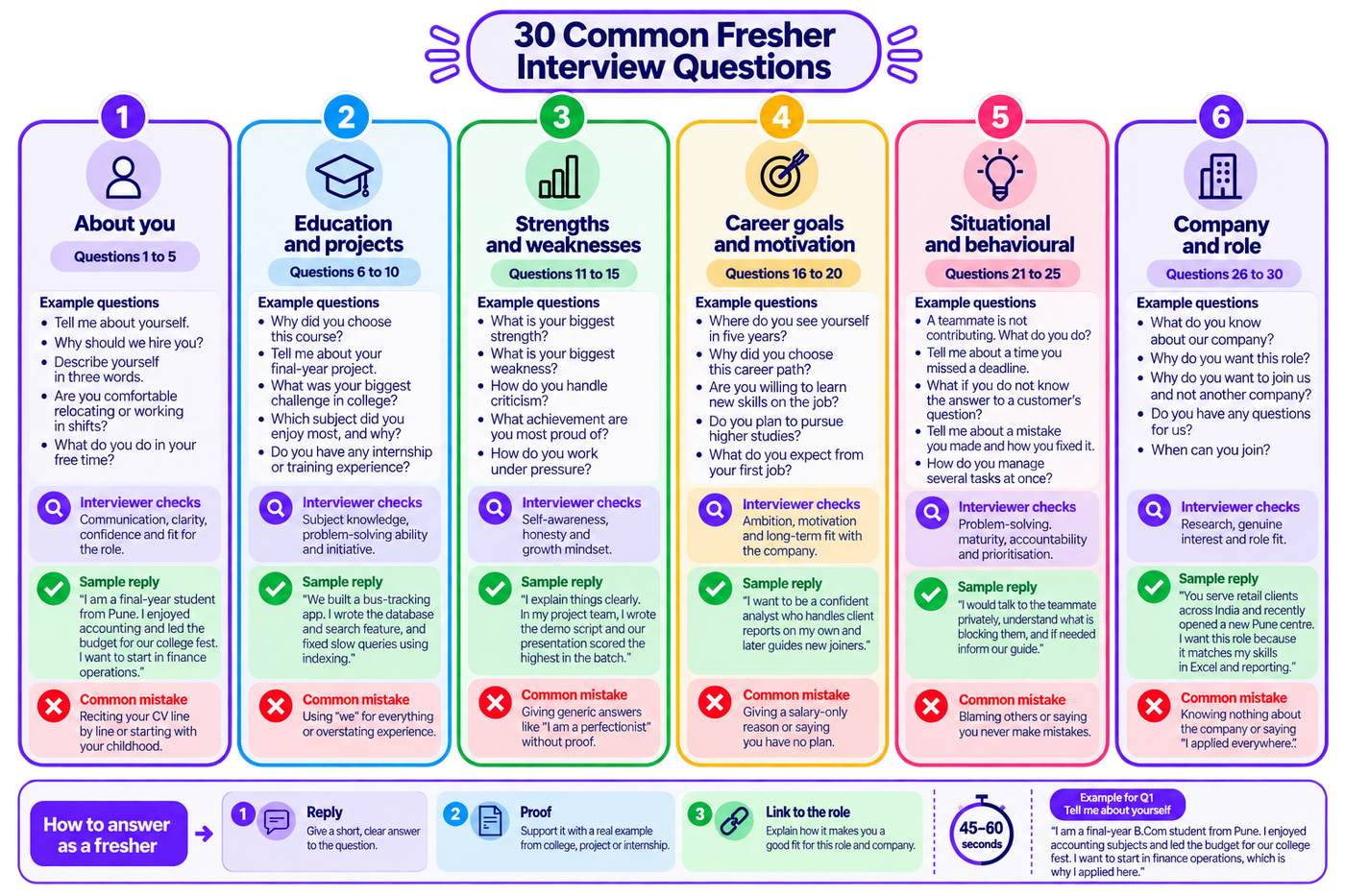
This guide gives you all 30, grouped into six sets. For each question you get what the interviewer is checking, a sample answer in plain English and the common mistake. Adapt the samples with your own facts. Do not memorise them word for word.
If you hire freshers, see how HireBound screens candidates at scale: explore the AI recruiting platform.
How Fresher Interviews Work in India
Many campus and off-campus processes run in stages, and each stage tests something different. The table below shows the usual order. Smaller companies may merge two stages into one.
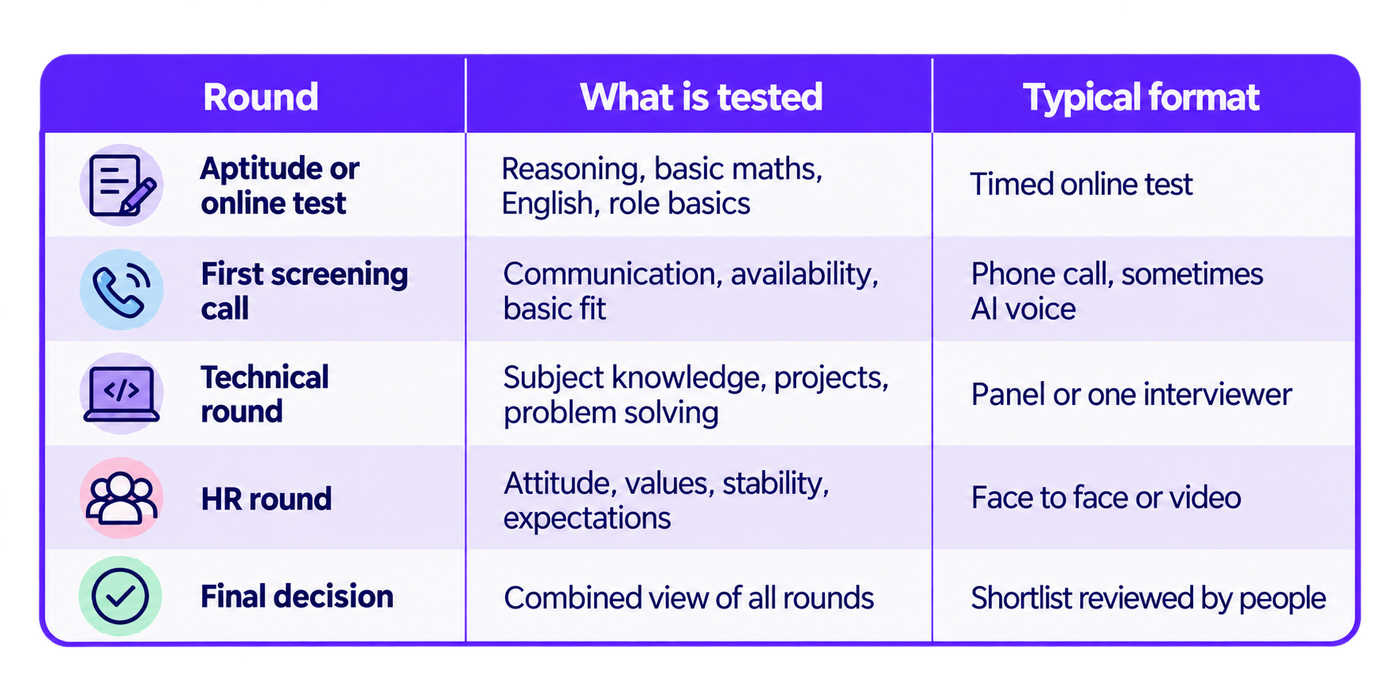
Most questions here come up in the screening call and the HR round. Prepare technical topics separately.
NACE, the US association for college-to-career professionals, names eight career readiness competencies in its career readiness framework. Its Job Outlook 2026 survey says employers hiring the Class of 2026 look for evidence of teamwork, problem-solving and communication. Freshers can show all three through college examples.
The Three-Part Answer for Freshers
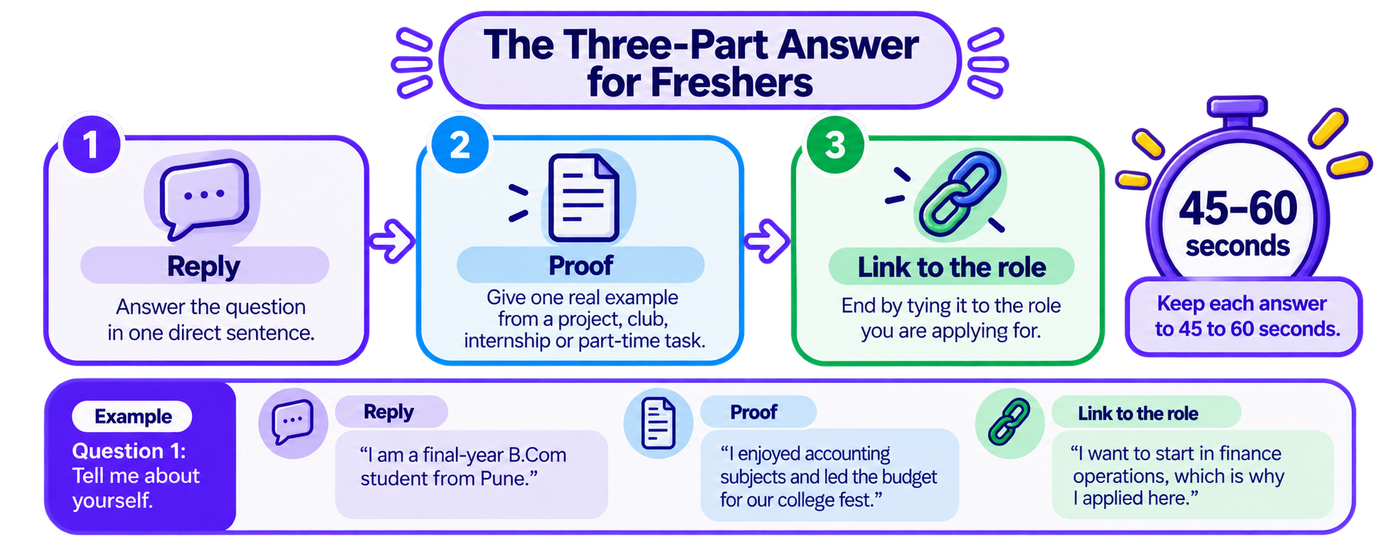
You do not need a job to give a strong answer. Use the same three parts every time.
- Reply: answer the question in one direct sentence.
- Proof: give one real example from a project, club, internship or part-time task. Name what you did, not what the team did.
- Link: end by tying it to the role you are applying for.
Keep each answer to 45 to 60 seconds. For how interviewers score answers like these, see HireBound’s structured interview scorecard template.
Group 1: About You (Questions 1 to 5)
These come first. Keep them short and calm.
- Tell me about yourself.
- Checking: Whether you can speak clearly and organise your thoughts.
- Sample: “I am a final-year B.Com student from Pune. I enjoyed accounting subjects and led the budget for our college fest. I want to start in finance operations, which is why I applied here.”
- Mistake: Reciting your CV line by line, or starting with your childhood.
- Why should we hire you?
- Checking: Whether you understand what the role needs.
- Sample: “The job needs accuracy and quick learning. In my internship I reconciled 200 entries a week with no errors flagged. I learn fast and I will ask when unsure.”
- Mistake: Saying “I am hardworking” with no example.
- Describe yourself in three words.
- Checking: Self-awareness and whether your words match your examples.
- Sample: “Curious, reliable and calm. For reliable, I have never missed a project deadline in college.”
- Mistake: Picking big words you cannot back up.
- Are you comfortable relocating or working in shifts?
- Checking: Flexibility and whether you will accept the posting.
- Sample: “Yes, I can relocate. I have lived in a hostel for three years. I would like to know the shift pattern so I can plan.”
- Mistake: Saying yes, then declining at the offer stage.
- What do you do in your free time?
- Checking: Personality, discipline and honesty.
- Sample: “I play cricket on weekends and watch short videos on Excel. I am building a small expense tracker.”
- Mistake: Claiming hobbies you cannot discuss for one more minute.
Group 2: Education and Projects (Questions 6 to 10)
Expect follow-up questions on every answer here.
- Why did you choose this course?
- Checking: Whether the choice was deliberate.
- Sample: “I liked problem solving in school, so I picked computer science. Data structures confirmed that choice.”
- Mistake: Blaming family pressure or rank cut-offs.
- Tell me about your final-year project.
- Checking: Whether you built it yourself and understand it.
- Sample: “We built a bus-tracking app for our campus. I wrote the database and the search feature. The hardest part was fixing slow queries, which I solved with indexing.”
- Mistake: Using “we” for everything, then failing the follow-up questions.
- What was your biggest challenge in college?
- Checking: Resilience and how you reflect.
- Sample: “I failed a core subject in semester three. I changed my study plan, joined a study group and cleared it with a better score.”
- Mistake: Choosing a challenge that was not your own doing, or saying “none”.
- Which subject did you enjoy most, and why?
- Checking: Real interest and depth.
- Sample: “Operating systems. Process scheduling felt like a puzzle, and I built a small simulator for a class assignment.”
- Mistake: Naming a subject you cannot explain further.
- Do you have any internship or training experience?
- Checking: Initiative and what you learned.
- Sample: “I did a six-week internship in a retail firm. I cleaned sales data and made a weekly report my manager used in meetings.”
- Mistake: Overstating a short course as work experience.
If you have no internship, say so and move to a project or a certification.
Group 3: Strengths and Weaknesses (Questions 11 to 15)
- What is your biggest strength?
- Checking: A strength that is relevant to the job.
- Sample: “I explain things clearly. In my project team, I wrote the demo script, and our presentation scored the highest in the batch.”
- Mistake: Listing five strengths with no proof.
- What is your biggest weakness?
- Checking: Honesty and whether you work on it.
- Sample: “I used to avoid public speaking. I joined the debate club last year and now present in every review.”
- Mistake: Giving a fake weakness such as “I work too hard”.
- How do you handle criticism?
- Checking: Coachability.
- Sample: “I listen first, then ask for an example. My project guide said my report was unclear, so I rewrote it with headings, and she approved it.”
- Mistake: Getting defensive or saying you never get criticised.
- What achievement are you most proud of?
- Checking: Your standard of success and ownership.
- Sample: “I organised a coding contest for 120 juniors. I managed the sponsors and the schedule, and it ran on time.”
- Mistake: Picking a marks-only achievement with no effort story.
- How do you work under pressure?
- Checking: Calm and a method.
- Sample: “I list tasks, finish the most urgent one first and ask for help early. This helped me during exam week while running the fest budget.”
- Mistake: Claiming you thrive on pressure with no example.
Group 4: Career Goals (Questions 16 to 20)
Interviewers often use these to judge whether you will stay and grow. Answer with a direction, not a rigid plan.
- Where do you see yourself in five years?
- Checking: Ambition that fits the company.
- Sample: “I want to be a confident analyst who handles client reports on my own, and later guide new joiners.”
- Mistake: Saying you plan to leave for a higher role elsewhere, or “I have no idea”.
- Why did you choose this career path?
- Checking: Genuine motivation.
- Sample: “Sales calls during my internship showed me I enjoy talking to customers and solving their problems.”
- Mistake: Giving a salary-only reason.
- Are you willing to learn new skills on the job?
- Checking: Learning attitude.
- Sample: “Yes. I taught myself SQL through free online courses in two months, and I can do the same for your tools.”
- Mistake: Saying yes without any proof of self-learning.
- Do you plan to pursue higher studies?
- Checking: Stability and commitment.
- Sample: “Not right now. I want two or three years of work experience first. If I study later, I would choose a part-time route.”
- Mistake: Being vague, which makes the recruiter doubt your stability.
- What do you expect from your first job?
- Checking: Realistic expectations.
- Sample: “A good manager, clear feedback and real work from the first month. I want to build skills before I think of a promotion.”
- Mistake: Opening with salary and leave demands.
Group 5: Situational Questions (Questions 21 to 25)
You have no work stories, so use college ones. Show what you did and what you learned.
- A teammate is not contributing to a group project. What do you do?
- Checking: Conflict handling and maturity.
- Sample: “I would talk to them privately first and ask what is blocking them. If it continues, I would split the tasks again and inform our guide.”
- Mistake: Complaining about the teammate or doing everything yourself.
- Tell me about a time you missed a deadline.
- Checking: Accountability.
- Sample: “I submitted a lab report one day late because I underestimated the data cleaning. I now add a buffer day to every plan.”
- Mistake: Blaming others, or saying you never miss deadlines.
- What if you do not know the answer to a customer’s question?
- Checking: Honesty and resourcefulness.
- Sample: “I would say I will confirm and call back, check the process document, and ask a senior if needed.”
- Mistake: Guessing an answer to avoid looking weak.
- Tell me about a mistake you made and how you fixed it.
- Checking: Honesty and learning.
- Sample: “I sent a client report with a wrong column. I told my mentor at once, corrected it and added a final check step.”
- Mistake: Choosing a mistake that is secretly a strength.
- How do you manage several tasks at once?
- Checking: Prioritisation.
- Sample: “I list tasks by deadline and effort, do the urgent ones first, and review the list each evening.”
- Mistake: Saying “multitasking” with no method.
Group 6: Company and Role (Questions 26 to 30)
Ten minutes of reading about the employer makes these the easiest five.
- What do you know about our company?
- Checking: Whether you did basic research.
- Sample: “You serve retail clients across India and recently opened a new Pune centre. I read the careers page and saw this role supports that team.”
- Mistake: Reading the About page aloud, or knowing nothing.
- Why do you want this role?
- Checking: Fit between your skills and the job description.
- Sample: “The job needs data entry and reporting. I have used Excel in two projects and enjoy turning numbers into summaries.”
- Mistake: Saying “I need a job”.
- Why do you want to join us and not another company?
- Checking: Real interest, not a mass application.
- Sample: “The training programme for freshers matters to me. I also want to work with clients early.”
- Mistake: Saying “I applied everywhere”.
- Do you have any questions for us?
- Checking: Curiosity and seriousness.
- Sample: “What does the first 90 days look like for a new joiner? How is performance reviewed in the first year?”
- Mistake: Saying “no”, or asking only about leave and salary.
- When can you join?
- Checking: Availability and planning.
- Sample: “I finish my last exam on 20 June and can join from 1 July.”
- Mistake: Giving a date you cannot meet, such as before your results.
Mistakes Recruiters Notice in Fresher Interviews
These patterns cost freshers marks, and most are fixable in a day.
- Memorised answers. Interviewers spot a recited script quickly, and one follow-up question breaks it.
- Vague examples. “I worked in a team” proves nothing. “I wrote the test cases for a four-member team” does.
- Overclaiming skills. If your CV lists a tool, expect a question about it. Remove anything you cannot discuss.
- Poor basics. Late joining or a bad audio setup costs marks before you speak.
- No questions at the end. It reads as low interest.
HireBound’s guide to pre-screening questions shows the screening-stage questions recruiters ask, which helps you see the call from their side.
The First Call May Be an AI Voice Screening
Some Indian employers start with a short screening call before any human interview, and in some cases an AI voice agent makes that call. HireBound’s Voice AI, for example, runs screening calls in 14 Indian languages.
Treat it as a real interview. Take the call in a quiet place with good network, and answer in full sentences. If a choice of language is offered, pick the one you speak most comfortably.
The agent asks role questions, notes your answers and passes a transcript and score along. A recruiter then reviews the shortlist and makes the decision, so people still decide who moves ahead. The questions in this guide apply as they are. Speak clearly, do not rush and keep each answer under a minute.
Recruiters also use WhatsApp. HireBound’s India figures show about 64% response on WhatsApp against about 12% for email. Reply the same day.
HR Round vs Technical Round for Freshers
The HR round checks attitude, communication and fit. It uses most of the questions above, especially groups 1, 3, 4 and 6. The technical round checks subject depth and uses groups 2 and 5 as openers. Expect “explain this concept” and “how would you solve this” follow-ups.
For the next round, read HireBound’s HR interview questions guide. Employers that hire for skills over degrees often add short practical tasks. HireBound’s skills-based hiring guide explains why.
A 24-Hour Prep Checklist
Use this the day before.
- Read the job description twice. Underline the three skills it names most.
- Pick six to eight stories: a project, a failure, a team conflict, a leadership moment, a deadline and a learning moment.
- Write each story in three lines: what happened, what you did, the result.
- Practise answers 1, 2, 7, 12 and 16 aloud and record yourself once.
- Read the company’s careers page and one recent news item.
- Prepare two questions to ask.
- Check your documents, audio, network and joining link. Sleep early.
Hiring freshers at volume? See how HireBound’s AI agents screen and schedule candidates while recruiters keep the decisions: talk to the HireBound team.