AI Hiring Laws in India: What Employers Must Know
 Suvam Moitra
 ·Oct 13, 2026·9 min read
Key Takeaways
- 1India has no dedicated AI hiring law. A Press Information Bureau (PIB) backgrounder of 15 February 2026 describes India’s AI governance guidelines as a principle-based framework that builds on existing laws.
- 2The DPDP Act, 2023 applies to every tool that handles a CV, a call recording or a chat transcript. PRS Legislative Research lists penalties of up to ₹250 crore for failing to take security measures against a breach.
- 3The Code on Wages, 2019 bars gender discrimination in recruitment for the same or similar work, according to the PIB (November 2025), and the Transgender Persons Act, 2019 bars discrimination in recruitment and promotion.
- 4None of these laws mentions algorithms, so a screening tool that filters out a protected group is the employer’s act to explain.
- 5Indian recruiters serving New York, EU, Colorado or Illinois employers face extra rules, such as NYC’s bias audit and the EU’s 2 December 2027 high-risk date.
AI hiring laws are the rules that govern automated tools used to advertise jobs, screen applications, rank candidates or support hiring decisions. India has no dedicated AI hiring statute, but several existing laws already apply to these tools.
The main ones cover candidate data, discrimination in recruitment and, for the State as an employer, constitutional equality. Each applies to the employer, not the software.
A recruiter making the final call does not take a tool out of scope. A system that ranks, filters or recommends still processes personal data and still shapes who gets hired.
This guide is operational, not legal advice. Confirm the current rules with qualified counsel before you deploy an AI hiring system.
Want to see how human review fits into an agent-led hiring workflow? See how HireBound works →
Which Indian Laws Apply to AI in Hiring?
India regulates AI hiring through data protection, labour and equality law, plus a non-binding AI governance framework. The table lists what applies and where each point comes from.
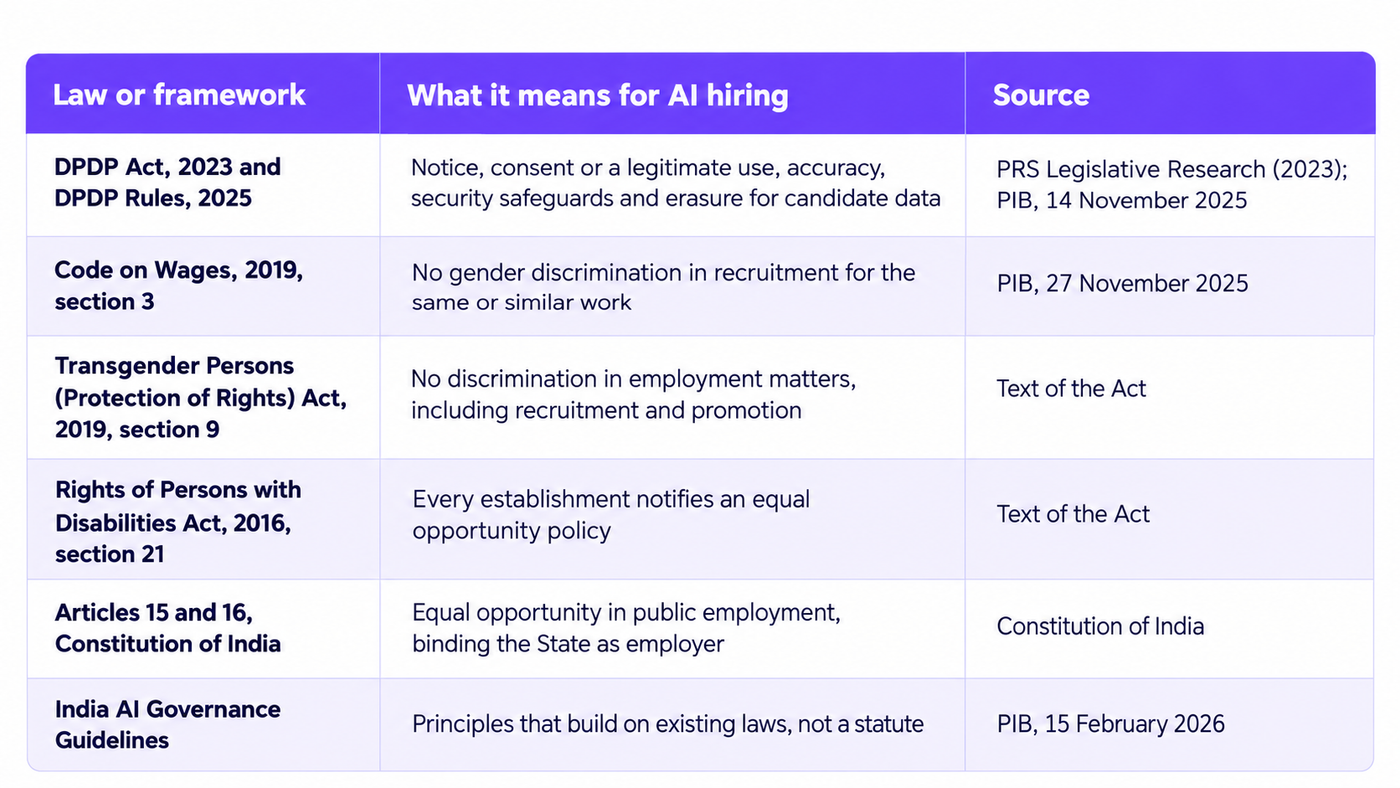
The safest first step is an AI use inventory. Record each tool, the data it receives, the output it produces, the human who reviews it and the hiring decision it supports.
What Does the DPDP Act Require When You Use AI Tools?
The Digital Personal Data Protection (DPDP) Act, 2023 matters most for AI recruiting, because every tool that handles a CV, a voice recording or a chat transcript processes personal data. According to PRS Legislative Research, personal data may be processed only for a lawful purpose after consent, and a notice describing the data and the purpose must come first.
The Act also lists legitimate uses where consent is not needed, and PRS includes employment among them. Whether that covers candidates who are not yet hired is a question for counsel, so most recruiting teams treat a clear notice and consent as the safe default.
PRS lists these duties for a data fiduciary, which is the employer or agency deciding why and how candidate data is used.
- Accuracy: Make reasonable efforts to keep data accurate and complete.
- Security: Build reasonable safeguards to prevent a breach.
- Breach reporting: Inform the Data Protection Board of India and affected people if a breach occurs.
- Erasure: Erase data once the purpose is met and retention is not needed for legal purposes.
PRS lists penalties of up to ₹250 crore for failing to take security measures to prevent a breach. The PIB reported on 14 November 2025 that the government had notified the DPDP Rules, 2025, with an 18-month phased timeline.
For a step-by-step version aimed at recruiters, see the DPDP Act compliance checklist.
What Rights Do Candidates Have Over AI-Processed Data?
Candidates are data principals under the Act. PRS says they can obtain information about processing, seek correction and erasure of their data, and use grievance redressal. They can also nominate another person to exercise these rights if they die or become incapacitated.
For a recruiter, that means a candidate can ask what an AI screening call recorded, ask you to correct a wrong transcript or score, or ask you to delete the record. A tool that stores transcripts and scores multiplies the records you must find and fix.
Build the process before the first request arrives. Decide who receives the request, where each record sits, who can edit it and how you confirm the change, and note that PRS says the Data Protection Board monitors compliance and imposes penalties.
Do Anti-Discrimination Laws Cover Automated Screening?
Yes, in the sense that the laws bind the employer’s conduct, whatever tool produced the outcome. Three Indian laws speak directly to recruitment.
The PIB’s November 2025 backgrounder on the new labour codes says employers shall not discriminate on grounds of gender in matters relating to recruitment, wages or conditions of employment for the same or similar work. That is the Code on Wages, 2019, section 3.
Section 9 of the Transgender Persons (Protection of Rights) Act, 2019 reads: “No establishment shall discriminate against any transgender person in any matter relating to employment including, but not limited to, recruitment, promotion and other related issues.” Section 21 of the Rights of Persons with Disabilities Act, 2016 requires every establishment to notify an equal opportunity policy. Articles 15 and 16 of the Constitution bind the State as an employer.
None of these texts mentions algorithms. A screening tool that filters out a protected group is therefore the employer’s act to explain, which is a reading counsel should confirm for your case.
The diagram shows where accountability sits when a tool is involved.
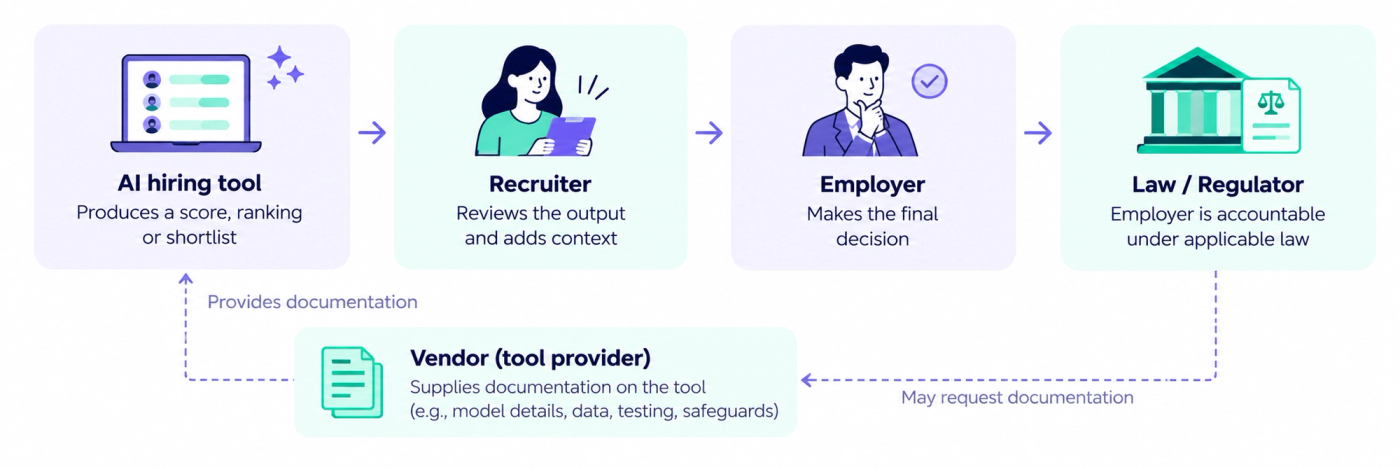
Check the inputs. Name, gender, language, school, location and employment gaps can act as proxies, so ask what the model uses and test the outcomes.
What Do India’s AI Governance Guidelines Say?
A PIB backgrounder of 15 February 2026 says India adopts a principle-based AI governance framework anchored in seven Sutras. It lists adopting a framework that builds on existing laws, reviewing the legal framework for AI-related gaps and introducing targeted legislative amendments.
The guidelines are not a statute, and they create no audit or notice duty for recruiters. Binding duties today come from the laws above.
That leaves a planning question. If targeted amendments follow, employers that already keep an inventory, human review records and candidate notices will adapt faster than those that start then.
What If You Recruit for US or EU Employers?
An Indian agency or company hiring for a foreign employer may need to follow that jurisdiction’s rules as well as Indian ones. The four below are the ones most often raised.
- New York City: The city’s Department of Consumer and Worker Protection (DCWP) says a covered automated employment decision tool needs a bias audit within one year of use, a public summary and candidate notices. DCWP said enforcement would begin on 5 July 2023.
- European Union: The European Commission’s AI Act Service Desk lists recruitment and candidate-evaluation systems as high-risk in Annex III. Regulation (EU) 2026/1744 moves those rules to 2 December 2027, according to the Commission.
- Colorado: SB 26-189, signed on 14 May 2026, replaced SB 24-205 with rules for automated decision-making technology, including in employment, according to the Colorado General Assembly. Developers must give deployers technical documentation from 1 January 2027.
- Illinois: HB 3773 amended the Illinois Human Rights Act and took effect on 1 January 2026. It bars AI use with a discriminatory effect in covered employment activities and requires notice.
Ask the client which rules they treat as applicable, and write the answer into the contract. These regimes differ, so a bias audit done for New York does not satisfy the EU or Colorado.
What Is a Bias Audit?
A bias audit evaluates a tool to see whether its outputs select people differently across demographic groups. No Indian law requires one today, but it is the clearest way to test a tool, and NYC requires one for covered roles.
An audit-ready process records the items in the table.
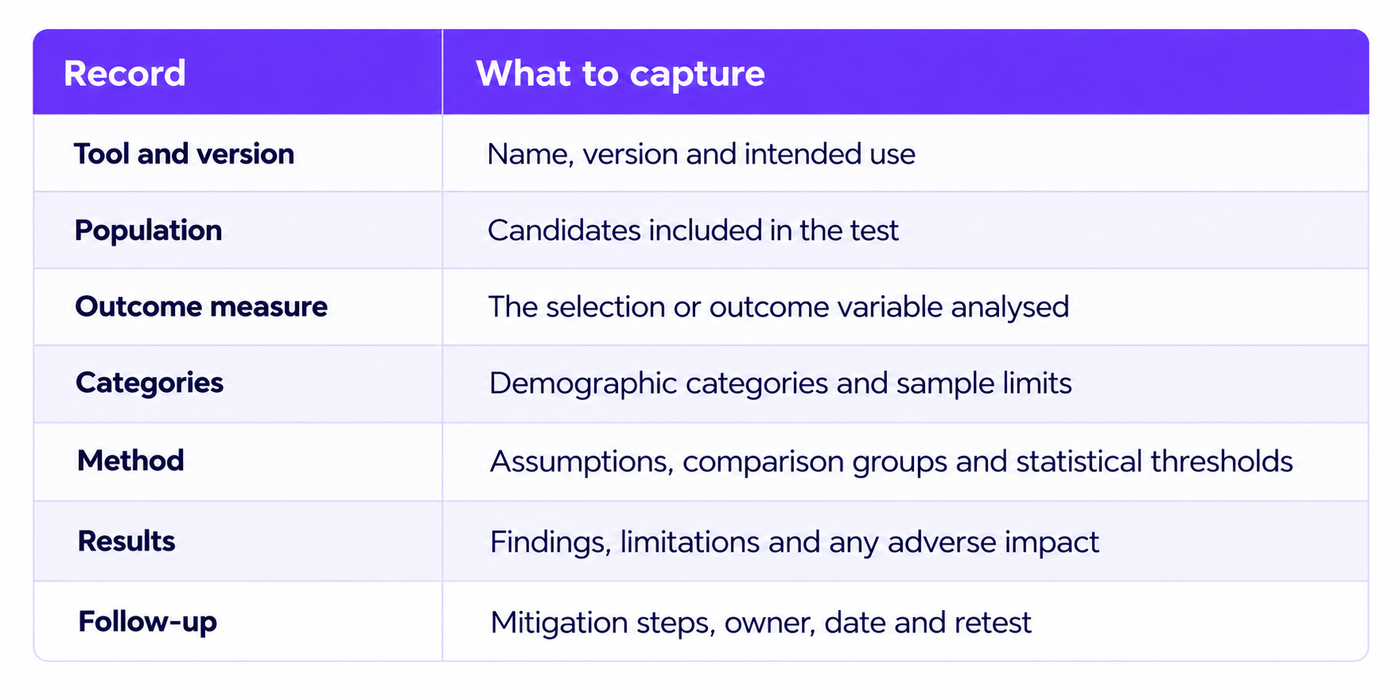
If a row is empty, the audit cannot be repeated or defended later.
Treat an audit as a snapshot, not a certificate. Models, prompts, data and candidate populations change, and a tool that worked acceptably for one role can behave differently for another.
Do not treat a vendor’s self-published audit as neutral evidence. Ask who ran it, what was tested, when and on which version.
How Should You Evaluate an AI Recruiting Vendor?
Start before procurement. A demo of a ranked shortlist does not show you the inputs, limits, data retention or human controls.
Ask each vendor these questions.
- What does the system output: a message, summary, score, classification or recommendation?
- Which output do you use to screen, rank, reject or select candidates?
- What data goes in, where is it stored, and which sub-processors can see it?
- Can a candidate request access, correction or erasure, and how fast can you act?
- Can the employer inspect, correct, override and record the human decision?
- Does the system use proxy variables such as location, school, gaps, language or name patterns?
- How are prompts, models, rules and scoring criteria versioned?
- Can the vendor support a review for your markets without claiming universal compliance?
Use the answers to build a system record naming a business owner, a legal owner and a technical owner. A procurement file that holds only the sales deck will not help when a candidate or regulator asks how a decision was made.
The structured interview scorecard template helps teams document job-related criteria and evaluate consistently. A scorecard does not make an AI system lawful, but it makes the decision criteria easier to review.
What Should an AI Hiring Compliance Checklist Include?
Before you deploy or materially change an AI hiring workflow, confirm the following.
- Scope: Which candidates, roles and locations are affected?
- Purpose: Which hiring decision does the tool support?
- Notice and consent: What do candidates see before data is collected, and how is consent recorded?
- Data: What enters the system, how long is it kept and when is it erased?
- Security: Who can access recordings, transcripts and scores?
- Human review: Who can override the output, and how is the override recorded?
- Fairness testing: What test fits this tool and candidate population?
- Candidate rights: How do you handle access, correction and erasure requests?
- Change control: What happens when the model, prompt or criteria change?
Put a review date on the assessment. Rules change, and an assessment goes stale when a law or the workflow does.
Want to review your recruiting workflow with human control points in mind? Talk to HireBound →
How Should Indian Companies Prepare for AI Hiring Rules?
Start with an inventory instead of waiting for an Indian AI hiring statute. List every tool that ranks, filters, evaluates or recommends people, and every market you recruit for.
Then separate candidate communication from candidate evaluation. A system that sends a scheduling message does different legal work from one that ranks candidates for rejection.
The diagram shows the loop to run for each hiring market.
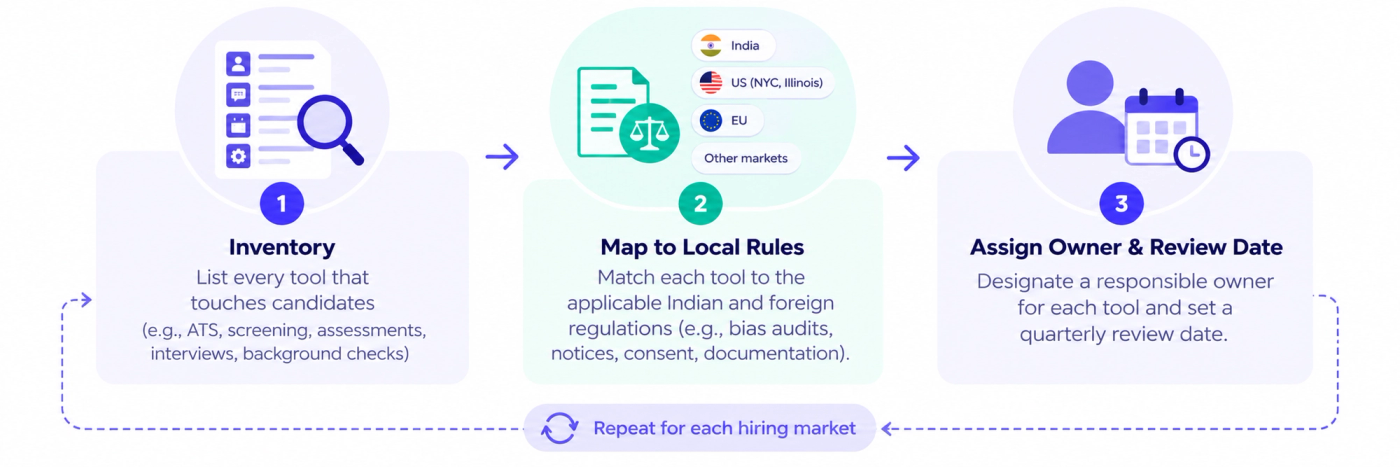
Keep the source statutes with the record, note the access date and assign an owner to check for changes every quarter. For roles in New York, the EU, Colorado or Illinois, add that jurisdiction’s requirements on top.
HireBound’s agents source, communicate with, screen and schedule candidates, with human review at the shortlist, interview and offer stages. That describes a workflow, not a claim that every deployment complies with every law, because applicability depends on the employer, role, location, configuration and decision.
For a plain definition of the category, see what AI in recruiting means. To test whether a vendor’s tool does the work it claims, see AI wrapper vs real AI.
Do not promise that a vendor, model or agent is “compliant” in the abstract. Ask what the system does in the actual workflow, who decides and what the employer must still do.


