Contract-to-Hire Conversion Rates: Benchmarks by Industry
 Suvam Moitra
 ·Oct 6, 2026·12 min read
Key Takeaways
- 1Staffing Industry Analysts (2017 survey) puts median conversion at 10% in North America, 8% in Asia Pacific and 5% in Europe among large employers.
- 2The share of job moves out of contract roles that land in permanent roles fell from 56% in 2016 to about 14% from 2022 to 2025, according to a February 2026 American Staffing Association analysis.
- 3Roles staffed as contract-to-hire from day one convert at 60% to 75%, so the design of the contract matters more than the market.
- 4A written conversion date, pre-approved headcount budget and a named evaluating manager predict conversion better than candidate skill alone.
- 5India’s labour codes, in force since 21 November 2025, changed the cost of long fixed-term and contract stints, so set conversion terms up front.
The contract-to-hire conversion rate is the share of contract or temporary workers who move into a permanent role with the client they were placed with. Published figures range from 5% to 75%, because each one measures a different population over a different window.
If you run a staffing agency or hire in bulk, that spread is the whole story. A 10% conversion rate can be healthy for one program and a failure for another. This report sorts the benchmarks by what they actually measure, explains why contracts stall, and shows what to write into the contract on day one.
Want conversion tracked from the first contact to the permanent offer? See how HireBound works for staffing agencies →
What Do the Key Findings Say About Contract-to-Hire Conversion?
Five findings shape everything below. They come from published surveys and staffing-industry analysis, and each is explained in its own section.
- Conversion depends on the population measured. Market-wide contract data, large-employer surveys and purpose-built contract-to-hire programs give answers that differ by a factor of five or more.
- Regional medians are low. Staffing Industry Analysts’ 2017 survey of large contingent workforce buyers reports median conversion for North America, Asia Pacific and Europe.
- Market-wide conversion has fallen sharply. A February 2026 American Staffing Association analysis of job transitions tracks the share of moves that start in a contract role and end in a permanent one.
- Design beats market conditions. Staffing firms that place candidates as contract-to-hire from the first day report much higher conversion on those searches.
- Most failures are process failures. Budget freezes, no written timeline and no named decision-maker cause more lost conversions than poor performance does.
For readers in India, one more fact frames the market. The Indian Staffing Federation’s 2026 annual report counts 1.91 million formal flexi workers across its member companies, up by about 118,000 (8%) in a year. Conversion practice therefore matters for a very large workforce.
How Was This Benchmark Report Compiled?
This report consolidates published figures rather than a single new survey. Every number is attributed in the sentence to the body that produced it, with the year.
The sources are the American Staffing Association’s staffing-industry statistics and 2026 contract-role analysis, Staffing Industry Analysts’ 2017 survey of large contingent workforce buyers, Indian Staffing Federation annual reporting, and India’s labour codes as notified by the Ministry of Labour and Employment. Figures from staffing firms’ own placement programs are described as firm-reported and are not treated as market averages.
Three definitions apply throughout. Conversion means the worker becomes a permanent employee of the client. Contract-to-hire means a role staffed with conversion as the intended outcome. Temp-to-perm is the same movement in temporary and light-industrial work, where the contract is usually shorter.
Before comparing your rate with any figure here, check who is in the denominator and how long the window is. Comparing a 12-month rate on your whole contract workforce with a per-search rate on roles built for conversion produces a false gap.
What Is a Good Contract-to-Hire Conversion Rate?
A good rate depends on the program. For a whole contract workforce, 10% to 20% converting each year is a reasonable target. For roles staffed as contract-to-hire from day one, 60% or more is the standard to aim for.
The benchmarks below cover the populations that get confused most often.
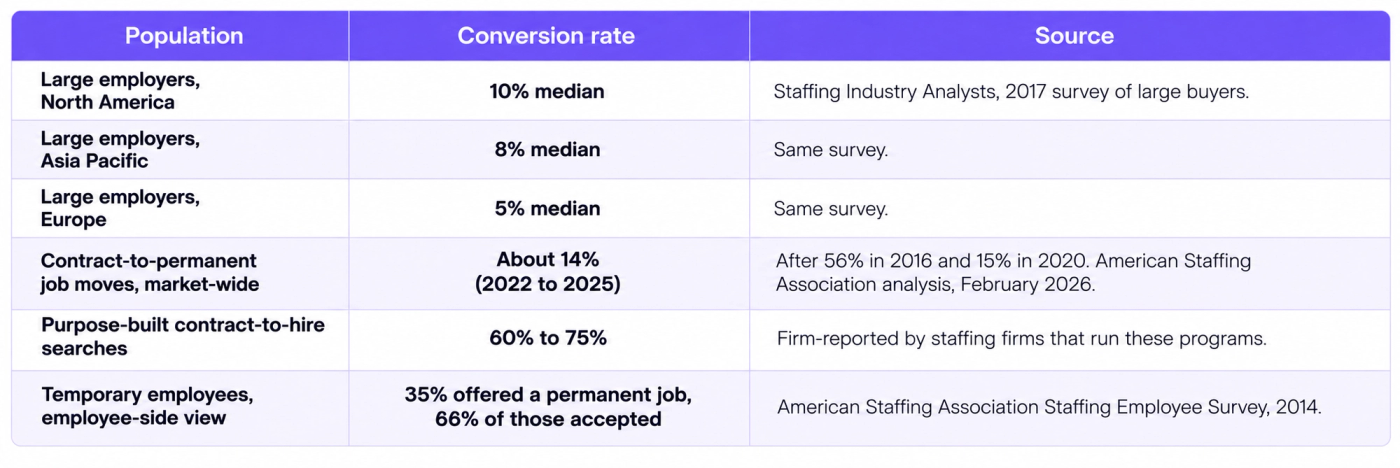
Take that last item. Its offer and acceptance rates imply an overall conversion of about 23% of temporary employees. It comes from an older survey and a different measure, but it sits between the market-wide 14% and the purpose-built 60% to 75%, which is where you would expect it.
What this means for your hiring: pick the benchmark that matches your program. If your clients hire contractors for project work with no intent to convert, 10% is normal. If you sell contract-to-hire as a try-before-you-buy product, 10% means the contract design is wrong.
Why Has the Market-Wide Conversion Rate Fallen?
The market-wide figure fell because contract work changed from a probation route into a permanent talent model. Employers now use contractors for project delivery, specialist skills and headcount flexibility, and they do not plan to convert most of them.
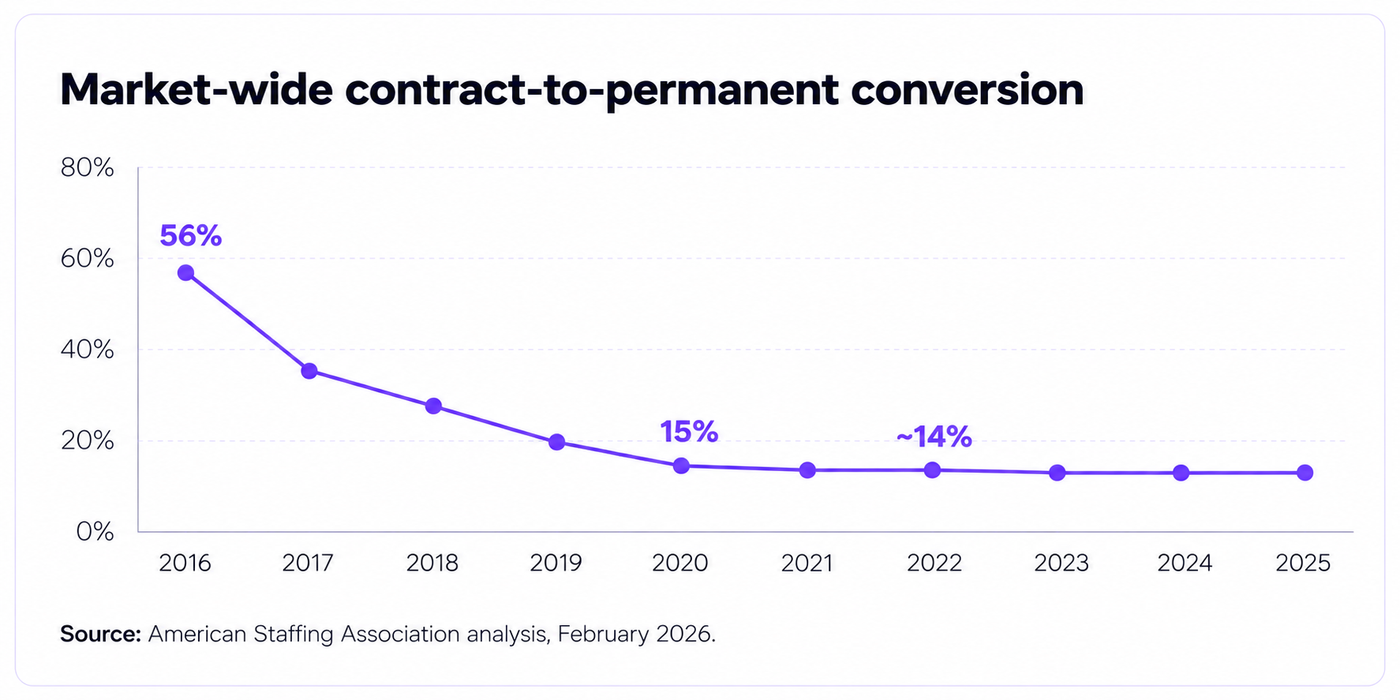
The drop since 2016 is a warning for anyone using an old benchmark. Older statistics such as “nearly 60% of temporary workers move into permanent jobs” describe a different labour market and often a different measurement. Treat them as historical.
Volume did not fall. The American Staffing Association reports nearly 2.2 million temporary and contract employees working for US staffing companies in an average week of 2024. Employers are converting a smaller share of a workforce that is still large.
What this means for your hiring: do not promise clients a conversion rate based on old figures. Sell the structure, meaning a defined evaluation window and a clear decision date, and report your own rate against your own placements.
How Does Conversion Vary by Industry and Role Type?
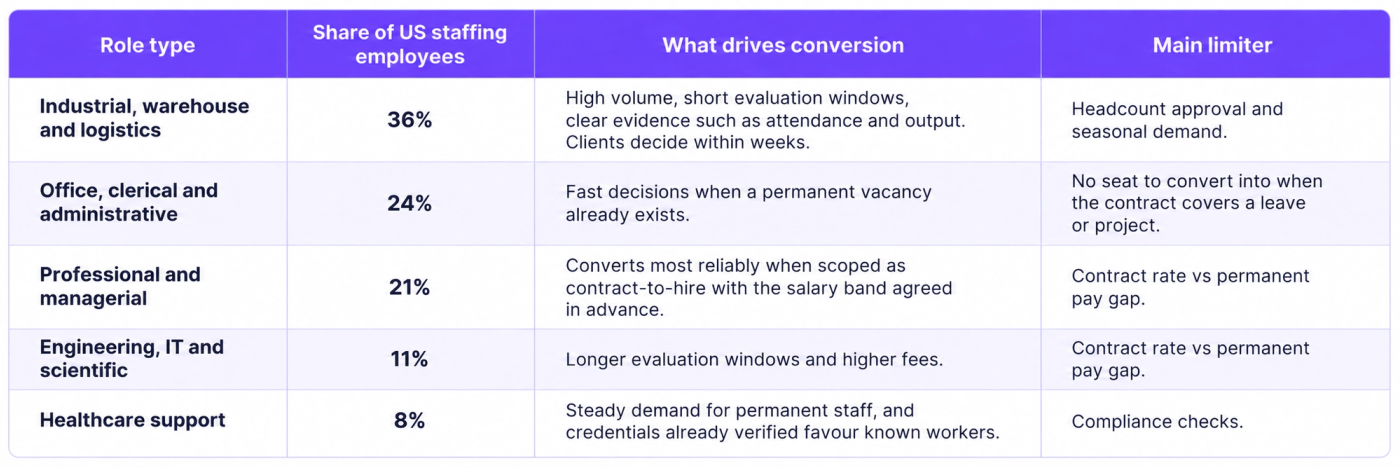
Conversion tracks how much a role depends on team fit, how expensive a bad hire is, and how quickly a client can approve headcount. Published surveys do not give a clean rate per industry, so the useful comparison is by role type and hiring pattern.
The American Staffing Association’s occupational mix for US staffing employees shows where contract volume sits. That mix explains why one blended conversion number hides so much.
In India the pattern shows up differently. The Indian Staffing Federation’s 2026 report describes growth anchored in retail, logistics, manufacturing and technology hiring, with e-commerce and quick-commerce, FMCG and retail, logistics, healthcare and pharma, and global capability centre hiring named as the strongest demand sectors for the next year. Many frontline roles in these sectors are filled through flexi staffing by design, which means the intended conversion is often lower than in a US contract-to-hire program.
What this means for your hiring: set your target per segment. A single blended target will punish the desk that fills industrial roles and flatter the desk that places senior specialists. For how conversion connects to the rest of an agency’s metrics, see HireBound’s guide to staffing agency KPIs.
Why Do Some Contracts Never Convert?
Most contracts fail to convert for reasons unrelated to the contractor’s performance. The client never had budget for a permanent seat, nobody owned the decision, or the contractor left while waiting for an answer.
These are the causes staffing firms cite most often.
- No approved permanent headcount. The role was funded as contract spend. When the evaluation ends, there is nowhere to move the person.
- Budget freezes. A hiring freeze arrives mid-contract and blocks conversion even for a strong performer.
- No written timeline. With no conversion date in the agreement, the decision drifts, and drift favours the status quo.
- Unclear ownership. The manager who works with the contractor is not the person who approves permanent hires, and neither is accountable for deciding.
- Contractor attrition. A good contractor who hears nothing for months takes another offer. Open-ended uncertainty is the most common reason candidates walk.
- Compliance caution. Employers worry about co-employment risk when a contractor stays for many months, and the safe option is to end the assignment.
- Pay gap. The permanent salary is lower than the contract rate with no allowance for benefits, so the contractor declines.
Only one of the seven concerns the person, so conversion rates respond strongly to program design.
What this means for your hiring: before a contract starts, ask the client three questions. Is there a budgeted permanent seat? Who decides? By what date? If any answer is vague, price the role as a plain contract and do not sell it as contract-to-hire.
What Predicts a Successful Contract-to-Hire Conversion?
Five design factors predict conversion better than the candidate’s skills do. They are all in place before the first day of work.
- A written conversion trigger date. The contract states the evaluation window and the date the client will decide. Ninety days is the usual minimum for a fair evaluation.
- Budget approved before the assignment starts. The permanent role exists on paper, with a salary band, before the contractor arrives.
- A named evaluating manager. One person owns the assessment and the decision, with a scorecard rather than a general impression.
- Screening for team fit, not only technical skill. Candidates are assessed on working style, communication and reliability as well as capability. For how this trial model compares with freelance and gig engagements, see HireBound’s guide to gig and freelance hiring versus full-time recruiting.
- The candidate knows the intent. Contractors who know the role is designed to convert stay engaged, and those who do not treat it as a short gig.
Firms that run purpose-built programs report 12-month retention of about 92% after conversion, which is a firm-reported figure and not a market average. It does point at something real: people who convert after a working trial tend to stay, because both sides have already seen how the job works.
What this means for your hiring: turn the five factors into a pre-start checklist and refuse to launch a contract-to-hire assignment that fails two or more.
How Should You Structure Contract-to-Hire Terms From the Start?
Structure the terms so that the conversion decision is scheduled, not hoped for. Write down who decides, by when, and at what pay, then track the date like any other deliverable.
Use this sequence when drafting terms.
- State the intent. Mark the role as contract-to-hire in the agreement and the job posting, not as a generic contract.
- Set the evaluation window. Ninety days is the floor for most roles. Longer suits professional and technical work, and shorter suits high-volume industrial roles with clear output measures.
- Fix the decision date. Put a calendar date in the agreement for the client’s convert-or-release decision, with a reminder two weeks earlier.
- Agree the permanent salary band. Share the range with the candidate at the start so the conversion offer holds no surprise.
- Define the conversion fee. Set the fee or the conversion buy-out, and how it steps down over the contract, so the client is not surprised by the invoice.
- Name the owners. Record the evaluating manager, the budget approver and the agency contact.
- Schedule two check-ins. A midpoint review and a final review keep the decision from arriving cold, and give you time to fix issues.
For agencies, the fee structure is where margin is won or lost. A conversion fee that falls with contract length rewards clients for deciding early. A flat fee with no step-down often leads clients to keep the contractor on the agency’s payroll indefinitely, which lowers the conversion rate you report and raises your co-employment exposure.
How Does India Compare With Global Contract-to-Hire Practice?
India has a large flexi workforce and a different legal setting, so conversion figures from Europe or North America should be applied with care. Staffing Industry Analysts’ regional medians put Asia Pacific between the other two regions, which is a useful anchor.
The Indian Staffing Federation’s 2026 annual report counts 1.91 million formal flexi workers across member companies, with 118,000 added in the year, an 8% rise. The same reporting notes that between 57% and 61% of new EPFO subscribers were aged 18 to 25.
The legal setting changed recently. The Government of India brought the four labour codes into force on 21 November 2025, according to the Press Information Bureau. Two changes bear on conversion decisions.
- Fixed-term employees become eligible for gratuity after one year of continuous service, instead of the five-year rule that applied before. A fixed-term contract that runs past a year now carries a cost that a shorter one avoids.
- Contract labour rules under the Occupational Safety, Health and Working Conditions Code apply where 50 or more contract workers are employed, and restrict contract labour in core activities, with listed exceptions.
The practical effect is that open-ended contract stints look more expensive and riskier than they did. Clients who once extended contractors by default now have a financial reason to decide. Confirm the details for your state and your clients’ industries with counsel before you rewrite terms.
What this means for your hiring: in India, the conversion conversation should happen at the start of the contract, not at the end. A fixed decision date suits both the client’s compliance position and the candidate’s need for certainty.
What Does This Mean for Staffing Agencies and Employers?
Agencies and employers both gain from conversion, but they gain in different ways, and the interests only align when the terms are clear.
For staffing agencies:
- Report conversion by program type, not as one blended number. Contract-to-hire searches, project contracts and seasonal placements each need their own target.
- Sell the structure. A defined evaluation window and decision date is a product clients understand, and it lets you price a conversion fee.
- Track the reasons for every failed conversion. Budget, ownership and timing problems are fixable by the agency at the start of the next deal.
- Protect the candidate relationship. A contractor who was not converted, but was treated well, is your best source of the next placement.
For employers:
- Use contract-to-hire when the role is hard to assess in interviews, when the team is small and fit matters, or when headcount approval is likely but not final.
- Do not use it as a delay tactic. Candidates notice, and the best ones leave.
- Decide the budget before you hire. The conversion rate you achieve is capped by the seats you have funded.
- Give contractors regular feedback. It improves the evaluation and improves the odds they say yes.
Speed matters throughout, and HireBound’s time-to-hire benchmarks show where the days go. A conversion decision made in week 10 with a candidate you have stayed in touch with is likelier to close than one made in week 16 after silence. Automated follow-up on WhatsApp and Voice helps here, because contractors can be reached and updated without recruiter time, and HireBound’s data shows a 64% WhatsApp response rate in India compared with about 12% for email.
When Is Contract-to-Hire the Wrong Choice?
Contract-to-hire is the wrong choice when there is no real chance of a permanent seat, when the role is senior enough that top candidates will not accept a trial, or when the client will not commit to a decision date.
Senior candidates in demand often refuse a contract stage because they have permanent offers elsewhere. If your shortlist keeps declining, offer a permanent role with a probation period instead. And if the client’s real need is a short project, sell it as a project contract and keep the promise of conversion out of the conversation. A false promise damages the candidate relationship and the agency’s reputation.
Ready to see your own conversion numbers move? Talk to us about tracking contract-to-hire conversion end to end →
What Are the Conclusions and Predictions for Contract-to-Hire?
Three expectations follow from the data and from India’s regulatory change.
- Conversion reporting will get more precise. Buyers already ask for conversion by program. Agencies that can show a purpose-built contract-to-hire rate, separate from a blended average, will win those tenders.
- Fixed decision dates will become standard in India. With gratuity eligibility at one year for fixed-term staff, clients have a reason to decide sooner and agencies have a reason to write dates into agreements.
- The gap between 14% and 60% will stay. Market-wide conversion will not recover to old levels, and purpose-built programs will keep outperforming. The difference is contract design, which the agency controls.
For a staffing owner, that means dropping the single conversion number. Choose the population, fix the window, write the decision date into the contract, and measure yourself against a benchmark that matches what you sell.


