Employee Referral Programs: Conversion Rates and ROI Benchmarks 2026
 Suvam Moitra
 ·Oct 6, 2026·12 min read
Key Takeaways
- 1Referrals account for 30% or more of hires (SHRM, 2016), and the channel converts several times better than job boards, where apply-to-hire runs 2% to 5%.
- 2SHRM reporting on a study of 14 million applications found external sources need four times as many applications to reach interview, and twice as many interviews per offer.
- 3A peer-reviewed study across nine firms (Quarterly Journal of Economics, 2015) found referred workers were 10% to 30% less likely to quit than comparable non-referred hires.
- 4In our worked example, one referral hire costs about ₹19,000 against ₹72,000 through an agency, and the saving repeats with every hire the program produces.
- 5Programs fail on participation and quality, not payout size. Pay in two stages, share open roles weekly, and send referrers a status update within 48 hours.
An employee referral program conversion rate is the share of referred candidates who go on to receive and accept an offer. Published benchmarks range from about 13% to 28% of referrals, against 2% to 5% for job board applicants. Referrals account for a large share of hires.
That gap explains why nearly every HR team says it runs a referral program, and why so few are happy with the results. Launching a program is easy. Building a referral flow that converts, retains and costs less than an agency takes design.
Want referred candidates screened and scheduled without recruiter follow-up? Explore HireBound →
This report pulls together the benchmarks that matter for an Indian hiring team: how many hires referrals produce, how they convert compared with other channels, how long referred hires stay, what a referral hire costs, and what separates programs that work from those that stall. It ends with a worked ROI example in rupees that you can rebuild with your own numbers.
Executive Summary: What Do Referral Program Benchmarks Show?
Referral programs produce more hires, faster, at lower cost than most channels. The pattern holds across the studies reviewed here, though the exact numbers vary by industry, role level and how a company counts a “referral.”
Here are the headline findings:
- Share of hires: SHRM’s coverage of a large sources-of-hire study found employee referrals produced 30% of all hires and 45% of internal-source hires.
- Retention: Peer-reviewed research finds referred workers are 10% to 30% less likely to quit.
- Cost and speed: Referral hires cost a fraction of agency placements and close faster than job board hires.
The rest of this report explains where each number comes from, what it measures and how to apply it.
How Were These Benchmarks Compiled?
The figures in this report come from published research and industry benchmark data, not from a single dataset, so each number carries its own scope. Where a source measures something narrow, the sentence says so.
Three sources anchor the analysis. The first is SHRM’s coverage of a sources-of-hire study that examined more than 14 million applications, 655,000 interviews and 329,000 hires across over 1,000 companies. The data dates from 2016, so treat its absolute percentages as directional and its ratios as more durable.
The second is a peer-reviewed paper by Burks, Cowgill, Hoffman and Housman, published in the Quarterly Journal of Economics in 2015. It used personnel records from nine large firms across call centers, trucking and high-tech.
The third is a set of recent industry benchmark reports covering apply-to-hire conversion, referral volumes and retention. These come from recruiting platforms that track referral programs, so they reflect companies that already run structured programs. That skews the numbers upward, and you should expect an ad hoc “send us names” program to convert less.
Two definitions keep the numbers comparable across this report:
- Referral conversion rate: referred candidates who accept an offer, divided by all referred candidates submitted.
- Apply-to-hire rate: hires from a source, divided by applications received from that source.
Because companies define these differently, compare your own program with the ranges below rather than a single number.
What Is a Good Employee Referral Conversion Rate?
A good referral conversion rate sits between roughly 13% and 28% of submitted referrals, depending on how strictly the program screens what comes in.
Industry benchmark data from a 2026 report puts the apply-to-hire rate for referral candidates at 28.2%. A separate analysis of about 1.1 million referrals processed in 2024 found roughly 13% led to a hire. Both can be true. The first counts candidates who actually enter the application pipeline, and the second counts every name submitted, including people who never apply.
Here is how the two channels compare:
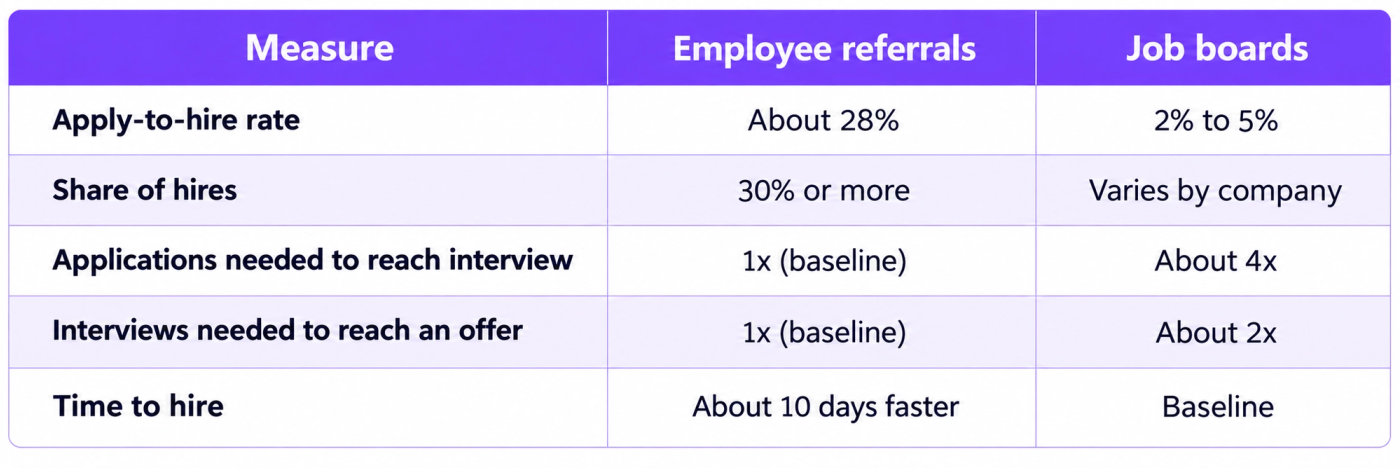
Sources: SHRM coverage of a 2016 sources-of-hire study; 2026 industry benchmark data. The 4x and 2x ratios compare external sources with referrals.
The funnel gap comes from the SHRM-covered sources-of-hire study. A recruiter working a job board pipeline reviews far more candidates to produce one hire.
What this means for your hiring: If your referral conversion is under 10%, the problem is usually intake, not the referrers. Names arrive without context, nobody contacts them for a week, and they drift away. Fix the first 48 hours before you raise the bonus.
How Much of Hiring Do Referrals Actually Produce?
Referrals typically produce 30% to 50% of hires in companies that run active programs. SHRM’s coverage of the sources-of-hire study found employee referrals were the largest single source of hire in that dataset.
Share varies by role level and industry. Technical, finance and consulting hiring in India leans heavily on referrals, and so does frontline hiring in BPO, logistics and retail, where employees hand a job to a cousin, a neighbour or a former colleague in a single WhatsApp forward. Senior leadership hiring uses referrals less, because the pool of people who can credibly vouch for a CXO is small.
A useful internal benchmark is your own referral share of hires over the last four quarters. If it is below 15% and you run a program, participation is the limiting factor. If it is above 40%, watch for concentration risk, since a workforce built mostly from personal networks can become homogeneous.
What this means for your hiring: Treat referral share as a lagging metric. Track the leading ones instead: the percentage of employees who have referred at least once, the number of referrals per open role, and the time from submission to first contact.
Do Referral Hires Stay Longer?
Yes. Referred hires stay longer on average, and the strongest evidence is a peer-reviewed study rather than a vendor report. Burks, Cowgill, Hoffman and Housman (Quarterly Journal of Economics, 2015) found referred workers were 10% to 30% less likely to quit than comparable non-referred workers.
The study also found that referred workers looked similar to non-referred workers on skills and on most productivity measures. The gap showed up in rare, high-impact outcomes: lower accident rates in trucking and more patents in high-tech.
Why does fit improve? Referrers know the job and the person. They filter out candidates who would hate the work, and they give the candidate an honest preview that a job description cannot. A clear role brief gives non-referred candidates a similar preview.
What this means for your hiring: In high-attrition roles, retention is the biggest part of the ROI case. A referral that keeps a warehouse associate for 12 months instead of 6 saves a full replacement cycle, which usually costs more than the referral bonus.
How Do You Calculate Employee Referral Program ROI?
Referral program ROI is the cost you avoid on alternative channels, plus the value of lower early attrition, minus the cost of running the program. The simplest version compares the total cost of one referral hire with the total cost of one hire through your current alternative.
Here is a worked example. The figures are illustrative assumptions for an Indian mid-level role, not benchmarks, so replace them with your own.
Assumptions: The role carries an annual CTC of ₹6,00,000. Your agency charges 12% of annual CTC. Your referral bonus is paid ₹7,500 on joining and ₹7,500 after 90 days. Program administration, recognition and internal recruiter time are costed per hire.
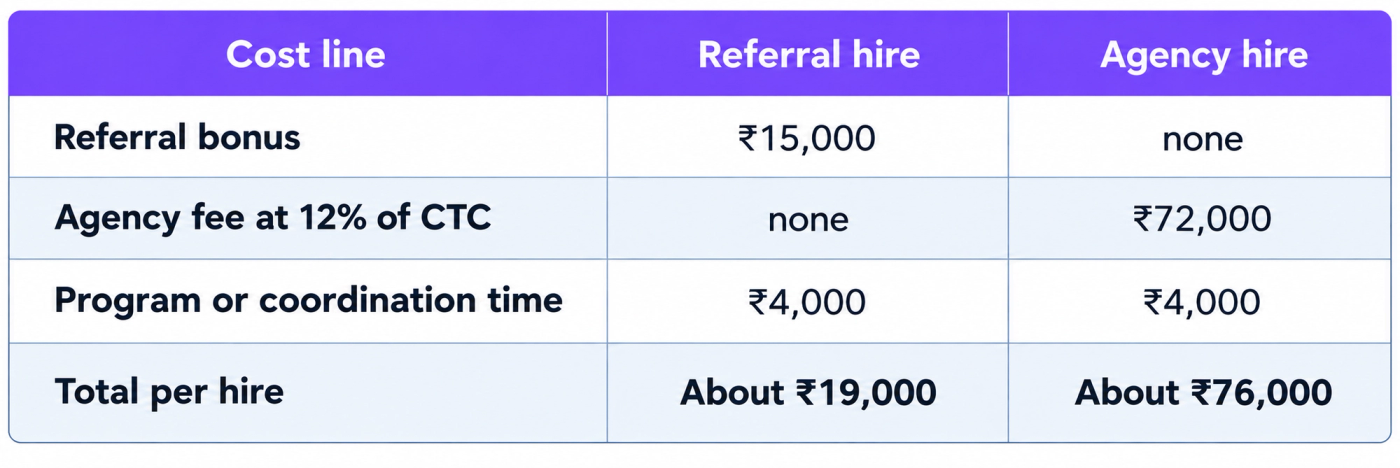
Direct saving per hire: roughly ₹57,000, or about 75% lower cost.
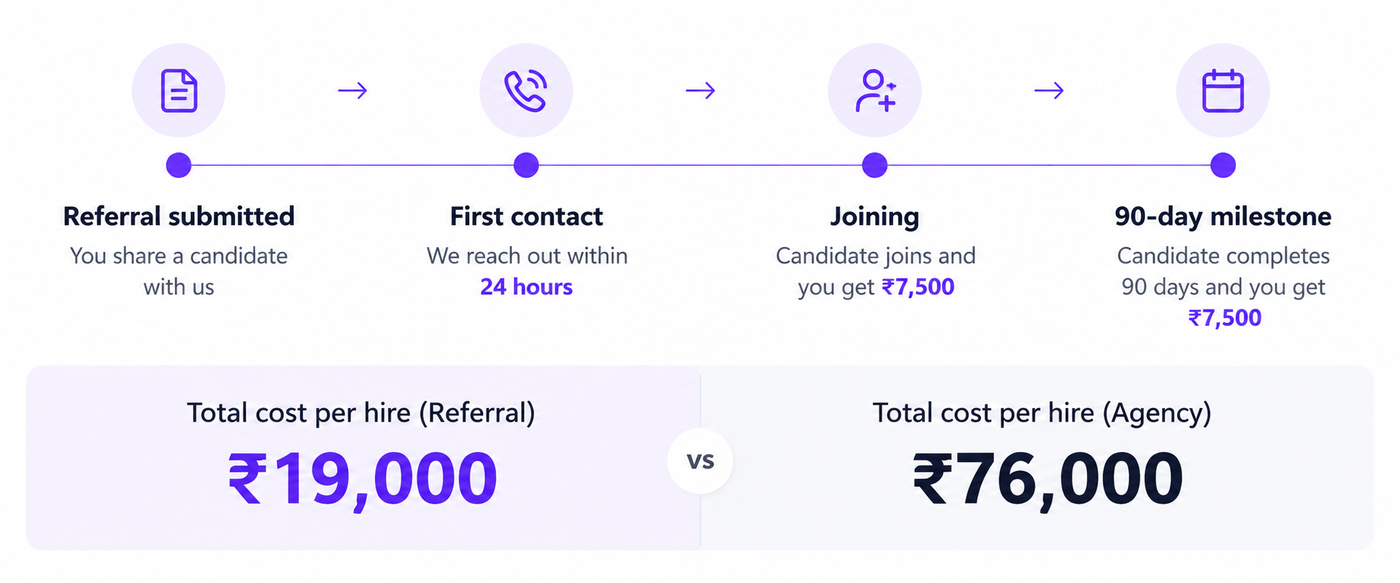
Now add retention. Assume 20 out of 100 job board or agency hires leave within the first year. If referred hires are 20% less likely to quit, that is 16 out of 100 leaving. Four extra hires stay, and each avoided replacement saves the agency fee again. On 100 hires, the retention effect is about 4 × ₹76,000, or ₹3.04 lakh.
Now subtract fixed costs. If you run the program on a spreadsheet or your ATS, the fixed cost is small. If you buy referral software, add its annual fee. A 50-hire-per-year program that saves ₹57,000 per hire clears ₹28 lakh in direct savings before retention effects.
Your own ratio will differ from this example, so rebuild it with your agency fee and bonus.
What this means for your hiring: Calculate ROI per role family, not company-wide. A referral bonus of ₹15,000 is generous for a delivery associate and thin for a senior engineer. The saving is largest where your agency fees are highest.
How Fast Are Referral Hires Compared With Other Channels?
Referral hires close faster because the candidate arrives with trust and context.
The speed comes from skipped steps. The referrer has already answered the candidate’s obvious questions about pay, team and manager. The candidate is less likely to accept a competing offer during the process, because someone they trust is waiting on the outcome.
Speed decays fast if intake is slow, though. A referred candidate who hears nothing for five days concludes the company is disorganised, and so does the referrer. On India’s most-used candidate channel, that delay is avoidable. HireBound’s own data shows a 64% WhatsApp response rate in India, against about 12% for email, so a first contact on WhatsApp within hours is far more likely to be read than an email sent the next day.
For a wider view of how sourcing channels stack up, see our guide to candidate sourcing channels.
What this means for your hiring: Set a service standard: every referral gets a personal first contact within 24 hours and a status update to the referrer within 48. Automate the reminders so the standard survives a busy week.
What Makes Referral Programs Succeed or Fail?
Programs succeed on participation and follow-through, and fail on friction and silence. Payout size matters less than most HR leaders assume.
Direct, named referrals convert. Broadcast links posted to a feed rarely do. That reframes the goal: you want fewer, better-matched names, not more clicks.
What Do Successful Programs Do?
Programs that work tend to share six habits:
- Publish open roles every week. Employees cannot refer for jobs they do not know exist. A short weekly list on WhatsApp or the company chat beats a portal nobody opens.
- Make submission take under two minutes. Name, phone number, role and one line on why. Long forms kill volume.
- Pay in two stages. Pay half on joining and half after a probation or 90-day milestone. This ties the reward to retention and is common practice in India.
- Update the referrer at every stage. Referrers who hear nothing stop referring. Tell them when the candidate is contacted, interviewed, offered or declined.
- Recognise referrers publicly. Certificates, a shout-out from leadership or an extra day of leave cost little and keep referrers engaged.
- Screen every referral properly. A referred candidate who is a poor fit and gets waved through damages the program’s credibility with hiring managers.
Why Do Referral Programs Fail?
The common failure modes are easy to spot:
- Silence after submission. The referrer never learns what happened, so they never refer again.
- A bonus that is too small or arrives too late. If payment comes six months after the hire, nobody connects it to the effort.
- Unfair handling of referrals. Hiring managers reject referred candidates without feedback, or worse, favour weak ones. Either damages trust.
- No fit criteria. Employees refer whoever they know. Without a clear role brief, quality drops.
- Ignoring your repeat referrers. The employees who refer most often know what works. Find them, thank them and ask what would help.
Invite your best people to refer and brief them well, since they know what a strong hire looks like on your team.
What this means for your hiring: Audit your program against the six habits above. Fixing follow-up speed is usually the cheapest place to start.
How Do Referral Programs Compare in India and Globally?
The global benchmarks above translate well to India, with three local differences: incentive size, channel and role mix. Most published conversion and retention figures come from US and European datasets, so use them as a starting range rather than a promise.
Program adoption. Referral programs are common among Indian employers, so having one is no longer an advantage. A structured payout and fast follow-up are what set a program apart.
Incentive levels. Bonuses usually scale with role level, from a modest sum for junior roles to a much larger one for senior or hard-to-fill positions, so set yours against the agency fee you would otherwise pay. Many employers split the payout, with part paid on joining and the rest after probation or 90 to 180 days.
Channel. Indian employees share jobs on WhatsApp far more than on a company portal. A referral flow that starts in WhatsApp, where the employee already is, gets more submissions than one that needs a login.
Role mix. Bulk and frontline hiring in BPO, logistics, retail and manufacturing benefits most, because turnover is high and each avoided replacement is worth more than the bonus. Tech and finance teams use referrals for hard-to-find skills where agency fees are steepest.
Candidate data. Referred candidates are data principals under India’s DPDP Act. When an employee submits a friend’s phone number, the candidate still needs a clear notice of why you are contacting them. Build that into the first message. Our DPDP Act compliance checklist for recruiters covers what a valid notice looks like.
What this means for your hiring: Start from the global ranges, then measure your own baseline for two quarters. Your India-specific numbers will become your best benchmark.
What Does This Mean for Referral Program Design?
Use this blueprint as a starting point.
- Set the target. Pick a referral share of hires you want in 12 months, for example 20% to 30% of hires in roles with high turnover.
- Set the reward ladder. Give junior roles a smaller bonus and hard-to-fill roles a larger one, each paid in two stages.
- Build a two-minute intake. Use WhatsApp or a short form. Capture name, number, role, relationship and consent to be contacted.
- Contact within 24 hours. A recruiter or an automated agent makes first contact, confirms interest and collects screening answers.
- Schedule quickly. Move interested candidates to interview slots without back-and-forth.
- Close the loop. Tell the referrer the outcome at every stage, with a reason when the answer is no.
- Review monthly. Track participation rate, submissions per role, referral-to-hire conversion, time to first contact, 90-day retention and cost per hire.
Referral pipelines also feed your longer-term talent pool. A referred candidate who was not the right fit today may be the right fit next quarter, and our guide to how to build a talent pipeline explains how to keep those relationships warm.
Referral programs are not a full sourcing strategy. They cap out at the size of your employees’ networks, they can reduce diversity when networks are similar, and they work best for roles where your current staff know suitable people. Use them alongside other channels, not instead of them.
See how referrals get screened and scheduled in one workflow. Book a free demo →
Conclusions: Where Is Referral Hiring Heading?
Three shifts look likely over the next two years, based on the direction of the benchmarks above.
First, referral programs will move from portals to messaging. Employees already forward jobs on WhatsApp, and the programs that meet them there will collect more names with less effort.
Second, first-contact speed will become the main differentiator. Because a referral’s advantage decays with silence, teams that respond within hours will outperform teams with better bonuses.
Third, more employers will pay by outcome. Two-stage payouts tied to retention are already common in India, and programs that measure 90-day retention per referrer will spot their best contributors early.
Measure how long a referred candidate waits for the first contact today, cut it to under 24 hours, and watch the conversion rate follow.


