HCL Hiring Process: Stages for Freshers and Experienced Hires
 Devansh Dhawan
 ·Oct 28, 2026·6 min read

Key Takeaways
- 1HCLTech’s careers page lists five steps for every hire: application, shortlisting, business or technical interview, HR interview, and decision and offer.
- 2Fresh engineering graduates are selected through AMP (Ascend, Momentum, Polaris), and HCLTech says off-campus candidates are eligible on the same terms as campus candidates.
- 3The Ascend test has three stages: a cognitive test of about 90 minutes, a coding or technical test of 60 to 90 minutes, and a Versant English test with a qualifying score of 46 to 56.
- 4HCLTech’s September 2026 quarter release shows 230,339 people, 6,136 freshers added in the quarter and 12.8% last-twelve-month attrition.
- 5Treat any timeline or round order from candidate forums as a guide only; the HCLTech careers page is the source of truth.
The HCL hiring process, as HCLTech publishes it, has five steps: application, shortlisting, a business or technical interview, an HR interview, and a decision and offer. Freshers enter through routes such as Graduate Engineer Trainee, selected through the AMP test, while experienced hires apply to open roles. This guide marks each step as official or commonly reported, so you know what to trust.
If you are a recruiter or talent leader, see how HireBound handles high-volume pipelines: explore the AI recruiting platform.
Facts below were checked against HCLTech’s own pages on 27 October 2026. Processes change, so treat the HCLTech careers page as the source of truth.
HCL or HCLTech: Which Name Applies?
The company is HCL Technologies Limited, and it trades and hires under the name HCLTech. Candidates search for “HCL” because that is the older, shorter name. Both terms point to the same employer in this guide.
The “HCL” label also appears on software products listed on hcltech.com, such as HCL BigFix and HCL AppScan. When you apply, use the HCLTech careers portal and check that the job post names HCLTech.
The Official Steps at HCLTech
HCLTech’s India careers page describes the same sequence of steps. Each one below is official, taken from HCLTech’s careers in India page.
- Job opportunities and application submission. You search for postings that match your skills and submit a resume with full credentials.
- Shortlisting. A recruiter or technical panel screens your application, and HCLTech contacts you if your credentials match.
- Business or technical interview. HCLTech says the questions span disciplines and may include puzzles and problems.
- HR interview. The aim is to understand your goals, skills, strengths and interests. HCLTech adds that you can ask the recruiter about the role.
- Decision and offer. A positive outcome brings an offer with a compensation structure and employment details.
HCLTech does not publish a fixed timeline between these steps. Any “joining in X weeks” claim you read online is unverified. Your offer letter is the document that states dates and terms.
Fresher Entry Routes at HCLTech
HCLTech’s campus hiring page lists several entry routes by degree. The table below shows them as the page describes them. All rows are official, with one limit: for TechBee, the India page gives the name and the Class XII audience, but this guide could not confirm further details.
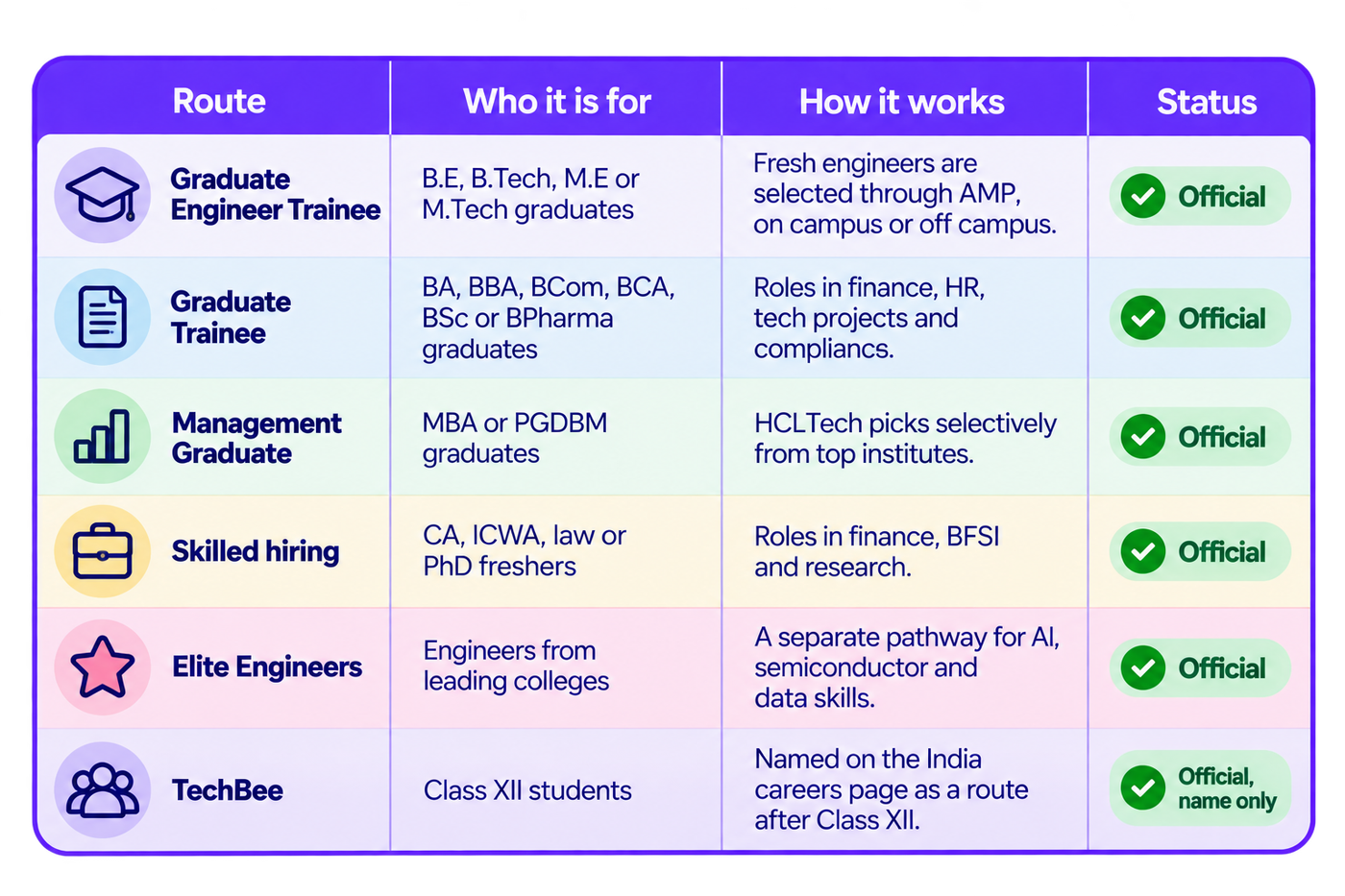
Graduate Engineer Trainee is only one of several routes, and your degree decides which one applies.
The AMP Test for Engineering Freshers
AMP stands for Ascend, Momentum and Polaris. HCLTech calls it a merit-based selection process for fresh engineering graduates. Everyone who clears selection gets an Ascend offer. The top 10% of Ascend candidates face further assessment and can move up to Momentum or Polaris.
The Ascend test has three stages, all described on HCLTech’s campus hiring page.
- Cognitive test: numerical, verbal and reasoning questions, about 90 minutes.
- Coding or technical test: 60 to 90 minutes.
- Versant test: English speaking and listening, with a qualifying score of 46 to 56 (B1 level).
Only candidates who clear the cognitive and coding tests reach the Versant test. After that, they move to technical and HR interviews.
On eligibility, the same page states a minimum of 65% throughout academics for Lucknow, Nagpur, Vijayawada and Madurai postings. For all other locations it states 70%, across Class 10, Class 12 and graduation. It also says an engineering degree in any branch qualifies. Check the live page for the current figures before you apply.
Campus and Off-Campus Hiring Compared
HCLTech says all fresh engineering graduates who meet the minimum criteria can join AMP, whether they come through campus or off campus. The route changes the training, not the test itself. The official pattern is below.
- Primus Campuses are select engineering colleges where HCLTech integrates an industry-aligned curriculum. Students there receive training meant to prepare them for AMP assessments.
- Candidates from non-Primus colleges, or hired off campus, must complete mandatory pre-joining training and clear a post-training assessment.
- That post-training assessment can help a candidate upgrade an offer from Ascend to Momentum or Polaris.
How colleges are invited to drive, or how often off-campus drives happen, is not stated on the pages we checked. Candidates often describe off-campus drives as announced on the careers portal and through college placement cells, but that is commonly reported, not official. Watch the portal for dates instead of relying on forum posts.
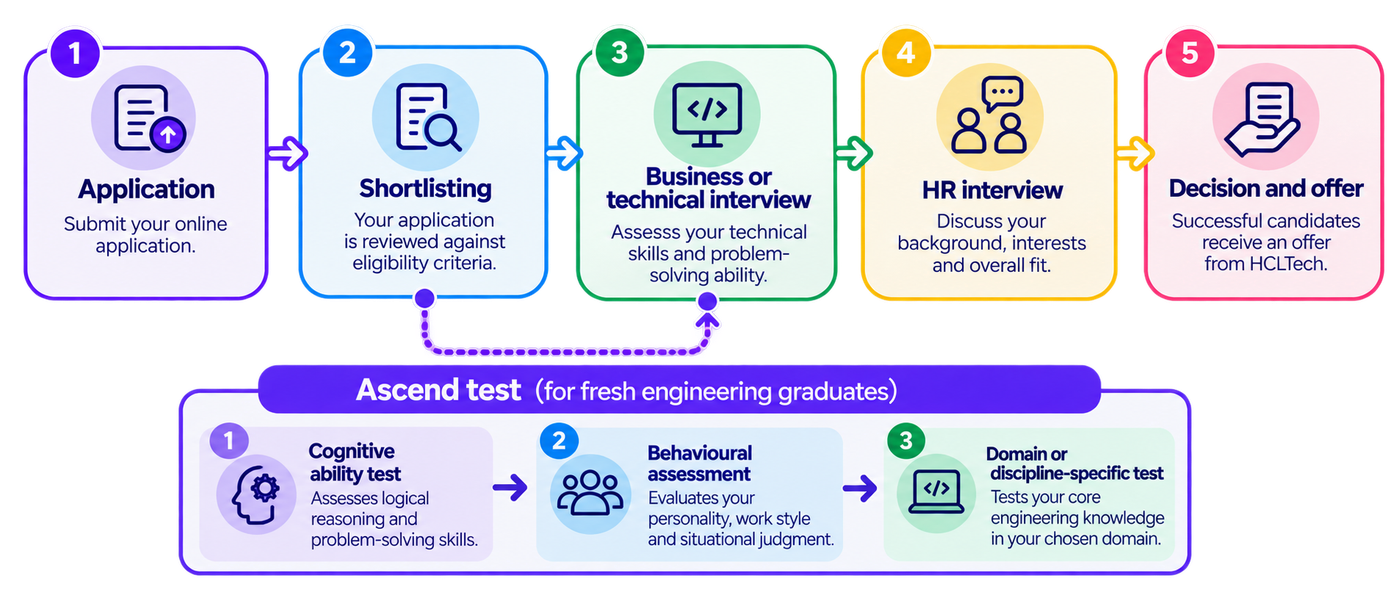
Plan your preparation around the written test first. The interviews follow only if you clear it.
The Experienced-Hire Flow
HCLTech’s careers page sends experienced professionals to open job postings. It does not publish a separate step list for them. The five steps above apply, and the business or technical interview is where experience gets tested.
Candidates commonly report that the technical discussion follows the skills on the resume. They describe questions on projects, tools and problem-solving, and sometimes a conversation with a hiring manager. Because rounds vary by role and team, this is commonly reported. HCLTech does not publish the count or order of rounds.
For a practical read on what interviewers ask, see HireBound’s guide to HR interview questions. Keep your resume specific, since the shortlisting step is a human screen of your credentials.
Notice period, offer terms and joining date are set in your offer letter. HCLTech publishes no standard figures on its careers pages, so read the letter before you resign.
What the HR Round Covers
HCLTech describes the HR interview as a conversation about your career goals, skills, strengths and passion. It also invites you to ask questions. Both points are official.
Candidates commonly report questions such as why you want to join the company, how you handle pressure, and whether you can relocate. These are commonly reported, so use them as practice rather than a script. Pay attention to the location question. HCLTech’s AMP eligibility and pay bands differ by posting location, so relocation can change your offer.
For fresher practice answers, see HireBound’s fresher interview questions.
What High-Volume Pipelines Like This Look Like for Recruiters
HCLTech hires at a scale few employers match. Its investor release for the quarter ended 30 September 2026, dated 12 October 2026, shows 230,339 people at quarter end. It also shows 6,136 freshers added in that quarter and last-twelve-month attrition of 12.8%. HCLTech notes that this attrition figure excludes involuntary attrition and digital process operations.
A pipeline at that scale runs on repeatable stages: a written screen, a structured interview and a defined offer step. Recruiters in India face the same pattern when they run bulk hiring for support, operations or fresher batches. Thousands of applicants need a fast first response and a fair first filter.
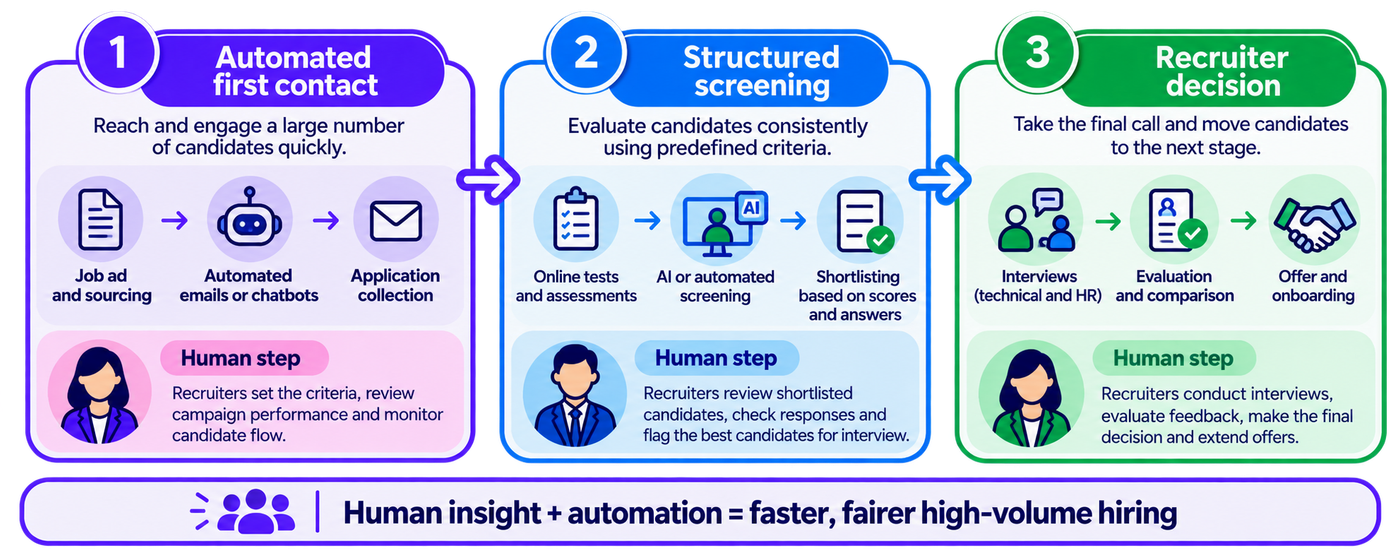
This is where HireBound fits on the employer side. It handles the repetitive early work: reaching candidates over WhatsApp, SMS, email and Voice AI in 14 Indian languages, and asking consistent pre-screening questions. HireBound’s India figures show a 64% WhatsApp response rate against about 12% for email, and recruiters using it handle 3x more candidates per day than with a manual process. More than 8M candidate conversations have run on the platform, across 60+ recruiting teams in India.
A human stays in the loop. Recruiters set the screening criteria, review the shortlist, run the interviews and make every offer decision. The software does not decide who gets hired.
Running high-volume hiring in India? See how HireBound’s AI agents screen and schedule candidates while recruiters keep the decisions: talk to the HireBound team.
Check the HCLTech Careers Page Before You Apply
HCLTech updates its hiring routes, assessments and eligibility on its own pages. This article reflects what those pages said on 27 October 2026. If a figure or step here differs from the live page, trust the live page.
Candidate stories are useful for preparation, but they describe one person’s experience in one year. For the current process, start at HCLTech’s careers in India page.