Bulk Hiring in India: A Process From Brief to Joining
 Devansh Dhawan
 ·Oct 15, 2026·11 min read
Key Takeaways
- 1Plan bulk hiring backwards from joining day. In the illustrative 100-role example, about 2,900 candidates must be contacted to land 100 joins.
- 2Offer-to-joining is the costliest leak. In the example, a drop from 70% to 50% joining raises the outreach needed by about 40%.
- 3India’s PLFS 2025 puts regular salaried work at 23.6% of workers and casual labour at 20.2%, so many frontline applicants come from outside regular salaried work.
- 4HireBound data shows a 64% WhatsApp response rate in India against about 12% for email, so run outreach, screening and reminders where candidates reply.
- 5PIB states appointment letters have been mandatory for all workers since the labour codes took effect on 21 November 2025, so build offers and e-signatures into the plan.
Bulk hiring is filling dozens or hundreds of similar roles inside a fixed window, usually through one campaign instead of separate requisitions. In India it covers frontline hiring in retail, logistics, BPO, manufacturing and field sales, often across several cities and languages. It works when the drive is planned backwards from joining day.
Most bulk drives lose people between the first call and the first day, and the team finds out in week four. This guide walks through each stage, shows where candidates leak out, and works through an illustrative drive to fill 100 roles across three cities in a month.
Running a drive with hundreds of candidates? See how HireBound runs outreach, screening and scheduling at volume →
Why Does Bulk Hiring in India Break Normal Recruiting Processes?
A process built for ten hires a quarter breaks at a hundred a month, because every manual step repeats for thousands of people. Phone calls stop scaling first, and spreadsheets become a source of errors.
India adds three pressures of its own, and the first is the candidate pool.
According to the Periodic Labour Force Survey Annual Report 2025 from MoSPI (released 27 March 2026), 56.2% of India’s workers are self-employed, 23.6% are in regular wage or salaried work and 20.2% are casual labourers. Many frontline applicants therefore come from outside regular salaried work, so each step needs plain instructions.
The second is geography and language. A drive across Pune, Hyderabad and Lucknow means three local labour markets, different spoken languages and different commute patterns.
The third is channel. Email is a weak channel for this audience, so a process that depends on it can lose candidates before the screening call.
A bulk drive is a funnel, and the funnel needs numbers before it needs candidates. The same holds for workflow design in AI-assisted recruiting: the process decides the result more than the tool.
What Are the Stages of a Bulk Hiring Process?
A bulk hiring process has six stages, and each one has a leak point you should measure from day one.
The table sets out the six stages and the leak to watch in each.
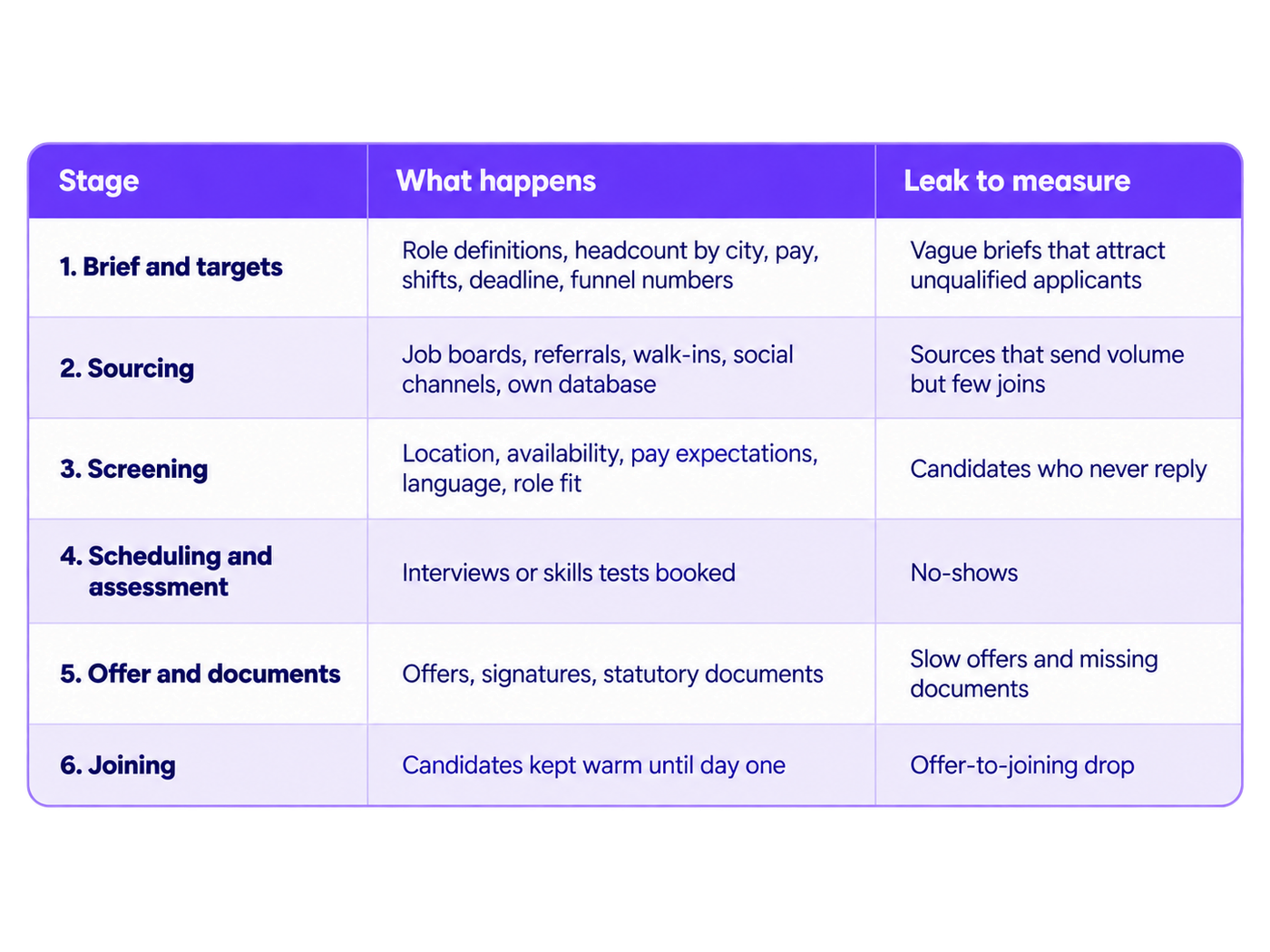
Track the right-hand column from day one, because each stage loses candidates in a different way.
How Do You Plan a Bulk Hiring Drive Backwards From Joining Day?
Start with the number of people you need on day one and divide backwards through every stage. Each division is a conversion rate, and the product of those rates tells you how many candidates must enter the top of the funnel.
Here is an illustrative example. All the rates below are assumptions for the arithmetic, not benchmarks, and your own drive history should replace them.
The drive needs 100 joins in 30 days across three cities. Assume 70% of offers end in a joining, 35% of completed interviews end in an offer, 70% of booked interviews are attended, 50% of screened candidates qualify and book, and 40% of contacted candidates respond and complete a screen.
- Joins needed: 100
- Offers needed: about 143 (100 divided by 0.70)
- Interviews completed: about 408 (143 divided by 0.35)
- Interview slots booked: about 583 (408 divided by 0.70)
- Candidates screened: about 1,166 (583 divided by 0.50)
- Candidates contacted: about 2,915 (1,166 divided by 0.40)
So roughly 2,900 contacts produce 100 joins. At five minutes a contact, also an assumption, that is about 243 hours of manual work, or around 30 working days, before a single interview happens.
For how many open roles one recruiter can realistically carry, see HireBound’s recruiter workload benchmarks.
Now test the weakest stage. If only 50% of offers end in a joining, the same arithmetic needs 200 offers and about 4,080 contacts, which is 40% more outreach for the same 100 joins. A small leak late in the funnel is expensive because everything upstream has to be bigger to cover it.
Split the target by city as well. Forty joins in Pune, 35 in Hyderabad and 25 in Lucknow means three funnels with their own interviewers and risks. Review them separately every few days, because the all-India average hides the city falling behind.
How Should You Write the Brief and Set Targets?
Write one page per role family covering the job, location, pay, shift and must-have requirements. Vague briefs attract unqualified applicants, the costliest problem in a high-volume funnel.
Include these items in every brief.
- Headcount by city and joining date, with the total as the sum.
- Pay as a fixed figure or a range, plus incentives and deductions stated plainly.
- Shift pattern, week-offs and the commute or relocation expectation.
- Three to five knock-out criteria, such as age, education, language, ability to start by a date, or willingness to work a shift.
- The documents a candidate will need at the offer stage.
The brief also sets the deadline for each stage. If joining day is day 30, offers should go out by about day 20 and interviews should finish by about day 18, which leaves time for travel and document checks.
How Do You Source Enough Candidates Across Multiple Cities?
Use several sources at once and track each by cost and by the share of its candidates who reach joining, as well as by applicant count. In a hypothetical case, a source that sends 800 applicants and 3 joins is worse than one that sends 100 applicants and 12.
Common sources for frontline roles in India include job boards, employee referrals, walk-in days, local community and social channels, vendor and agency partners, and your own database of past applicants. HireBound has native job portal integrations, with two-way sync with Naukri, Indeed and 12+ boards, so applicants from several boards can land in one pipeline instead of several inboxes.
Past applicants are usually the cheapest source. Anyone who applied in the last year and missed out for a reason unrelated to fit is a warm lead, so message them before buying advertising.
Give every source its own tracking tag from the start, or you cannot tell in week three which source to cut.
The diagram below shows how many contacts the sources must feed in the worked example.
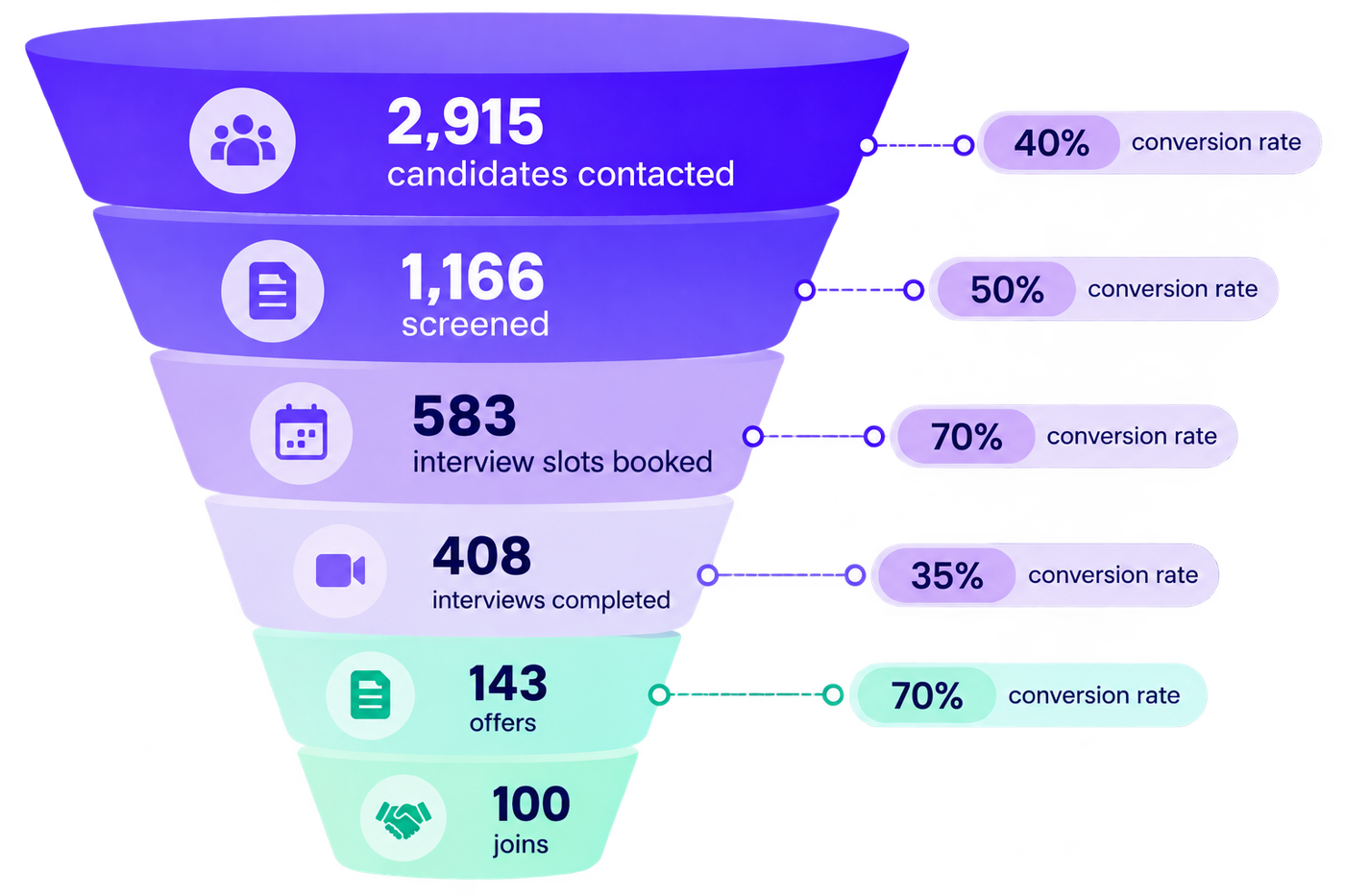
Sourcing has to supply about 2,900 contacts, not 100 applicants.
How Should You Screen Thousands of Applicants?
Screen with the same short, structured set of questions for every candidate, delivered on the channel the candidate answers. A consistent script is faster than ad hoc calls and gives you comparable answers to review.
Channel matters. HireBound data shows a 64% WhatsApp response rate in India, compared to about 12% for email. For a frontline drive, that gap decides whether you reach 2,900 contacts or 500.
A good screen is short. It checks the brief’s knock-out criteria, confirms preferred city and shift, asks about availability to start and captures expected pay. Borderline answers go to a recruiter instead of being rejected by rule.
Language is a practical constraint in India. HireBound’s Voice AI works in 14 Indian languages, so a candidate in Lucknow can be screened in Hindi and one in Hyderabad in Telugu, with the transcript and score saved for the recruiter.
Measure your own response rate in the first two days of the drive. HireBound’s dataset of 8 million+ candidate conversations is an average, not your result.
For message wording and opt-in practice, see our guide to WhatsApp recruiting.
How Do You Keep Interview Slots From Going Empty?
Book the interview in the same conversation as the screen, send reminders, and plan for a share of no-shows from the start. The longer a qualified candidate waits for a slot, the less likely they are to attend.
Offer a real choice of slots in the next three to four working days, and send reminders the day before and a few hours before. Our comparison of self-scheduling and recruiter-scheduled interviews covers the evidence on reminders and when a person should still do the scheduling.
In the worked example, 583 booked slots become about 408 attended interviews. At 30 minutes each, that is roughly 205 interview hours across three cities, so interviewer availability can become the bottleneck before candidate supply does. Block interviewer calendars in each city before the drive starts, with reserve slots for reschedules.
How Do You Handle Offers and Documents at Volume?
Issue offers quickly after the interview decision, in writing, and collect the documents that onboarding needs in the same step. Every day between interview and offer is a day for the candidate to accept something else.
According to the Press Information Bureau (21 November 2025), the four labour codes took effect that day, and the Government of India states that appointment letters are now mandatory for all workers. Each hire therefore needs a written letter stating designation, wages and entitlements, so a bulk offer template with e-signature saves hours.
The table lists what a practical offer package includes.
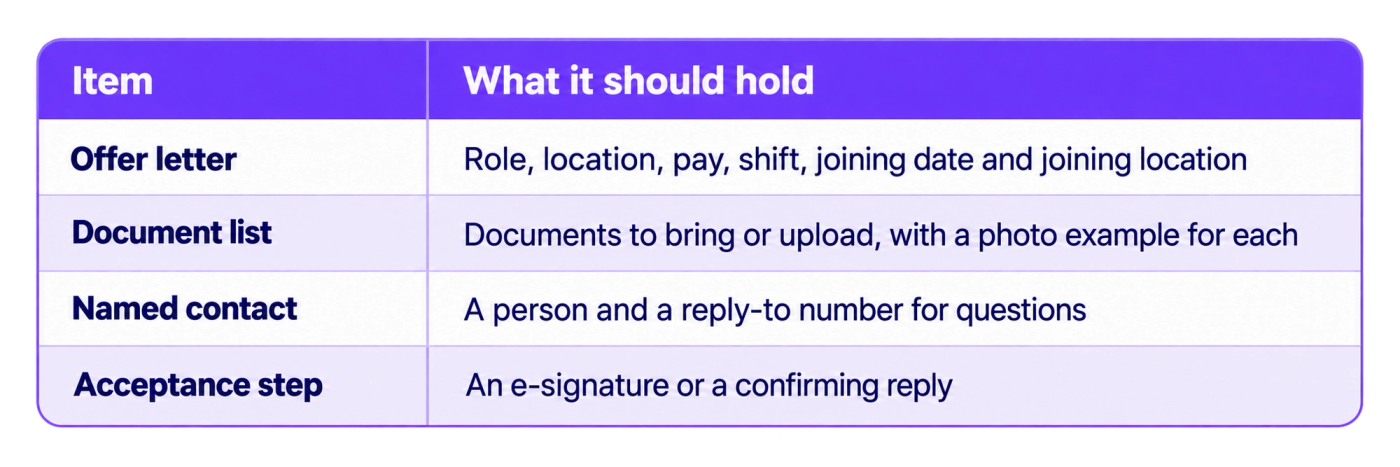
A complete package answers a candidate’s questions before they ask.
HireBound’s bulk-hiring service covers offer generation, e-signatures, digital onboarding and document tracking, so the same record that holds the screening transcript also holds the signed offer. If you manage this yourself, a shared tracker with one row per candidate and a status per document works, as long as one person owns it.
What Happens Between the Offer and Joining Day?
This is the stage most drives under-manage, and the worked example shows why. Moving from 70% to 50% joining added about 40% to the outreach needed, so even a small improvement here is worth more than extra sourcing.
Candidates drop for ordinary reasons: a better offer, a family concern, a longer commute than expected, or silence from the employer. Our post on why candidates ghost covers the pattern in detail.
The fix is regular, useful contact. A simple sequence works well.
- Confirm the offer the same day, with the joining address and a contact person.
- Send a message a week before joining day with the shift timing, what to bring and who to ask for on arrival.
- Check in two days before, and ask a direct question: “Are you able to join on Monday?”
- Call anyone who does not reply, and offer the next-in-line candidate the seat if you still get silence.
Hold a reserve list. If you expect 70% of offers to convert, over-issue offers to match, and keep the next few ranked candidates warm for each city.
Mis-hires add up across a large drive, and our breakdown of the cost of a bad hire shows how to put numbers on it for your own roles.
What Statutory Checks Should a Bulk Hiring Plan Include in India?
Plan for provident fund and state insurance enrolment before day one, because both depend on wage levels and headcount. This section is general information, not legal advice, so confirm the current rules with your payroll provider or counsel.
On provident fund, the Press Information Bureau reported that the Union Cabinet raised the wage ceiling for mandatory EPFO coverage from ₹15,000 to ₹25,000 a month, in effect from 17 September 2026. It expects about 51 lakh more employees to come under the provident fund framework.
Check the Ministry of Labour and Employment notification and EPFO’s circulars for how your payroll applies it, then check which new hires paid between ₹15,000 and ₹25,000 now fall inside coverage.
On state insurance, ESIC states that the Act applies to non-seasonal factories with 10 or more persons, with coverage extended to other listed categories. The wage limit is ₹21,000 a month (₹25,000 for persons with disability), so check how the rules apply to your establishment type.
Add three items to the onboarding checklist.
- Appointment letter issued and signed before or on joining day.
- PF and ESIC details captured with the right identity documents.
- A record of which documents are missing, with an owner and a date.
When Is Bulk Hiring Automation Not the Right Answer?
Automation helps most when you hire many similar roles with structured screening questions. It helps less when volume is low, when every role differs, or when the decision needs a long conversation.
If you hire 15 people a quarter, a shared tracker, a short script and a recruiter’s phone may cost less than any tool. Roles with licensing, safety or security checks may need a human at several steps.
Even in a high-volume drive, people write the brief, handle exceptions, run interviews, make offers and call candidates at risk of dropping. HireBound’s AI agents run screening and scheduling with no recruiter involvement in those two stages, which leaves the recruiters’ time for the work that needs judgement.
The diagram shows how the work splits in a high-volume drive.
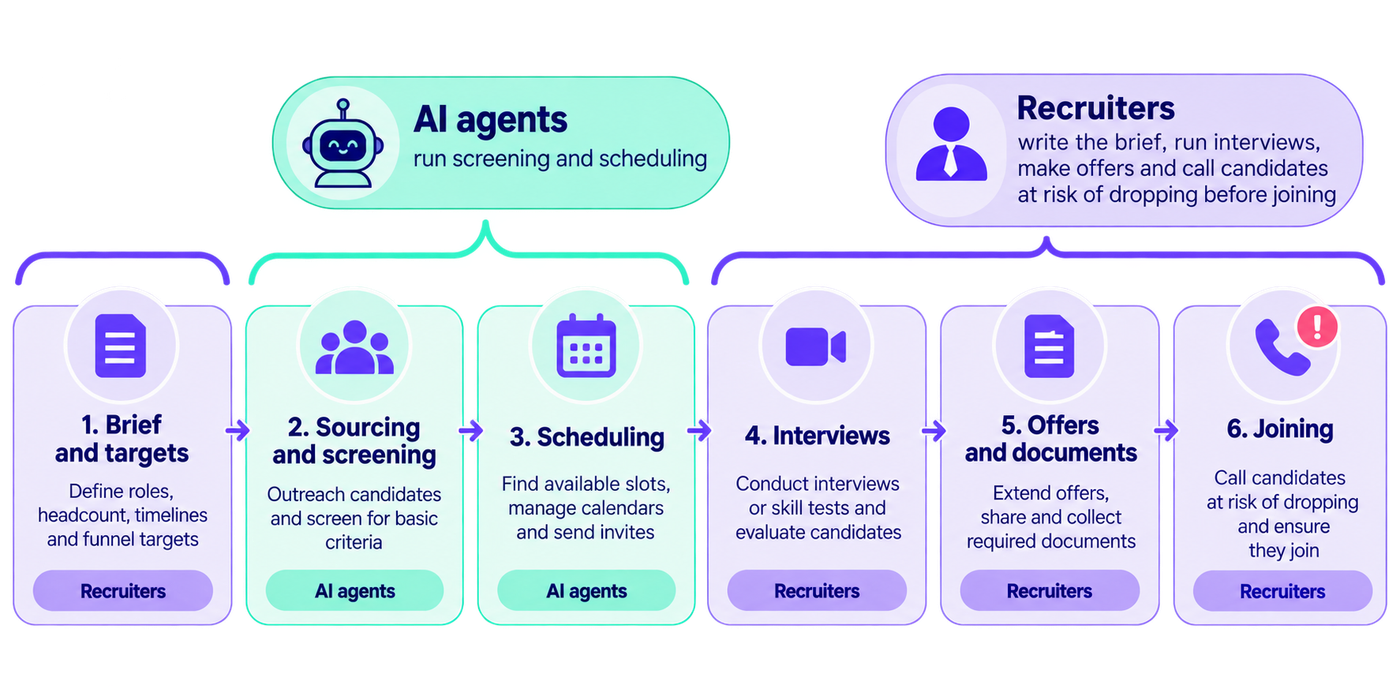
Automation takes the repeatable stages, and recruiters keep the judgement calls.
Conclusion: How to Run Your First Drive
Bulk hiring in India comes down to four habits. Plan backwards from joining day with real conversion rates, screen and book in the channel candidates answer, treat the offer-to-joining gap as a stage of its own, and plan the statutory and document steps before the first offer goes out.
One decision rule: if most of your week goes on calling, chasing and rescheduling candidates, weigh automation of screening and scheduling most heavily, and keep your recruiters for briefs, interviews and closing.
Planning a drive of 100 or more roles? Talk to HireBound about running it end to end →


