Self-Scheduling vs Recruiter-Scheduled Interviews: No-Show Data Compared
 Suvam Moitra
 ·Oct 13, 2026·12 min read
Key Takeaways
- 1No-show rates vary widely by role and channel, and hourly and frontline hiring tends to lose more. Delay and weak reminders drive most of the loss.
- 2Self-scheduling shrinks time-to-schedule from days to hours. Cronofy’s 2023 survey of 6,500 candidates found 49% had left a process because scheduling took too long, and 42% said the same in its 2024 survey.
- 3A pediatric clinic randomized trial cut no-shows from 38.1% to 23.5% with text reminders alone, so pair every booking with a reminder sequence.
- 4HireBound data shows a 64% WhatsApp response rate in India against about 12% for email, which makes WhatsApp the strongest channel to send scheduling links.
- 5Keep recruiter-led scheduling for senior, panel, and sensitive interviews. Use self-scheduling for high-volume and first-round slots, with a human fallback.
Candidate self-scheduling means the candidate picks their own interview slot from a live list of open times, usually through a link, instead of trading messages with a recruiter. Recruiter-scheduled interviews mean a person proposes times and confirms one. The two models differ most in speed, in no-show risk, and in how much recruiter time each interview costs.
If you hire at volume, scheduling is where good candidates quietly disappear. The shortlist is ready, the hiring manager is free on Thursday, and the candidate never gets a message they can act on in time. This report compares both models on the things that decide the outcome: no-show rates, time-to-schedule, candidate experience, and the cases where a recruiter still does it better.
Want scheduling to run without recruiter back-and-forth? See how HireBound handles it →
Executive Summary: Does Self-Scheduling Reduce Interview No-Shows?
Yes, in most high-volume settings. Self-scheduling wins because it removes delay, lets the candidate choose a time they can keep, and makes it easy to attach reminders and a reschedule option. A link with no reminders performs closer to manual scheduling than most teams expect.
Here are the headline findings.
- No-show rates vary widely by role and channel, and hourly and frontline hiring tends to lose more, so measure your own baseline by scheduling method.
- In Cronofy’s Candidate Expectations Report 2023, a survey of 6,500 candidates, 49% had left a hiring process because scheduling took too long, up from 38% the year before. Its 2024 report put the figure at 42%.
- In a randomized trial in a pediatric clinic, text message reminders cut missed appointments. Interviews differ from clinic visits, but the mechanism is the same: people forget, and a timely nudge fixes some of it.
- HireBound data shows a 64% WhatsApp response rate in India, against about 12% for email. A scheduling link sent by email is often not seen in time.
- Recruiter-led scheduling still wins for senior roles, panel interviews, and candidates who need a conversation before they commit.
How Was This Comparison Built?
This report combines four kinds of evidence, and it treats each for what it can and cannot show.
The first is published hiring-manager and candidate surveys, namely Cronofy’s Candidate Expectations Reports from 2023 and 2024. These surveys were run mainly in the US and Europe and describe attitudes and stated behaviour, so we use them for direction, not for precise rates or for Indian candidates.
The second is peer-reviewed reminder research. Randomized trials of appointment reminders, including a pediatric clinic trial on text reminders, a 54,066-patient trial on reminder number and timing, and a 2015 study of two trials on stating the cost of a missed appointment to the health service, give the cleanest evidence on how reminders change attendance. These come from healthcare, so we use them to explain behaviour and design, and we do not treat their percentages as hiring benchmarks.
The third is industry reporting on scheduling time and candidate behaviour. These figures vary by role, region, and how a no-show is defined, so treat them as directional.
The fourth is HireBound’s dataset of 3M+ candidate conversations across WhatsApp and Voice, which we use for channel behaviour in India, such as response rates. Use every number here as a planning range and measure your own baseline before you set targets.
What Is the Interview No-Show Rate: Self-Scheduling vs Recruiter-Scheduled?
Interview no-show rates vary widely by role and channel, and hourly and frontline hiring tends to lose more. Self-scheduling combined with automated reminders is widely reported to lower them relative to manual scheduling. The size of the drop matters more than any single starting rate, so measure your own baseline by scheduling method.
Take an illustrative example. A team runs 200 first-round interviews a week and starts at a 30% no-show rate, an assumed figure. That is 60 empty slots. If self-scheduling with reminders cut that rate by a third, about 20 of those empty slots would fill each week. The 30% baseline and the one-third cut are both assumptions for illustration, not a promise, but the scale shows why the topic deserves attention.
Why does the gap exist? Four mechanisms explain most of it.
- The sooner a slot is booked after the shortlist, the warmer the candidate is when the interview arrives. Booking in an hour beats booking in three days.
- A candidate who chooses their own slot picks a time they can keep. A recruiter-proposed time is a guess.
- Picking a slot yourself is a small act of ownership. People are more likely to keep a commitment they made than one that was assigned.
- Self-scheduling tools usually come with confirmations, reminders, and a reschedule link, which are exactly the parts manual scheduling drops when a recruiter is busy.
Teams often miss the fourth point. Switch to a link but skip the reminders, and you keep the risk and lose the conversation.
What this means for your hiring: measure no-shows by scheduling method for one month before you change anything. If self-scheduled interviews with reminders run below recruiter-scheduled ones, you have your own proof, and it is more convincing to hiring managers than any external number.
How Much Do Reminders Change Attendance?
Reminders are the most reliably documented tool for cutting missed appointments, and the trial evidence is consistent even though it comes from healthcare. In a randomized controlled trial in a pediatric clinic, text reminders cut the no-show rate by 14.6 percentage points.
Timing, number and content of reminders all matter. The table below sets the three trials side by side.
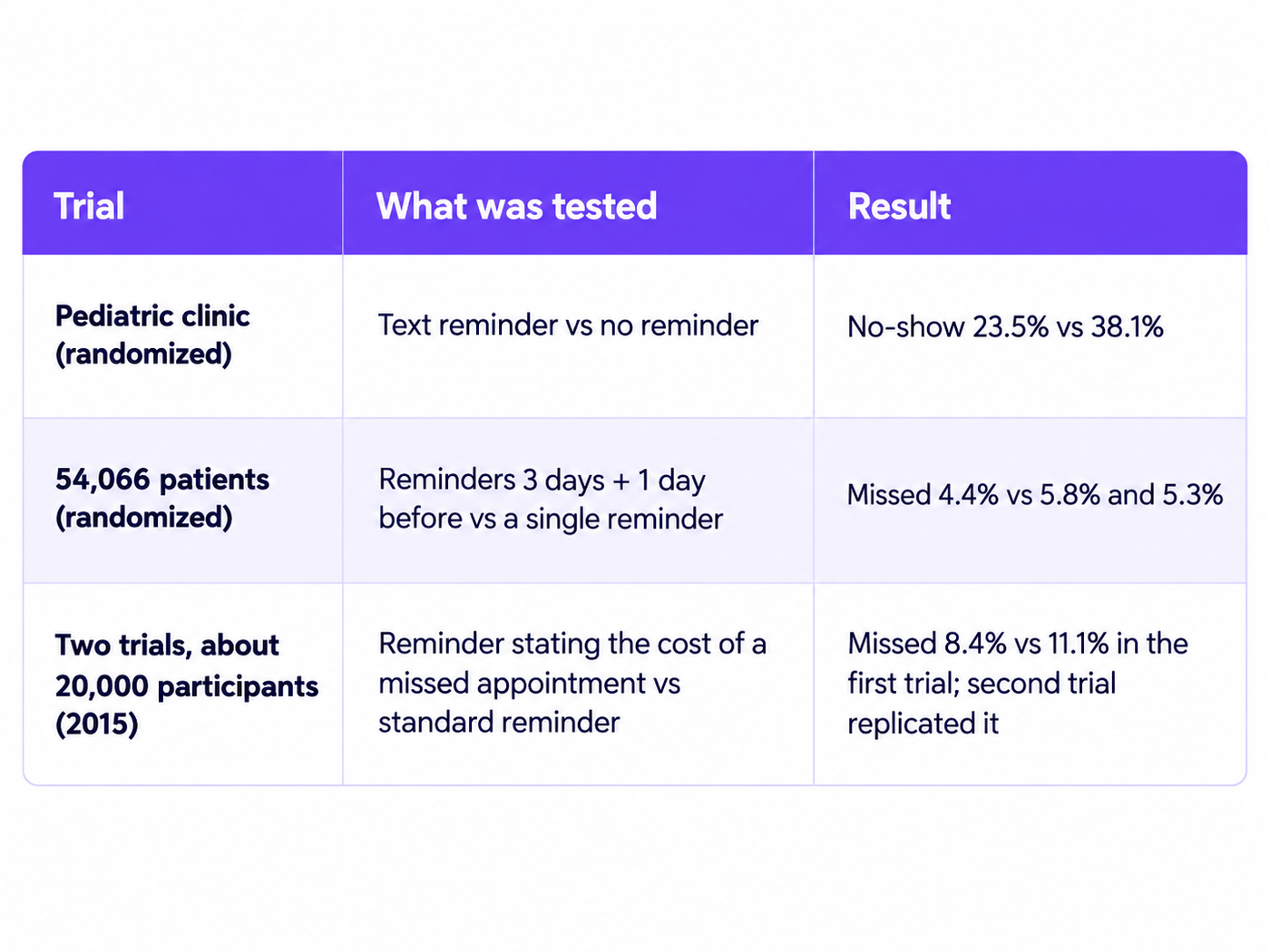
All three come from healthcare, so read them as evidence of behaviour, not as interview benchmarks. Two touches, not one, is the pattern to copy. For interviews, the equivalent of stating the cost is stating who is giving up their time: “Priya from the operations team has blocked 30 minutes for you on Thursday at 11 am.”
A sound reminder sequence for interviews looks like this.
- Immediate confirmation with date, time, format, location or link, and the interviewer’s name.
- A reminder the day before, with a one-tap confirm or reschedule option.
- A reminder two to three hours before, with directions or the video link.
- A recovery message within 15 minutes of a no-show that offers a new slot.
Send every message on the channel the candidate answers. In India that is usually WhatsApp, which we return to below.
What this means for your hiring: build the reminder sequence before you build anything else. It works with recruiter-led scheduling too, and it is the cheapest gain available.
How Does Time-to-Schedule Compare?
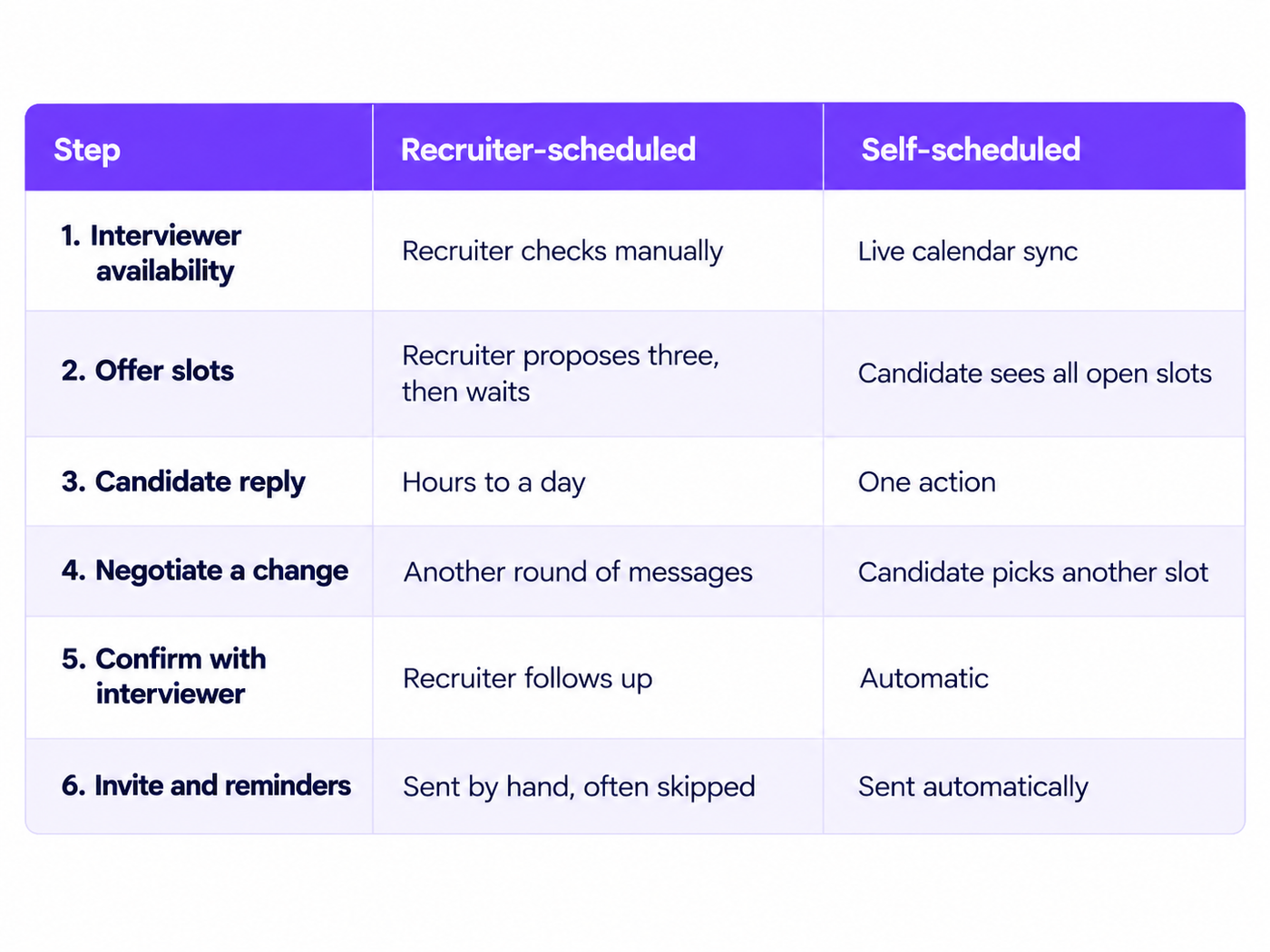
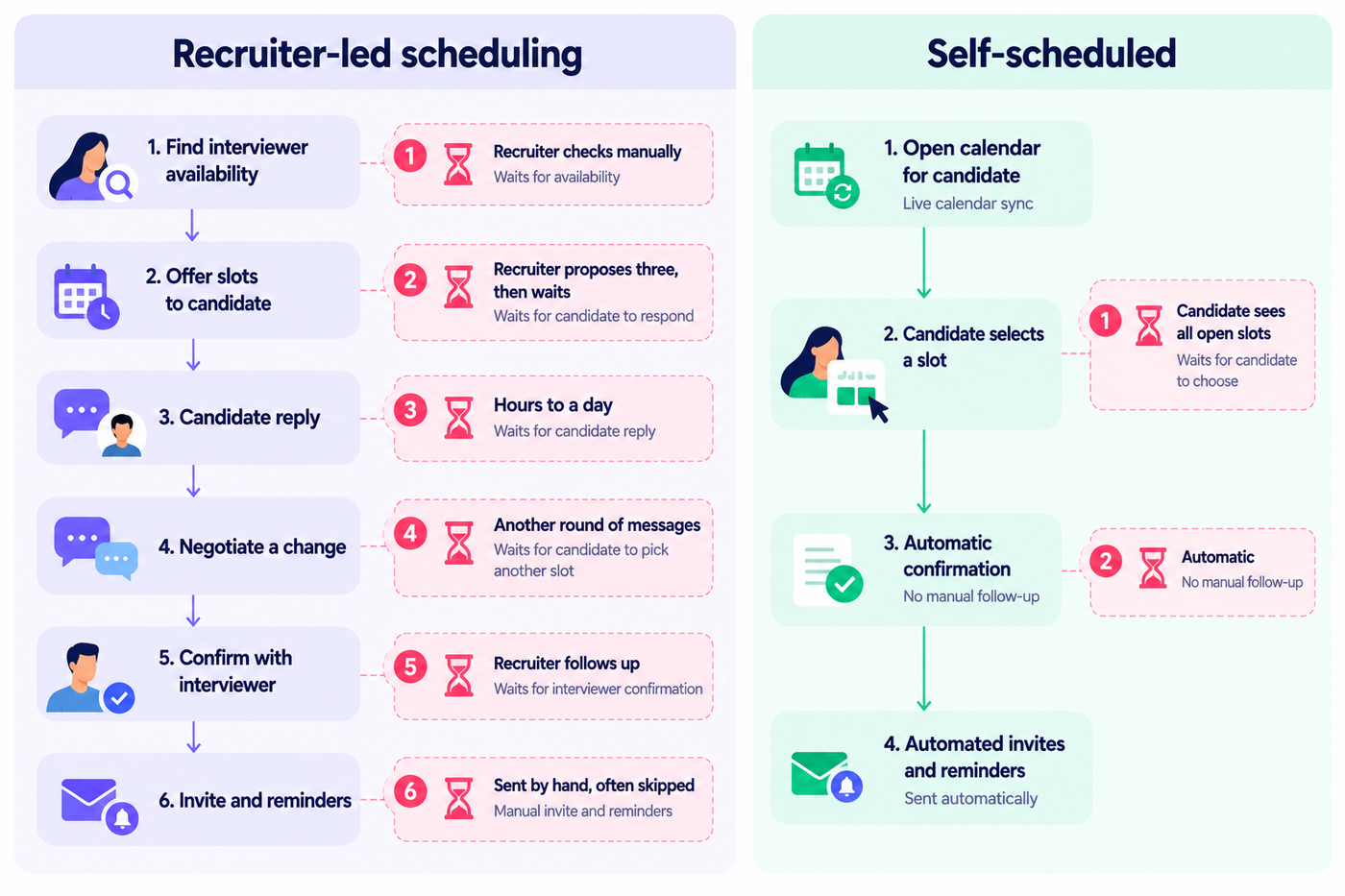
Self-scheduling brings the wait between shortlist and confirmed interview down from days to hours, and that speed is where most of the value sits. Recruiter-led scheduling typically takes several message exchanges, and each one waits on a busy person.
Cronofy’s 2023 survey found that 40% of candidates expect scheduling to take two to six days after applying, and 49% had left a process because scheduling took too long. In its 2024 survey, 42% said they had left for that reason. Read those together and the window is short. If your process takes longer than a week to offer a slot, you are competing with employers who moved faster.
The cost falls on recruiters as well. Every message exchange waits on a busy person, and coordination eats a large share of a recruiter’s week. Measure that time in your own team before you set a target.
The table shows the typical sequence in each model. The self-scheduled path removes four of the six waiting points.
What this means for your hiring: log the hours between “shortlisted” and “interview confirmed” for a sample of candidates. Even a rough average shows how much delay you are carrying, and it is the number that justifies the change.
Is Self-Scheduling Worse for Candidate Experience?
For most candidates it is no worse, and for many it is better. In Cronofy’s 2024 survey of 12,000 candidates, 53% preferred to be offered time slots to choose from, and in its 2023 survey 62% preferred an automated system that manages the process over lengthy back-and-forth messages. Candidates value control and speed, and a link gives them both.
The risk sits in how the link is delivered. Self-scheduling goes wrong in four familiar ways.
- A bare URL from an unknown number looks like spam. Add a line on who is writing, which role, and what the interview covers.
- If the earliest option is nine days out, the candidate reads it as low priority.
- A candidate who cannot move the slot will skip it instead.
- Some candidates are unsure, anxious, or have questions. A visible way to reach a recruiter fixes this at little cost.
Candidate experience matters because it feeds the same no-show problem. In Cronofy’s 2023 survey, 72% of candidates said the smoothness of the interview process would affect their final decision on whether to take the job. A clunky scheduling step is part of that process, and our guide to candidate experience metrics covers how to measure it. For a deeper look at why candidates disappear between steps, see our post on why candidates drop off during scheduling.
What this means for your hiring: send the link inside a short personal message, offer at least five slots in the next three to four working days, and show a phone number or reply option for questions.
When Does Recruiter-Scheduled Still Win?
Recruiter-scheduled interviews win when the conversation itself is part of the process, or when the calendar is too complex for a link. Self-scheduling suits volume and simple availability.
Use recruiter-led scheduling in these cases.
- These candidates expect a personal touch, and a recruiter uses the scheduling exchange to sell the role and answer questions. A link can feel dismissive.
- Coordinating five interviewers across time zones is a real puzzle. Some tools handle it, but a recruiter with context handles exceptions better.
- Someone on notice, relocating, or working night shifts may need a negotiated slot outside standard availability.
- If you hire four people a year for a function, setting up automation may cost more than the time it saves.
- Rescheduling after a candidate raises a concern, a rejection, or a reference issue should be handled by a person.
There is also a middle path. Many teams use self-scheduling for first-round and screening slots and switch to recruiter-led scheduling from the final rounds. That keeps volume efficient and the important conversations personal.
What this means for your hiring: decide by round and role level, not by company-wide policy. Automate the interviews where a link is enough, and keep people on the ones where the scheduling message is part of the pitch.
Which Channel Works Best for Sending Scheduling Links in India?
For most Indian candidates, WhatsApp is the strongest channel for a scheduling link, especially in blue-collar, BPO, retail, and logistics hiring. WhatsApp has 530M+ users in India, and HireBound data shows a 64% WhatsApp response rate in India, compared to about 12% for email. A link that the candidate never sees cannot reduce no-shows.
The practical reasons are simple. Many frontline candidates do not check email regularly, share a phone with family, or use a mobile number as their main identity online. WhatsApp messages arrive where they already spend time, they support quick replies, and they can carry the confirmation, the reminder, and the reschedule in one thread.
For a full playbook on opt-in, timing, and message design, see our post on WhatsApp recruiting done without annoying candidates.
A few India-specific habits improve results.
- A short opt-in message at application time sets expectations and protects you under India’s Digital Personal Data Protection Act, 2023.
- A message in Hindi, Tamil, Telugu, or another regional language is easier for many frontline candidates to read and act on than English-only text. HireBound’s Voice AI works in 14 Indian languages, which helps when a candidate would rather talk than tap.
- Avoid late evenings and early mornings. Send reminders in the window when candidates are usually reachable.
- For in-person interviews, a confusing address is a hidden no-show cause.
- A quick call to confirm attendance works for candidates who rarely read messages.
What this means for your hiring: put the scheduling link on the channel that gets replies, not the one that is easiest for your team. If you send it by email and see low pickup, changing the channel may fix more than changing the tool.
How Should You Design Your Interview Scheduling Process?
Start simple and add complexity only where the data asks for it. A workable process for most Indian hiring teams has six steps.
- Block standing interview windows on the calendars of hiring managers so that slots are ready when a shortlist arrives.
- Aim to get the scheduling message out on the same day as the shortlist decision.
- Show at least five slots across the next three to four working days, including a spread of morning and afternoon times.
- Send the confirmation with interviewer name, format, duration, and what to bring.
- Remind the candidate the day before and again a few hours before, with a one-tap reschedule option.
- Message within 15 minutes of a missed slot, offer one new time, and record the reason if the candidate replies.
Track four numbers each week: hours from shortlist to confirmed slot, no-show rate by method, reschedule rate, and share of candidates who book without recruiter help. If the no-show rate falls but the booking rate does too, your link is getting ignored, so check delivery and message content.
Three mistakes are common.
- Sending a link with no reminders and expecting the no-show rate to fall.
- Overbooking interviewers so heavily that available slots run out and candidates see an empty calendar.
- Automating every round, including the ones where a personal call would close the candidate.
HireBound’s AI agents run screening and scheduling over WhatsApp and Voice with no recruiter involvement in those stages, and the recruiter picks the process back up when a human conversation adds value. The steps above apply whatever tool you use.
Hiring at volume and tired of empty interview slots? Talk to us about automating your scheduling →
Conclusions and What to Expect Next
Three conclusions come out of the evidence.
First, self-scheduling reduces no-shows mainly by removing delay and making reminders routine. Second, the largest gains come from the parts around the link: fast delivery, the right channel, real slot choice, and a two-touch reminder sequence. Third, recruiter-led scheduling remains the better choice for senior, panel, and sensitive interviews, so the practical answer is a mix by round and role.
We expect Indian employers to move scheduling into the same conversation thread as screening, so that the candidate who answers a WhatsApp screening question can book a slot in the next message. Teams that measure hours-to-confirmed-slot and no-show rate by method will see the gain first and make the case internally without needing anyone else’s benchmark.


