Internal Mobility vs External Hiring: When Promoting from Within Wins
 Devansh Dhawan
 ·Oct 11, 2026·10 min read
Key Takeaways
- 1Internal mobility fills an open role with an existing employee through promotion or transfer, while external hiring recruits from outside. Each route has different costs and risks.
- 2A Wharton study (Bidwell, 2011) found external hires were paid about 18% more than internal promotions and scored lower on performance reviews for their first two years.
- 3Gallup (2019) puts the cost of replacing one employee at one-half to two times annual salary, which is why the backfill belongs in every internal-versus-external comparison.
- 4SHRM’s 2025 benchmarking found only 7% of non-executive roles were filled internally, so most employers leave the cheaper route underused.
- 5Hire externally when the skill does not exist in-house or the team needs a reset. Otherwise promote, then measure quality of hire on both routes.
Internal mobility is the practice of filling an open role with an existing employee, through a promotion, a lateral transfer, or a stretch assignment, instead of recruiting someone from outside. External hiring brings in a new employee from the market. The two routes differ in direct cost, time to productivity, retention, and what happens to the seat the internal candidate leaves behind.
Most companies say they prefer to promote from within, then default to the job board when a requisition opens. This explainer sets out what each route really costs once you count the backfill, what the research says about performance and retention, when external hiring is the better call, and how to decide role by role.
Want to see how HireBound runs screening and scheduling for open roles? Explore HireBound →
What Counts as Internal Mobility?
Internal mobility covers any move that keeps talent inside the company. It includes vertical promotions, lateral transfers between teams or locations, and short-term project or gig assignments that build skills for a later move. A referral for someone who already works for you is not internal mobility, and neither is rehiring a former employee, which is usually called a boomerang hire.
The distinction that matters is where the vacancy ends up. When a support executive becomes a team lead, one seat is filled and another opens. Internal mobility moves a vacancy down the chain. External hiring adds a person from outside and closes the chain.
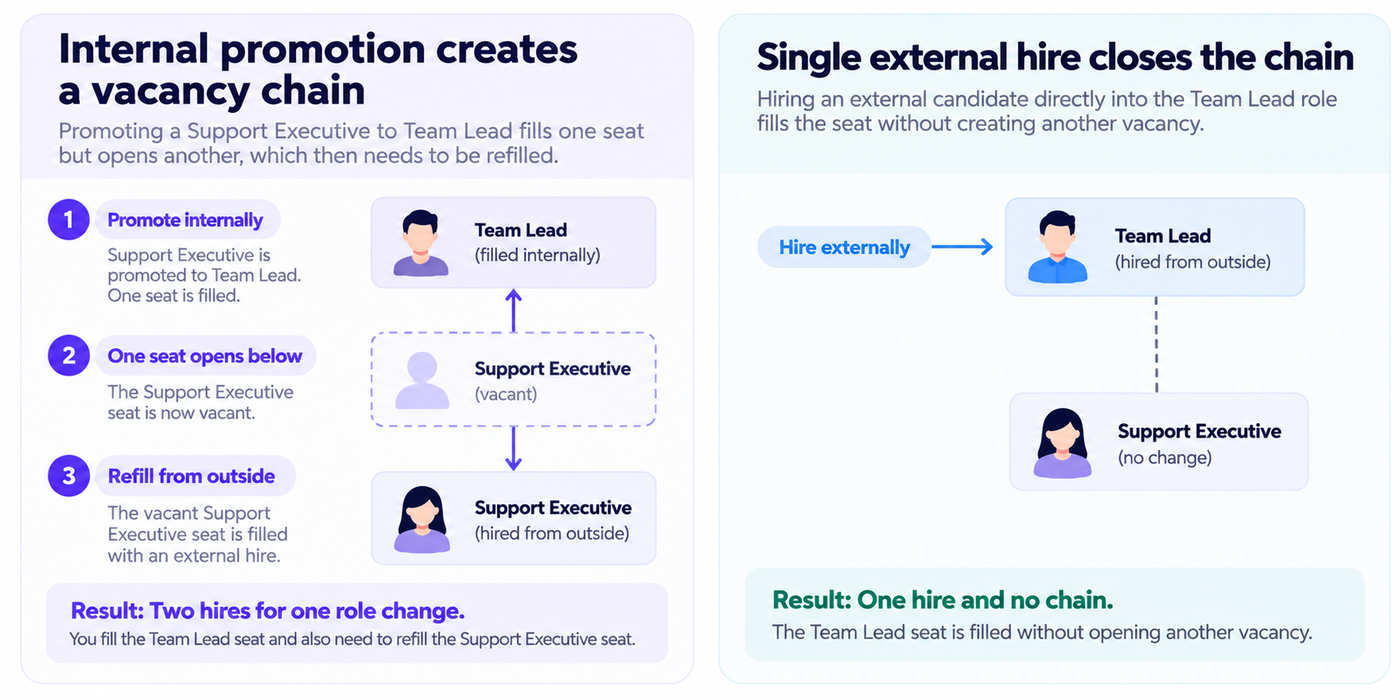
That chain effect is the reason the “internal is always cheaper” claim needs a closer look. It is true for direct recruiting spend. It is not always true once the whole chain is priced.
How Do Internal and External Hiring Compare on Cost?
Internal hiring costs less on direct recruiting spend, but a fair comparison also counts the backfill and the ramp-up time. For roles where the backfill is easy to fill, internal mobility usually wins on total cost. For roles where the vacated seat is hard to fill, the gap narrows or reverses.
Start with what is easy to measure. SHRM’s 2025 benchmarking report puts median time to fill at about a month and a half for both executive and non-executive roles. Every one of those days has a price: the work the vacant seat should be doing, and the recruiter hours spent sourcing, screening, and scheduling. An internal move skips sourcing and most of screening, and a manager already knows how the person performs.
Then add the parts that usually go missing from the spreadsheet.
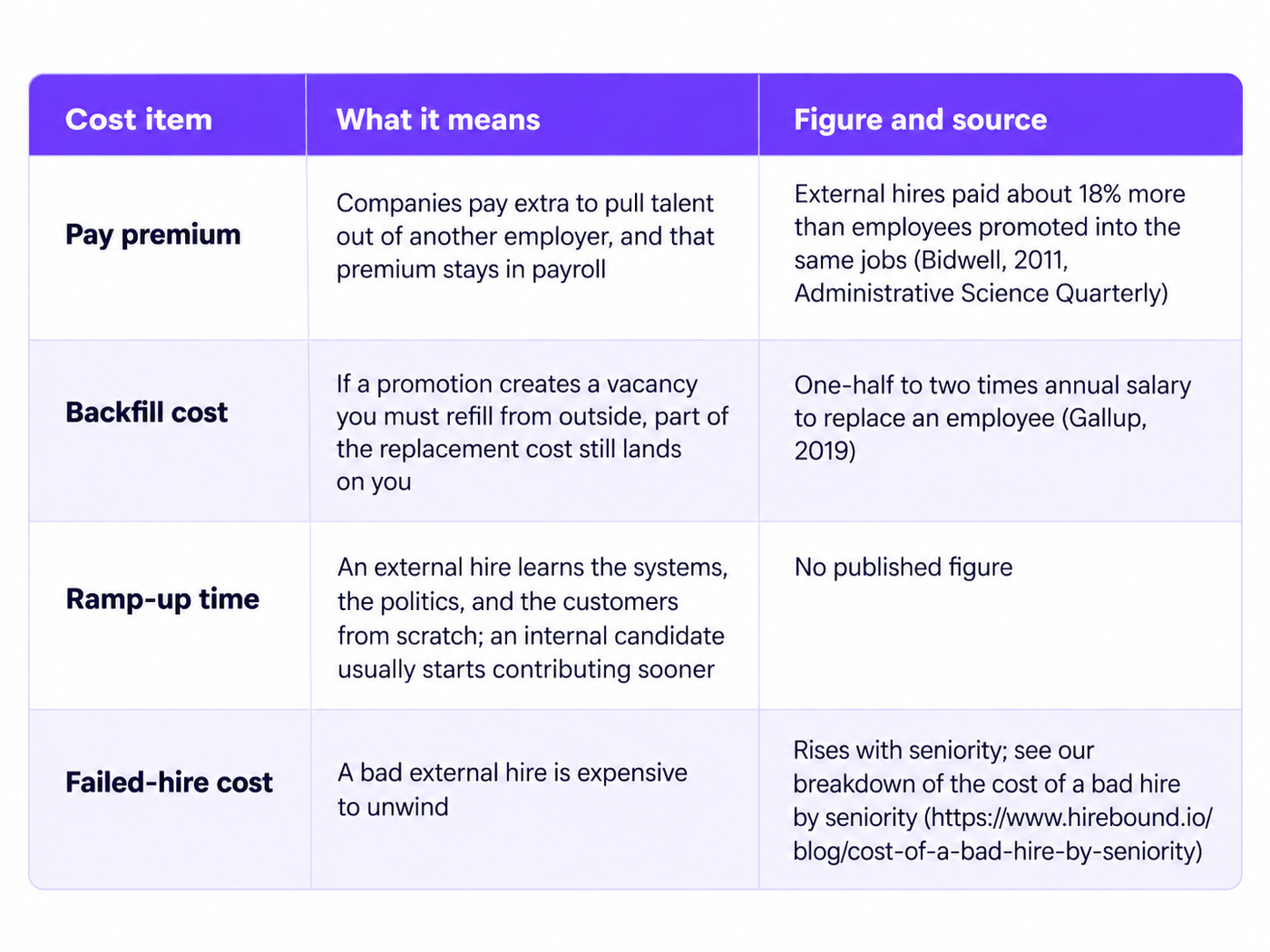
Rises with seniority; see our breakdown of the cost of a bad hire by seniority
Here is an illustration with assumed numbers. A manager role pays Rs 12 lakh a year, and a team member on Rs 8 lakh is ready for it. Promoting that person leaves a Rs 8 lakh vacancy, which sits in a wider candidate pool and is quicker to fill.
Hiring externally for the manager role means one search at the higher band, a possible 18% pay premium, and a passed-over team member who may start looking elsewhere. The figures are assumptions, but they show why the comparison has to follow the whole chain of vacancies and not only the first one.
What this means for your hiring: price both routes on the same sheet. Include recruiter hours, the pay premium, the days the seat sits empty, the backfill, and the first six months of ramp-up. Do the sum for your three most frequent roles before you set a policy.
What Does the Data Say About Performance and Retention?
The best-known research favours internal promotion on early performance and on retention, with one important caveat about long-term career growth. The evidence is strongest for mid-level roles in large organisations and thinner for very small teams.
Bidwell’s study analysed seven years of employee data from the US investment banking unit of a financial services firm, covering roles from traders and analysts to support staff. Beyond the pay gap shown above, it found three things:
- External hires received lower performance evaluations than internally promoted employees during their first two years in the job.
- External hires were more likely to leave, both voluntarily and involuntarily.
- After the first two years, external hires were promoted faster than internal promotions, which suggests they gain ground later.
A second line of research, published in Organization Science in 2020 under the title “Strength from Within: Internal Mobility and the Retention of High Performers,” by Alan Benson and Ben Rissing, studied a retailer with more than 109,000 commissioned salespeople and their managers. It found that the performance gap between internal and external hires is driven mainly by retention: high performers and internal hires are less likely to quit, and high-performing internal hires are especially unlikely to quit.
India adds a timing problem. Aon’s 2025-26 survey put India’s overall attrition at 17.1% in 2025, and notice periods in professional roles can run to two or three months. An external hire can take that long to arrive before any ramp-up begins, while an internal candidate can start the new role much sooner.
The research shows internal hires perform better on average early in the role. It does not show that every internal candidate is the right choice, or that promoting someone into a job they are not ready for pays off.
What this means for your hiring: track first-year performance and first-year exits separately for internal and external hires. Your own numbers will tell you more than any published study, and our guide on how to measure quality of hire shows how to set that up.
Do External Hires Bring More Innovation?
The evidence is mixed and depends on context. It is a common belief that fresh outside perspective drives new ideas, and in some situations it does. The research above shows external hires gain ground after year two, which fits the idea that they bring different networks and different habits.
But new ideas come from more than a new employer. A team that is failing because of a culture problem may benefit from an outsider. A team that is stalled because the process is unclear will not be fixed by a new face who also has to learn the process.
So treat “external hires bring innovation” as a hypothesis to test for a given role, not a rule. Ask what specific capability or perspective is missing, and whether it exists inside the company before you go outside to find it.
When Is External Hiring Clearly Better?
External hiring is clearly better when the skill is missing in-house, when the company is scaling faster than its internal pipeline, or when the team needs a break from its current way of working. In those cases, promoting from within saves money on paper and costs more in results.
Five situations favour going outside.
- The capability does not exist internally. A company building its first data engineering function cannot promote its way into it.
- Volume is too high for the internal pool. A BPO ramping up 300 agents for a new client cannot fill those seats from its current workforce. Entry-level roles are almost always filled from outside, because the internal pipeline starts there.
- The team needs a reset. After a merger or a failed product, an outsider can change habits that insiders find hard to challenge.
- No internal candidate is ready. Promoting someone too early hurts the person and the team, so say so and hire.
- The company is small. With a few dozen employees, the internal pool is too thin to offer a real choice.
SHRM’s 2025 benchmarking report shows how this plays out in practice. The share of roles filled internally varied widely:
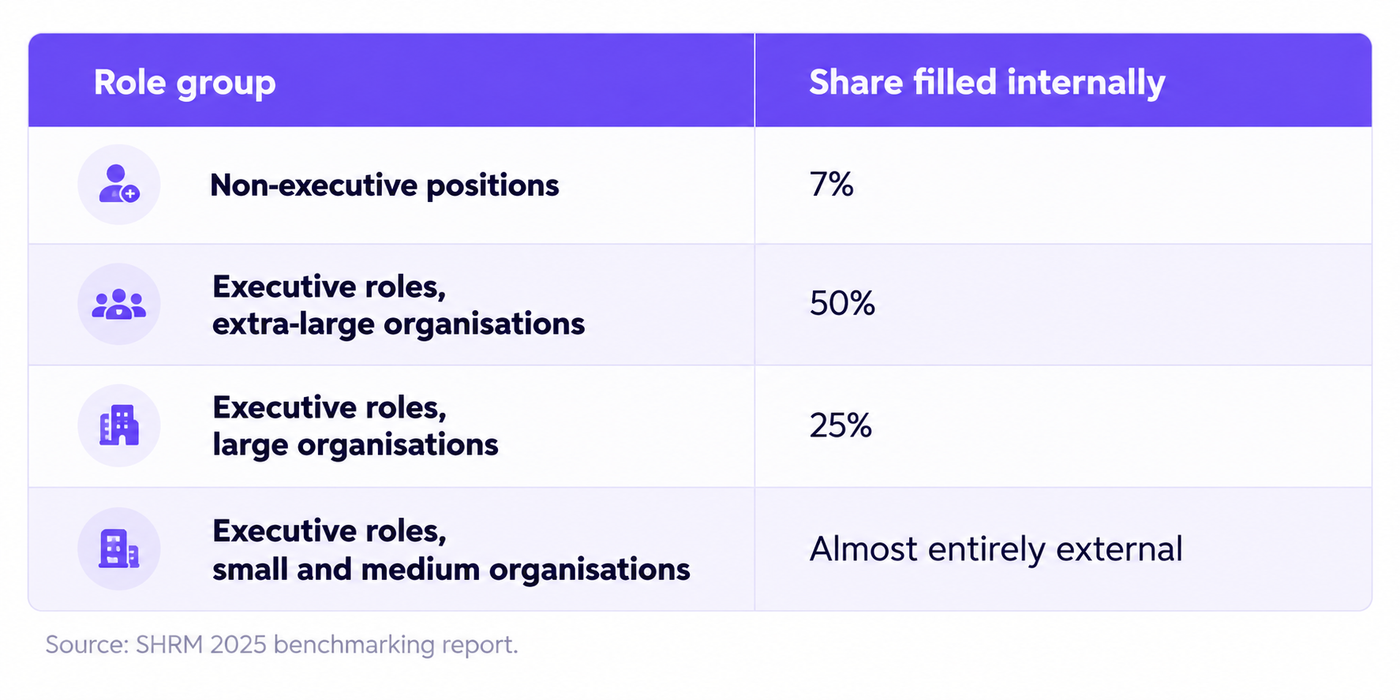
Size shapes the option, and this is worth remembering before you copy the policy of a company ten times your size.
What this means for your hiring: write down the specific reasons a role should go external. If the reasons are only “we have always done it this way,” run the internal search first.
How Do You Build an Internal Mobility Process That Works?
An internal mobility process works when employees can see open roles, know what skills each role needs, and get a fair, fast response. Most programmes fail on visibility and on manager permission, not on lack of talent.
Follow these steps.
- Post every opening internally first. Give employees a fixed window, often five to seven working days, before you open the search to outsiders. Publish the role, the skills, and the salary band.
- Keep applications simple. A frontline employee without a company email address will not fill in a long form, so announce openings for shift and branch staff on the channel they already use, such as WhatsApp, and keep the application to a few questions.
- Screen internal candidates with the same structure as external ones. Use one scorecard for both groups, or internal hiring turns into a favour and external hiring into an audition. Our post on the structured interview scorecard covers how to build one.
- Remove the manager veto. In many companies a manager can block a move to protect the team. Set a rule: an employee can apply after a minimum time in role, and the current manager is informed but cannot block.
- Plan the backfill before the move. Agree who covers the seat, how long the handover takes, and whether the vacancy opens externally.
- Give feedback to unsuccessful internal candidates. A rejected applicant who hears nothing is a retention risk, and a short conversation on what to build next keeps them.
- Track the outcomes. Compare internal and external hires on time to fill, first-year performance, and first-year exits.
Recruiters are employees too. Internal mobility applies to talent teams, and a coordinator who sees a route to senior recruiter stays longer. Our guide to the recruiter career path sets out what that route can look like.
What this means for your hiring: start with one function and one clear rule, such as a five-day internal window on all roles above entry level. Run it for a quarter, then compare.
A Worked Example: A Contact Centre Team Lead Vacancy
Take a contact centre with 400 agents and a team lead role that has just opened. This is an illustration, not a customer story.
The external route: the recruiter posts the role, screens applicants, schedules interviews, and makes an offer. With a notice period of 30 to 60 days, the new team lead may start two to three months after the vacancy opens. The person needs several weeks to learn the campaigns, the tools, and the agents.
The internal route: the manager shortlists two senior agents who have been top on quality scores for six months. Both are interviewed against the same scorecard. One is promoted within two weeks, and the team already knows and respects them. The vacated agent seat is then filled from outside, a role where the candidate pool is wide and the ramp-up is short.
Here the vacancy moves from a hard-to-fill role to an easy-to-fill one. Internal mobility costs less because the seat you eventually fill from outside is cheaper to fill.
The same team would go external if no agent had people-management skills, or if the team needed a new quality approach. The decision follows the role.
Want to reduce the time and cost of the seats you fill from outside? Talk to us about automating screening and scheduling →
How Should You Decide Between Internal and External Hiring, Role by Role?
Decide by role type, not company policy. A simple filter works for most Indian teams.
- Is there an internal candidate who meets most of the requirements? If yes, run an internal process first. If no, go external.
- Can the vacated seat be filled easily? If yes, the internal route saves the most. If the vacated seat needs scarce talent, price the backfill carefully.
- Do you want continuity or change? Continuity favours internal candidates, change favours outsiders.
- How fast do you need the person? Long notice periods make external hires slow, so internal moves often win when the role is urgent.
- What does the pay premium look like? If the external market asks well above your band and an internal candidate is close to ready, a development plan may cost less than the premium.
Some roles sort themselves. Entry-level and high-volume roles go external. Specialist and first-of-a-kind roles go external. Team lead, manager, and mid-level roles are where internal mobility pays most.
Then measure. After a year, compare the two routes on time to fill, cost, first-year performance, and first-year exits. Adjust the rule where the data disagrees with your assumptions.
The two routes work together. Internal mobility keeps your best people and cuts cost on mid-level roles, while external hiring brings in scarce skills and fresh perspective.


