Panel vs One-on-One Interview: Bias, Speed
 Tanmey Goswami
 ·Oct 9, 2026·9 min read
Key Takeaways
- 1A panel interview uses several interviewers at once; sequential one-on-ones use one at a time. The format changes who sees what, and when opinions form.
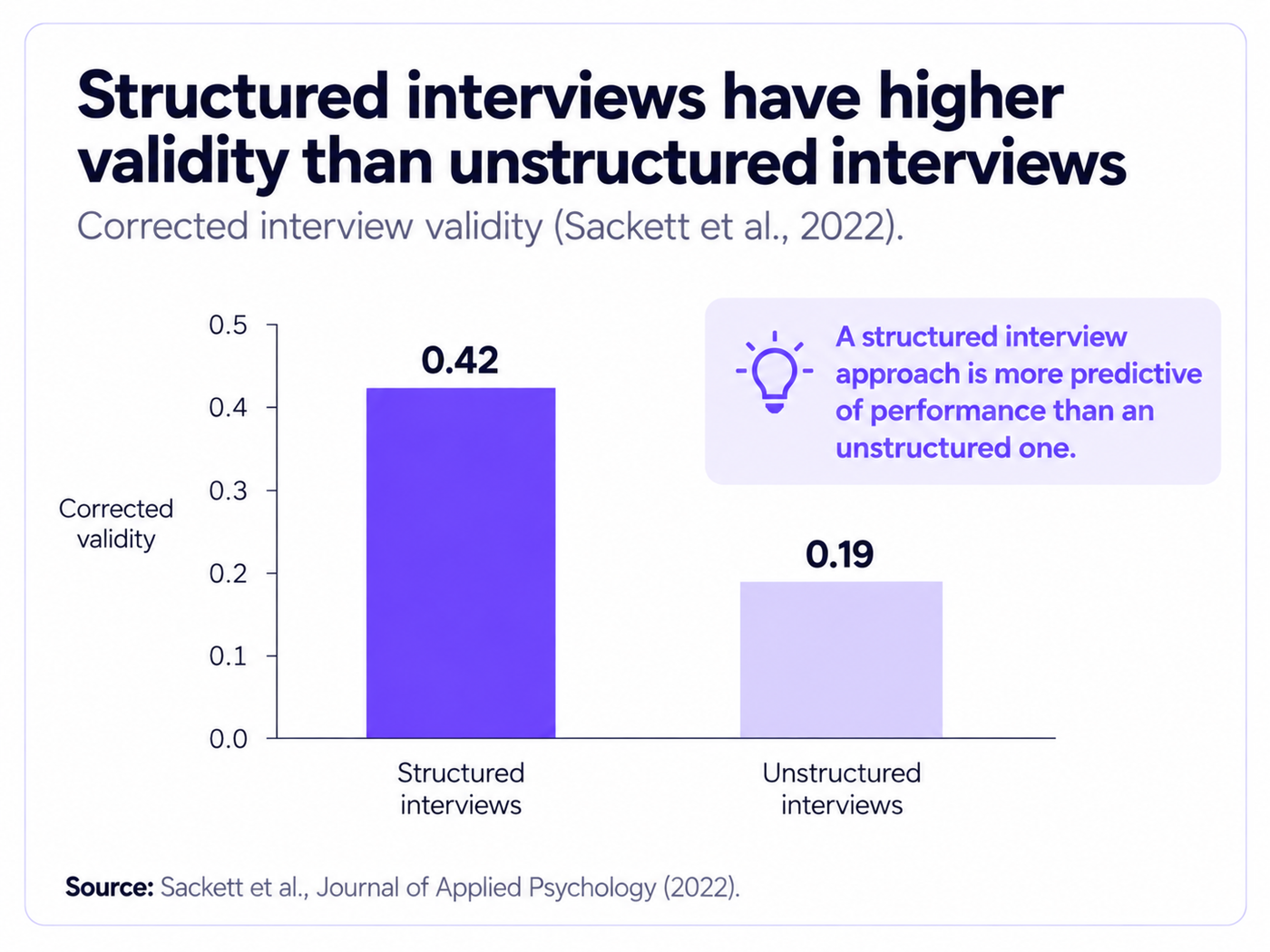
- 2Sackett and colleagues (2022) put structured interview validity at 0.42 against 0.19 for unstructured, so structure predicts performance more than panel size does.
- 3A review by Dixon and colleagues (2002) found panel research conflicting and tied results to design features such as scoring anchors and training, so have each panelist score independently before discussion.
- 4Panels save calendar time on interviews; one-on-ones are easier to schedule but add days. Decision time depends on how quickly feedback is collected.
- 5Use panels for senior and high-stakes roles, and sequential one-on-ones for high-volume hiring where interviewer availability is the bottleneck.
A panel interview is a single session in which two or more interviewers question and assess one candidate together. Sequential one-on-ones are separate sessions in which each interviewer meets the candidate alone, one after another. The format changes how opinions form, how much interviewers influence each other, and how fast a decision can be made.
Neither format is automatically fairer or faster. The research says that how the interview is structured and scored matters more than how many people are in the room.
Scheduling panels across busy calendars? See how HireBound automates interview coordination on WhatsApp, Voice and email. Explore HireBound →
What Is the Difference Between a Panel Interview and a One-on-One Interview?
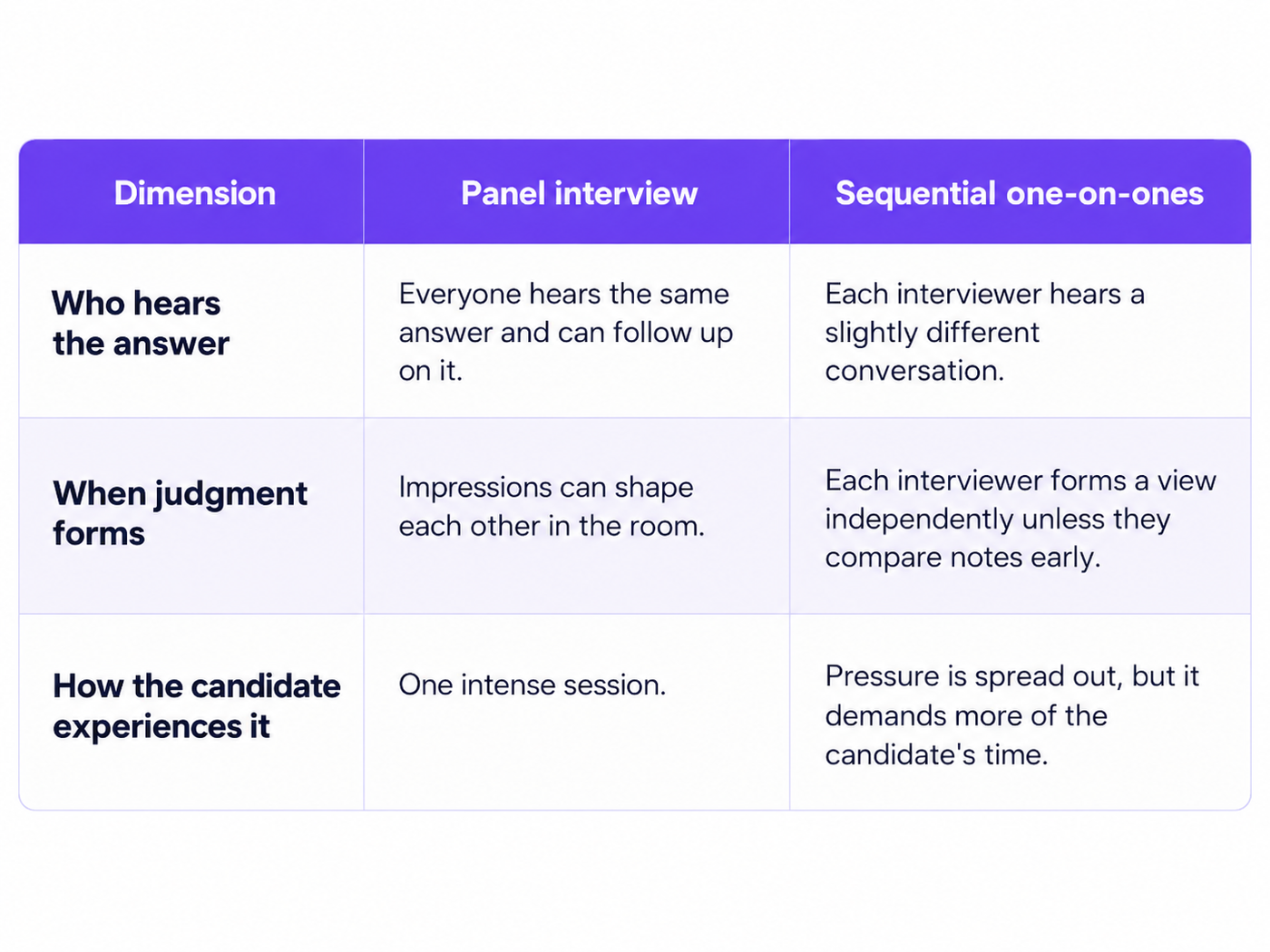
A panel interview has multiple interviewers present at the same time. The candidate answers each question once, and every panelist hears the same answer. Panels are common for senior hires, campus recruitment, government and public-sector selection, and leadership roles in Indian companies where a hiring manager, an HR lead and a functional head sit together.
A sequential one-on-one process has one interviewer per session. Each interviewer forms an impression alone and then shares it. The candidate might meet a recruiter, then the hiring manager, then a skip-level leader, on the same day or across several days.
Two related formats are worth separating from these. A group interview puts several candidates in front of one or more interviewers. A serial panel puts the candidate through several panels in a row. This article compares the two most common formats: one panel round against a chain of individual conversations.
The practical distinction comes down to three things:
What Does the Research Say About Bias in Each Format?
The assumption that a panel is more objective because several people are watching is only partly supported. The evidence is mixed and depends on how the panel is run.
Start with what predicts job performance at all. According to Sackett, Zhang, Berry and Lievens (2022), the corrected validity of structured interviews is about 0.42, compared with about 0.19 for unstructured interviews. Structure means the same job-related questions for every candidate, a defined rating scale and scoring against criteria written in advance. That gap is far larger than any difference reported between panel and individual formats.
On the panel question specifically, Dixon, Wang, Calvin, Dineen and Tomlinson (2002) reviewed more than 50 years of panel research in Public Personnel Management. Earlier reviews had reached conflicting conclusions on panel reliability and validity, and the authors pointed to design features such as structure, scoring anchors, interviewer training and how ratings are combined as what shapes the results.
Agreement is not the same as accuracy. Several people can agree and all be wrong, particularly if they share the same blind spots or if the senior person on the panel speaks first and others follow. Group dynamics can amplify bias as easily as dampen it.
On demographic bias, Huffcutt and Roth (1998) analysed 31 studies in the Journal of Applied Psychology and found that Black and Hispanic applicants scored about a quarter of a standard deviation lower than White applicants on average in interviews, and that high-structure interviews showed smaller group differences than low-structure ones. Again, structure is the lever. The same logic applies to bias by caste, gender, accent or college pedigree in an Indian context: the more an interviewer scores against fixed criteria, the less room there is for first impressions to decide the outcome.
Two things follow from this research:
- A panel with no scoring rubric and open discussion is an unstructured interview with a larger audience. It can be less fair than a well-run one-on-one.
- A sequence of one-on-ones with the same scorecard, scored independently, can be as fair as a panel and sometimes more so.
The structured interview scorecard template covers how to build the rating scale that makes either format defensible.
How Do Panel Interviews and Sequential One-on-Ones Compare on Speed?
Speed has two parts, and the formats split them differently. One is how quickly you can get the interviews done. The other is how quickly you reach a decision afterwards.
Getting interviews done. A panel is one calendar slot, but it needs every panelist free at the same time. Each added person makes that slot harder to find. In practice, a panel often waits days for a common gap that a set of one-on-ones would have filled. Sequential one-on-ones are easier to book individually, but they stretch the candidate’s journey across days if interviewers are not aligned.
Reaching a decision. After a panel, everyone has heard the same answers, so the debrief can be short. After one-on-ones, each interviewer has a different picture and someone has to reconcile them. When feedback trickles in over several days, decision time grows. Recruiters who chase feedback manually feel this most.
Time-to-hire is influenced by both. HireBound’s guide to time-to-hire benchmarks explains how interview stages contribute to overall time-to-fill and where the delays usually sit.
A panel is faster to decide when the panel can debrief immediately. One-on-ones are faster to schedule when interviewers work in different locations or shifts.
When Do Panel Interviews Make Sense?
Panels earn their cost when the decision is expensive to get wrong or when many stakeholders must agree.
- Senior and leadership hires. When a role has several internal stakeholders, one shared conversation avoids five candidate-stakeholder meetings that end in five different opinions.
- Cross-functional roles. A product manager or operations head has to satisfy engineering, business and HR at once. A panel lets each function probe live.
- Reducing single-interviewer risk. One interviewer’s mood, bias or bad day carries less weight when several people share the load.
- Public-sector and campus selection. These processes often need a documented, defensible record of who asked what, and a panel provides it.
- Candidate-facing fairness. Every candidate faces the same group, which is easier to demonstrate than a chain of different individuals.
Panels work best at three to four people. Beyond that, the candidate is outnumbered, questions overlap and the loudest voice starts to dominate. Assign each panelist a topic to cover, name one person as chair, and require written scores before any discussion.
When Do Sequential One-on-Ones Make Sense?
One-on-ones fit high-volume hiring, early screening and roles where the interview is mostly a conversation about specific skills.
- High-volume and frontline hiring. For BPO, logistics or retail roles, gathering multiple interviewers for each candidate is not realistic. A single structured round with a trained interviewer is faster and cheaper per hire.
- Distributed teams. When interviewers sit in different cities or time zones, individual slots are far easier to place than one shared window.
- Independent judgment. Separate sessions guard against groupthink, because each interviewer forms an opinion before hearing anyone else’s.
- Different competencies per stage. A recruiter tests communication and basics, a technical lead tests skill, and a manager tests fit. Each round has a clear job. For the technical stage, see how skills assessments compare with take-home tests and live coding.
- Candidate comfort. Some candidates, especially early-career ones, perform better with one person than in front of a group.
The weakness of the sequential format is drift. Each interviewer asks different questions, so results are hard to compare. The fix is the same scorecard, the same core questions and independent scoring submitted before anyone reads a colleague’s notes.
What Does This Look Like in a Real Hiring Process? (Illustrative Example)
This hypothetical example uses round numbers to show the mechanics.
A logistics company in Pune is hiring a regional operations manager. Three stakeholders need to weigh in: the head of operations, the finance lead and the HR business partner.
Under a sequential plan, the candidate meets each of them on separate days. The three interviews are easy to book but span six working days. Each interviewer asks their own questions. In the debrief, the operations head remembers the candidate as decisive, while the finance lead remembers them as vague on cost control. They are not comparing the same evidence, so the discussion turns into opinions.
Under a panel plan, all three sit in a single 75-minute session with a shared scorecard. Each has assigned topics: operations, cost management and team leadership. They write scores independently in the last ten minutes, then compare. The debrief takes 20 minutes because the evidence is common. The catch was finding a slot: it took four days to align three calendars.
The panel saved decision time but not scheduling time, and the sequential plan did the opposite. A hybrid often wins: one panel round for the final decision, preceded by individual screens for the early filter.
Want interview scheduling handled without the back-and-forth? Talk to us about how HireBound coordinates interviews across busy calendars. Book a free demo →
What Mistakes Make Panel Interviews Unfair?
Most panel problems come from process, not from the people. Five mistakes show up again and again.
- The most senior person speaks first. Everyone else adjusts their score to match, and the panel produces one opinion with several signatures.
- Panelists ask overlapping or unrelated questions. The candidate spends the session repeating answers, and each panelist scores a different set of topics.
- Scores are shared aloud before they are written down. Independent scoring is what keeps each panelist’s judgment their own, and it disappears the moment someone says “I thought that was strong.”
- Nobody owns the timing. The candidate who arrives first gets a relaxed hour and the last gets twenty minutes, which turns time into a hidden variable.
- Panelists have not read the role criteria. In Indian hiring, panel members often join from other teams at short notice, so a five-minute briefing on the scorecard before the candidate enters is worth more than an extra panelist.
Fixing these costs nothing. A written scorecard, a chair who controls the order of speaking, and scores locked before discussion turn a panel into a structured interview. Without them, it is an unstructured interview with a bigger audience.
How Should You Choose Between a Panel and One-on-Ones?
Work through these questions in order.
- How costly is a wrong hire in this role? The higher the cost, the stronger the case for a panel at the final stage. HireBound’s analysis of the cost of a bad hire by seniority shows how that cost rises with level.
- How many candidates will you interview? Beyond a handful per role, panels stop being practical.
- How many stakeholders must agree? More than two usually justifies a panel.
- Can you get interviewers in the room together within two or three days? If not, individual slots with a shared scorecard will move faster.
- Do you have a scorecard and trained interviewers? If not, fix that first. It matters more than the format. Refer to HireBound’s blog Structured Interview Scorecard Template for more info.
- Can you collect independent scores before discussion? Whichever format you choose, make this non-negotiable.
A sensible default for most teams is a hybrid. Use structured one-on-ones for screening and a short panel for the final round on senior roles. Keep panels to three or four people, give each a defined area, and require written scores before the debrief.


