Skills Assessments vs Take-Home Tests vs Live Coding Interviews: Which Predicts Performance Best
 Tanmey Goswami
 ·Oct 9, 2026·10 min read
Key Takeaways
- 1Work sample tests, the category that includes take-homes, show a validity of .33 in Sackett et al.'s 2022 revision, against .42 for structured interviews.
- 2Live coding often measures composure under observation: in a 2020 NC State and Microsoft study of 48 students, being watched cut performance by more than half.
- 3Take-home tests are not automatically fair, because unpaid hours filter out candidates with caregiving duties, second jobs or a full-time role.
- 4A structured scorecard applied to any of the three methods beats an unscored version of the best one.
- 5A balanced process uses a short skills assessment first, one capped work sample second, and a structured conversation last, so no single format decides the hire.
A skills assessment, a take-home test and a live coding interview are three different ways to check technical ability before an offer. A skills assessment is a standardised, timed test. A take-home is a work sample done on the candidate’s own time. Live coding is solving a problem while an interviewer watches. Each predicts job performance differently.
Most hiring teams pick one by habit or by what the last engineering manager preferred. That is how a company ends up rejecting strong engineers who freeze in front of an audience, or losing senior candidates who will not spend a weekend on unpaid work.
This guide defines each method, sets out what selection research says about how well each predicts performance, and shows when to use which. It also covers how to design a take-home that does not quietly screen out the people you want.
Hiring for technical roles at volume? See how HireBound handles screening and scheduling before your engineers get involved. Explore HireBound →
What Are the Three Methods, and How Do They Differ?
The three methods answer different questions, and confusing them is the root of most bad assessment design.
Skills assessment: a standardised test, usually online, that every candidate takes under the same conditions. It might be a timed set of coding problems, a debugging task, a data exercise or a multiple-choice check of job knowledge. It is scored automatically or against a fixed key. It answers: can this person do the core tasks, measured the same way for everyone?
Take-home test: a realistic task, such as building a small feature, analysing a dataset or reviewing a pull request, completed on the candidate’s own time over a few days. A person reviews it against a rubric. It answers: what does this person produce when they have time, tools and no audience?
Live coding interview: a problem solved in real time, on a shared editor or whiteboard, with an interviewer present and often talking. It answers: how does this person think and communicate while being watched?
A take-home and a skills assessment capture output. Live coding captures a performance, which mixes coding skill with nerves, familiarity with the format and how well the interviewer runs the session.
What Does the Predictive-Validity Research Show?
In short, structured interviews and work samples predict best, and live coding predicts only as well as its scoring. Predictive validity is the correlation between a selection method’s score and later job performance. A value of 0 means no relationship, and 1 would mean perfect prediction. In hiring research, values between .30 and .50 are considered useful.
Two academic anchors are worth knowing. The first is Schmidt and Hunter’s 1998 review in Psychological Bulletin, which summarised 85 years of selection research. For a long time, it made work samples look like the best single predictor available.
The second is a 2022 revision by Sackett and colleagues in the Journal of Applied Psychology. They found that earlier studies had overcorrected for range restriction, which inflated many estimates. Structured interviews moved from second place to first, while work samples and cognitive ability tests each came down by roughly .20.
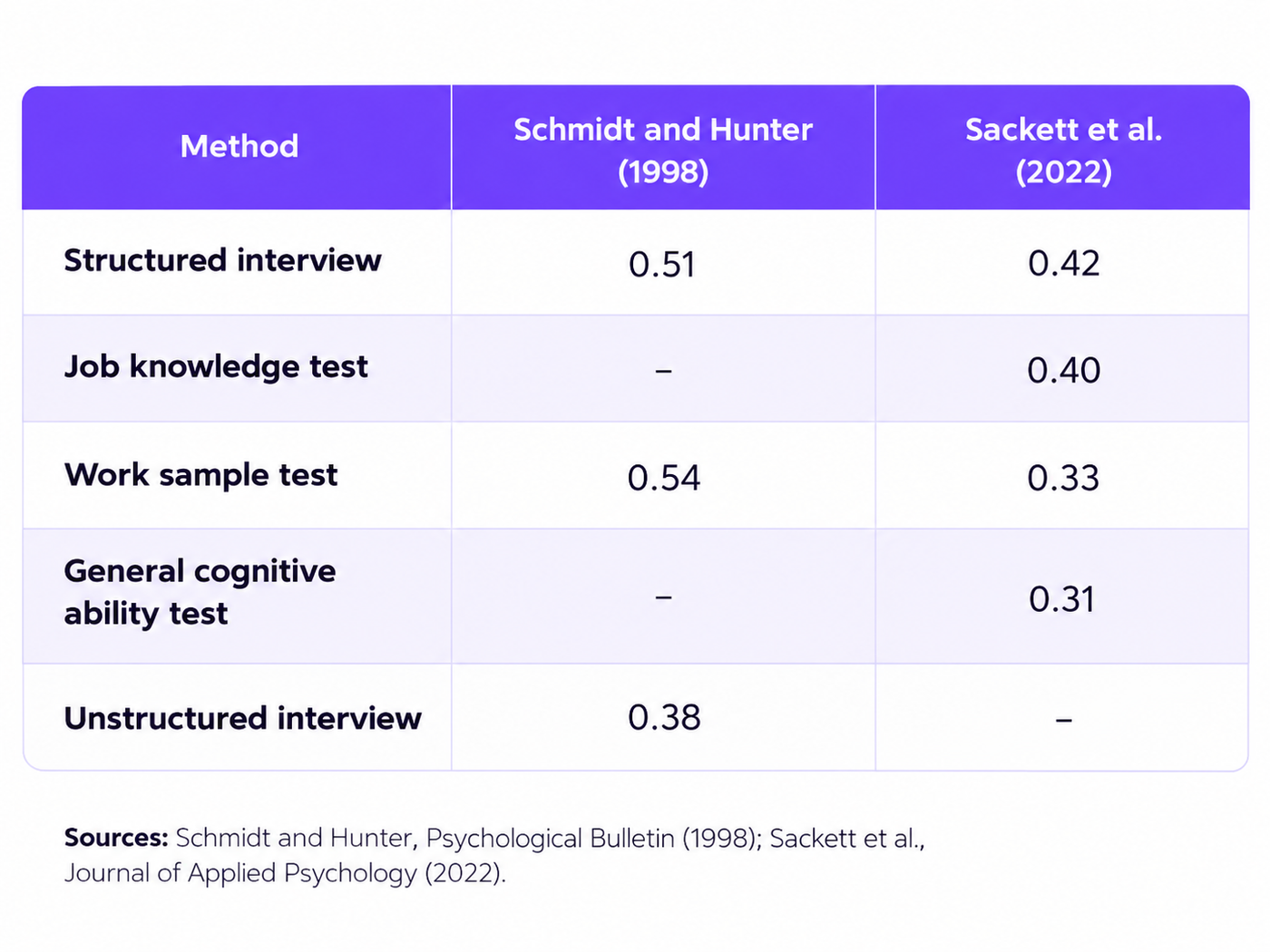
Three points follow for technical hiring.
- Work samples still predict well. A take-home test is a work sample, and it sits near the top of the range, though the older figures made it look like a clearer winner than it is.
- Structure matters most. The best-performing method in the 2022 revision is the structured interview, where every candidate gets the same questions and is scored against the same criteria.
- Live coding has no validity figure of its own. No published meta-analysis treats it as a separate predictor. It behaves like an interview with a work-sample element, so it is only as good as its scoring. Unscored, it drifts toward the weaker unstructured interview.
One caution: these figures come from broad selection research across many job types, not from software engineering alone. Use them to compare methods; they cannot promise a specific accuracy for your own process.
Why Does Live Coding Often Test Stress More Than Skill?
Many teams believe live coding shows real skill because the candidate cannot look anything up. For many candidates the evidence points the other way.
In a 2020 study, researchers at North Carolina State University and Microsoft ran a randomised trial with 48 computer science students on a whiteboard problem. Half solved it in private and half solved it in front of an interviewer. The paper, “Does Stress Impact Technical Interview Performance?”, presented at the ACM ESEC/FSE conference, found that performance was reduced by more than half when candidates were simply being watched. Stress and cognitive load were also measurably higher in the public setting.
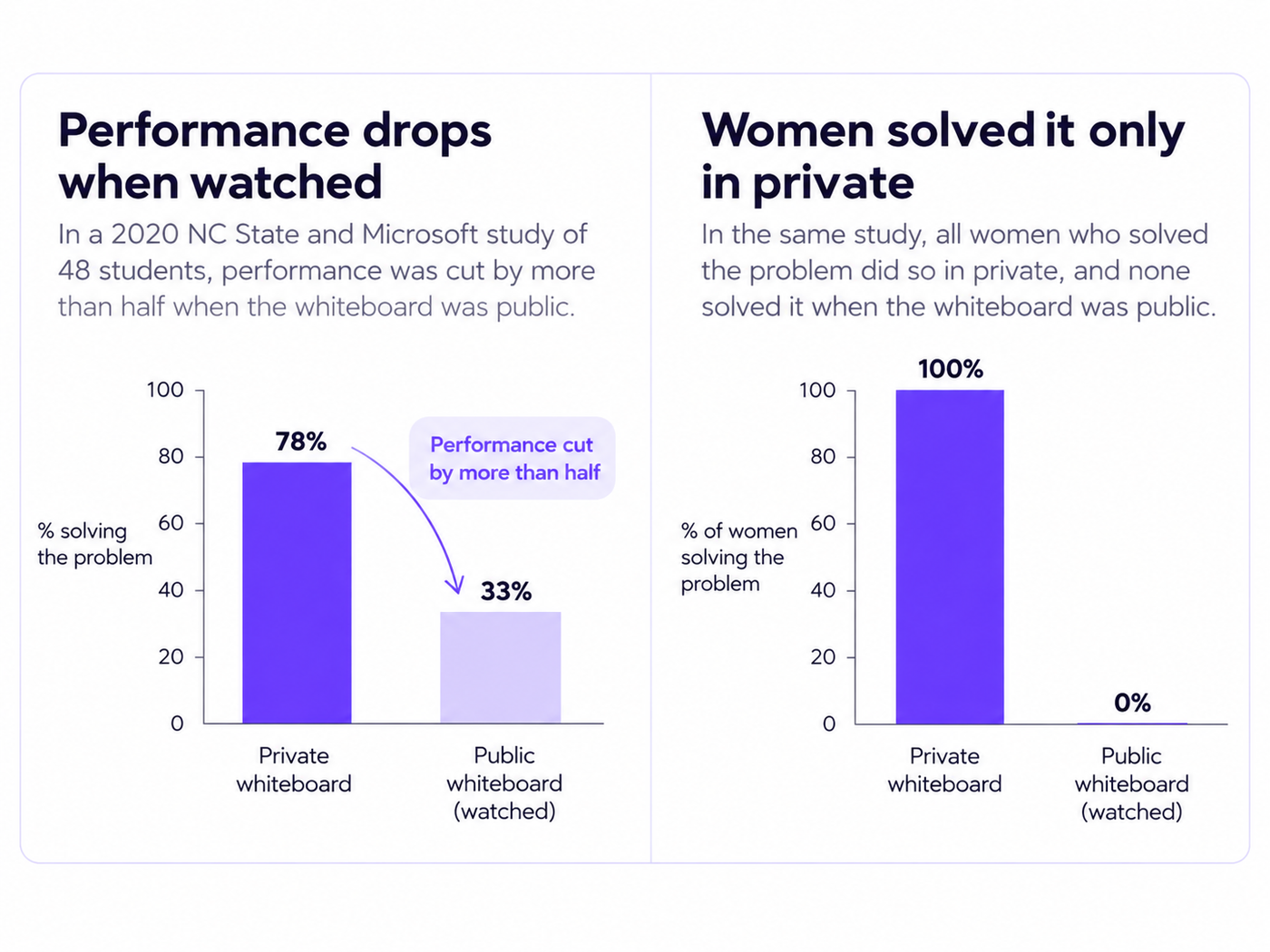
The gender result stood out. In the private condition, all the women in the sample solved the problem. In the public condition, none did. The sample is small and the setting was academic, so treat it as a warning about method, not a precise rate. The format was measuring composure under observation.
Live coding still has a use. Watching how someone reasons, asks questions and responds to a hint is valuable, particularly for roles that involve pairing with others. Score communication and approach, and give little weight to whether the candidate finished a puzzle in 45 minutes with a stranger watching.
Are Take-Home Tests Actually Fair?
Take-homes feel fairer because they remove the audience, but they add a different barrier: time.
A task that takes four hours is not four hours for everyone. It is a weekend for a candidate who is employed full-time. It is far more for someone caring for a child or a parent, working a second job or studying. Those constraints have nothing to do with engineering ability, yet they decide who completes the task. The strongest candidates, who often have several conversations under way, are also the most likely to walk away from an unpaid assignment.
The other weakness is authorship. A take-home is done unobserved, and AI coding assistants now make it easy to produce polished output that says little about what the candidate can do alone. The format is still usable if the follow-up conversation, where the candidate explains and extends their own solution, becomes the real assessment.
A take-home is fair only if it is short, clearly scoped and reviewed against a rubric. A vague four-hour project with a subjective review is neither fair nor predictive.
Skills Assessment vs Live Coding Interview vs Take-Home: How Do They Compare?
Each method has a different profile. These are qualitative comparisons based on the research above and common practice.
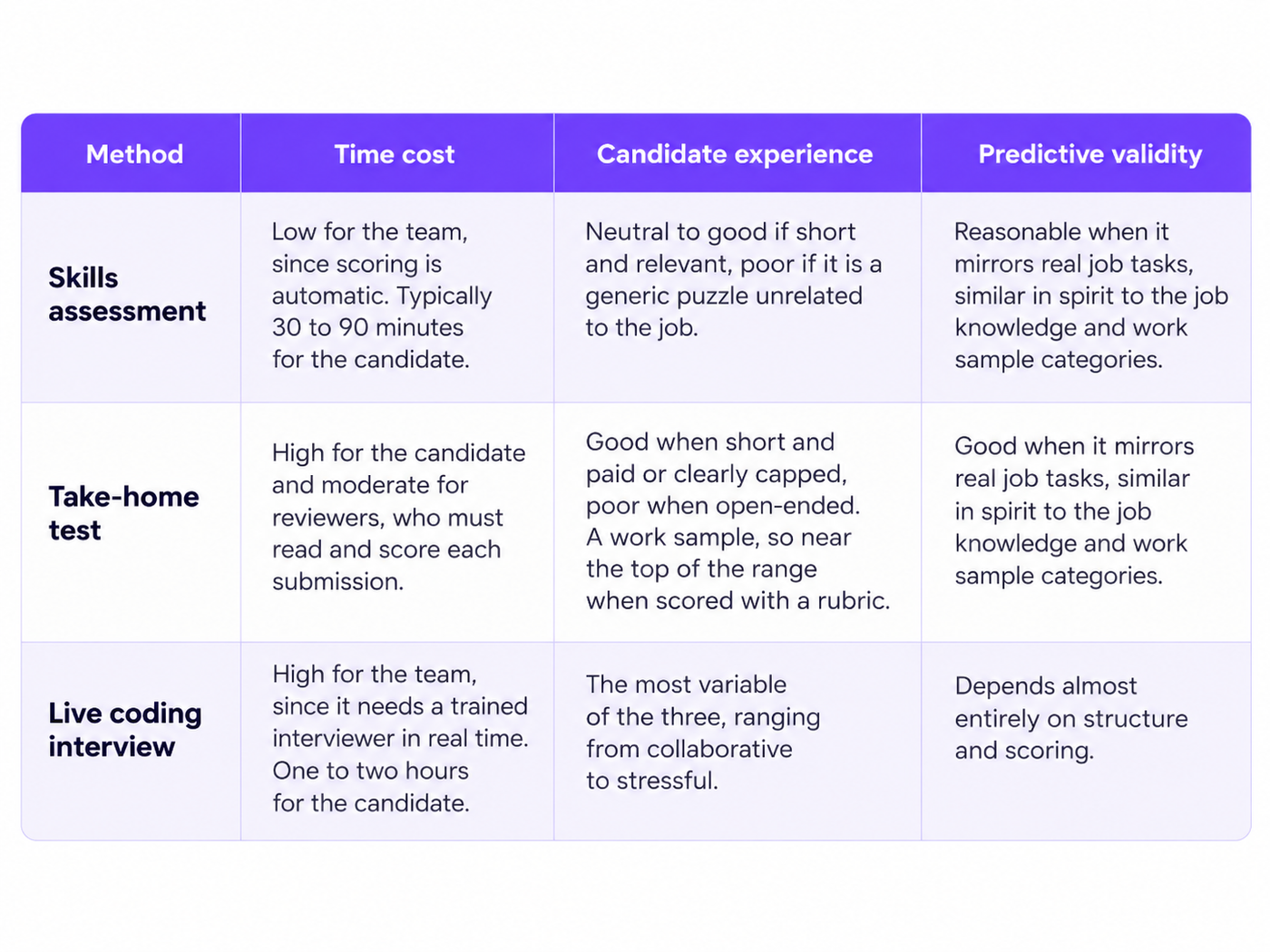
The cheapest method for the team, the skills assessment, is not the weakest. The most familiar, live coding, is not the strongest.
When Does Each Method Fit Best?
Choose by role and volume.
Use a skills assessment when volume is high. If you are screening 200 applicants for 5 roles, an automated test protects your engineers’ time. This is typical of Indian IT services and campus hiring, where a single drive can bring in thousands of applicants and no team can interview them all. Keep the test tied to real tasks and short enough to finish in one sitting.
Use a take-home when the work is the job. For roles where output is the product, such as front-end developers, data analysts or designers, a scoped work sample shows the thing you will pay for. Limit it to two hours or less for early stages, and reserve longer projects for finalists.
Use live coding when collaboration is the job. If the role involves pairing, debugging with others or explaining trade-offs to non-engineers, a live session shows how the candidate works with people. Make it a collaborative problem, allow documentation and search, and score reasoning rather than speed.
Skip the format when the signal exists elsewhere. For a senior engineer with a strong track record, a long test adds little. A structured conversation about past decisions and a short review of real work is usually enough, and it respects their time.
The wider principle is skills-based hiring, which means judging what people can do rather than where they studied or worked. HireBound’s post on skills-based hiring covers how to build that approach into job design and screening.
How Do You Design a Fair Take-Home Test?
If you use a take-home, the design determines whether it helps or hurts. Follow these steps.
- Cap the time and say so. State a maximum of two hours for early stages and up to four for finalists. Tell candidates that extra hours will not earn extra credit.
- Mirror real work. Use a problem drawn from your actual codebase or domain, simplified. Avoid brain-teasers and algorithm trivia that will not appear in the job.
- Write the rubric before you send it. List four to six criteria, such as correctness, readability, handling of edge cases and quality of the written notes, each scored on a fixed scale.
- Give a flexible window. Allow five to seven days so a candidate with a job or family can choose their own hours.
- Pay for anything long. If a task exceeds a few hours, pay for it. Paying also signals that you value the candidate’s time.
- Review blind where you can. Remove names before scoring, and have two reviewers score independently.
- Discuss the submission live. Spend 20 minutes asking the candidate to walk through their choices and change one part. This confirms authorship and shows how they think.
- Offer an alternative. Let candidates who cannot spare the time do a shorter live session instead.
Scoring against a structured rubric is the same principle that makes interviews work. HireBound’s structured interview scorecard template gives a ready format for the discussion stage.
What Does This Look Like in a Real Hiring Process? (Illustrative Example)
This hypothetical example uses round numbers to show how the methods combine.
A 300-person product company in Bengaluru needs three backend engineers. It receives about 250 applications.
Stage one is a 45-minute online skills assessment, sent by WhatsApp so candidates can start from a phone link and reply quickly. It covers two practical tasks: a small API bug to fix and a query to optimise. Automated scoring narrows 250 applicants to about 40.
Stage two is a capped 90-minute take-home for those 40, with a flexible seven-day window and a published rubric. Reviewers score blind, and about 12 candidates move on.
Stage three is a 60-minute collaborative session with one of the future teammates. The candidate walks through their take-home and then extends it live with documentation open. A scorecard captures reasoning, communication and response to feedback. Three hires emerge.
No single method carried the decision. The assessment protected engineer time, the work sample showed real output, and the structured conversation confirmed authorship and fit. The same logic applies to the interview stage, and HireBound’s comparison of panel interviews and one-on-one interviews shows how format changes who has to be in the room and how long the decision takes.
Want to run technical screening without the scheduling overhead? Talk to us about how HireBound handles candidate outreach and interview coordination. Book a free demo →
How Do You Build a Balanced Technical Evaluation Process?
A balanced process rests on a few decisions you can make this week:
- Decide what the role needs to prove. Write down the three tasks the person will actually do in their first 90 days. Design every assessment around those tasks.
- Match method to stage. Use cheap, standardised checks early and expensive, human ones late. Never ask a candidate for four hours before you have spent an hour of your own time.
- Score every stage the same way. A rubric turns any of the three formats into a structured measure, and structure is what the research rewards.
- Watch the drop-off at each step. If many candidates start a take-home and few submit it, the task is too long or too vague. Fix the task before blaming the pool.
- Communicate quickly. Candidates who wait two weeks after a long assignment assume the worst. A prompt reply matters more to experience than the format itself.
- Review outcomes. After six months, compare assessment scores with actual performance. If they do not line up, change the test.
No format wins on its own. A short assessment, a capped work sample and a structured conversation, each scored against a rubric, will outperform any single method used loosely.


