Walk-In Drive: Meaning, How It Works and How to Run One
 Devansh Dhawan
 ·Nov 19, 2026·9 min read

Key Takeaways
- 1A walk-in drive is an open hiring event: candidates arrive without a booked slot and are screened, interviewed and often offered a job that day.
- 2Pre-register and pre-screen candidates before the day, so interviewers spend the drive on eligible people and the queue keeps moving.
- 3MoSPI's PLFS put urban youth unemployment at 19.0% in September 2026, which is why open fresher drives in metros can overflow a venue.
- 4ManpowerGroup's survey of 3,055 Indian employers put the net employment outlook at 54% for late 2026, so expect selected candidates to hold other offers.
- 5Track three rates after every drive: registration-to-attendance, attendance-to-offer and offer-to-joining, each split by the source that sent the candidate.
A walk-in drive is a hiring event where an employer interviews candidates who arrive at a set venue in an announced time window, without a pre-booked interview slot. Screening, interviews and often the offer happen the same day, so employers in India use it to fill many similar roles quickly.
This explainer is written first for recruiters and HR teams that run high-volume recruitment. It covers the stages of the day, a step-by-step plan and the numbers to track. Freshers get a short section on what to carry.
Planning a hiring drive this quarter? See how HireBound screens and schedules candidates before the day →
Walk-In Drive Meaning: What Does the Term Cover?
A walk-in drive means open-door hiring. The employer announces the role, venue, dates and timings, and any eligible candidate can turn up. Nobody gets an individual interview slot, and candidates are seen in the order they register at the venue.
The term overlaps with "walk-in interview". A walk-in interview usually describes the candidate's side, meaning one interview attended without an appointment. A walk-in drive is the employer's event, which can run for one to three days with several interviewers and hundreds of candidates.
How Does a Walk-In Drive Work on the Day?
A walk-in drive runs as a chain of short stages, each of which filters some candidates out. A typical day for a customer support or sales role has six stages:
- Registration: the candidate signs in at the front desk, hands over a CV and ID, and gets a token number.
- Eligibility check: a recruiter confirms the basics in two or three minutes, such as qualification, location, shift and language.
- Assessment: eligible candidates take a short test. It may be a typing test, a voice check, an aptitude paper or a group discussion.
- Interview rounds: an HR round covers pay, shift and joining date. An operations or team-leader round checks fit for the actual work.
- Document verification: shortlisted candidates show originals of their ID, education certificates and any earlier employment papers.
- Offer or result: selected candidates get an offer or a letter of intent that day, with a joining date. Everyone else hears the outcome before leaving.
The diagram below shows the six stages in order.
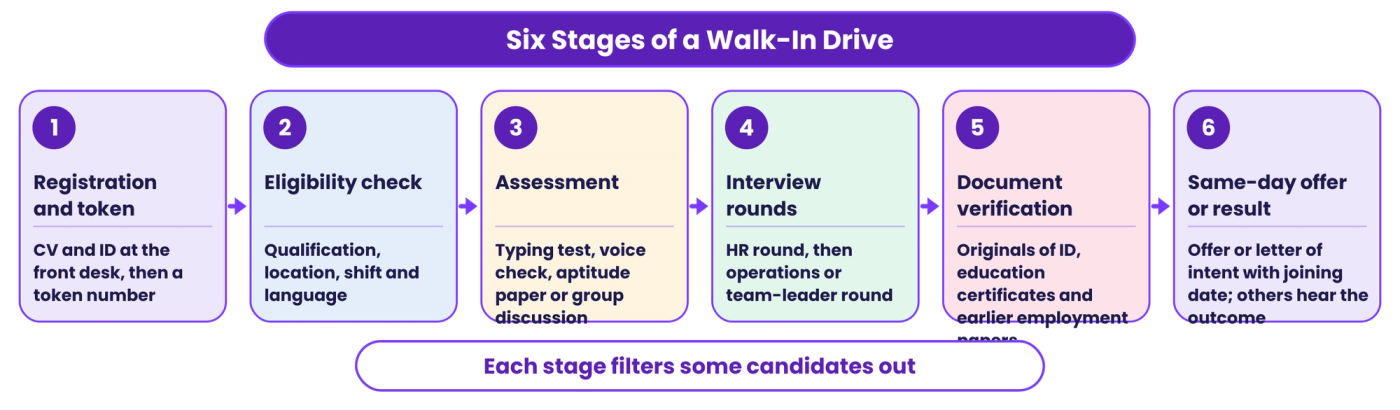
Give each stage a named owner and a target time, because the queue builds at whichever stage is slowest.
Which Roles and Sectors Use Walk-In Drives?
Walk-in drives suit roles where many people are hired against the same criteria and a short conversation is enough to judge fit. Senior and specialist roles need longer evaluation, so the format suits them poorly.
Sectors in India that use the format regularly:
- BPO and customer support: voice and chat process roles, where a language check and a mock call decide most outcomes.
- IT services: fresher and junior batches for support, testing and infrastructure roles, usually with an aptitude or technical test.
- Retail: store associates, cashiers and seasonal staff ahead of festive sales.
- Logistics and e-commerce: warehouse associates, delivery riders and hub staff, with document checks on site.
- Banking and insurance sales: field sales and relationship officers, tested on communication and local market knowledge.
- Healthcare support: nursing assistants, pharmacy staff, front-office and medical coding roles, with certificate checks.
Our guide to blue collar hiring in India covers the licence, location and shift checks for frontline roles.
Where Are Walk-In Drives Most Common in India?
Walk-in drives are most common in Pune, Bangalore, Hyderabad, Chennai and Noida. Each city has many employers that hire in batches, and a large pool of graduates within commuting distance of the venue.
The mix of roles differs by city:
- Bangalore and Hyderabad: IT services firms and global capability centres with regular fresher and junior intake.
- Pune: IT services, BPO and the auto and manufacturing belt around the city.
- Chennai: IT services, BPO, banking back offices and manufacturing.
- Noida, with the wider Delhi NCR: customer support, BPO, IT services and field sales.
Employer demand in these markets is strong. ManpowerGroup's Employment Outlook Survey for October to December 2026 covered 3,055 Indian employers and put India's net employment outlook at 54%.
Supply is also heavy at the entry level. MoSPI's PLFS Monthly Bulletin for September 2026 put unemployment among people aged 15 to 29 at 15.2% nationally and 19.0% in urban areas. The overall rate was 5.0%. Our India job market explainer reads the same data segment by segment.
Plan for both. An open fresher drive in a metro can draw more people than the venue holds, and the strongest candidates will have other offers.
Walk-In Drive vs Scheduled Interview vs Campus Drive: What Is the Difference?
The three formats differ on who can attend and how fast a decision is made. A walk-in drive is open and fast, a scheduled interview is invite-only and slower, and a campus drive is limited to students of chosen colleges.
The table compares them on five points.
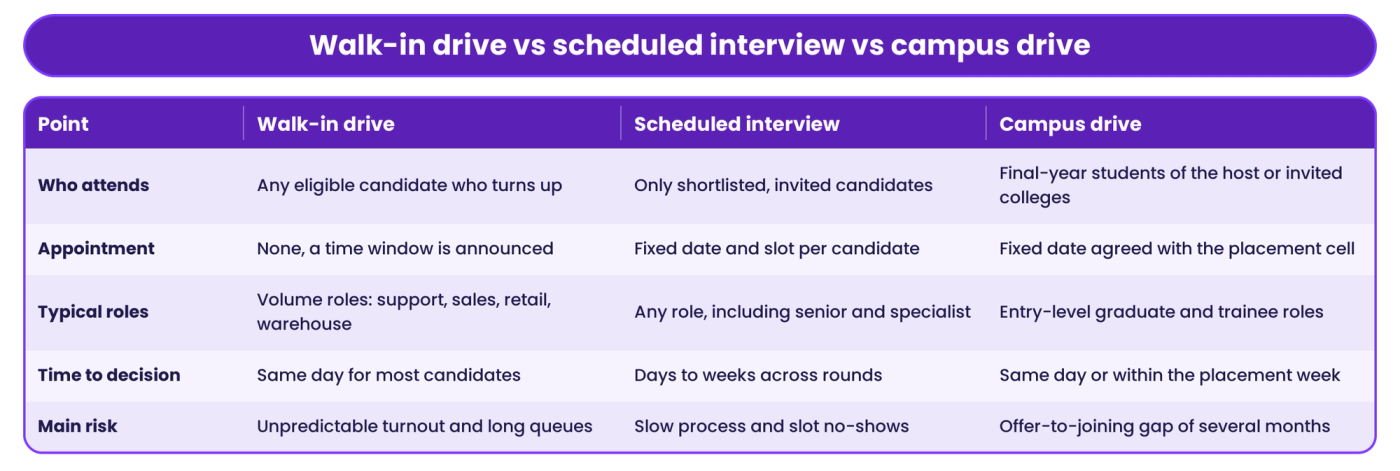
Choose a walk-in drive when the role is repeatable and speed matters more than a hand-picked shortlist. For college intake, our guide to campus hiring in India covers placement-cell timelines.
How Do You Run a Walk-In Drive as an Employer?
Run a walk-in drive in six steps: plan capacity, announce it, pre-register and pre-screen, manage the day, make offers before candidates leave, and follow up until joining. Most failed drives skipped one of them.
1. Plan Capacity Before You Pick a Date
Start from the number of joiners you need and work backwards to interviewers and rooms. As an illustration, assume a 10-minute interview and a six-hour interview window. One interviewer can then see about 36 candidates, so 150 interviews need at least four interviewers plus a reserve.
Fix eligibility, pay band, shift and joining dates in writing before you announce. Our guide to bulk hiring in India covers how to size a hiring batch from brief to joining.
2. Announce the Drive With the Facts Candidates Need
State the role, eligibility, pay range, shift, venue with a map pin, dates, timings, documents to carry and a contact number. Leaving out pay or shift brings in people who drop out at the HR round. Post on job boards, referral channels, college groups and WhatsApp.
3. Pre-Register and Pre-Screen Candidates
Ask candidates to register in advance through a form, a WhatsApp number or a QR code. Then ask the eligibility questions before the day, so people who do not qualify are told early and do not travel.
Software can do most of this step. HireBound's bulk hiring platform runs role-specific screening on WhatsApp and voice, and its Scheduling Agent books candidates into time bands and sends reminders. HireBound data shows a 64% WhatsApp response rate in India against about 12% for email, so send confirmations and reminders there.
4. Run the Day as a Flow
Use tokens, a seated waiting area and clear signs for each stage. Put your quickest recruiter on the eligibility desk, because it sets the pace for every later stage. Send pre-screened candidates through a faster lane.
5. Make Offers Before Candidates Leave
Decide on the day and put it in writing. A selected candidate who leaves with "we will call you" is likely to accept another employer's offer first. Hand over an offer or a letter of intent with pay, shift, location and joining date.
India's four labour codes have been in force since 21 November 2025. The Ministry of Labour and Employment's Compliance Handbook for Employers lists issuing an appointment letter to every new recruit as an employer action point. Check the wording and timing with your payroll or legal team.
6. Follow Up Until Joining Day
Collect remaining documents digitally within two days, then contact each selected candidate at least twice before the joining date. Keep a ranked waitlist from the drive, and offer the seat to the next person if a selected candidate goes quiet.
What Goes Wrong in a Walk-In Drive, and How Do You Fix It?
Four problems account for most failed drives: low turnout, unqualified walk-ins, long queues and offer dropouts. Each has a fix that starts in the days before the drive.
- Low turnout: the announcement was vague or went out once. State pay and shift, and remind registered candidates the evening before.
- Unqualified walk-ins: the eligibility line was unclear. Put the criteria at the top of the announcement and pre-screen registered candidates.
- Long queues: one stage has too few people. Add a second eligibility desk and split candidates into time bands.
- Offer dropouts: the candidate held a second offer or heard nothing after the drive. Issue the letter on the day and keep the joining gap short.
What Should Freshers Carry and Expect at a Walk-In Drive?
A walk-in drive for freshers usually takes most of a day, so arrive early and carry every document the announcement lists. Read the eligibility criteria first, because the eligibility desk turns away anyone who misses the degree, year of passing or shift requirement.
The checklist below covers what most employers ask freshers to bring.
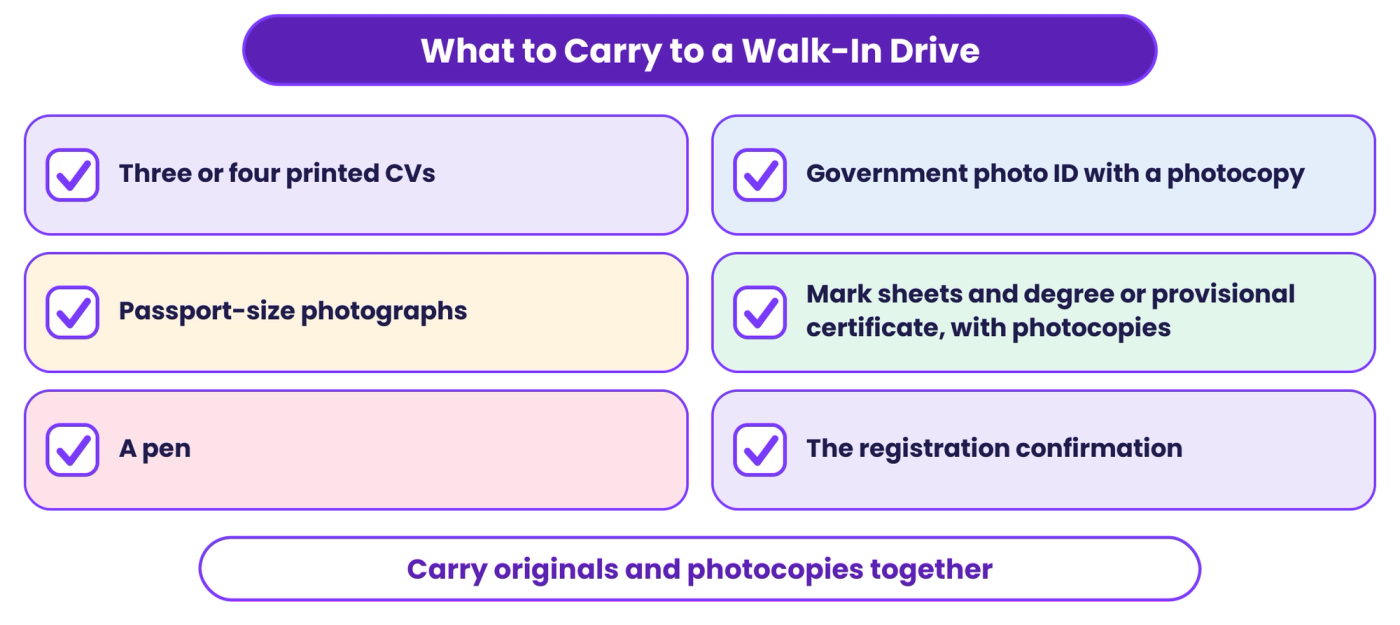
Carrying originals and photocopies together saves a second trip if you are selected.
Expect a wait, a short test and two interview rounds. Prepare a one-minute introduction, and ask about pay and joining date in the HR round. A genuine employer does not charge a registration or processing fee at a walk-in drive.
Which Metrics Should You Track After a Walk-In Drive?
Track three conversion rates after every walk-in drive, and split each by the source that sent the candidate:
- Registration-to-attendance rate: attendees divided by pre-registrations. It shows how well the announcement and reminders worked.
- Attendance-to-offer rate: offers divided by attendees. A low rate means the wrong people came, so tighten the eligibility line and the pre-screen.
- Offer-to-joining rate: joiners divided by offers. It measures what happened after the drive and is the number the business cares about.
The following example uses assumed figures for illustration. If 400 people register and 240 attend, registration-to-attendance is 60%. If 60 of them get offers and 42 join, attendance-to-offer is 25% and offer-to-joining is 70%.
Also record the average waiting time per candidate. Compare each drive with your own previous one, because rates vary by role, city and season.
Running walk-in drives for volume roles? Talk to HireBound about pre-screening, scheduling and follow-up for your next drive →
Conclusion: When a Walk-In Drive Is the Right Format
A walk-in drive fits when you have many similar openings, clear eligibility rules and the authority to decide on the day. It fits poorly when the role needs a long evaluation or the pool is small.
Recruiting teams that get results from the format do most of the work beforehand. They pre-screen, staff each stage against expected turnout, issue letters on the day and count joiners as the result.


