Gratuity Eligibility: Who Qualifies and How the 5-Year Rule Works
 Suvam Moitra
 ·Nov 15, 2026·8 min read

Key Takeaways
- 1Covered employees qualify for gratuity after five continuous years under section 53 of the Code on Social Security, 2020, in force since 21 November 2025.
- 2Four years 7 months is below the five-year condition in section 53(1). The six-month rounding in section 53(2) applies to the amount.
- 3Death, disablement and expiry of fixed-term contracts waive the five-year condition. Fixed-term employees qualify after one year under rule 33 of the 2026 central rules.
- 4Continuous service survives sickness, accident, leave, lay-off, strike and lock-out under section 54. Section 54(B) adds a 240-day test where service has a break.
- 5A 5 year 8 month exit on Rs 50,000 monthly wages pays Rs 1,73,077, because the part-year above six months counts as a full year.
An employee is eligible for gratuity when they work for a covered employer and finish five years of continuous service before the job ends. The condition is waived on death, disablement and the expiry of a fixed-term contract. The Code on Social Security, 2020 has set these rules since 21 November 2025.
This explainer states the law as of 16 November 2026, for employees near the five-year mark and the HR teams who answer them. For the wider picture, see our guide to gratuity in India.
Hiring for permanent roles in India? See how HireBound's AI recruiting agents source, screen and schedule candidates →
Who Is Eligible for Gratuity?
Eligibility has two layers: the employer must be covered, and the employee must meet the service condition. The gratuity chapter of the Code on Social Security, 2020 covers every factory, mine, oilfield, plantation, port and railway company. It also covers every shop or establishment with ten or more employees on any day of the preceding twelve months.
Inside a covered employer, the chapter applies to permanent staff, fixed-term employees and contract workers. For contract labour, the Ministry of Labour and Employment's FAQs of 16 March 2026 name the contractor as the employer who pays. Government employees governed by another Act or rules on gratuity are outside the chapter.
Better terms in an award, agreement or contract are protected by section 53(5), so an offer letter can promise more than the law requires.
How Does the 5-Year Rule Work?
Section 53(1) makes gratuity payable on termination of employment after "continuous service for not less than five years". The same sub-section lists the events: superannuation, retirement or resignation, death or disablement, and the end of a fixed-term contract. The Ministry's FAQ of 30 December 2025 also lists termination.
For working journalists, the five years is read as three. Everyone else needs the full five. That is the gratuity eligibility period in years: five completed years of continuous service, counted to the last day of employment, not to the day of resignation.
What Counts as Continuous Service?
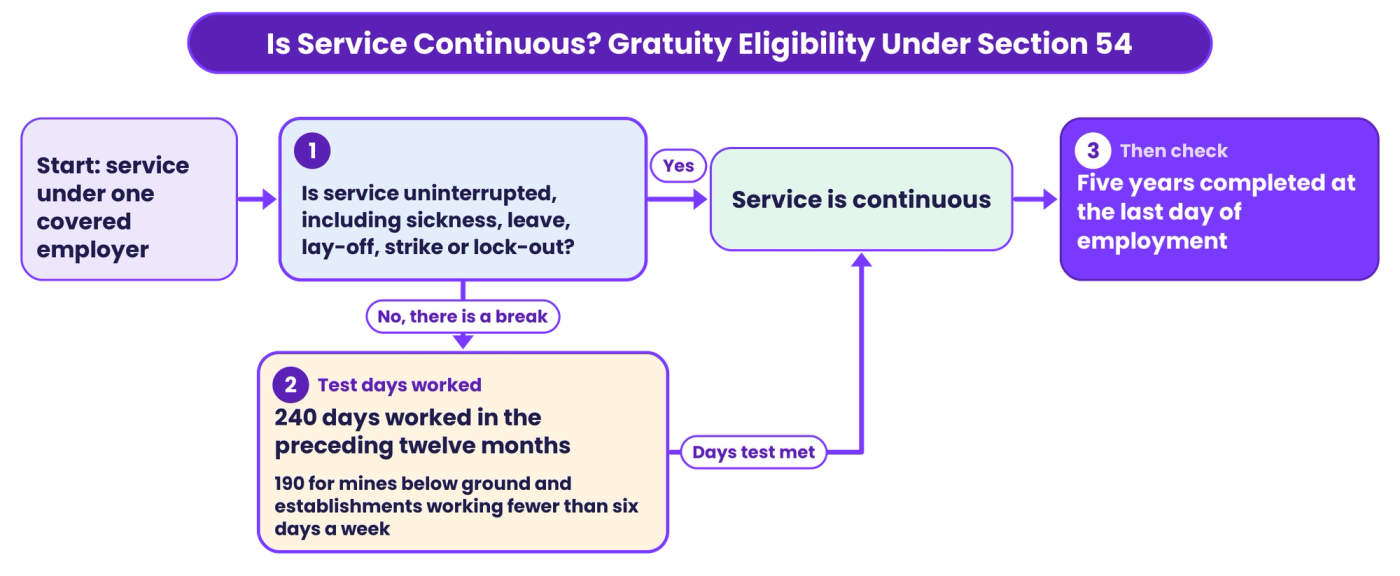
Continuous service tolerates some absence. Section 54(A) says service stays continuous even when interrupted by:
- sickness or accident
- leave
- absence without leave, unless an order treating it as a break in service has been passed under the establishment's standing orders, rules or regulations
- lay-off, strike or lock-out
- cessation of work that is not the employee's fault
Where there is a real break, section 54(B) gives a fallback. A year is deemed continuous if the employee actually worked at least 240 days in the twelve calendar months before the calculation date. The figure is 190 days for mines below ground and for establishments that work fewer than six days a week. For a six-month period the figures are 120 and 95 days.
Lay-off days, full-wage earned leave, temporary disablement from a work accident and maternity leave of up to 26 weeks count as days worked. The diagram below turns the test into a decision path.
Attendance and leave records are the evidence for this test.
Is 4 Years 7 Months Eligible for Gratuity?
On the text of the Code, no. Section 53(1) requires "not less than five years" of continuous service, and 4 years 7 months is less. The Ministry's FAQs of 30 December 2025 and 16 March 2026 repeat the five-year condition and do not round it up.
The six-month rule causes the confusion. Section 53(2) pays for "every completed year of service or part thereof in excess of six months". That sets how many years of wages are paid once an employee is eligible, and it leaves 4 years 7 months short of five.
A second question follows: does 240 days in the fifth year complete five years? The 240-day figure in section 54(B) is a test for whether a year with a break counts as continuous. Neither the Code nor the Ministry's FAQs say that 4 years and 240 days completes the five-year condition.
Some advisers argue that reading, and it has been raised in disputes under the earlier Act. The official text does not adopt it, so this explainer does not rely on any ruling.
If you are at 4 years 7 months or 4 years 240 days, check the exact last working day with your payroll or legal team before you resign. Notice period matters here. Employment continues until the last day, so serving a notice period that ends after the five-year date can change the answer.
When Is the Five-Year Condition Waived?
The second proviso to section 53(1) waives the five-year condition in three cases. They are death, disablement and expiration of fixed-term employment.
- Death. Gratuity goes to the nominee, or to the heirs if no nomination exists. A minor's share is deposited with the competent authority until the minor comes of age.
- Disablement. Section 53 defines it as incapacity for the work the employee could do before the accident or disease.
- Fixed-term expiry. The employee qualifies without five years, subject to the one-year test below.
How Do Fixed-Term Employees Qualify?
A fixed-term employee qualifies after one year of service under the contract, and the gratuity is paid pro rata. Rule 33(1)(a) of the Social Security (Central) Rules, 2026 sets the test. Service beyond one year counts as an additional year if the extra period is more than six months but less than twelve.
The Ministry's FAQ of 16 March 2026 addressed an 11-month contract. The reply says a fixed-term employee is eligible after one year of service under the contract, from its start. A shorter contract does not meet the test.
Under the 1972 Act, a fixed-term employee needed five years like anyone else. HR teams should now write the one-year condition into fixed-term offer letters.
Does Gratuity Depend on How You Leave?
The route of exit matters less than the service count. Section 53(1) names resignation, retirement and superannuation, and the Ministry's FAQ adds termination. Forfeiture, covered next, is the main exception.
The table lists common scenarios and the position under the Code.
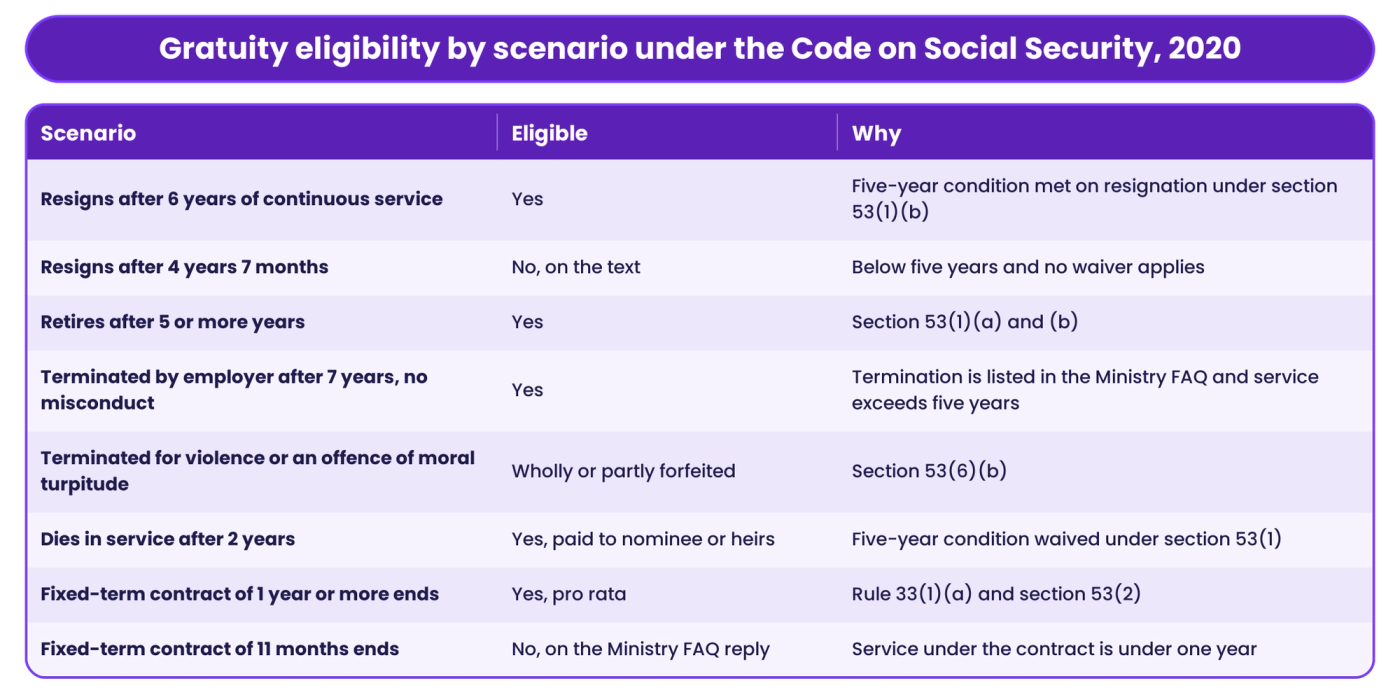
Check any case not listed against the same section 53 conditions.
Probation is the most common doubt. Sections 53 and 54 do not exclude probation from service, so an employee who is employed and in uninterrupted service during probation is in continuous service. Our explainer on probation period in India covers the wider rules.
When Can Gratuity Be Forfeited?
Section 53(6) allows forfeiture in two situations, and both need a termination for that reason.
If an employee's services are terminated for an act, wilful omission or negligence that damages or destroys the employer's property, gratuity is forfeited to the extent of the loss.
If the termination is for riotous or disorderly conduct, an act of violence, or an offence involving moral turpitude committed in the course of employment, gratuity may be forfeited wholly or partly.
Poor performance is not a ground. The employer should record the reason in the termination order.
How Much Gratuity After 5 Years?
After five years, gratuity is 15 days' wages for each completed year, based on the wages last drawn. For a monthly-paid employee, section 53 Explanation 3 divides the monthly wage by 26 and multiplies by 15. The Ministry's December 2025 FAQ states the current ceiling as Rs 20 lakh.
Assume a covered employer, no forfeiture and 5 years and 8 months of continuous service. The wage is monthly basic plus dearness allowance of Rs 50,000, with no allowance add-back. The 8-month part-year exceeds six months, so it counts as a full year, making six years.
Gratuity is Rs 50,000 × 15 ÷ 26 × 6, which comes to Rs 1,73,077. At exactly 5 years and 3 months, the extra three months do not count and the amount is Rs 1,44,231 for five years. The full method and edge cases are in our guide to gratuity calculation.
How Do You Claim Gratuity? Forms and Timelines
The claim runs on set forms under the Social Security (Central) Rules, 2026. State rules may prescribe their own forms. The infographic shows the central sequence.
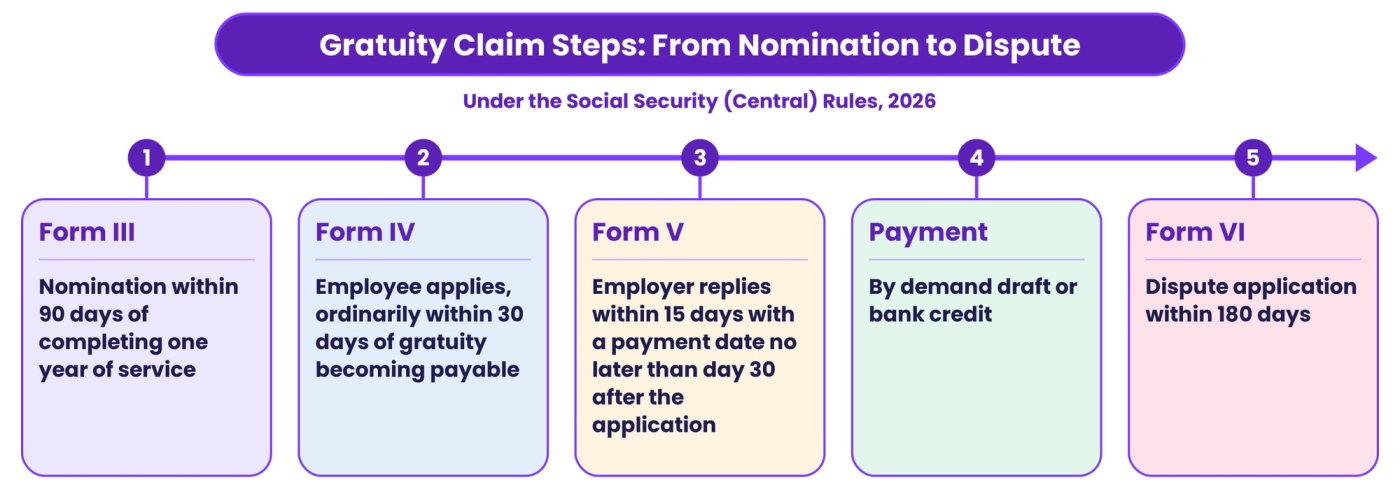
The steps run in this order:
- Nominate early. Section 55 requires a nomination from any employee who has completed one year. Form III is ordinarily due within 90 days of that anniversary.
- Apply. The employee applies in Form IV, ordinarily within 30 days of the date gratuity became payable. A nominee has 30 days and a legal heir one year.
- Employer replies. Within 15 days the employer issues Form V, with the amount and a payment date, or with reasons for rejection.
- Payment. Section 56(3) requires payment within 30 days of the date it becomes payable. Rule 33(3) says payment is by demand draft or bank credit.
- Dispute. If the employer rejects the claim, underpays or does not respond, the claimant can apply in Form VI to the competent authority within 180 days.
Late applications are not invalid on that ground alone. The competent authority must decide an application within six months.
How Do Hiring Teams Answer Tenure and Benefits Questions?
Candidates read the gratuity line in an offer and ask when it vests. Recruiters should be able to say that it is payable after five years of continuous service, one year for fixed-term roles, and paid at exit.
HireBound's permanent hiring service covers sourcing, screening and multi-round interview coordination, with salary benchmarks for the role. Teams doing recruitment for fixed-term roles should state the one-year condition in the offer letter.
Building a permanent hiring pipeline in India? Talk to HireBound about sourcing, screening and offer-stage coordination →
Conclusion: The Gratuity Eligibility Rules in Brief
Eligibility needs a covered employer and five years of continuous service, unless death, disablement or the end of a fixed-term contract applies. Fixed-term employees qualify after one year. Four years 7 months does not meet the condition on the text of the Code.
For HR teams, the working rule is to track service dates from day one and record every break. Where the facts are close, check with your payroll or legal team.


