Gratuity in India: Meaning, Rules and Who Gets It
 Devansh Dhawan
 ·Nov 15, 2026·8 min read

Key Takeaways
- 1Gratuity is a lump sum for long service, paid by the employer at 15 days' wages for each completed year of service.
- 2Since 21 November 2025, the Code on Social Security, 2020 governs gratuity in India, replacing the Payment of Gratuity Act, 1972.
- 3The Code covers factories, mines, plantations, ports and railway companies, plus any shop or establishment with 10 or more employees.
- 4Five years of continuous service is the normal condition, but death, disablement and the expiry of a fixed-term contract are exceptions under section 53.
- 5Employers must pay gratuity within 30 days of it falling due. The Ministry of Labour's December 2025 FAQ puts the ceiling at Rs 20 lakh.
Gratuity is a lump sum an employer pays an employee for long service when the job ends. In India it is a statutory right. Covered employers pay 15 days' wages for each completed year, normally after five years of continuous service. Since 21 November 2025, the Code on Social Security, 2020 has governed it.
This explainer sets out the gratuity rules as they stand on 16 November 2026. It is for employees checking what they are owed and the HR teams who answer them.
Hiring for permanent roles in India? See how HireBound's AI recruiting agents source, screen and schedule candidates →
What Is Gratuity?
Gratuity is a one-time payment from employer to employee, made when employment ends, in return for years of service. The employee contributes nothing. The employer funds the whole amount and pays it at exit.
In plain terms, gratuity means the employer's payment for staying. It differs from provident fund, where both sides contribute every month, and from a bonus, which rewards one year's performance.
The law sets a minimum. Section 53(5) of the Code on Social Security, 2020 protects any better gratuity terms in an award, agreement or employment contract.
Which Law Governs Gratuity in India Now?
The Code on Social Security, 2020 governs gratuity in India today. Chapter V of the Code, sections 53 to 58, holds the gratuity rules. Section 164 of the Code repealed the Payment of Gratuity Act, 1972.
The Press Information Bureau announced on 21 November 2025 that all four labour codes took effect that day. The Ministry of Labour and Employment confirmed the gratuity position in its FAQs on the labour codes, dated 30 December 2025. Gratuity under the Code applies from 21 November 2025, the FAQ says.
The procedure sits in rules. The Central Government notified the Social Security (Central) Rules, 2026 on 8 May 2026. They apply where the Central Government is the appropriate government, and other employers follow their state's rules.
The timeline below shows how the law moved from the 1972 Act to the Code.
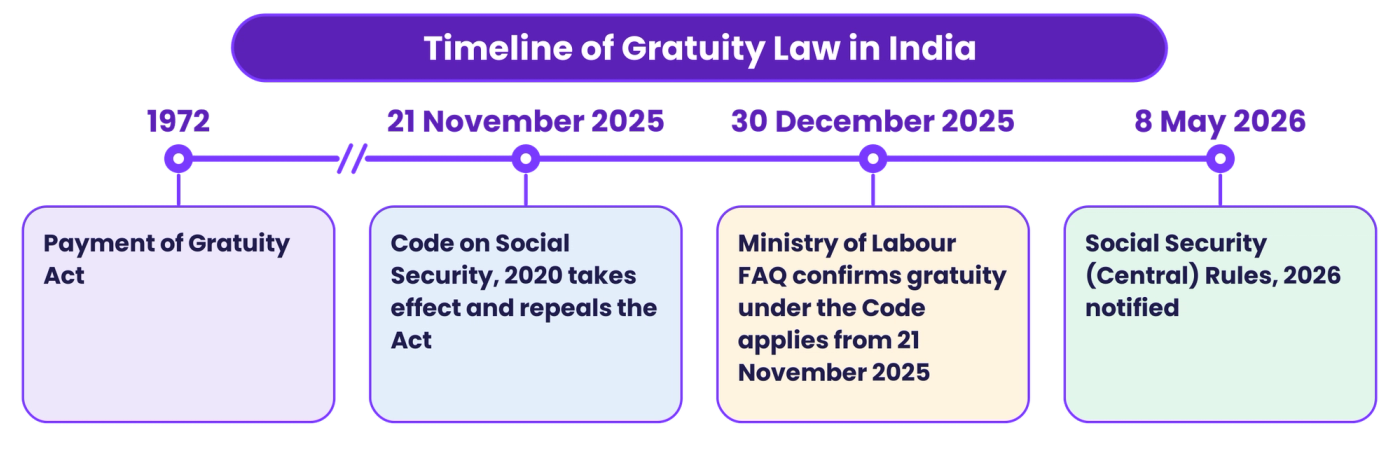
For any exit on or after 21 November 2025, the Code is the law to read.
Which Employers and Employees Are Covered by Gratuity Rules?
The gratuity chapter covers two groups of employers, listed in the First Schedule of the Code on Social Security, 2020. The first is every factory, mine, oilfield, plantation, port and railway company. The second is every shop or establishment with ten or more employees on any day of the preceding twelve months.
Within a covered employer, the rules reach permanent staff, fixed-term employees and workers on a contractor's rolls. For contract labour, the Ministry's additional FAQs of 16 March 2026 name the contractor as the employer who pays.
One group sits outside the chapter. Central and state government employees who are governed by another Act or rules on gratuity are excluded.
What Is the 5-Year Rule for Gratuity?
The 5-year rule says gratuity is payable on termination after at least five years of continuous service. Section 53(1) of the Code keeps this condition from the 1972 Act. For working journalists, the period is three years.
Continuous service does not require perfect attendance. Under section 54, a year counts if the employee worked at least 240 days in the preceding twelve months. The figure is 190 days for mines below ground and for establishments that work fewer than six days a week.
Sickness, authorised leave, lay-off and maternity leave of up to 26 weeks do not break service.
When Does Gratuity Become Payable?
Gratuity becomes payable when employment ends. Section 53(1) lists superannuation, retirement or resignation, death or disablement, and the end of a fixed-term contract. The five-year condition applies to the first three and falls away for the rest.
The table sets out each event and the service condition attached to it.
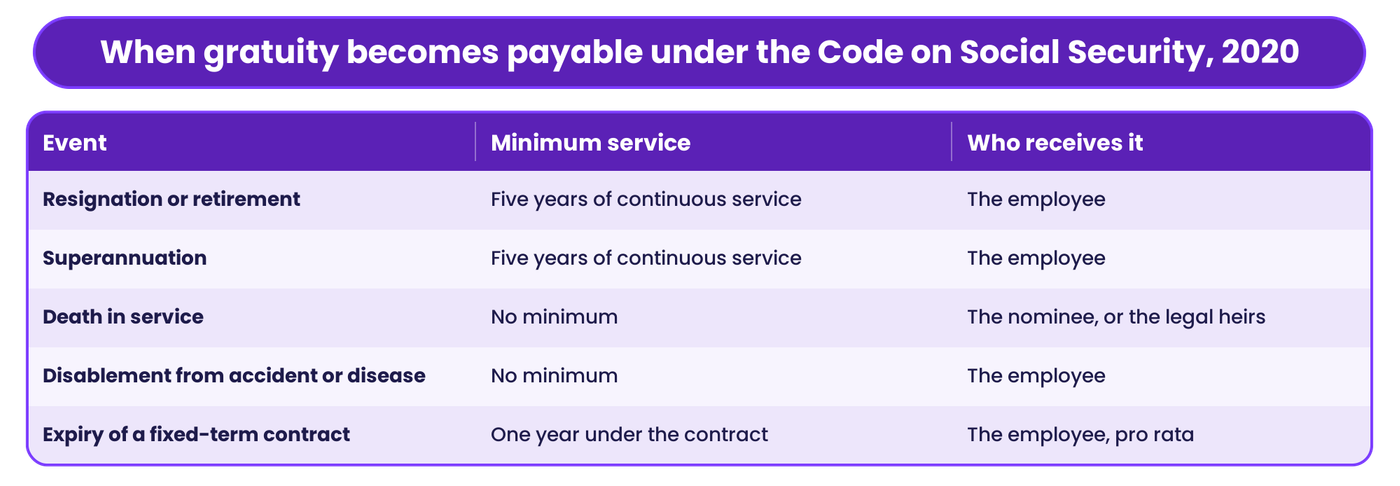
An employee who resigns after four years usually gets nothing under the statute, while a nominee is paid whatever the length of service.
Resignation is the most common trigger. The clock starts on the last working day, so the length of the notice period in India decides when gratuity falls due.
How Is Gratuity Calculated?
Gratuity is 15 days' wages for every completed year of service, based on the wages last drawn. A part-year of more than six months counts as a full year. For a monthly-paid employee, section 53 divides the monthly wage by 26 and multiplies by 15.
Here is a one-line illustration, assuming a last-drawn wage of Rs 40,000 a month and 7 completed years. Rs 40,000 × 15/26 × 7 comes to Rs 1,61,538.
The amount is capped. The Ministry of Labour's December 2025 FAQ states that the maximum gratuity notified by the Central Government is currently Rs 20 lakh. Our guide to gratuity calculation works through the formula, rounding and edge cases.
What Is Gratuity in Salary and CTC?
Gratuity in salary is a cost the employer sets aside, shown as a line in cost to company. It is not deducted from wages and it is not paid monthly. The employee receives it once, at exit, if the service condition is met.
Many offer letters show the provision as 4.81% of basic pay. That figure is arithmetic: 15 days out of 26, spread over 12 months. It is a budgeting convention that the statute does not prescribe.
This is why take-home pay is lower than CTC divided by twelve. Our explainer on CTC meaning and components shows where gratuity sits beside provident fund and allowances.
What Changed Under the Labour Codes?
The labour codes changed two things for gratuity: fixed-term employees and the definition of wages. Both changes apply from 21 November 2025. The rate, the five-year rule and the 30-day deadline stayed the same.
A fixed-term employee now qualifies after one year of service under the contract, paid pro rata. The Ministry's 16 March 2026 FAQs and rule 33 of the central rules both state the one-year condition.
Wages now mean basic pay, dearness allowance and retaining allowance. If excluded allowances exceed 50% of total remuneration, the excess is added back to wages. A salary structure with a low basic can therefore produce a higher gratuity than before.
The table compares the two laws.
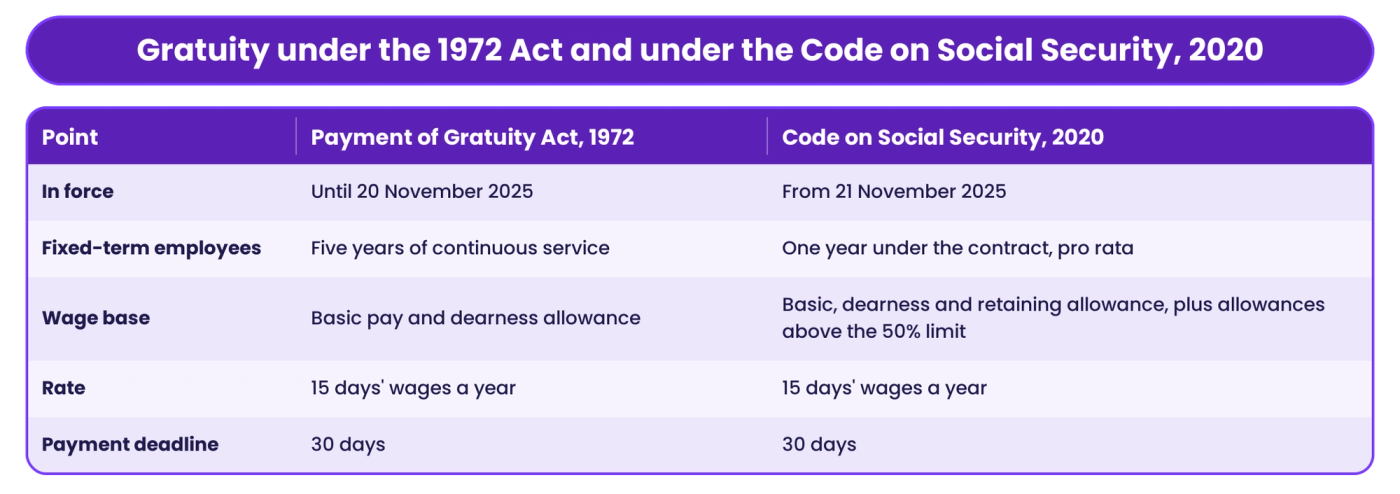
For most permanent employees the rule is unchanged, but the wage base may be larger.
How Soon Must Gratuity Be Paid, and When Can It Be Forfeited?
An employer must pay gratuity within 30 days of the date it becomes payable, under section 56(3) of the Code. The employer has to work out the amount and send written notice whether or not the employee applies.
Late payment carries simple interest from the due date to the payment date. The rate cannot exceed the rate the Central Government notifies for long-term deposits. Interest is waived only if the delay is the employee's fault and the competent authority has given written permission.
Section 53(6) allows forfeiture in two situations:
- Damage or loss to the employer's property through an act, wilful omission or negligence. Gratuity is forfeited only to the extent of that loss.
- Termination for riotous or disorderly conduct, violence, or an offence involving moral turpitude committed in the course of employment. Gratuity may be forfeited wholly or partly.
In both cases the employee's services must have been terminated for that reason. Poor performance is not a ground.
Is Gratuity Taxable?
Gratuity is tax-exempt up to a limit for most employees. The Income Tax Department's guidance treats gratuity paid to government employees as fully exempt. For other employees, the exemption is capped at Rs 20 lakh.
Anything above the exempt amount is taxed as salary. The exempt amount also depends on service and last-drawn pay, so check with your payroll or legal team before you quote a figure.
What Should HR and Payroll Teams Do?
HR and payroll teams should treat gratuity as a liability that builds from an employee's first day. Six tasks cover most of it.
- Confirm coverage against the threshold of ten employees on any day of the past twelve months.
- Collect nominations. Section 55 requires one after a year of service, and the central rules ask for Form III within 90 days.
- Review the salary structure against the 50% wage rule, then re-estimate the gratuity provision.
- Track fixed-term contract end dates. One year under the contract triggers a pro rata payment.
- At exit, determine the amount, send written notice to the employee and the competent authority, and pay within 30 days.
- Record any forfeiture with the termination order and the reason for it.
Under the central rules, an employee applies in Form IV and the employer replies in Form V within 15 days. State rules may set different forms.
The timeline below shows the exit steps for an employer under the central rules.
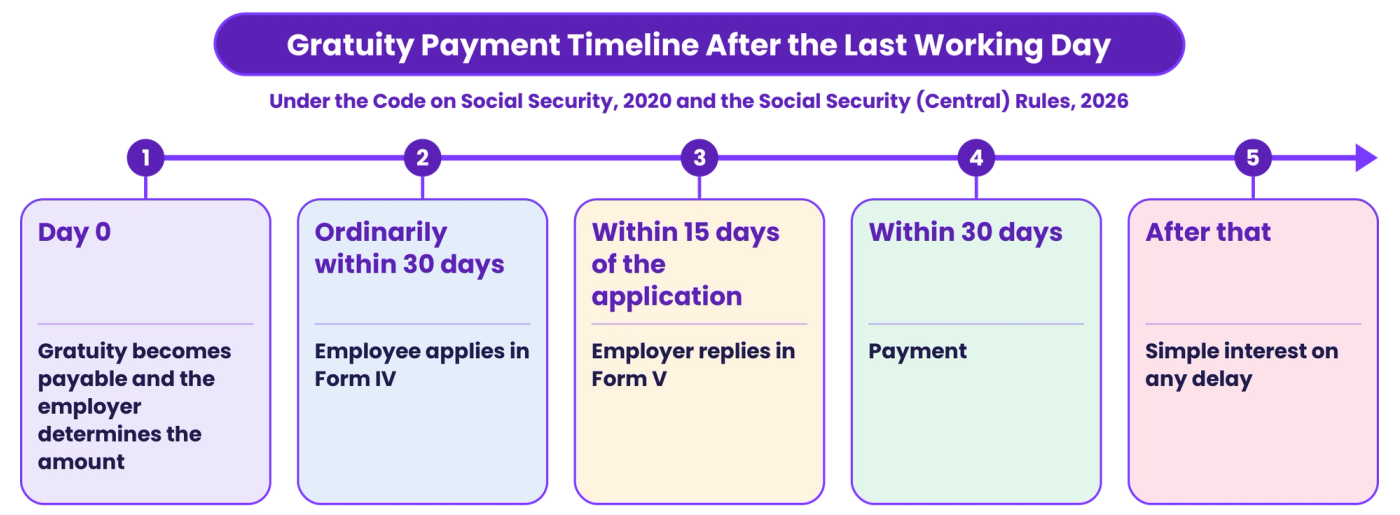
A team that starts the calculation during the notice period has the full 30 days in hand.
How Do Hiring Teams Handle Gratuity Questions at the Offer Stage?
Candidates ask about gratuity when they read the CTC break-up in an offer. Recruiters should be able to say whether the figure is inside CTC, when it is paid and what the service condition is. A clear answer at this stage avoids a dispute over take-home pay after joining.
HireBound's permanent hiring service handles sourcing, screening and multi-round interview coordination, and provides salary benchmarks for the role. The recruiting team can then spend the offer stage on compensation questions.
Recruitment teams hiring fixed-term staff should also state the one-year gratuity condition in the offer.
Building a permanent hiring pipeline in India? Talk to HireBound about sourcing, screening and offer-stage coordination →
Conclusion: The Gratuity Rules in Brief
The Code on Social Security, 2020 has governed gratuity since 21 November 2025, and employers with ten or more employees are covered. It is payable after five years, or sooner on death, disablement or the end of a fixed-term contract of a year or more.
For HR, the working rule is to provide for gratuity from day one on the Code's wage definition and to pay within 30 days of exit.


