Notice Period in India: Meaning, Rules, Buyout and Negotiation
 Devansh Dhawan
 ·Nov 3, 2026·7 min read

Key Takeaways
- 1A notice period is the written-notice window between resigning and your last working day; India has no single central number, so contract and applicable law decide.
- 2Section 30 of the Delhi Shops and Establishments Act asks for one month’s written notice, or one month’s pay in lieu, from employees with three months’ continuous service.
- 3The Model Standing Orders, 2026 require one month’s notice or pay for terminating a permanent worker, and none for a probationer or an expired fixed-term contract.
- 4In the illustrative example, buying out 30 unserved days on a ₹60,000 monthly base costs about ₹60,000, but the company’s policy sets the base.
- 5A 60 to 90 day notice window leaves recruiters a long gap to manage; WhatsApp gets a 64% response rate in India against about 12% for email.
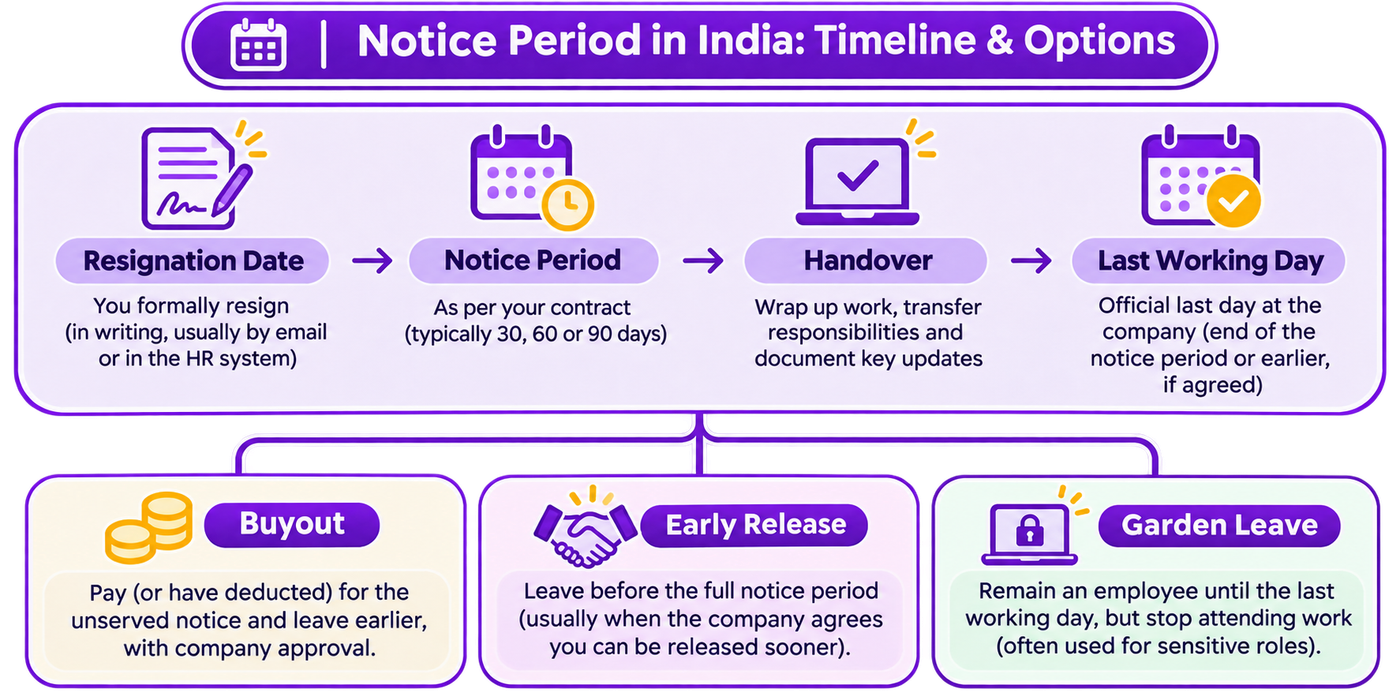
A notice period is the time between giving written notice that you are leaving a job, or that an employer is ending it, and the last working day. In India, resignation notice is usually 30, 60 or 90 days. The exact length comes from your contract, not one central rule.
For candidates, that number decides when you can start a new job. For recruiters, it decides when a selected candidate can actually join. This guide explains the meaning of notice period, where the rules come from, what buyout and early release mean, and how to negotiate.
If you hire in India, see how HireBound supports the work around offers: explore the HireBound platform.
This is general information, not legal advice. Check your appointment letter and the law that applies to your establishment and state.
What Does Notice Period Mean?
A notice period is a contractual waiting window. The employee keeps working, and keeps getting paid, while the employer plans the handover and a replacement. Either side can give notice, so there are two versions.
Resignation notice is what an employee gives when leaving. Termination notice is what an employer gives when ending a job. They often differ in length and in who must give it.
Two points are often misread.
- A notice period is mainly a contract term. If your appointment letter is silent, ask HR and check the state law that covers your establishment.
- Serving notice means working. You stay on the payroll and keep your duties until the last day, unless the employer says otherwise.
Where Do Notice Period Rules Come From?
India has no single national figure for resignation notice. Four sources work together, and your contract is the first one to read.
- Appointment letter: states the notice length, who can waive it and whether pay in lieu is allowed.
- Standing orders: apply to certain industrial establishments and set termination rules.
- State Shops and Establishments Acts: cover offices and shops, and differ by state.
- The Labour Codes: four codes took effect on 21 November 2025, according to a Press Information Bureau release. Rules under them were still in transition when this was written.
Two official texts help. The Ministry of Labour’s Model Standing Orders, 2026 say an employer must give a permanent worker one month’s notice or pay in lieu. The same text says a probationer, or a fixed-term employee whose contract expires, is not entitled to notice or pay in lieu.
On retrenchment, the Ministry’s FAQ on the Industrial Relations Code says one month’s notice and compensation continue. Whether these rules cover your employer depends on establishment size and type, so ask HR which set applies.
Resignation Notice Versus Employer Notice
Resignation notice follows your contract and, where it applies, the state Act. The Delhi Shops and Establishments Act, 1954 is a clear example. Under section 30, an employee with three months’ continuous service must give one month’s written notice. Otherwise, the employer can release them on payment of one month’s pay.
The Model Standing Orders text covers the employer’s notice. It does not set a resignation period for you, so the contract usually governs. Other states have their own Acts, and the wording differs, so check yours.
Fixed-term employees are a separate case. A Ministry of Labour FAQ lists expiry of a fixed-term contract as an event on which gratuity is payable, and says the usual five years of service is not needed. The same Ministry material says fixed-term employees become eligible for gratuity after one year of service.
How Long Is a Notice Period in India?
Most appointment letters set one of three lengths. The table shows what is typical, not what the law requires.
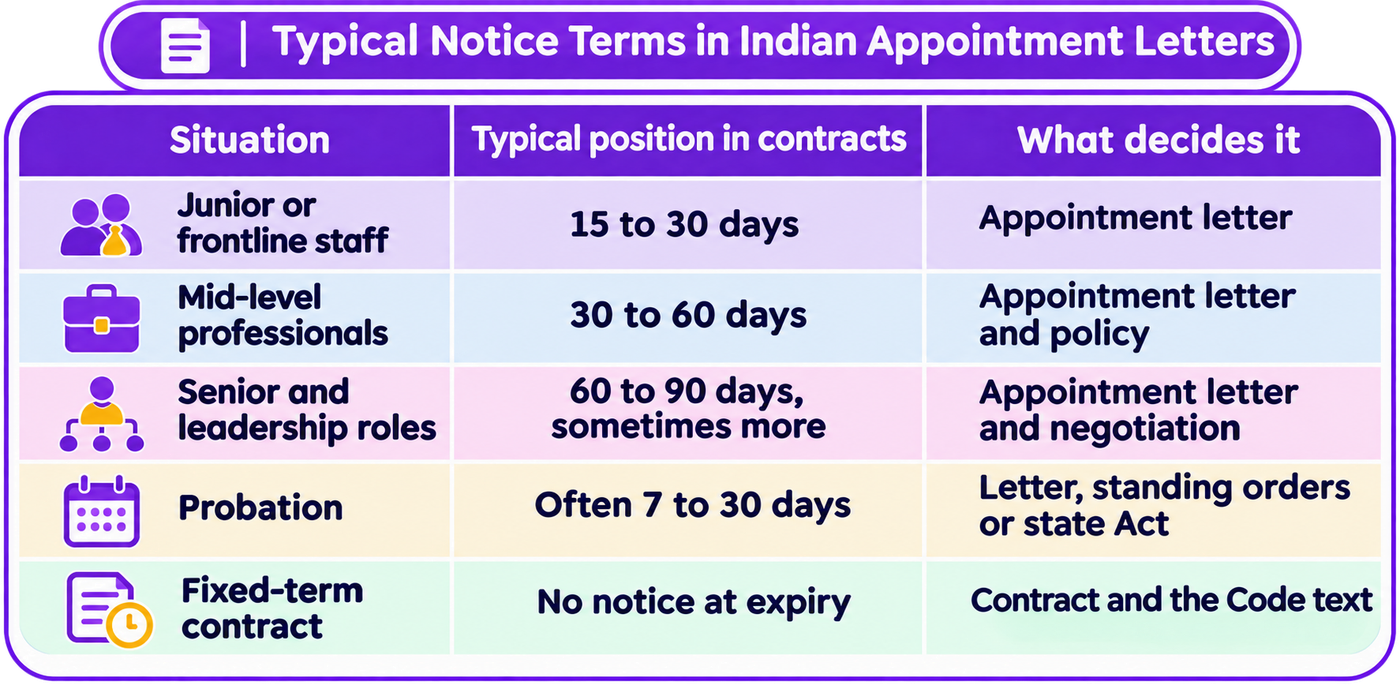
These ranges reflect common practice. They are not statistics or statutory figures. Senior roles run longer because replacing them takes longer. Companies that ask for 90 days often allow a shorter exit by mutual agreement.
Buyout, Early Release and Garden Leave
Buyout means paying the employer for the notice days you will not serve. Early release means the employer waives some or all of the notice. Garden leave means you stay on payroll but do no work, often while barred from joining a rival.
A buyout depends on the letter and company policy. Some employers refuse, some accept, and some set a different pay base. The Delhi Act’s one-month-pay release is a statutory example.
An illustrative worked example, with assumptions stated:
- Notice is 60 days, and the employer agrees to a buyout after 30 days of service.
- Monthly fixed pay is ₹60,000, and the policy uses that figure as the base.
- Unserved days are 30, so the buyout is ₹60,000 ÷ 30 × 30 = about ₹60,000.
Some firms use basic pay only, which gives a lower sum. Others deduct leave balance. Ask HR for the formula in writing before you resign. Get any early-release agreement in writing as well.
What Happens If You Leave Without Serving Notice?
Leaving without serving notice is a breach of contract. The employer may try to recover the notice pay, withhold the experience letter or hold the full and final settlement until the dues are cleared. The legal position depends on the contract and the applicable state law.
Other costs follow. Background checks can surface an unfinished exit, which some new employers treat as a red flag. Gratuity can also be affected, because leaving a few weeks before a service milestone may change eligibility. Confirm your service count with HR.
If you must leave early, ask for a written release and settle your dues.
Notice Period for Freshers and During Probation
Freshers usually have a shorter notice period. Many first-job letters set 15 to 30 days, and some campus offers carry a service agreement as well. That is a contract term, so read it before you sign.
During probation, the Model Standing Orders, 2026 give a probationer no right to notice or pay in lieu when the employer ends the job. For resignation, many letters allow a shorter period, often a week to a month. HireBound’s guide to the probation period in India explains how confirmation works.
How to Negotiate Your Notice Period
Negotiate before you accept the offer, when you have the most leverage. A new employer that wants you will often wait or help with the buyout.
- Read the notice clause and note any buyout or waiver language.
- Tell the new employer your real last date, and ask for a joining date after it.
- Ask your current manager for a shorter notice, with a handover plan.
- Offer a clean handover: documents, a trained successor and a transition schedule.
- Get any agreement in writing before you resign. Verbal promises disappear.
Be honest about dates. A candidate who promises 30 days and delivers 60 loses trust on both sides.
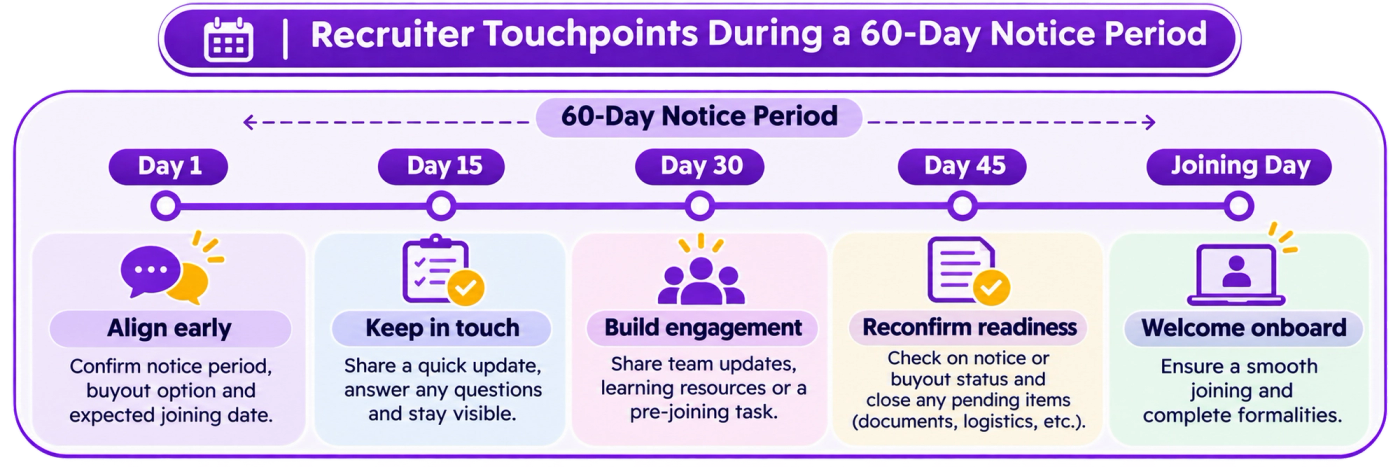
What Recruiters Can Do About Long Notice Periods
A 60 to 90 day notice stretches time-to-join and raises the risk of drop-off. The candidate may receive a counter-offer or a better one. HireBound’s guides on time-to-hire benchmarks and candidate drop-off cover the cost.
Recruiters can reduce the risk in four ways.
- Ask about notice and buyout early, in the first screening call.
- Confirm the joining date in the offer letter, and flag any buyout the company will fund.
- Stay in touch every week or two until day one.
- Keep a backup candidate for roles with long notice.
This is where HireBound fits. Its WhatsApp recruiting software sends follow-ups through a candidate’s notice window. HireBound’s India figures show a 64% WhatsApp response rate against about 12% for email. Recruiters own the candidate relationship, the offer and every decision. HireBound does not negotiate notice or guarantee a joining date.
Managing candidates through a long notice period? See how HireBound keeps them engaged while recruiters keep the relationship: talk to the HireBound team.
Notice Period Meaning in Hindi
नोटिस अवधि (Notice Period) वह तय समय है जो नौकरी छोड़ने या नौकरी समाप्त करने से पहले पूरा करना होता है। इस समय में कर्मचारी काम करता है और वेतन पाता है। भारत में यह अक्सर 30, 60 या 90 दिन होता है। सही अवधि नियुक्ति पत्र और लागू कानून पर निर्भर करती है।
नोटिस अवधि में कर्मचारी के मुख्य कर्तव्य:
- नियुक्ति पत्र में नोटिस की शर्त ध्यान से पढ़ें।
- लिखित इस्तीफ़ा दें और उसकी तारीख़ सुरक्षित रखें।
- काम का हैंडओवर पूरा करें और दस्तावेज़ सौंपें।
- कंपनी की संपत्ति लौटाएँ।
- फुल एंड फाइनल सेटलमेंट और रिलीविंग लेटर माँगें।


