Attrition Rate: Meaning, Formula and Benchmarks in India
 Devansh Dhawan
 ·Nov 3, 2026·7 min read

Key Takeaways
- 1Attrition rate equals employees who left in a period divided by average headcount, times 100. In the worked example, 56 exits on an average of 400 staff is 14.0%.
- 2Aon’s India survey of 1,200+ organisations reports overall attrition of 18% in 2026, up from 16.2% in 2025 and 17.1% in 2024.
- 3Companies define attrition differently. HCLTech reported 12.7% (LTM, June 2026) excluding involuntary exits, and Wipro reported 13.8% voluntary (TTM, September 2026).
- 4Compare your rate only with a benchmark that uses the same formula, the same period and the same exit types.
- 5Early attrition, such as exits within 90 days (14.5% of hires in the example), points to hiring quality, so track it separately.
Attrition rate is the percentage of employees who leave an organisation during a period, usually a year. The formula is employees who left divided by average headcount, multiplied by 100. A 14% rate means about 14 in every 100 employees left.
Last updated: 1 November 2026. Benchmark figures were checked against the sources named below on that date.
This guide gives the formula, a worked example with stated assumptions, and India benchmarks from named sources. It also explains why two companies can report different attrition for the same workforce. If you hire at volume, explore the HireBound platform to see how hiring teams run screening and scheduling.
What Is Attrition Rate?
Attrition rate measures how quickly people leave. It counts exits, including resignations, terminations, retirements and end-of-contract departures, unless the company states otherwise. It is a ratio, so it lets you compare a team of 50 with a team of 5,000.
Most HR teams report it monthly, quarterly and annually. The annual figure is the one that appears in company results and salary surveys.
The number does not say whether exits were good or bad. A low performer leaving and a top engineer leaving move it equally, so the split by type, covered below, tells you more than the headline.
How to Calculate Attrition Rate (With a Worked Example)
The basic formula is:
Attrition rate (%) = (employees who left during the period ÷ average headcount) × 100
Average headcount is the opening headcount plus the closing headcount, divided by 2. Some teams use a monthly average for more accuracy. Pick one method and keep it fixed.
The example below is illustrative. These numbers are invented to show the arithmetic and are not a benchmark. Assumptions: a company opens the year with 390 employees, hires 76, and sees 56 exits, of which 42 are resignations and 14 are involuntary. It closes with 410. Eleven of the 76 new hires left within 90 days.
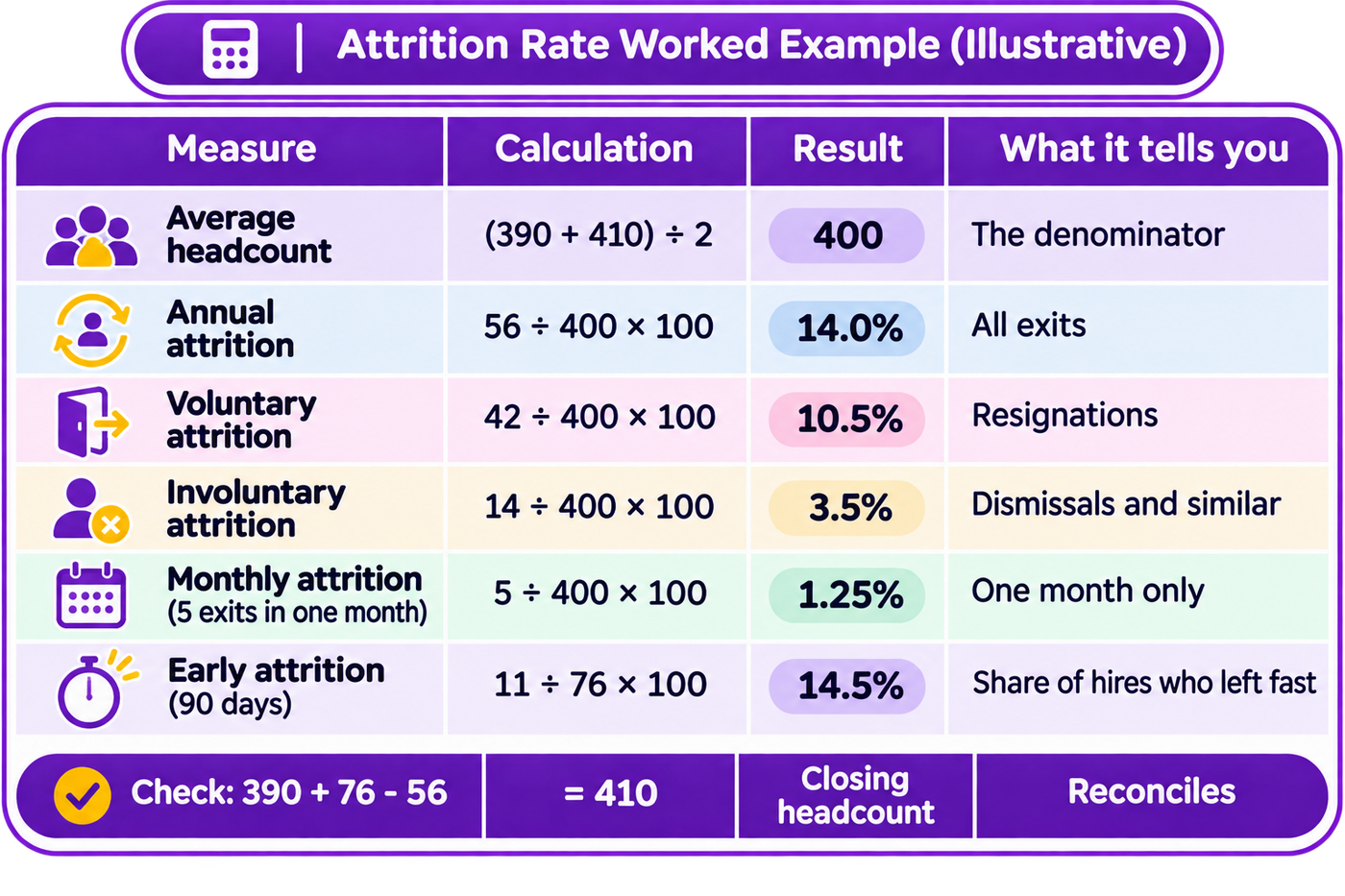
Early attrition uses hires as the denominator, not average headcount. It asks how many of the people you hired did not stay.
Multiplying a single month’s rate by 12 gives only a rough annual estimate. Exits are rarely spread evenly across the year, so use the actual twelve-month count when you can.
Voluntary, Involuntary and Early Attrition
Voluntary attrition is when the employee chooses to leave: resignation for a better offer, relocation, study or personal reasons. It is the number most employers try to reduce.
Involuntary attrition is when the employer ends the employment: performance exits, misconduct, redundancy or restructuring. It reflects management and hiring decisions.
Regretted attrition counts only the exits the company wanted to avoid, such as high performers or people with scarce skills. There is no standard definition, so each company sets its own list.
Early attrition covers exits within the first weeks or months, often the first 90 days. It sits between the other types because it is usually voluntary but caused by the hire, the role or the onboarding.
Attrition vs Turnover vs Retention
These words overlap, and usage varies by company. In Indian corporate usage, attrition and turnover are often treated as the same thing. Some firms use attrition for exits that are not backfilled and turnover for exits that are replaced. Ask which meaning a report uses before you compare.
- Attrition or turnover rate: the share of employees who left.
- Retention rate: the share who stayed. In a simple view, it is 100% minus the attrition rate.
- Tenure: a company can show a moderate rate and still have a young workforce if exits cluster in the first months.
What Is a Good Attrition Rate in India?
There is no single good rate. It depends on the sector, the job level and the labour market. Use benchmarks to ask questions about your own number.
Aon’s Annual Salary Increase and Turnover Survey for India 2026-27, published on 14 October 2026, covers more than 1,200 organisations across 45 industries. The firm reports overall attrition of 18% in 2026, against 16.2% in 2025 and 17.1% in 2024. Aon’s own reading is that competition for talent remains strong. You can read the release on Aon’s Asia newsroom.
That is an all-industry average. High-volume frontline and BPO roles often run higher, and some sectors run lower. No neutral published figure for those roles was available to cite, so use your own history as the baseline.
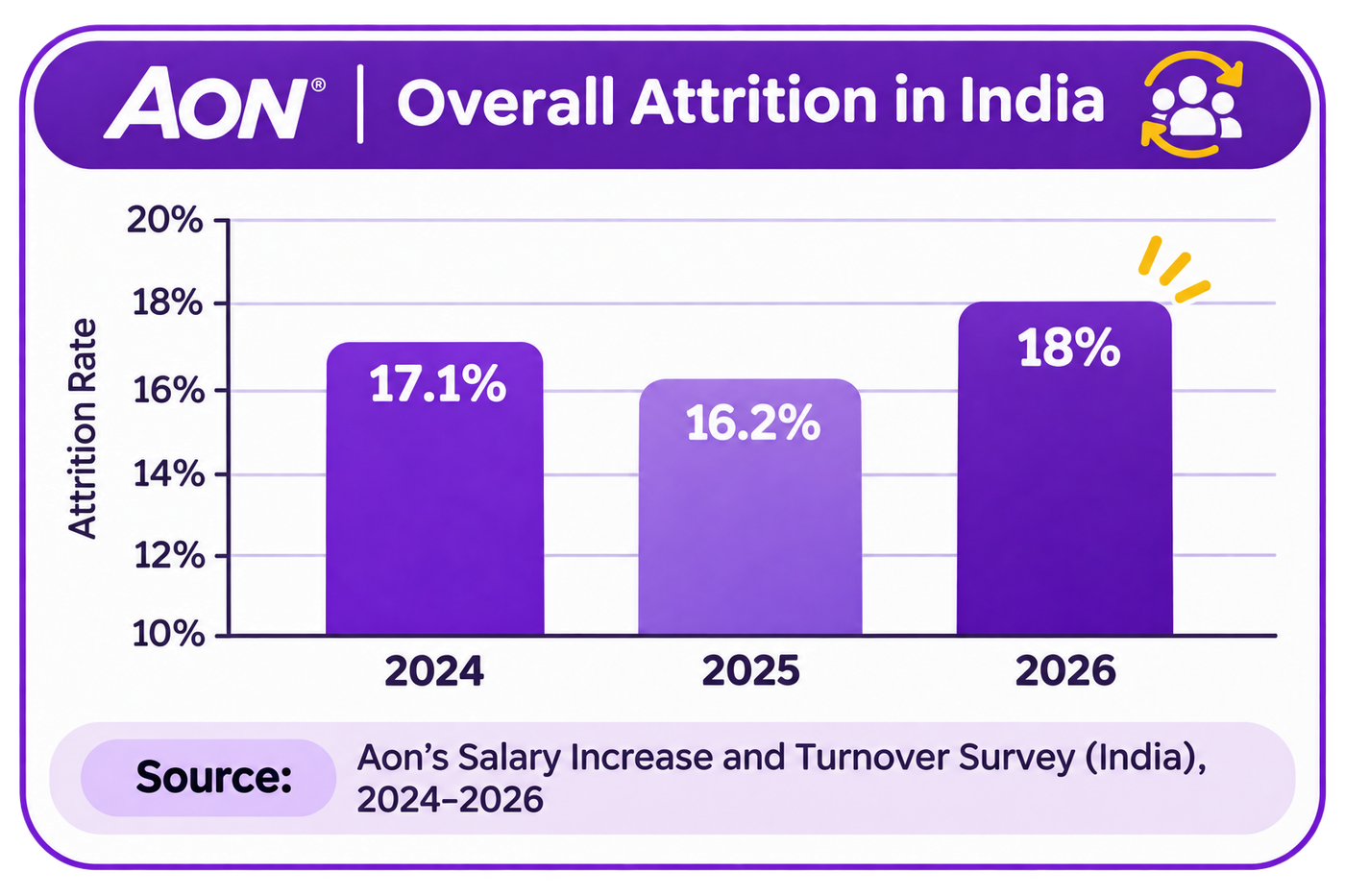
A benchmark is useful only if the definition matches yours. A 12% voluntary rate and an 18% overall rate can describe the same workforce.
How to Read a Company’s Reported Attrition
Listed Indian IT companies publish attrition every quarter. The numbers are public, dated and useful, but the definitions differ.
- HCLTech: in its Q1 FY27 investor release, for the quarter ended 30 June 2026, the company reports attrition of 12.7% on a last-twelve-months (LTM) basis. A year earlier, at 30 June 2025, it was 12.8%. HCLTech states that the figure excludes involuntary attrition and digital process operations. The figures are in the HCLTech investor release.
- Wipro: in its Q2 FY27 press release, for the quarter ended 30 September 2026, Wipro reports voluntary attrition of 13.8% on a trailing 12-month (TTM) basis. Its datasheet specifies IT Services excluding business process services (BPS).
TCS and Infosys also report attrition each quarter in their results material. Open the latest release for the current figure and read its definition note first.
Neither figure is the same as Aon’s all-industry 18%. One covers a single company, one excludes involuntary exits, and the scope differs by business unit. Treat each as a separate data point.
When you read any reported figure, check four things:
- Is it voluntary or total attrition?
- Is the period quarterly annualised, or a true trailing 12 months?
- Which businesses or roles are excluded?
- Is the headcount basis average or closing?
Why People Leave and What Recruiting Can Influence
Pay, career growth, manager quality, workload and location all drive exits. Many of these sit outside recruiting. Salary-survey data from Aon shows employers are budgeting around 9% increases, yet attrition still rose in 2026, so pay alone does not fix it.
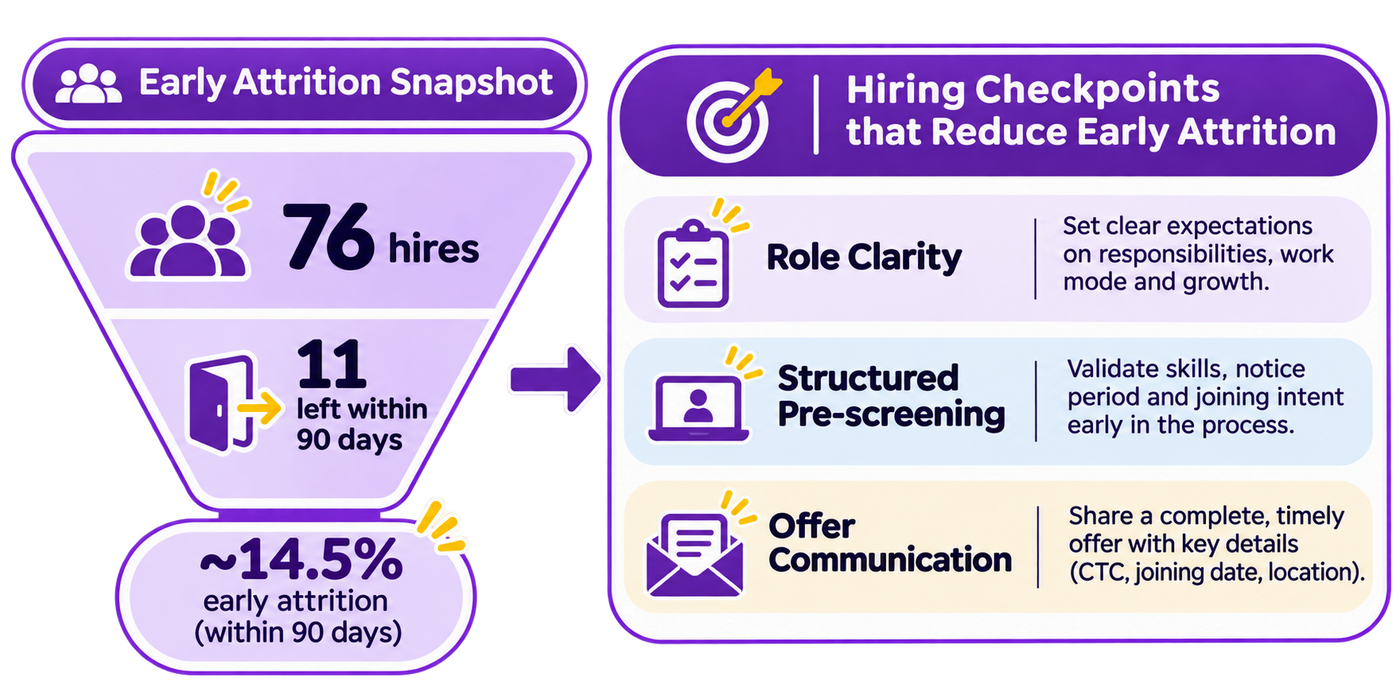
Recruiting does influence one slice: people who leave because the job was not what they were told, or because they were a poor fit for it. That slice shows up early. If many exits happen in the first 90 days, the cause is often the hiring process, not the market.
Three hiring factors are worth checking:
- Role clarity. Is the job description honest about shifts, targets, location and pay structure?
- Screening quality. Do candidates get asked about the conditions that cause exits, such as shift timing, commute and notice period?
- Offer communication. Does the candidate understand fixed and variable pay before joining?
Early Attrition: A Hiring Quality Signal
If 14.5% of hires leave inside 90 days, as in the worked example, the problem sits upstream of retention programmes. Track early attrition by source, role, recruiter and hiring manager. A pattern by source tells you where to adjust.
This is the same logic behind quality of hire. The HireBound guide on how to measure quality of hire lists 90-day retention as one of its inputs. The cost side is covered in the post on the cost of a bad hire.
Structured questions help. A good pre-screening questions set asks about shifts, travel, pay expectations and notice period before a recruiter spends time on the candidate. Candidates who know the conditions up front are less likely to quit in week two.
Want to cut early exits at the screening stage? Talk to the HireBound team about structured screening and follow-up.
Where HireBound Fits
HireBound does not reduce attrition by itself. Most causes of leaving sit with pay, managers and workplace conditions. What it can influence is the screening and conversation stage that precedes the hire.
HireBound’s data shows a 64% WhatsApp response rate in India, against about 12% for email. HireBound has powered 8 million+ candidate conversations. In practice, that means structured screening questions about shifts, location and expectations reach candidates in the channel they actually answer.
For high-volume roles, Voice AI screening software can run those conversations in 14 Indian languages, so candidates answer in the language they prefer. Recruiters using HireBound handle 3× more candidates per day than with a manual process. A human recruiter reviews the shortlist and makes the hiring decision, and HireBound makes no guarantee about retention outcomes.


