Campus and Off-Campus Hiring in India: How to Run a High-Volume Drive
 Suvam Moitra
 ·Nov 2, 2026·10 min read

Key Takeaways
- 1Off-campus hiring means recruiting freshers outside college placement drives. You set the calendar, but you also source, screen and schedule every applicant yourself.
- 2Plan backwards from joins. In the illustrative example, 200 joins need about 4,270 registrations, and a 60% joining rate raises that to 5,335.
- 3AISHE 2023-24 lists 48,246 colleges and nearly 4.5 crore enrolled students, so pick pools by fit with the role, not by college name.
- 4PLFS 2025 puts unemployment among Indians aged 15 to 29 at 9.9%, so fresher applicants are plentiful and screening capacity is the real limit.
- 5HireBound data shows a 64% WhatsApp response rate in India against about 12% for email, so reach freshers on the channel they answer.
Off-campus hiring is recruiting freshers and recent graduates outside college placement drives, through open applications, referrals and fresher pools. Campus hiring recruits students through colleges, on a calendar the college controls. Both work at volume when you plan backwards from joins, screen on the channel candidates answer, and manage the long wait between offer and day one.
A drive can look strong on offers made and still miss on joins. This guide covers both routes and works through an illustrative drive that targets 200 joins.
Running a drive with thousands of fresher applicants? See how HireBound runs outreach, screening and scheduling at volume →
What Is Off-Campus Hiring, and How Is It Different From Campus Hiring?
Off-campus hiring puts you in charge of the calendar, the sourcing and the volume. On campus, the placement cell brings students to you. Off campus, you find them, and the pool includes the 2026 batch, earlier batches and graduates who missed placements.
The table compares the two routes.
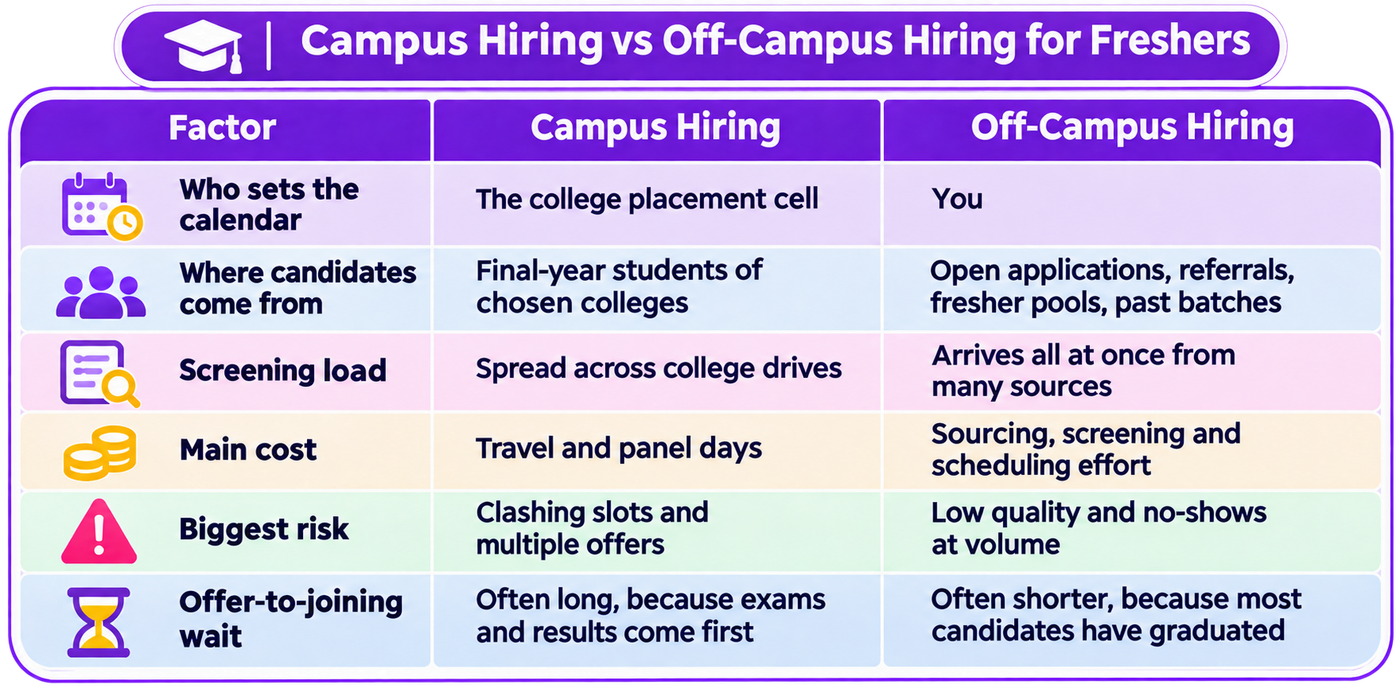
The right mix depends on the role, the headcount and how fast you need people.
When Should You Choose Off-Campus Hiring?
Choose off-campus hiring when you need freshers outside the placement season, or when your target colleges cannot supply enough students. It also suits roles where skills matter more than the college name.
It works well in four cases.
- You missed the campus window and still need a batch.
- You hire for a role where a short skills test predicts success better than a marks cut-off.
- You want the 2026 batch or earlier batches, including graduates who are already available to join.
- You want to rehire strong students from past drives who did not join.
Plan eligibility rules before you open applications. Passing year, degree, backlogs and location are the usual filters, and a clear rule saves hours of manual review.
Where Do Off-Campus Freshers Come From?
Freshers come from five main pools, and each needs its own outreach. Track registrations and joins per pool from the first week, so you can shift effort toward what works.
- Open applications from your careers page and job posts.
- Employee referrals, where your own team shares the role with juniors and friends.
- Skills platforms, hackathons and assessment contests that surface students by what they can do.
- Fresher communities and college alumni groups.
- Your own database of past applicants and offer holders who did not join.
Job boards such as Naukri, Shine, Apna and WorkIndia are also channels, and HireBound integrates with them. Our guide to candidate sourcing channels covers how to compare channels by cost and quality.
Why Is Fresher Hiring Different From Other Bulk Hiring?
A fresher drive has no work history to screen, and a college or graduation calendar sits behind every candidate. The general mechanics of high-volume recruiting still apply, and our guide to bulk hiring in India covers that process. This post covers what changes when the candidates are students and new graduates.
Scale is the first difference. The Ministry of Education’s All India Survey on Higher Education (AISHE) 2023-24 lists 1,289 universities and 48,246 colleges, with nearly 4.5 crore students enrolled. Among the 46,468 colleges that responded, 70.0% are private un-aided.
Geography is the second. The same report says Uttar Pradesh, Maharashtra, Tamil Nadu, Madhya Pradesh, Karnataka, Bihar and Rajasthan hold 59.0% of total enrolment. Your pools will cluster in a few states, and so will your travel and language needs.
Competition for jobs is the third. The Periodic Labour Force Survey annual report for 2025, released by MoSPI, puts unemployment among those aged 15 to 29 at 9.9% in 2025, down from 10.3% in 2024. That figure covers all young people, not only graduates. Applications are plentiful, so screening time is the limit.
How Do You Plan a Fresher Drive Backwards From Joins?
Start with the joins you need and divide backwards through each stage. Each division is a conversion rate, and the chain tells you how many candidates must register.
This is an illustrative example. Every rate below is an assumption for the arithmetic, not a benchmark, so replace them with your own past-drive data.
The drive needs 200 joins. Assume 75% of offers end in a joining, 35% of interviewed candidates get an offer, 85% of those who clear the assessment attend an interview, 30% of assessment attempts clear the cut-off, and 70% of registered candidates attempt the assessment.
- Joins needed: 200
- Offers needed: about 267 (200 divided by 0.75)
- Interviews held: about 762 (267 divided by 0.35)
- Candidates clearing the assessment: about 896 (762 divided by 0.85)
- Assessment attempts: about 2,988 (896 divided by 0.30)
- Registrations needed: about 4,269 (2,988 divided by 0.70)
So roughly 4,270 registrations produce 200 joins. At an assumed 8 interviews per panel per day, the 762 interviews need about 95 panel days.
Now stress the weakest stage. If only 60% of offers end in a joining, the same arithmetic needs about 333 offers and about 5,335 registrations. That is 25% more of everything, or about 1,070 extra registrations, for the same 200 joins.
The same chain works for an off-campus drive. Registrations come from open applications and referrals instead of college lists, so the cost moves from travel to sourcing and screening.
How Should You Tier Colleges and Choose Your Pools?
Tier colleges by how well their students match the role, then give each tier its own plan. A tier is a working label such as “premier”, “strong regional” or “emerging”, not an official ranking. Off-campus pools can be tiered the same way, by source instead of college.
Judge each college or pool on four things.
- The share of candidates who meet your eligibility rules, such as degree, branch and year.
- Past results with you: attendance, assessment scores, offers and joins.
- Travel and location, which affects interview cost and joining rates.
- The language and channels candidates use.
In the example, the drive uses 33 colleges with an assumed number of registrations per college. Five premier colleges at 200 registrations each give 1,000, twelve regional colleges at 150 give 1,800, and sixteen emerging colleges at 92 give 1,472. That totals 4,272, close to the 4,269 the funnel needs.
Review each college or pool after the assessment, not only after the drive. A source with strong attendance and weak joins needs a different fix from one with weak attendance.
How Do You Pre-Screen and Assess Thousands of Freshers?
Use one short, structured screen for every candidate, then a skills-based assessment for those who qualify. A consistent script gives you comparable answers and saves recruiters from thousands of near-identical calls.
The screen checks eligibility, preferred location, language, availability and any pending exams. Send it on the channel candidates actually answer. HireBound data shows a 64% WhatsApp response rate in India against about 12% for email, so a drive that relies on email can lose candidates before the screen starts.
HireBound has powered 8 million+ candidate conversations, and the 64% to 12% gap is an India-wide figure, not a fresher-specific one. Measure your own rate in the first two days.
Language matters across states. HireBound’s Voice AI works in 14 Indian languages, so a candidate in Lucknow can be screened in Hindi and one in Coimbatore in Tamil, with the transcript saved for the recruiter.
For the assessment, test what the job needs. Marks cut-offs are easy to filter on, but a short task on real work shows what a fresher can do. Keep the test short and mobile-friendly, because many candidates will sit it on a phone. Send reminders before the window closes.
The diagram below shows the example funnel from registration to joining.
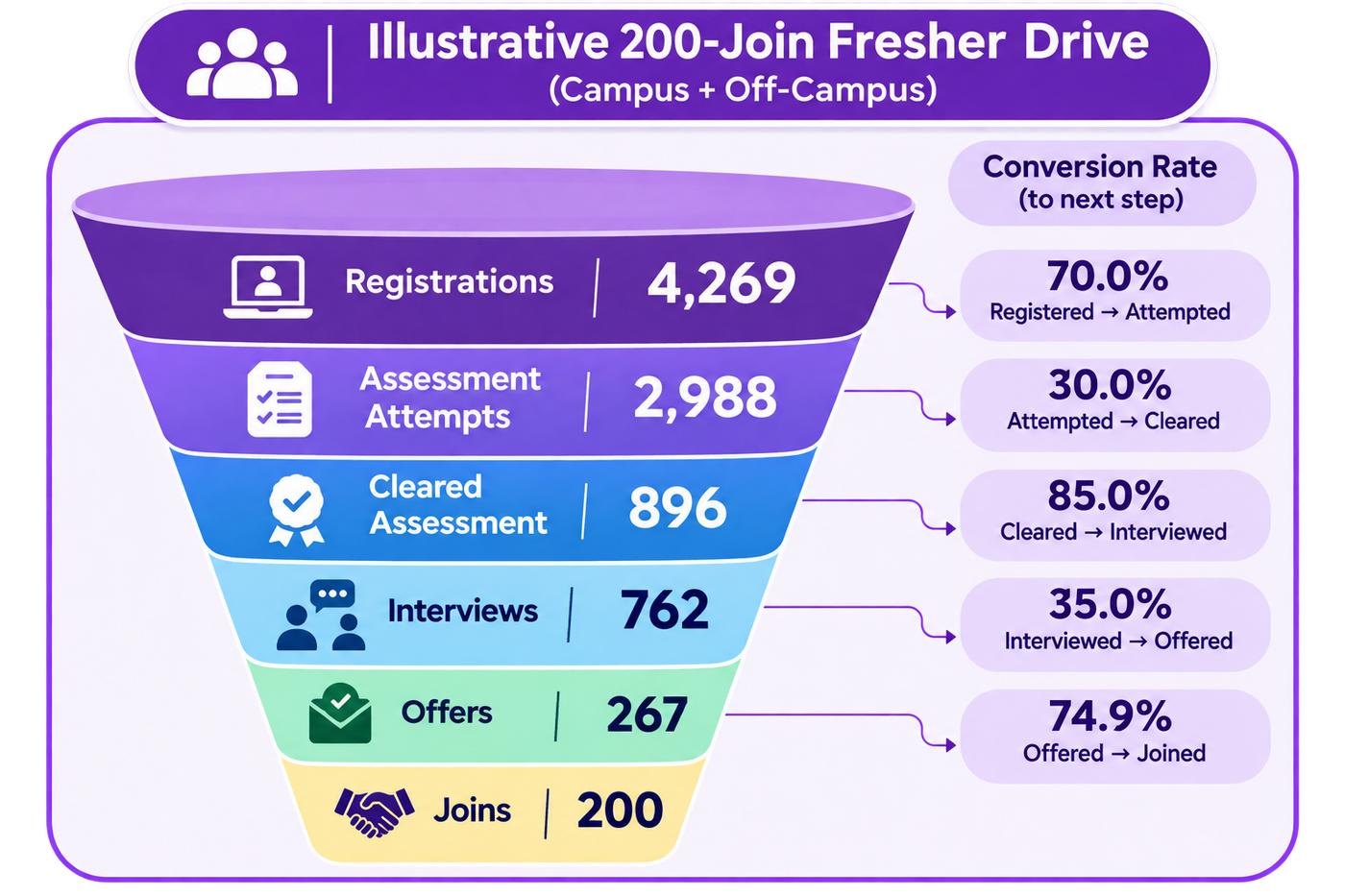
The example drive needs about 4,270 registrations to reach 200 joins.
How Do You Run Interviews and Logistics Without Chaos?
Book the interview in the same conversation as the assessment result, and give candidates a short list of real slots. Delay gives qualified freshers time to accept another offer.
Plan the interview days before the drive starts.
- On campus, fix panel dates with each placement cell and book a reserve day.
- Off campus, run batch interview days by city or online, with the same slot rules.
- Send the same scorecard to every panel so scores compare across sources.
- Send reminders the day before and a few hours before.
In the example, 95 panel days is a large block of interviewer time. Count interviewer availability early, because it often limits the drive before candidate supply does. Tell every candidate when they will hear, and keep that promise even when the answer is no.
How Do You Make Offers and Collect Documents at Volume?
Issue offers soon after the panel decision, in writing, and collect the documents joining needs in the same step. A fresher weighing several offers is more likely to accept the one with clear terms.
According to the Press Information Bureau (21 November 2025), the four labour codes became effective that day, and the release lists mandatory appointment letters to all workers. A bulk offer template with e-signature saves hours across hundreds of hires.
A complete offer holds the role, location, pay, joining date and a named contact. It also lists the documents to submit, such as degree proof or final marksheets when results are pending. Add a clear note on what happens if final results are late.
Track every offer in one record per candidate: status, documents received, documents missing and next contact date. A shared tracker works if one person owns it.
What Happens Between the Offer and Joining Day?
This gap is the most under-managed stage of a fresher drive. For campus hires it is often long, because final exams and results sit before day one. In the example, a drop from 75% to 60% joining adds 25% to the whole funnel.
Freshers drop for ordinary reasons: a better offer, family concerns, a change in plans, or silence from the employer. Our post on why candidates ghost covers the pattern.
The answer is regular, useful contact on a schedule. The table sets out one.
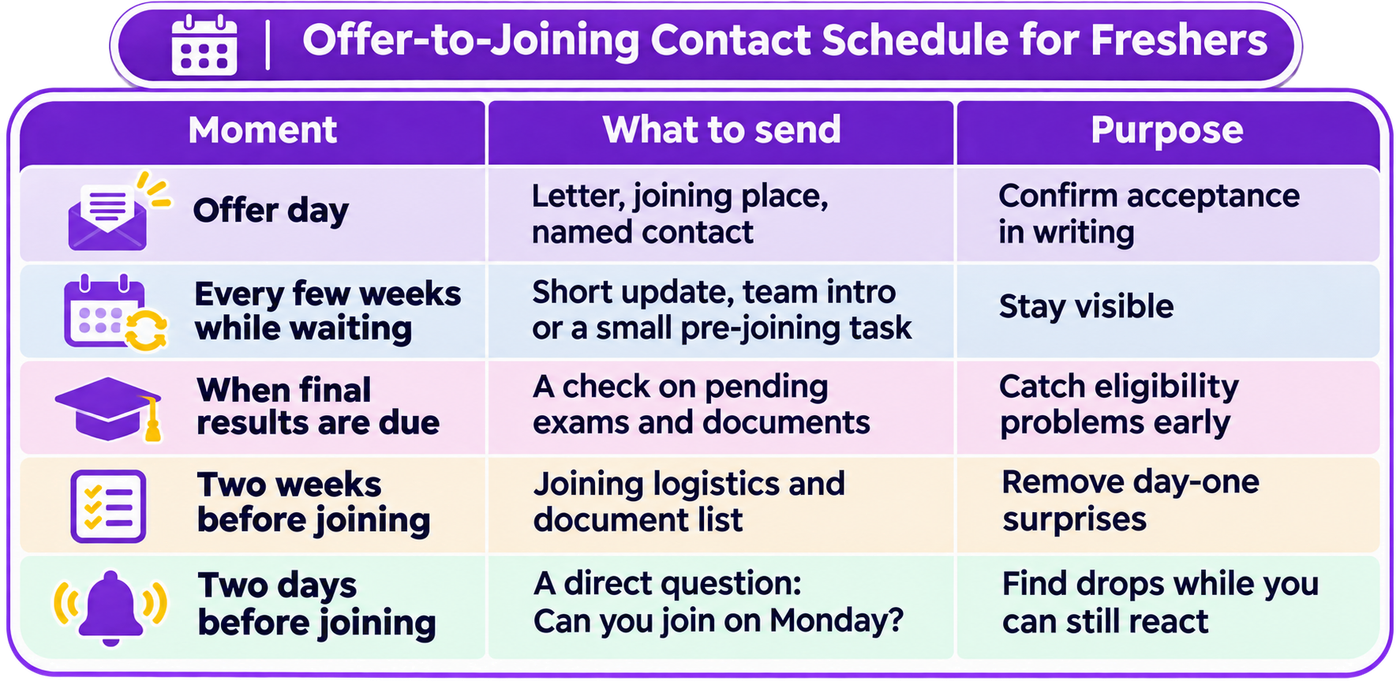
Hold a reserve list. If you expect 75% of offers to convert, over-issue to match, and keep the next ranked candidates warm in each tier or pool.
Which Metrics Show a Fresher Drive Is Working?
Track five numbers per source and per stage: registration-to-assessment rate, assessment pass rate, interview attendance, offer acceptance and offer-to-joining rate. Compare them with the assumptions you set at the start.
Add two checks. Measure time from registration to first contact, because delay loses candidates early. Measure joins per source, not applications per source, because a pool that sends volume and few joins wastes screening time.
Keep scores, notes and consent in one place, tagged by source and role. Candidates who cleared the assessment but missed an offer, and offer holders who did not join, are warm leads for your next drive.
How Should You Handle Fresher Data Under DPDP?
Treat candidate data as personal data you must justify. The Press Information Bureau reported on 14 November 2025 that the Government of India notified the DPDP Rules, 2025, making the Act fully operational. It lists seven principles, including consent and transparency, purpose limitation, data minimisation and storage limitation.
In a drive, this means four habits. Tell candidates why you collect each item, record their consent, collect only what the screen and offer need, and set a deletion date for those you do not hire. Placement cells and fresher pools also share lists with you, so agree in writing what you may use them for and how long you may keep them. This is general information, not legal advice, so confirm your approach with counsel.
When Is a High-Volume Fresher Drive Not the Right Choice?
A large drive suits roles you fill in batches with similar entry requirements. It is a poor fit for a handful of specialised roles, or when you cannot support the joining wait.
If you hire 10 freshers a year, a few strong colleges or referrals, a short test and a recruiter’s phone may be enough. Roles needing licences, deep domain skills or senior sign-off also need a person at more steps.
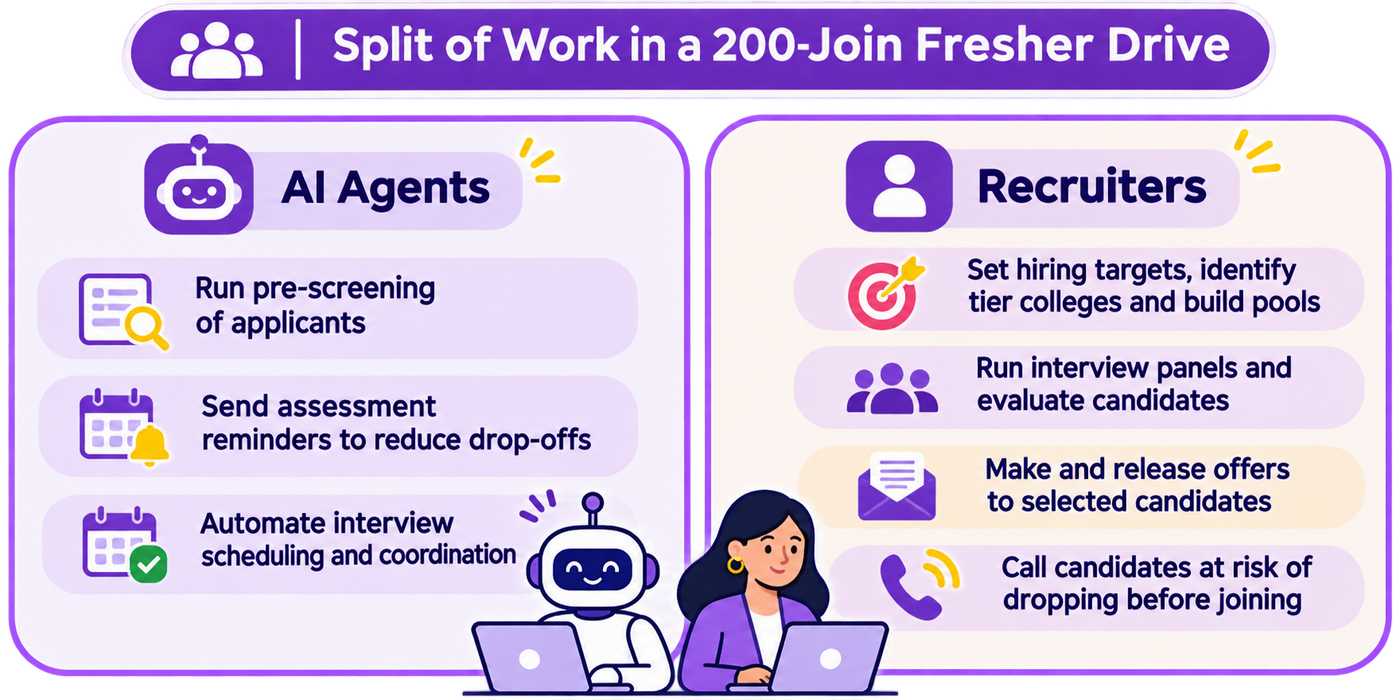
Even in a large drive, people set targets, choose pools, interview and close offers. HireBound’s bulk hiring solution for corporates covers campaign setup, screening, skills testing, scheduling, offers and onboarding at volume. Recruiters using HireBound handle 3× more candidates per day than with a manual process, and a human reviews the shortlist. HireBound does not guarantee joins, and recruiters keep the judgement calls.
The diagram shows how the work splits in a high-volume fresher drive.
Planning a campus or off-campus drive of 100 or more hires? Talk to HireBound about running it end to end →
A Decision Rule for Your First Drive
Fresher hiring in India comes down to four habits. Plan backwards from joins with your own conversion rates, pick pools by fit, screen and test candidates on the channel they answer, and treat the offer-to-joining wait as a stage of its own.
If most of your week goes on chasing candidates for tests, slots and documents, weigh automation of screening and scheduling most heavily. Keep recruiters for panels and closing.


