Offer Letter Acceptance Email: Samples for Every Situation
 Suvam Moitra
 ·Oct 27, 2026·8 min read

Key Takeaways
- 1An acceptance email needs four things: a clear “I accept”, the role and CTC as you understood them, your joining date, and a thank-you.
- 2Five situations cover most Indian offers: plain acceptance, joining-date confirmation, acceptance during a notice period, a clarification request, and acceptance after negotiation.
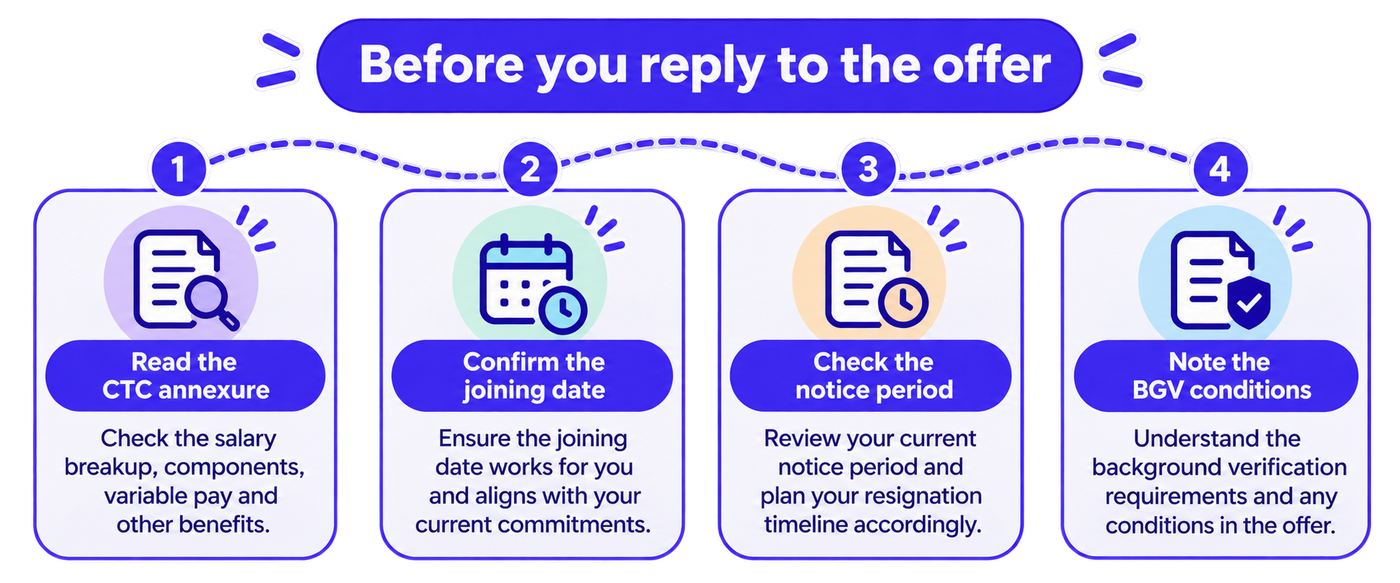
- 3Check the CTC annexure, joining date, notice-period buyout terms and background verification (BGV) conditions before you write “I accept”.
- 4Negotiate before you accept, never after. Once you reply “I accept”, asking for a higher CTC usually damages trust with the recruiter.
- 5Recruiters in India see 64% response on WhatsApp against about 12% on email (HireBound data), so a prompt email reply is worth following with a short WhatsApp note to the recruiter.
An offer letter acceptance email is a short reply that says you accept the role, confirms the terms you are agreeing to, and states your joining date. Keep it to five or six lines, send it from your personal email, and reply on the same thread as the offer. Below are five copy-ready samples, each with a subject line, for the situations Indian candidates actually face.
Replying fast helps, but replying carefully helps more. Most acceptance problems come from skipping the offer letter’s fine print, not from poor wording.
Recruiters sending offers at volume can see how HireBound handles bulk offer generation, tracking and e-signature.
What an Offer Letter Acceptance Email Must Say
Every acceptance email carries the same four parts. Miss one and the recruiter has to write back to ask.
- A clear acceptance. Say “I am pleased to accept the offer”. Do not hide it behind “looking forward to discussing”.
- The role and terms as you understand them. Name the designation, location and annual CTC.
- Your joining date. Give the date, or say when you will confirm it.
- Thanks and next steps. Thank the sender and ask what documents are needed.
Subject line options:
- Acceptance of Offer: [Role], [Your Full Name]
- Re: Offer Letter for [Role] at [Company]: Accepted
- Offer Acceptance: [Your Full Name], [Role]
Use “Re:” and keep the original thread when you can. It lets the recruiter and HR find the offer and your reply in one place.
Check These Four Things Before You Reply
An accepted offer is a commitment, and in practice it starts the joining and verification process. Read the whole letter and the annexure first. This article is general information, not legal advice, and an offer’s binding effect depends on its wording, so ask the employer or a lawyer if you are unsure.
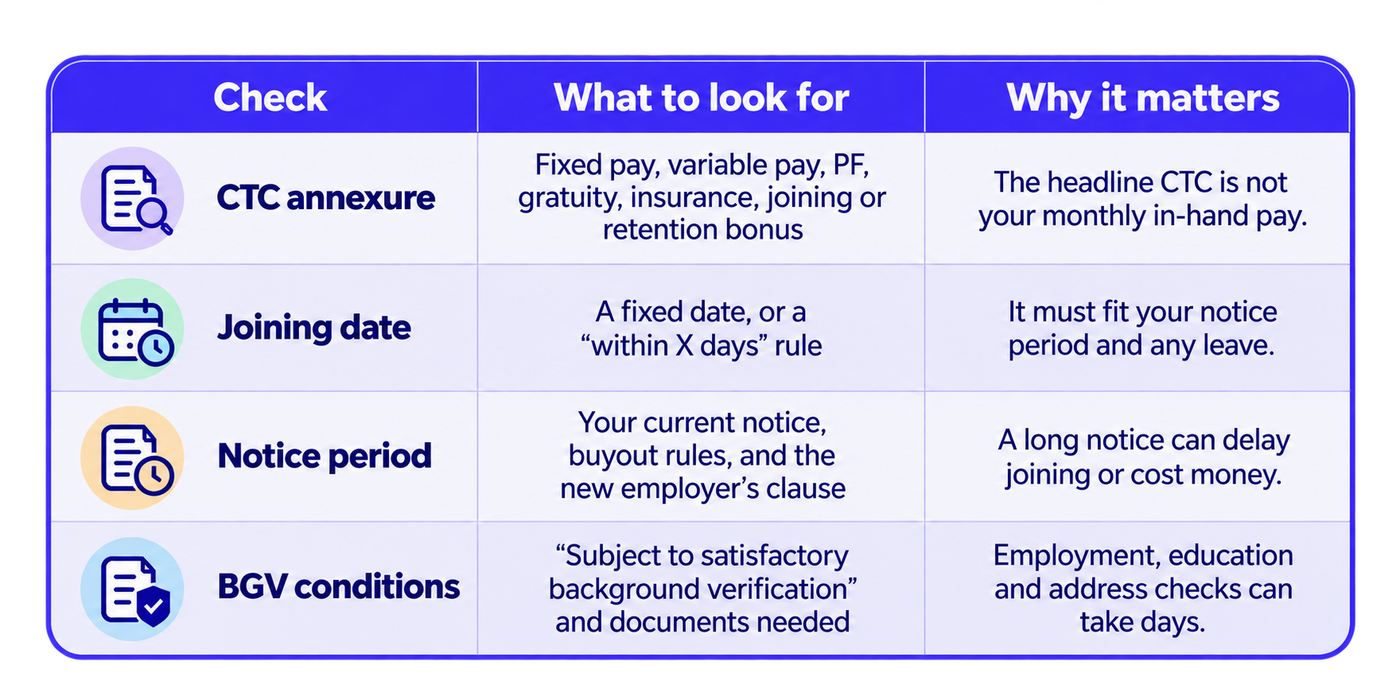
Use this table as your pre-send checklist.
If any of these is unclear, use the clarification sample below before you accept. For a view of the whole document, including the pay annexure, read a sample offer letter with each clause explained.
Five Offer Acceptance Email Samples
Replace the text in brackets and delete any line that does not apply.
1. Plain Acceptance
Use this when the offer is clear and you agree with every term.
Subject: Acceptance of Offer: [Role], [Your Full Name]
Dear [Recruiter or HR name],
Thank you for the offer for the position of [Role] at [Company]. I am pleased to accept it on the terms in your letter dated [date], including an annual CTC of Rs. [amount] and the role location in [city].
I will confirm my joining formalities as soon as I hear from you. Please let me know which documents you need from me.
Thank you again. I look forward to joining the team.
Regards,
[Your Full Name]
[Phone number]
2. Acceptance With Joining-Date Confirmation
Use this when the offer lists a date, or asks you to confirm one.
Subject: Offer Acceptance and Joining Date: [Your Full Name], [Role]
Dear [Name],
I am pleased to accept the offer for [Role] at [Company]. As per the letter, I confirm that I will join on [date] at [location].
Could you please share the joining-day schedule, the documents to carry, and the reporting time? I will send my scanned documents by [date] if that helps with onboarding.
Regards,
[Your Full Name]
3. Acceptance While Serving a Notice Period
Use this when you are still working your notice. Do not promise a date that your current employer has not agreed to.
Subject: Offer Acceptance: [Your Full Name], Notice Period Until [Date]
Dear [Name],
Thank you for the offer for [Role] at [Company]. I am happy to accept.
I am currently serving a [number]-day notice period that ends on [date], as per my relieving terms. I can join on [date] after my relieving. I have also [applied for an early release / discussed a buyout] and will update you if the date moves earlier.
Please let me know if this works for the joining schedule.
Regards,
[Your Full Name]
Read more about how notice periods work in India, including buyouts and early release, before you commit to a date.
4. Acceptance Asking for a Clarification
Use this when one term is unclear. Ask, and do not write “I accept” until you have an answer. A partial acceptance leaves the recruiter unsure whether you are in or out.
Subject: Query on Offer Letter: [Your Full Name], [Role]
Dear [Name],
Thank you for the offer for [Role]. I am very interested in the role and would like to accept it.
Before I confirm, could you clarify [one specific item, for example: the variable pay percentage in the CTC annexure, the BGV timeline, or the notice-period clause in clause 7]? I can reply with my formal acceptance within [one or two] working days of your answer.
Regards,
[Your Full Name]
5. Acceptance After Negotiation
Use this when you negotiated and the revised terms are now agreed. Refer to the revised letter, and name what changed.
Subject: Acceptance of Revised Offer: [Your Full Name], [Role]
Dear [Name],
Thank you for revisiting the offer. I am pleased to accept the revised terms: annual CTC of Rs. [amount], designation of [title], and joining date of [date], as per your email of [date].
Please share the updated offer letter for my records. I am glad we reached an agreement and look forward to starting.
Regards,
[Your Full Name]
Keep the tone appreciative and brief. The negotiation is over, so do not reopen it in the acceptance.
What to Do If You Want to Negotiate First
Negotiate before you accept. Once you reply “I accept”, asking for a higher CTC or a better title sends a mixed signal and can sour an offer that was already agreed.
Ask in one message. Say you are keen on the role, name the specific term you want to discuss, and give a reason tied to your experience or to the market. Fix the term in writing and wait for a revised letter before you send sample 5.
Negotiation is one place where a short phone call helps. Follow it with an email so that both sides have the final terms in writing.
What Happens After You Accept
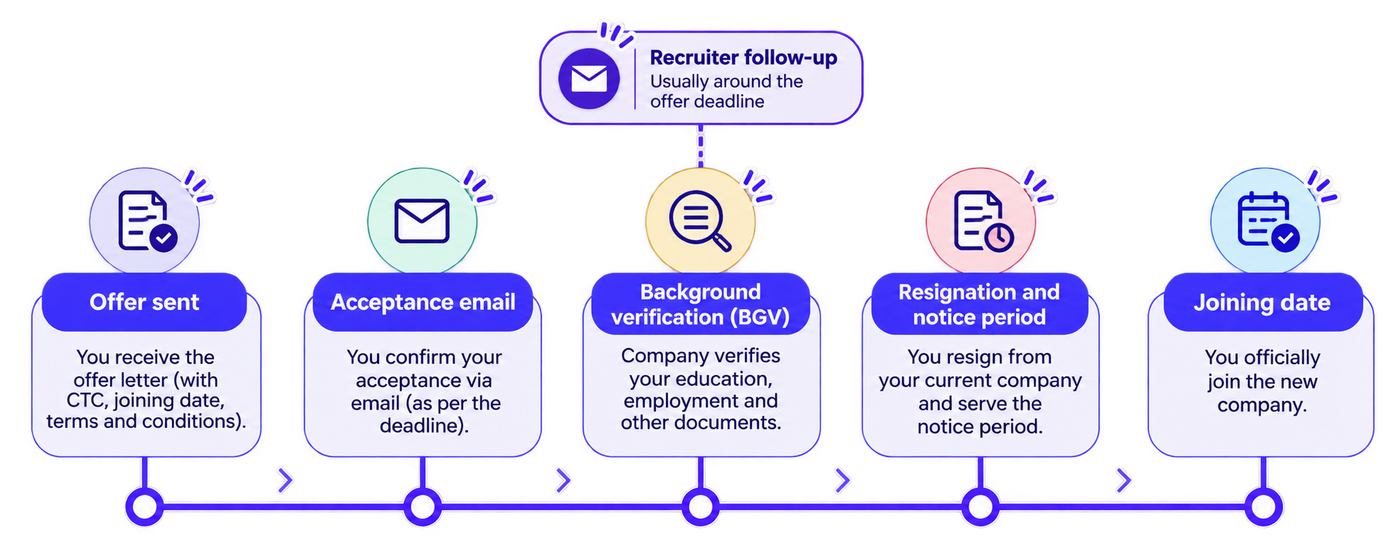
After acceptance, expect three steps in India.
- Background verification. The employer usually verifies employment, education and address, and may check identity documents. Many offers are “subject to satisfactory BGV”, so an accepted offer is not final until it clears.
- Resignation and relieving. You submit your resignation to your current employer and work out your notice, unless the notice is waived or bought out.
- Joining formalities. You sign the appointment letter, share documents, and get a joining date and a reporting manager.
Before you resign, get written confirmation from the new employer. Where the offer is subject to BGV, ask whether it is safe to resign now or after verification clears. If anything differs in the final letter, ask before you act.
Mistakes to Avoid in an Acceptance Email
These are the errors that most often cost candidates time or trust.
- Accepting before reading the annexure. The CTC may include variable pay or benefits you cannot take home monthly.
- Replying “OK” or “Noted”. Neither is a clear acceptance. Write the full sentence.
- Promising a joining date you cannot meet. Check your notice period and relieving terms first.
- Writing a long story. The email is a confirmation, not a cover letter.
- Replying from a work email. Use a personal address, so your current employer does not see it.
- Accepting and negotiating in the same email. Pick one. If you want to negotiate, do it first.
- Ignoring the deadline. Most offers carry an expiry date. If you need more time, ask in writing.
The Recruiter’s View: Why a Quick Acceptance Matters
A recruiter with an open offer has a plan that depends on your answer. If you decline or go silent, the recruiter may need to reopen the shortlist and restart interviews. That is why a timely acceptance, or a clear “I need two more days”, is useful to them.
For recruiters, the practical goal is a clear answer fast. Share the offer with a deadline, ask for a reply by email, and follow up on the day it is due. For more on the pattern behind silent candidates, see why candidates drop off and how to keep them engaged.
How to chase a silent candidate:
- Send a short check-in two working days after the offer, asking if they have any questions.
- Follow up by phone or WhatsApp on the day the offer expires, with a one-line message.
- Offer a quick call to answer open questions about CTC, joining or notice period.
- If there is still no reply, mark the offer as lapsed and tell the hiring manager.
Subject: Following up on your offer for [Role] at [Company]
Hi [Name],
Just checking in on the offer we sent on [date]. It is valid until [date]. If any detail is unclear, such as the CTC annexure or joining date, I am happy to walk through it on a quick call.
Regards,
[Recruiter name]
Channel choice matters here. HireBound’s data for India shows a 64% response rate on WhatsApp against about 12% for email. For high-volume hiring, HireBound’s bulk-hiring offering includes bulk offer generation, customizable templates, tracking and e-signature integration. For more email wording, see these recruiting email templates.
Sending offers in bulk? See how HireBound handles templates, tracking and e-signature. Talk to HireBound
One Rule to Remember
Read everything, resolve doubts, then accept in writing. A short, clear email sent after the annexure check protects both you and the recruiter. If you are the recruiter, make that reply easy to give.


