Probation Period in India: Meaning, Duration and Rules
 Suvam Moitra
 ·Oct 27, 2026·8 min read

Key Takeaways
- 1A probation period is a trial stretch after joining; India has no single central statute for it, so the appointment letter and applicable standing orders or state Act decide.
- 2The Model Standing Orders, 2026 (notified 8 May 2026) define probation as under six months, extendable by up to three months after a performance assessment.
- 3Under those model orders, a probationer is not entitled to notice or pay in lieu on termination, while a permanent worker gets one month’s notice.
- 4State Shops and Establishments Acts can add duties; the Delhi Act, for example, requires one month’s notice once an employee has three months of continuous service.
- 5Three written check-ins, at roughly month one, the midpoint and the end, turn probation from a formality into a documented confirmation decision.
A probation period is a fixed trial stretch at the start of a job, during which the employer checks whether the new hire fits the role before confirming them as a regular employee. In India, it commonly runs three to six months. No single central law sets one number for every employer.
That gap causes most of the confusion. The length, the notice terms and the leave rules come from a mix of your appointment letter, standing orders and the state Shops and Establishments Act. This guide explains each source, what changed after the Labour Codes, and how managers can run probation properly.
If you are a recruiter or talent leader, see how HireBound handles the work that comes before day one: explore the AI recruiting platform.
This is general information, not legal advice. Check your appointment letter and the law that applies to your establishment and state.
What Does Probation Period Mean?
Probation means a provisional employment stage. The employee works in the role, and the employer observes performance, conduct and attendance. At the end, the employer confirms the person, extends the period or ends the employment.
Probation is not the same as an internship, a trainee programme or a fixed-term contract. A trainee is usually in a learning programme with its own terms. A fixed-term employee is hired for a set duration with no automatic confirmation. A probationer is hired for a permanent post, subject to confirmation.
Two points are often misread.
- Probation is mainly a contract term. If the appointment letter has no probation clause, do not assume one exists. Ask HR, and check the standing orders that apply.
- Probation does not remove all protection. Wages, statutory deductions and equal treatment still apply from day one.
Where the Rules Come From
India has no single probation statute. Four sources work together, and the most specific one usually wins in practice.
- Appointment letter: states the probation length, the confirmation process and notice terms. This is the first document to read.
- Standing orders: apply to industrial establishments of a certain size and set rules for classifying workers, including probationers.
- State Shops and Establishments Acts: cover shops, offices and commercial establishments, and differ by state.
- The Labour Codes: four codes replaced 29 central labour laws. The Government of India brought them into force on 21 November 2025.
The most useful change for this topic is the Industrial Relations Code, 2020. On 8 May 2026, the Ministry of Labour and Employment notified the Model Standing Orders, 2026 under that Code (S.O. 2312(E), Gazette of India). Central rules under the codes were also notified in 2026. State rules were still being framed in many states when this was written, so check what your state has notified.
Under section 28 of the Industrial Relations Code, standing orders apply to an industrial establishment that has 300 or more workers, or had that many on any day in the preceding twelve months. The Code’s definition of “worker” leaves out people employed mainly in a managerial or administrative capacity. It also leaves out supervisors drawing wages above ₹18,000 a month, or a higher amount the Centre notifies. A software firm, an agency or a small office may therefore be governed mainly by its appointment letter and its state Act.
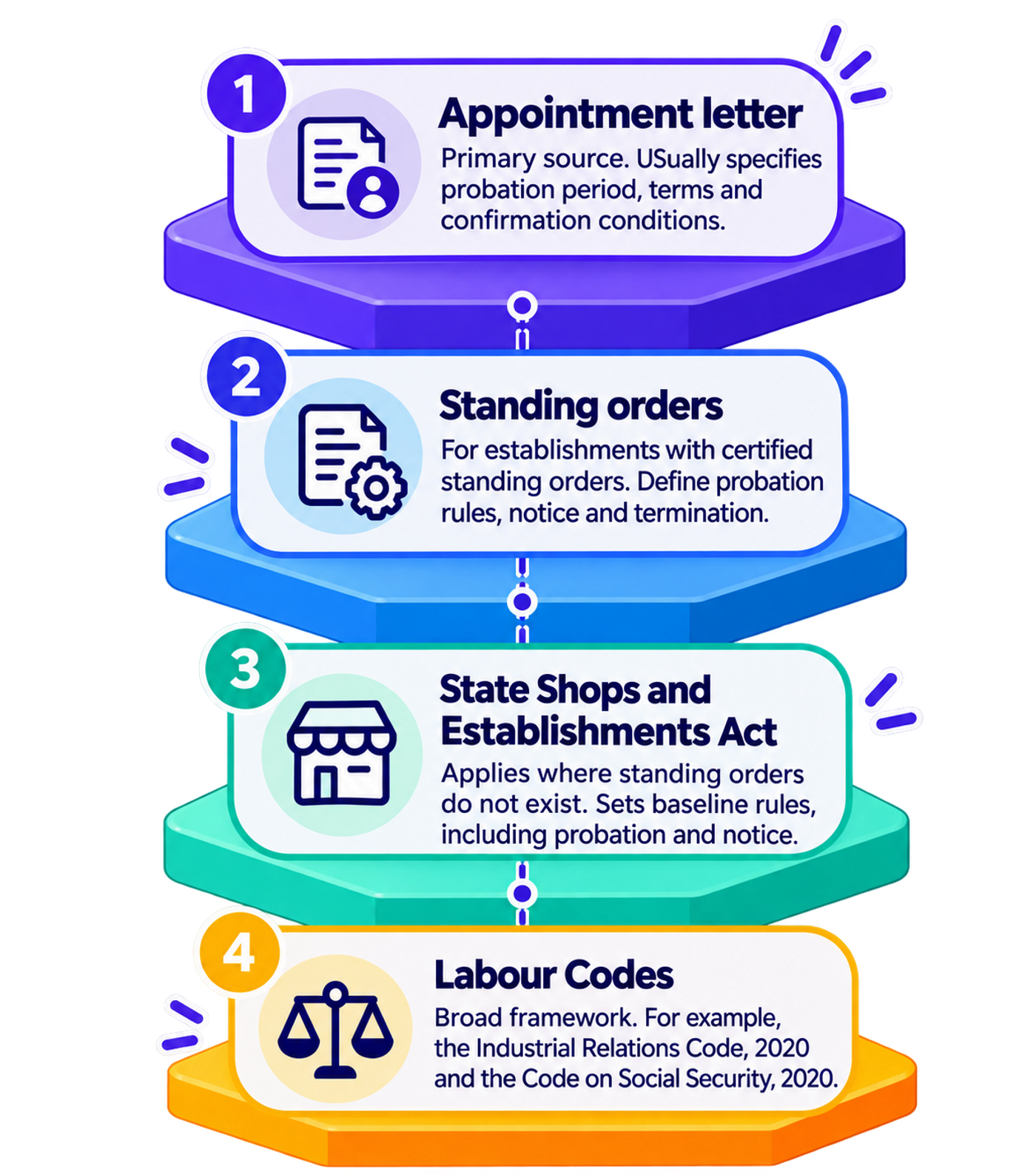
Ask which source applies to your employer, then read that one first.
How Long Does a Probation Period Last in India?
There is no universal figure, but the official model text gives a clear anchor. In the Model Standing Orders, 2026, a probationer is a worker provisionally employed to fill a permanent vacancy who has not completed six months of service in that post. An employer can extend the period by up to three months after assessing performance.
The 2026 orders supersede the Industrial Employment (Standing Orders) Central Rules, 1946, so far as model standing orders go. Check which set your establishment follows.
In practice, appointment letters commonly set probation at three or six months. Some roles, such as senior hires, carry shorter or no probation. Others set it at one year, which is hard to defend where standing orders cap it. A longer period in a letter is not automatically valid, but the answer depends on the establishment and the law that applies to it.
A worked example, with assumptions stated:
- An employee joins an establishment covered by the Model Standing Orders, 2026 on 1 April.
- The appointment letter sets a six-month probation, which ends on 30 September.
- The manager’s review finds gaps and extends probation by two months, which is within the three-month limit.
- Probation then ends on 30 November, and the employee is confirmed on that date if the review is satisfactory.
An extension beyond the permitted maximum, or an extension with no written assessment, invites a dispute. Keep the paperwork.
Extension and Confirmation
Probation ends in one of three ways: confirmation, extension or termination. Confirmation should be a documented decision, not an assumption.
Under the model orders, a probationer who completes the period satisfactorily becomes a permanent worker. The text treats interruptions such as leave, accident or a lockout as part of the probation period. Always check how your own letter treats long leave during probation.
A good confirmation process has four parts:
- A written review before the end date.
- A written outcome: confirmed, extended with reasons, or not confirmed.
- A confirmation letter that states the date and any change in terms.
- A record kept in the employee file.
Silence is the usual failure. If probation lapses with no letter, the status is unclear for both sides, so close the loop in writing.
Rights During Probation: Leave, Notice and Benefits
Probation changes some terms but not all. The table below shows what usually differs, based on the model orders and common letters. Your own letter and state law can change the details.
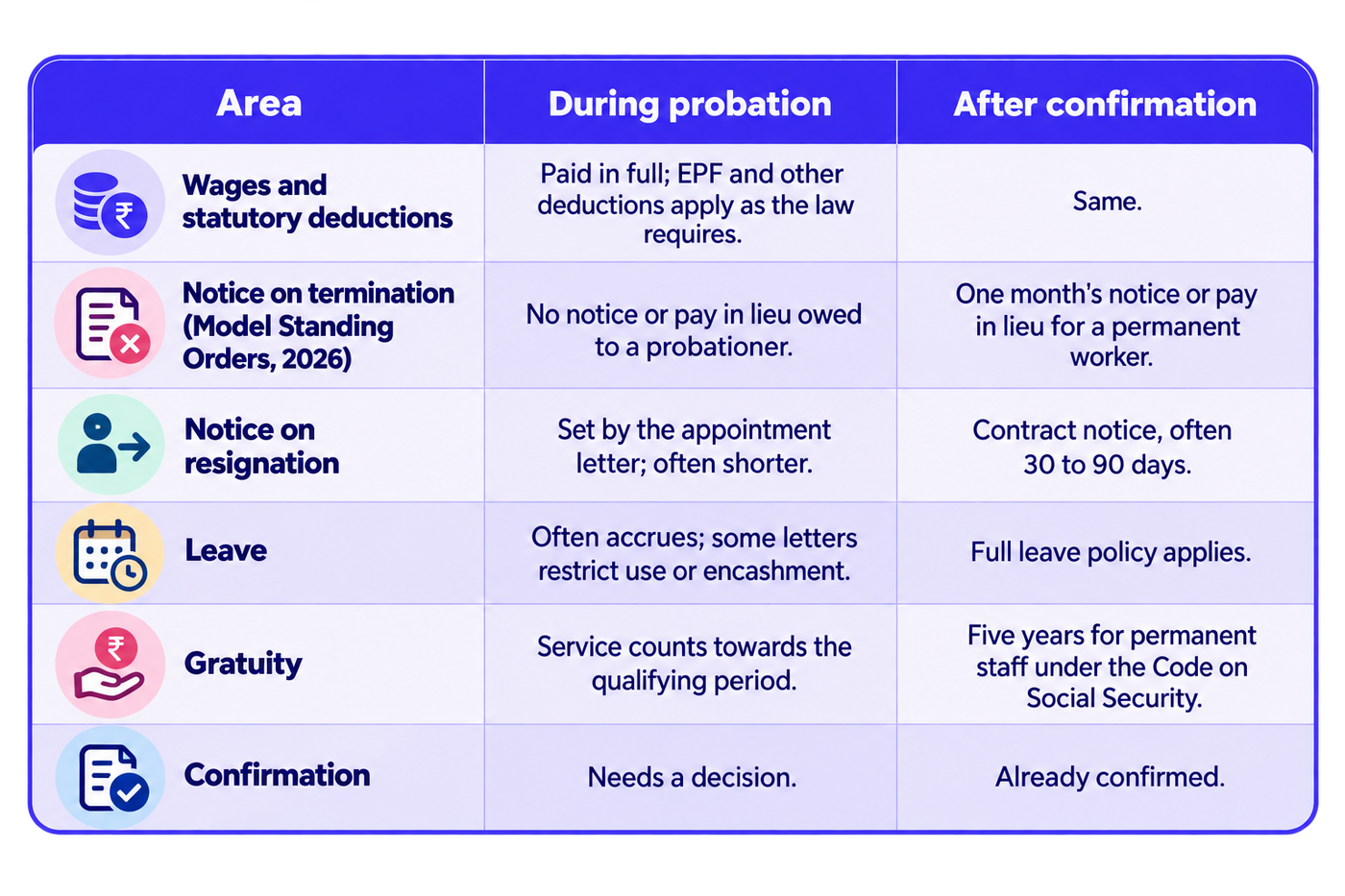
Termination notice is the main gap. Employers have the most flexibility during probation, and employees have the least security.
Two cautions apply. First, state Acts can add duties. The Delhi Shops and Establishments Act, 1954, for example, requires one month’s written notice or wages in lieu once an employee has three months of continuous service (section 30). Notice is not needed for misconduct dismissals after a written chance to explain. Second, the Ministry of Labour’s compliance handbook says fixed-term employees get gratuity after one year, while section 53 of the Code on Social Security keeps five years for others.
For how resignation notice works after confirmation, see HireBound’s guide to the notice period in India.
Leaving or Termination During Probation
An employer can usually end a probationer’s employment more easily than a confirmed employee’s. That does not mean it can do so without a reason or a record.
The safe approach has three rules:
- State the ground. Whether the cause is performance, conduct or role fit, write it down and link it to the review.
- Follow the letter. If the appointment letter promises notice or pay in lieu, honour it, even where the model orders do not require it.
- Settle dues on time. The Model Standing Orders, 2026 require wages and other dues to be paid before the end of the second working day after termination.
Termination for misconduct is a separate matter. It needs a proper opportunity to respond, as the standing orders and the state Act specify. Do not treat “probation” as a way around that process.
For the employee, leaving mid-probation usually follows the resignation clause in the letter. Many letters allow a short notice, often one week to one month. Read it before accepting an offer, and before resigning.
A Probation Review Framework for Managers
Probation reviews often fail for a simple reason. The manager never set goals or gave feedback, then declined to confirm someone who did not know the standard.
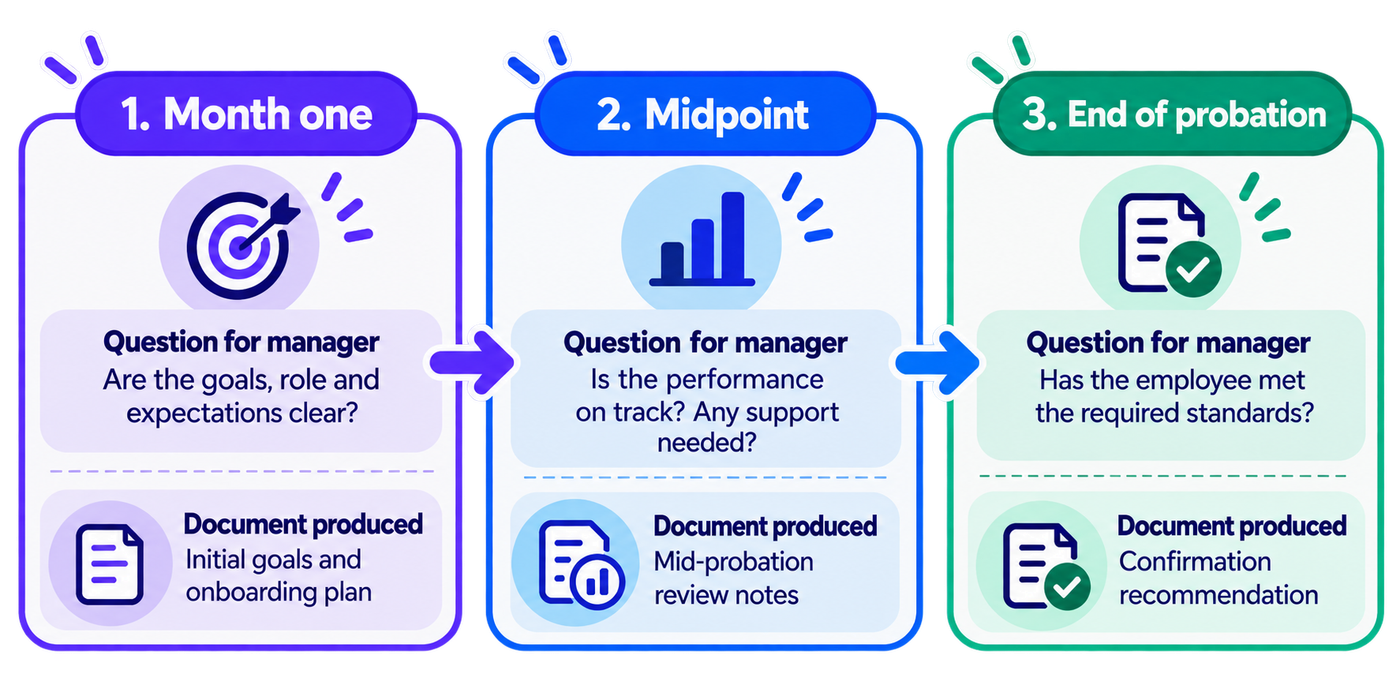
A three-check-in structure fixes this. It is a suggested practice, not a legal requirement.
- Month one, set the standard. Agree three to five goals in writing. Cover output, behaviour and any role-specific skill. Confirm how success will be measured.
- Midpoint, review the evidence. Compare work against the goals. Give written feedback with examples. Flag any risk of a non-confirmation decision now, not at the end.
- End of probation, decide. Score the goals, record the decision and share it with the employee before the deadline. State whether you are confirming, extending with a clear plan, or not confirming.
Use the same scorecard for every hire in the role. A structured scoring sheet, like the one in HireBound’s structured interview scorecard template, carries the same criteria from hiring into the probation review. That makes the confirmation decision easier to defend.
What Recruiters Can Do Before and During Probation
Probation outcomes are partly decided before the offer. A role with unclear criteria produces a weak hire, and a weak hire tends to show up early in the job. HireBound’s guides on how to measure quality of hire and the cost of a bad hire cover how to track and price that outcome.
Recruiters can help in three ways:
- Write the probation goals into the job brief, so candidates see them before they accept.
- Share the probation length and notice terms in the offer stage, not after joining.
- Stay in touch with joiners through the first weeks, so problems surface early.
This is where HireBound fits. It runs the work before day one: finding and ranking candidates against the role’s criteria, then engaging them over WhatsApp, SMS, email and Voice AI in 14 Indian languages. HireBound’s India figures show a 64% WhatsApp response rate against about 12% for email. Recruiters stay in charge of the offer, the probation terms and every decision about a person. HireBound does not run probation reviews or make confirmation decisions.
Hiring for roles where probation matters? See how HireBound’s AI agents screen and schedule candidates while recruiters keep the decisions: talk to the HireBound team.
Probation Period Meaning in Hindi
परिवीक्षा अवधि (Probation Period) वह शुरुआती समय है जिसमें नियोक्ता किसी नए कर्मचारी के काम, व्यवहार और उपयुक्तता को परखता है। इस अवधि के बाद कर्मचारी को स्थायी किया जाता है, अवधि बढ़ाई जाती है, या नौकरी समाप्त की जाती है।
भारत में अधिकतर कंपनियाँ तीन से छह महीने की परिवीक्षा अवधि रखती हैं। इसकी शर्तें नियुक्ति पत्र में लिखी होती हैं। कुछ संस्थानों पर स्थायी आदेश या राज्य का दुकान एवं प्रतिष्ठान अधिनियम भी लागू होता है। अपनी शर्तों के लिए नियुक्ति पत्र ज़रूर पढ़ें।


