CTC Meaning in Salary: Components, Formula and In-Hand Pay
 Suvam Moitra
 ·Oct 27, 2026·8 min read

Key Takeaways
- 1CTC stands for Cost to Company: the total yearly amount an employer spends on one employee, including pay that never reaches the bank account every month.
- 2In the worked example on a ₹6,00,000 CTC, employer PF, gratuity and insurance take ₹62,423, so fixed monthly in-hand is about 73% of CTC.
- 3India’s four Labour Codes took effect on 21 November 2025, and the Ministry of Labour says the new wage definition applies to gratuity from that date.
- 4Under the Code on Wages, allowances above 50% of total remuneration (gratuity and retrenchment compensation excluded) are added back to wages, so a very low basic can no longer shrink the wage base for gratuity.
- 5Ask for CTC split into fixed, variable and benefits, because a headline figure with no breakup hides the monthly in-hand number.
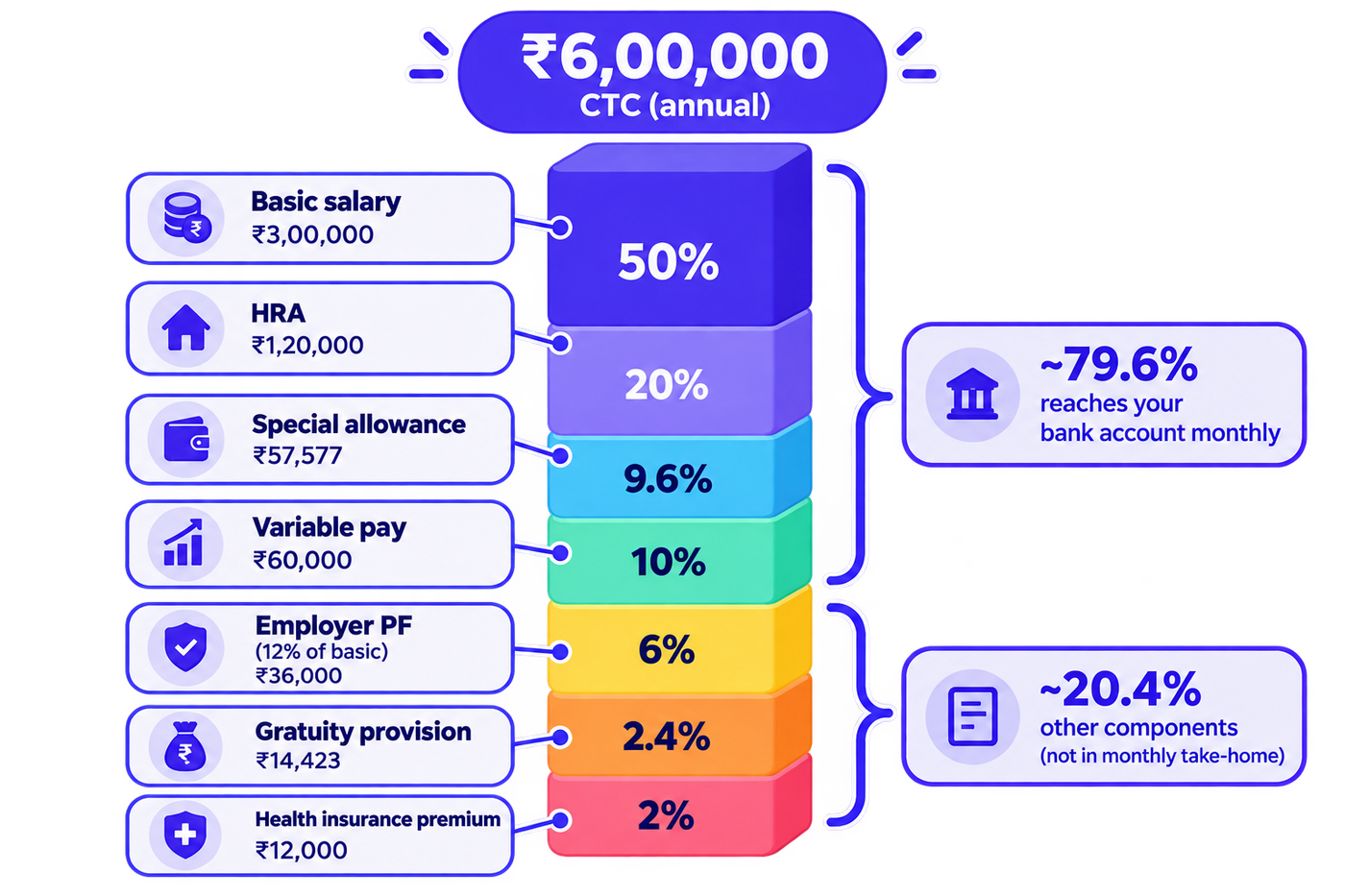
CTC stands for Cost to Company. It is the total amount a company spends on one employee in a year, including salary, employer contributions, benefits and variable pay. Your monthly bank credit is lower.
That gap confuses many first-time job seekers in India. A ₹6,00,000 CTC does not mean ₹50,000 a month in hand. This guide explains the components, the formula linking CTC, gross and in-hand pay, India’s new Labour Code rules, and what “expected CTC” means.
If you hire in India, the same breakup explains an offer clearly. See how HireBound supports offer-stage communication: explore the HireBound platform.
What Is CTC in Salary?
CTC is the sum of everything the employer pays or sets aside for you in a year. That includes cash you receive, such as basic pay and allowances. It also includes money the employer pays on your behalf, such as its share of provident fund and your gratuity provision.
In-hand salary, also called take-home pay, is the part you receive monthly after deductions.
The formula looks like this:
CTC = gross salary + employer contributions + benefits + variable pay (if included in the offer)
Companies define CTC slightly differently. Some include the annual bonus, the insurance premium or a joining bonus, so read the full breakup.
CTC Meaning in Hindi
हिंदी में CTC का मतलब है “कंपनी पर कुल खर्च”। इसका पूरा नाम Cost to Company है। यह वह कुल रकम है जो कंपनी एक कर्मचारी पर साल भर में खर्च करती है।
इस रकम में हर महीने मिलने वाली सैलरी के अलावा कंपनी का PF योगदान, ग्रेच्युटी, बीमा और वेरिएबल पे भी शामिल होते हैं। इसलिए बैंक खाते में आने वाली इन-हैंड सैलरी हमेशा CTC से कम होती है।
सरल उदाहरण: अगर CTC 6 लाख रुपये सालाना है, तो हर महीने 50,000 रुपये नहीं मिलेंगे। PF, ग्रेच्युटी और बीमा जैसी चीज़ें CTC में गिनी जाती हैं, पर वे हर महीने हाथ में नहीं आतीं।
What Goes Into a CTC Breakup
Fixed cash pay is what you receive every month before deductions:
- Basic salary: the core pay and the base for PF and gratuity. Employers often set it between 40% and 50% of CTC.
- House rent allowance (HRA): paid towards rent. It can reduce taxable income under rules that depend on the tax regime you choose.
- Special and other allowances: the balancing figure that fills the gap, such as special allowance, conveyance or a meal card.
Employer-paid items sit inside CTC but do not arrive monthly:
- Employer PF contribution: the employer’s share of provident fund. In a 2023 Press Information Bureau release, the Ministry of Labour and Employment says the employer contributes 12% of wages under the EPF Scheme, 1952.
- Gratuity provision: money the employer sets aside. Under the Code on Social Security, 2020, it is payable on exit after five years of continuous service in most cases.
- Insurance and other benefits: group health cover and similar items, valued at the employer’s premium.
Variable pay is the performance-linked part, such as a bonus or incentive. It is paid only if targets or company results are met, so treat it as uncertain.
The Labour Code Change Candidates Should Know
India’s four Labour Codes took effect on 21 November 2025, according to a Press Information Bureau release of that date. The Code on Wages sets one definition of “wages” and says that if allowances exceed 50% of total remuneration, the excess is added back to wages.
The Ministry of Labour and Employment’s FAQ dated 16 March 2026 adds that the revised wage definition applies to gratuity from 21 November 2025. It also says annual performance-based incentives are not part of “wages”.
In the Ministry’s FAQs, the excess over the 50% limit is added back to basic pay and dearness allowance, and statutory calculations use the revised wages. So a very low basic and a very high special allowance can no longer cut gratuity as much as before.
Employer PF and statutory bonus count towards total remuneration in that test. Gratuity does not. Take-home can shift for some employees, so check your own offer.
An Illustrative CTC Breakup
The table shows one way a ₹6,00,000 annual CTC could be split. It is an illustration, not a benchmark. The assumptions:
- Basic is 50% of CTC, so allowances stay within the 50% limit and no add-back arises.
- Employer PF is 12% of the full basic, not only of a capped wage.
- Gratuity provision is 15 days of basic for each year, which is about 4.81% of basic.
- Health insurance premium is ₹12,000 a year.
- Variable pay is 10% of CTC.
- Special allowance is the balancing figure.
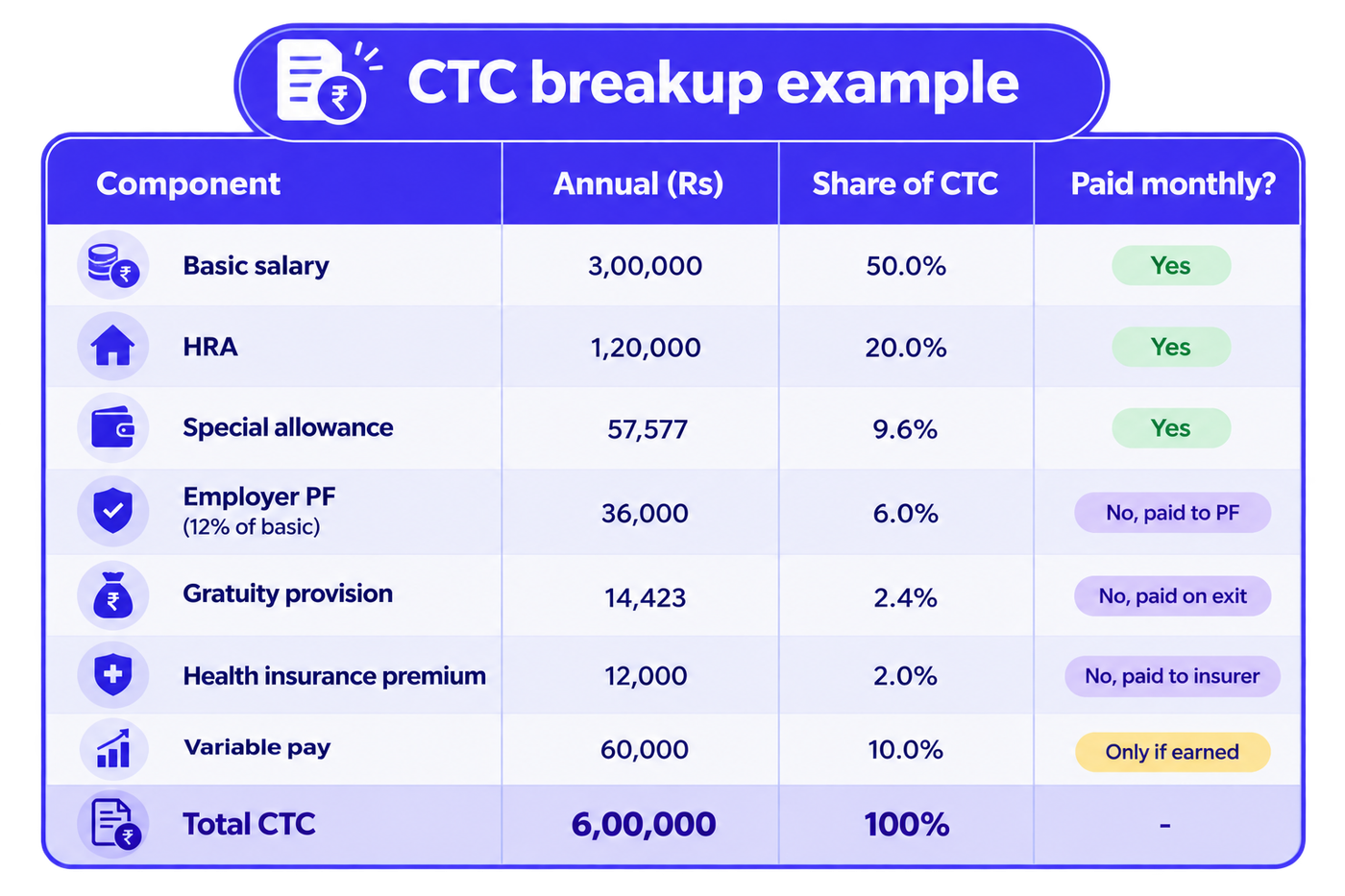
Only the first three rows, ₹4,77,577 a year, form the fixed monthly pay. The other ₹1,22,423 does not arrive as regular salary.
CTC vs Gross Salary vs In-Hand Salary
- CTC is the full annual cost to the employer.
- Gross salary is CTC minus the employer-paid items (employer PF, gratuity, insurance), and often minus variable pay that has not been earned yet.
- In-hand (net) salary is gross salary minus the employee’s deductions: employee PF, professional tax and income tax.
Why In-Hand Pay Is Lower Than CTC
Employer-side items. Employer PF, gratuity and insurance count towards CTC, but the employer pays them to the PF account, the gratuity fund or the insurer.
Employee PF. The same Ministry release says a covered employee contributes 12% of wages to the EPF, and the employer contributes 12% too. It defines those wages as basic wages, dearness allowance and retaining allowance, if any. It cites a statutory wage limit of ₹15,000 a month. Whether PF is calculated on actual basic or on a capped wage depends on the employer’s policy, so check which applies.
Professional tax. State governments levy it, so the amount depends on where you work. Article 276 of the Constitution caps it at ₹2,500 a year for one person, as amended by the Constitution (Sixtieth Amendment) Act, 1988.
Income tax. It depends on your regime and income. The Income Tax Department’s page for assessment year 2026-27 lists a nil rate up to ₹4,00,000 under the new regime. It also shows a Section 87A rebate of up to ₹60,000 for resident individuals with taxable income up to ₹12,00,000. The Income-tax Act, 2025 applies from 1 April 2026, so check the current slabs and rebate before you rely on these figures.
How to Calculate In-Hand Salary From CTC
Use the same ₹6,00,000 example, then repeat the steps with your own offer.
- Start with the annual CTC: ₹6,00,000.
- Subtract employer PF, gratuity and insurance (₹62,423) to get ₹5,37,577.
- Subtract variable pay (₹60,000) to get fixed gross of ₹4,77,577, or about ₹39,798 a month.
- Subtract employee PF (12% of basic, ₹3,000 a month) and professional tax (assumed ₹200 a month; states differ).
- Subtract income tax. Assuming the new regime, taxable income here is far below ₹12,00,000, so the rebate listed above makes tax nil under the assessment year 2026-27 rules.
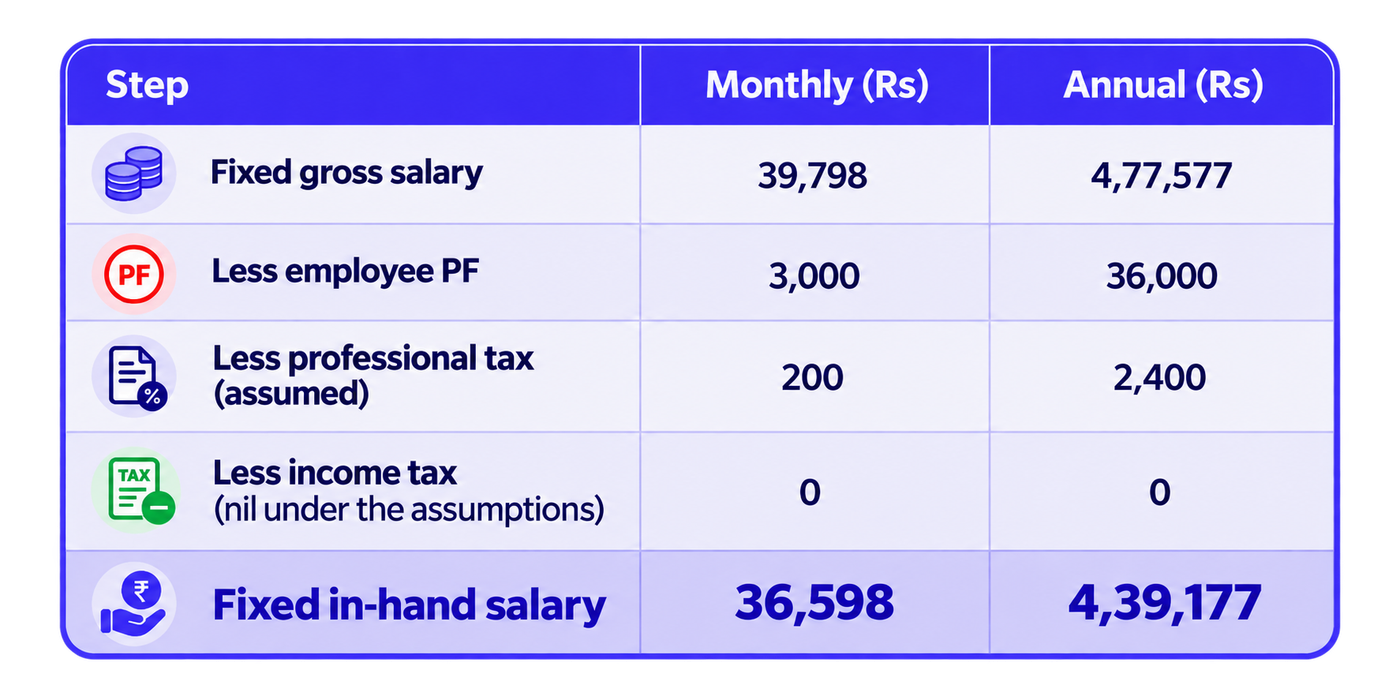
Fixed in-hand pay is about 73% of CTC in this illustration. CTC divided by 12 would suggest ₹50,000 a month, well above the real figure. Variable pay, if paid in full, adds ₹60,000 a year.
Expected CTC Meaning and How to Answer It
Expected CTC is the total annual package you want in the new job. Recruiters ask for it early to check the role’s budget.
Give a number with its structure, because a CTC with a large variable part is worth less than one that is mostly fixed.
- State your expected CTC as fixed pay plus variable pay.
- Ask what the CTC includes: PF, insurance, bonus, and any joining bonus.
- Convert any offer to monthly in-hand pay before comparing it with your current job.
Variable Pay and Joining Bonus Clawbacks
Ask whether the variable figure is a target, a maximum or a likely payout, and how it is measured.
A joining bonus often has a clawback clause: leave within a set period and you may repay it.
Enforceability depends on how the clause is drafted. This is general information, not legal advice.
Red Flags in a CTC Breakup
Ask about these patterns before you sign:
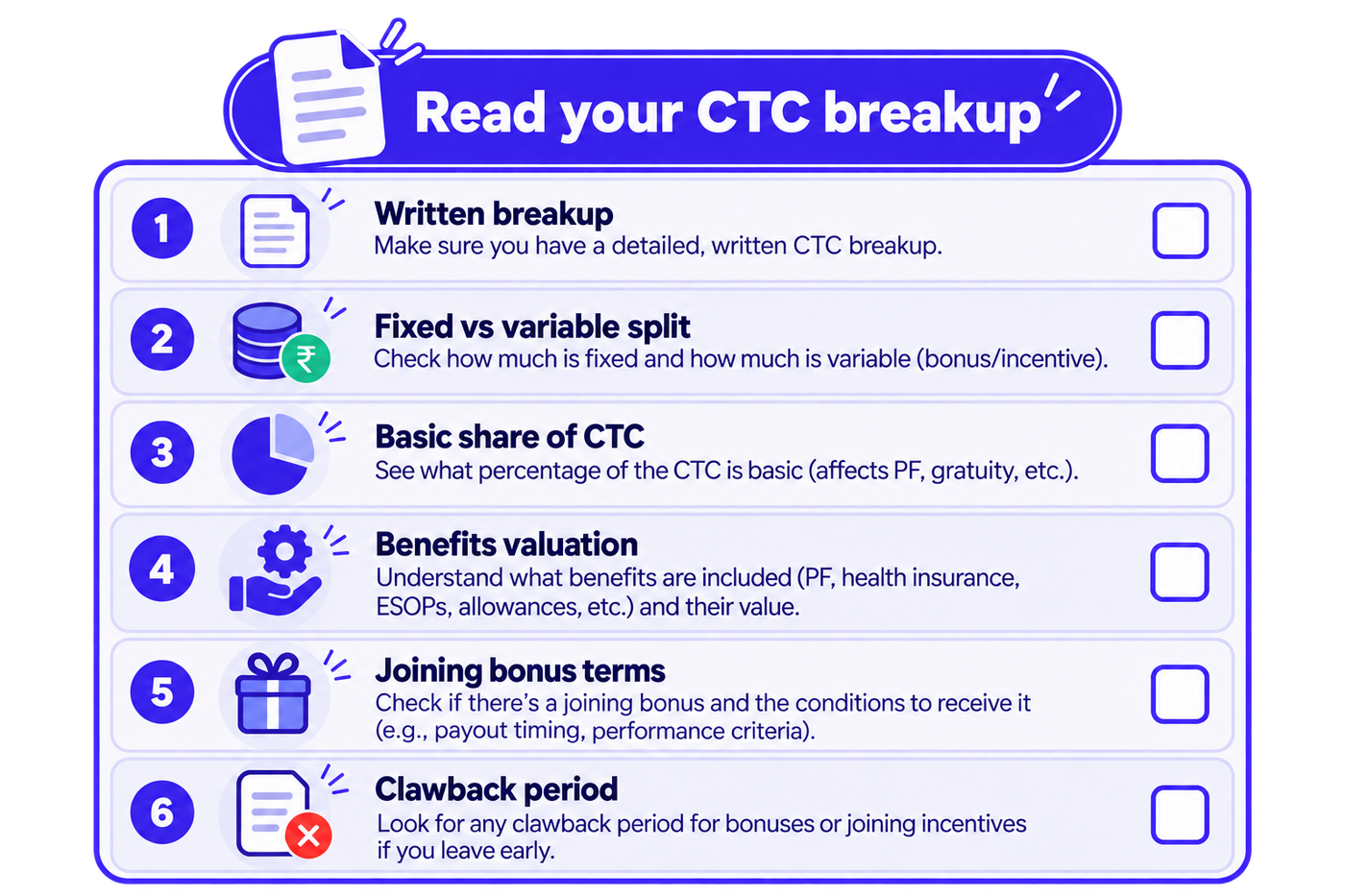
- No written breakup. A single number with no components cannot be compared with another offer.
- Heavy variable share. Fixed monthly pay may be far lower than expected.
- Unusually low basic pay. Check the gratuity effect against the 50% wage rule.
- Joining bonus inside CTC. A one-time payment can make year-one CTC look higher than it will be later.
How Recruiters Should Present CTC in Offers
Recruiters can avoid many offer disputes with one habit: present CTC and monthly in-hand pay together. A candidate who sees both numbers is less likely to feel misled later.
A clear offer conversation covers four points:
- The annual CTC and what it includes.
- The fixed monthly gross and the approximate in-hand figure.
- The variable pay: target, conditions and timing.
- Any bonus with a clawback, and the notice period.
Send the breakup in writing. The HireBound post on recruiting email templates has plain, human follow-up examples. The sample offer letter guide covers the letter itself.
A declined offer also raises hiring cost, as the cost per hire benchmarks guide explains.
Want offers that candidates understand the first time? Talk to the HireBound team about clear offer communication and follow-up.
Where HireBound Fits
Offer misunderstandings are communication problems. HireBound’s data shows a 64% WhatsApp response rate against about 12% for email. Its Voice AI handles conversations in 14 Indian languages, so follow-up can happen in the language a candidate prefers.
Within HireBound’s bulk-hiring offering, offers can be generated in bulk from templates, tracked, and signed through e-signature integration. Digital onboarding with document management follows the signed offer.


