Job Enquiry Email: Samples for Asking HR About Openings
 Devansh Dhawan
 ·Nov 15, 2026·11 min read

Key Takeaways
- 1A job enquiry email asks whether openings exist; a job application email applies to a named, advertised role. Mixing the two is the commonest reason HR does not reply.
- 2Recruiters weigh years of experience (84%) and type of experience (83%) first in an initial review (SHRM, 2023), so state both in your first two lines.
- 3Indian HR teams screen on total experience, location, notice period, current CTC and expected CTC, so an experienced enquiry email should list all five.
- 482% of employers in India struggle to find skilled talent (ManpowerGroup, 2026), so a specific enquiry with a clear skill and role reaches people who need candidates.
- 5Send one enquiry, follow up once after about a week, then stop. Name a role, a skill and one small ask in under 130 words.
A job enquiry email is a short message to a company's HR team asking whether suitable openings exist, usually when no role is advertised. It names the kind of role you want, shows one or two facts that make you a fit, and asks a single small question. Americans call the same thing a job inquiry email, and the format is identical.
Below are the format, nine subject lines and nine copy-ready templates, from a fresher's first note to a returnee's message. Each has a "use when" line. The advice comes from the recruiter's side of the inbox: what makes HR reply.
Recruiters reading this can see how HireBound helps hiring teams answer candidate emails faster.
What Is a Job Enquiry Email?
A job enquiry email asks "do you have, or expect to have, a role like this?" A job application email says "I am applying for this role." Because the question is open, the email has to make it easy for HR to say yes: it needs a clear role family, a location and a skill.
A cold email to a recruiter sits between the two. It targets a recruiter and often a known role, while an enquiry goes to a company's general HR contact and covers any suitable opening. The table shows the difference.
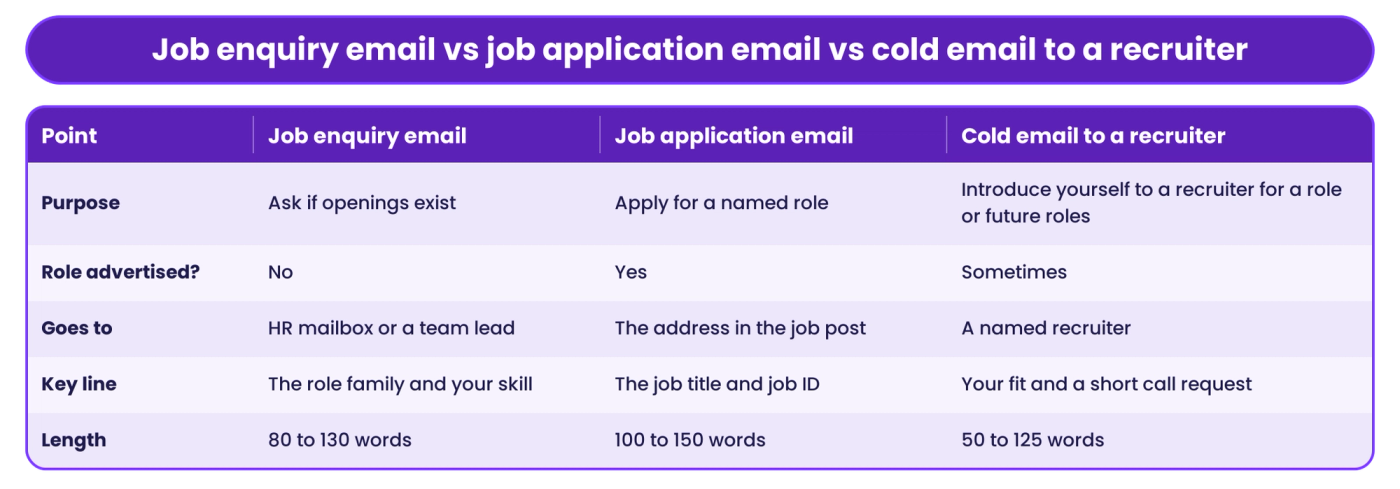
Pick the type by one test: if the job post exists, apply; if it does not, enquire.
Job Enquiry Mail Format: The Five Parts
Every template below uses the same five parts. Keep the whole email under 130 words, because HR reads it on a phone between calls.
- Subject line. Write three to eight words: the role family, your experience and your name.
- Greeting. Use "Dear Ms. Mehta" if you know the name, or "Dear Hiring Team" if you do not. Avoid "Dear Sir/Madam".
- Opening line. Say who you are and why this company, in one sentence.
- Fit. Give two or three facts: skill, years of experience, one result with a number.
- The ask and sign-off. Ask one question, such as "Do you have openings for a [Role], or could you keep my CV on file?" Then add your name, phone and CV link.
Attach your CV as a PDF named like "Priya-Sharma-Accounts-Executive.pdf". Add one attachment only, and include a link as well, because some company filters strip files. Send from a plain personal address on a weekday morning.
Subject Line Examples for a Job Enquiry Email
A good subject line says what you do and that you are asking about openings. These nine work for most situations:
- Enquiry: Accounts Executive, 3 Years, Pune
- Any openings for a Java Developer? 4 Years, Bengaluru
- Fresher Enquiry: B.Com Graduate, Tally and GST
- Marketing Roles: [Your Name], 5 Years, 30-Day Notice
- Enquiry about Sales Roles in Hyderabad: [Your Name]
- Referred by [Name]: Enquiry for Operations Roles
- Met at [Event] Job Fair: Enquiry for [Role]
- Following up on [Role] Closing: Open to Similar Roles
- Returning to Work: Finance Professional, 2 Years' Gap, Delhi
Avoid "Job", "Resume" or "Urgent" alone. Those say nothing, and HR sees dozens of them a day.
Job Enquiry Email Samples for HR
Use these when no role is advertised. Replace everything in square brackets, and delete any line that does not apply.
Template 1: General Enquiry to HR About Openings
Use when: you like a company and want to know if any suitable role is open.
Subject: Enquiry: [Role], [X] Years, [City]
Dear Hiring Team,
I am a [Role] with [X] years of experience in [skill], currently at [Company]. I admire [Company]'s work in [area] and would like to know if you have, or expect, openings in [function].
Could you let me know if there is a fit, or keep my CV on file? My CV is attached and linked here: [link].
Regards,
[Full name]
[Phone] | [City]
Template 2: Enquiry to a Specific Team or Hiring Manager
Use when: you know the team you want to join and have found a manager's name through a public profile.
Subject: [Skill] professional interested in [Team] at [Company]
Dear [Mr./Ms. Surname],
I follow [Team]'s work on [specific project or product]. I have [X] years in [skill] and recently [one result with a number].
Are you hiring, or planning to hire, for [Role] in [City]? I would be glad to send more detail or speak for ten minutes. My CV is attached.
Regards,
[Full name]
[Phone]
Job Enquiry Email for Freshers
A job enquiry email for freshers has less experience to show, so it leans on skills, projects and willingness to start soon. The recruiter's question is "can this person do the basics?" and your proof is a project, internship or certificate. For answers to the interview that follows, see our fresher interview questions and answers.
Template 3: Fresher Enquiry With No Experience
Use when: you are a final-year student or recent graduate with no full-time job.
Subject: Fresher Enquiry: [Degree], [Skill], [Your Name]
Dear Hiring Team,
I am a [degree] graduate from [College], [City], [year of passing], with [X]% marks. I have built [one project or internship], where I [what you did and result].
Do you have any openings for freshers in [function]? I can join immediately and relocate to [City]. My CV is attached.
Regards,
[Full name]
[Phone] | [LinkedIn or portfolio link]
Template 4: Internship Enquiry
Use when: you want a summer, winter or semester-end internship.
Subject: Internship Enquiry: [Field], [Duration], [Your Name]
Dear [Name],
I am a [year] student of [course] at [College]. I have worked on [project or skill] and would like to learn from your [team] team.
Are you offering internships from [month] for [X] weeks? I can work [on-site in City or remotely]. My CV is attached, and my college can share a recommendation letter if needed.
Regards,
[Full name]
[Phone]
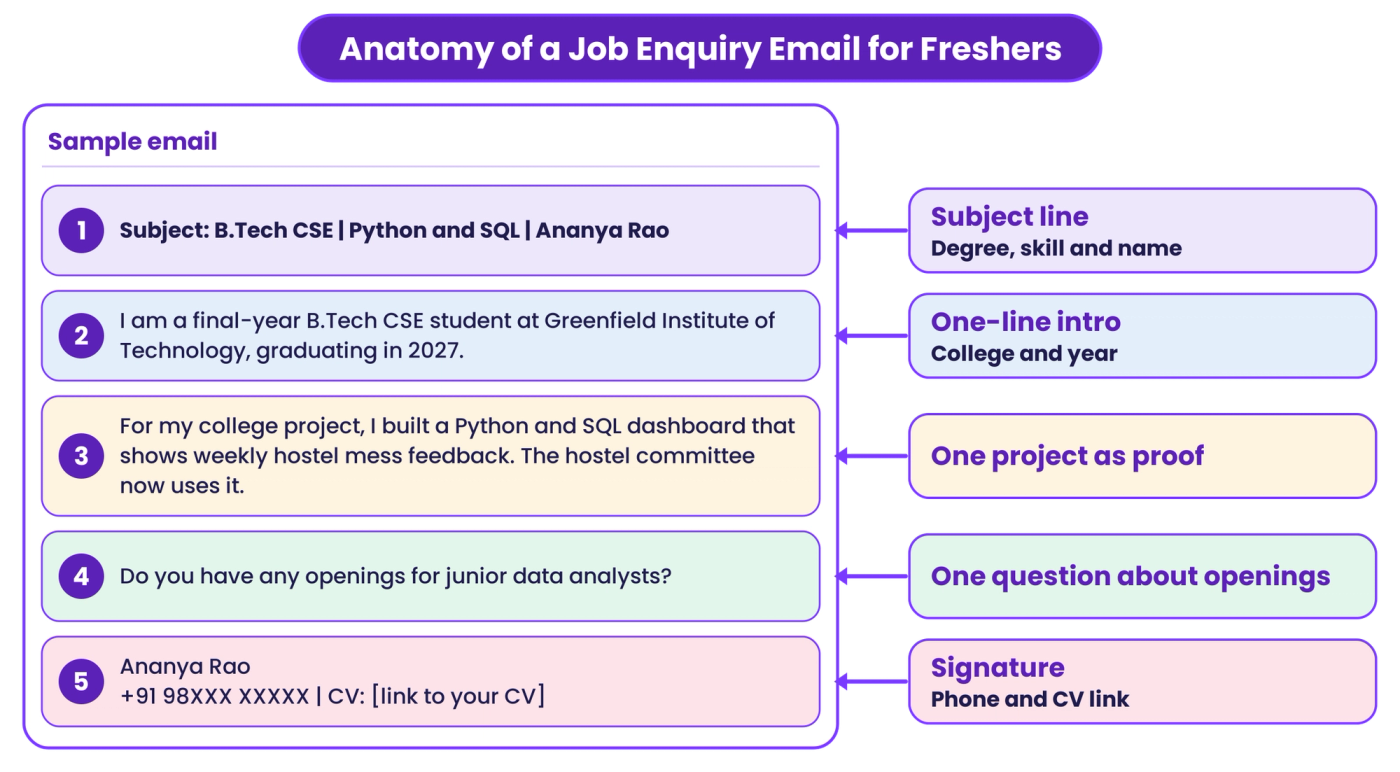
Freshers who show one concrete project give HR a reason to open the CV.
Job Enquiry Email for Experienced Professionals
Indian HR screens experienced candidates on a fixed set of facts before it reads anything else. Put them in a short block so the recruiter can copy them into a tracker. Quote current CTC in lakhs per annum, such as Rs. 8.5 LPA.
Template 5: Experienced Professional With Notice Period and CTC
Use when: you have two or more years of experience and are enquiring while still employed.
Subject: Enquiry: [Role], [X] Years, [Notice Period] Notice, [City]
Dear Ms. [Surname],
I am a [Role] with [X] years of experience in [skill], currently at [Company]. In my last role I [one result with a number].
Details for your reference:
- Total experience: [X] years
- Current location: [City] (open to [City])
- Notice period: [30/60/90] days
- Current CTC: Rs. [X] LPA
- Expected CTC: Rs. [Y] LPA
Do you have openings in [function]? My CV is attached.
Regards,
[Full name]
[Phone]
If your notice period is long, say if it is negotiable or if you can buy out part of it, because HR often has a hard joining date.
When You Have a Reason to Write: Walk-Ins, Closed Roles and Career Breaks
In each of these, the first line gives HR a reason to remember you.
Template 6: Enquiry After a Walk-In Drive or Job Fair
Use when: you met the company at a walk-in drive, campus event or job fair and heard nothing.
Subject: Met at [Event] on [Date]: Enquiry for [Role]
Dear [Name],
I attended your walk-in drive at [Venue] on [date] and spoke with [Name, if you remember it] about [Role]. I have [X] years in [skill], and my CV is attached.
Could you tell me whether the process has moved forward, or if any other openings suit me? I am available on [days or notice].
Regards,
[Full name]
[Phone]
Template 7: Enquiry About a Role That Closed or Was Filled
Use when: a job post has gone but you liked the company.
Subject: Interested in future [Role] openings: [Your Name]
Dear Hiring Team,
I saw the [Role] opening on [site] and understand it has closed. I would like to be considered for similar roles at [Company], as my work in [skill] matches what the team looked for.
Please keep my CV on file, and let me know if I should apply to any other open role. My CV is attached.
Regards,
[Full name]
[Phone]
Template 8: Returning After a Career Break
Use when: you left work for caregiving, health, study or relocation and want to return.
Subject: Returning to Work: [Role], [X] Years' Experience, [City]
Dear Ms. [Surname],
I have [X] years of experience as a [Role] and took a [duration] break for [one-line reason]. During that time I completed [course or freelance work], and I am ready to return full-time in [function].
Do you have openings that suit this background? I can join within [notice period]. My CV is attached.
Regards,
[Full name]
[Phone]
State the break plainly and briefly, without a long apology.
Short Job Enquiry Message for WhatsApp or LinkedIn
Use a short version only when HR has shared a number or you are already connected. HireBound's data shows a 64% response rate on WhatsApp in India, against about 12% for email, which is why many recruiters prefer it after first contact. Do not message a personal number nobody gave you.
Template 9: One-Line WhatsApp or LinkedIn Enquiry
Use when: you are connected on LinkedIn or HR asked you to message.
Hi [Name], I am a [Role] with [X] years in [skill], based in [City]. Are there openings in [function] at [Company]? I can email my CV if helpful.
Keep it under 300 characters, and do not send a CV file unasked.
What Does HR Check Before Replying to an Enquiry?
HR checks four things in about ten seconds: the role family, the experience level, the location and whether anything is missing. If the answer is clear, HR forwards the CV to the right team lead or keeps it on file. If it is not, the email stays unread.
SHRM's 2023 study of over 1,030 recruiters found that years of experience (84%) and type of experience (83%) are the first things recruiters weigh in an initial review. Put both in your opening lines. In India, add notice period and CTC, since 45% of those recruiters also looked at expected salary.
Inbox volume explains the rest. Teams that use HireBound's recruiting email automation manage candidate replies and follow-ups in one threaded inbox, because enquiries compete with active candidates for attention. An enquiry that names one role and one location is easy to route.
ManpowerGroup's 2026 Global Talent Shortage Survey found that 82% of employers in India struggle to find the skilled talent they need.
Common Mistakes in a Job Enquiry Email
Check your draft against this list before you send it.
- An open ask. "Please let me know if any job is available" gives HR nothing to match. Name a role family.
- A vague subject line. "Job enquiry" or "Resume" tells HR nothing.
- A long autobiography. Your story belongs in the CV.
- Bulk mailing. Sending the same text to 50 companies shows. Change the company name, the first line and the role.
- A wrong name or company. One mismatch ends the conversation.
- Missing basics. Experienced candidates in India who leave out notice period and CTC create an extra round.
How to Follow Up on a Job Enquiry
Follow up once, about seven working days after your first email. A mailbox that is not tied to a live role has no deadline, so silence usually means "not now" rather than "no".
Reply on the same thread and add one new fact, such as a certificate or project.
Subject: Re: [Original subject line]
Dear [Name],
I wrote on [date] about [Role] openings. I have since [one new detail], and I remain very interested in [Company].
Could you let me know if there is a fit, or keep my CV on file?
Regards,
[Full name]
If there is no reply, stop and move on. For full follow-up sequences and a thank-you email, use the templates in our cold email to recruiter guide. When a company replies with a call or a slot, our interview invitation email templates show what to expect and how to confirm.
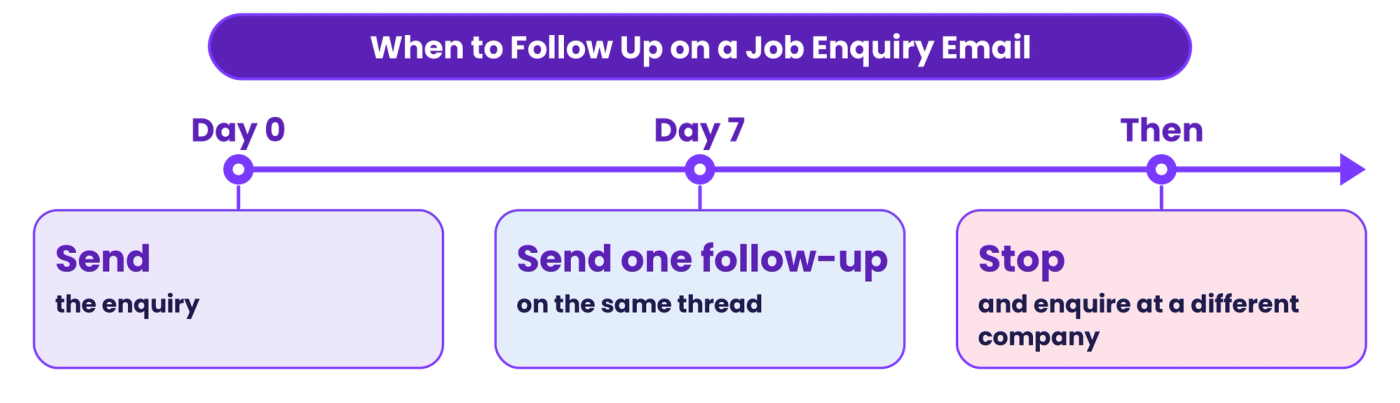
One follow-up after a week respects HR's inbox and gives your enquiry a second look.
How Do You Find the Right HR Email Address?
Find an address a company has chosen to publish, and do not guess or scrape. Start with the careers page, the "contact us" page and any job post that lists an email for applications. Many companies publish a "careers@" or "hr@" mailbox.
Next, check public LinkedIn profiles for the name of an HR manager or team lead, then write to the published mailbox or send a connection request first. Do not buy lists of personal emails or pull addresses from leaked databases. If no address exists, apply through the portal and use the short LinkedIn version.
Hiring at volume and want every candidate email answered on time? See how HireBound's AI agents handle candidate outreach and follow-ups while recruiters keep the decisions: talk to the HireBound team.
Make the Enquiry Easy to Answer
A job enquiry email works when it names the role, shows your fit in two lines and asks one small question. Send it to a published HR address, follow up once and move on.


