Cold Email to Recruiter: Templates for Every Stage of a Job Search
 Tanmey Goswami
 ·Nov 11, 2026·10 min read

Key Takeaways
- 1A cold email to a recruiter works best at 50 to 125 words; Boomerang's study of 40 million+ emails found response rates above 50% in that range.
- 2The average worker gets 117 emails a day and skims most in under 60 seconds (Microsoft, 2025), so put the role and your fit in the first two lines.
- 3Send one follow-up after five to seven working days and a final one a week later; SHRM puts the median time to fill at 39 days, so early silence is normal.
- 4An email to HR for a job in India should list experience, location, notice period, current CTC and expected CTC, because recruiters screen on those first.
- 582% of Indian employers struggle to find skilled talent (ManpowerGroup, 2026), so a specific, well-targeted cold email reaches recruiters who need good candidates.
A cold email to a recruiter is a short, unsolicited message asking a recruiter to consider you for a role, or to keep you in mind for one. The best ones run 50 to 125 words. They name the role in the subject line, show your fit in two lines and end with one clear request.
Below are copyable templates with subject lines for each stage of a job search, from first outreach to the follow-up after an interview. There is also an India-style email to HR and a section written from the recruiter's side of the inbox.
Recruiters reading this can see how HireBound helps hiring teams reply to candidates faster.
What Is a Cold Email to a Recruiter?
A cold email to a recruiter is a message to someone who has not asked to hear from you. You might send it before applying, after applying, or when no role is posted yet. Its job is to get your CV opened and a short call booked.
The type of recruiter changes what you write. An in-house recruiter hires only for their own company, so name the team or the open role. An agency recruiter fills roles for several clients, so name the kind of role you want and your location. Our guide on what a recruiter does explains both.
Recruiters need candidates as much as candidates need recruiters. SHRM's Talent Trends 2025 survey found that 69% of HR professionals had trouble recruiting for full-time roles in the previous 12 months.
What Do Recruiters Actually Read?
Recruiters read the subject line, the first two lines and your signature. If those three parts tell them the role, the fit and how to reach you, they open the CV. If not, the email waits, often for good.
Volume explains this. Microsoft's 2025 Work Trend Index report found the average worker receives 117 emails a day and skims most of them in under 60 seconds. A recruiter with several open roles also gets applications, calls and messages from hiring managers.
Much of a recruiter's inbox is ongoing candidate conversations. Teams that use HireBound's recruiting email automation run thread-aware sequences and follow-ups that adapt to each reply, so your cold email lands beside those threads. HireBound's sourcing tools also let recruiters filter by skills, seniority, location and notice period, and those are the facts a recruiter looks for in your email.
Here is what a recruiter checks, in roughly the order they check it.
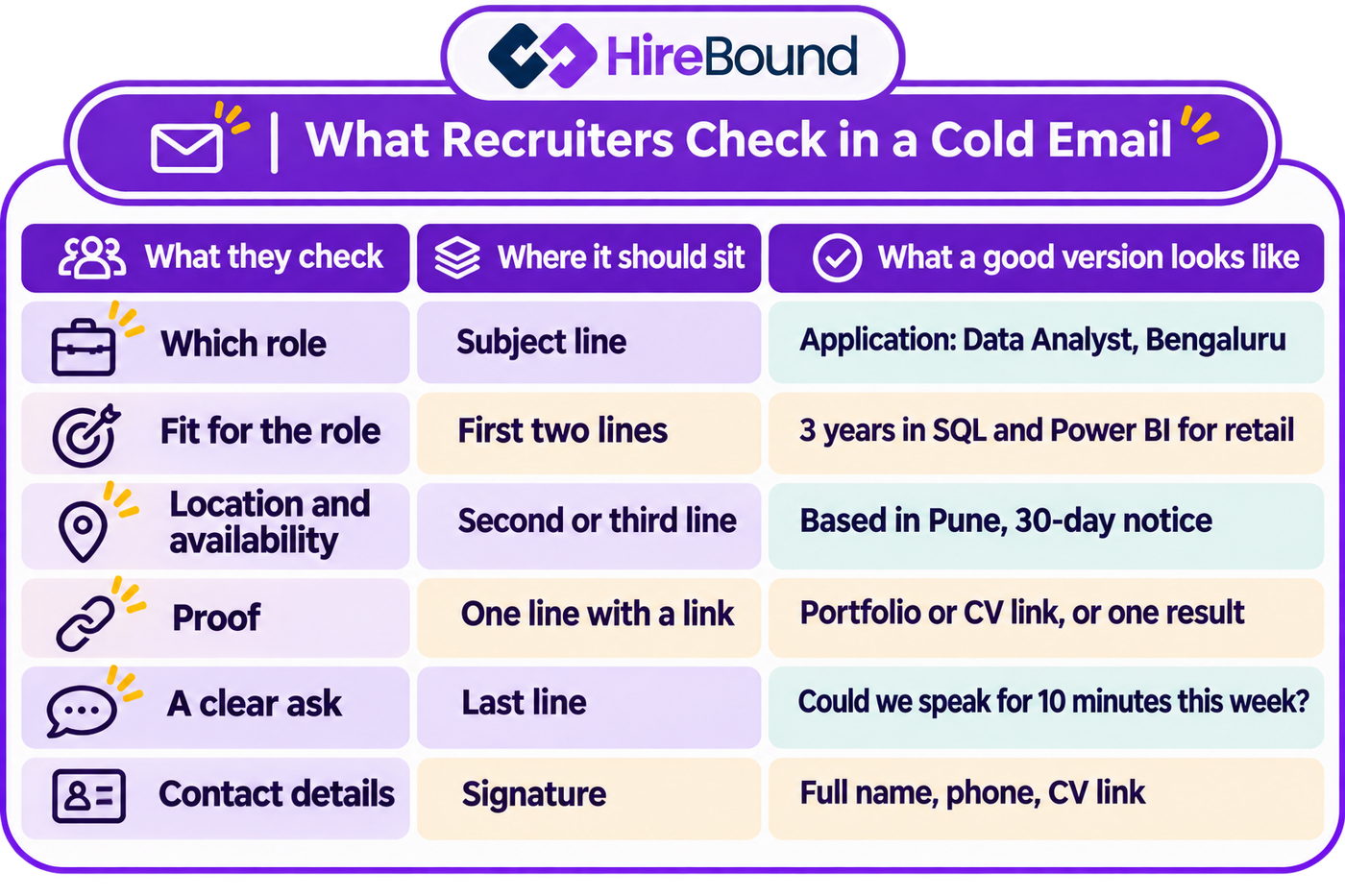
If a recruiter can answer all six from a skim, the email has done its job.
In-house recruiters often forward a strong candidate's email to the hiring manager. Write it so a stranger can read it cold and still know who you are.
How to Email a Recruiter: The Five Parts
Every template below uses the same five parts.
- Subject line. Name the role and yourself in three to six words. Boomerang's 2016 analysis of over 40 million emails found subject lines of three to four words got the most replies.
- Opening line. Say why you are writing to this person now: the role, the job ID, or how you found them.
- Fit. Give one or two facts that match the role, such as years of experience, a skill, or a result with a number.
- The ask. Make one small request, such as a 10-minute call. Boomerang found emails with one to three questions were 50% more likely to get a reply than emails with none.
- Sign-off. Full name, phone number and a link to your CV.
Keep the whole email between 50 and 125 words. In Boomerang's data, that range got response rates above 50%, and replies fell as emails grew longer. The data covers everyday email rather than job-search email, but it matches how recruiters skim.
Write from your personal address and send on a weekday morning. Attach the CV as a PDF and include a link too, because some company mail filters strip attachments.
Cold Email to Recruiter Templates for First Outreach
Use these before you apply, or when no role is posted. Replace everything in brackets.
Template 1: Cold Email to an In-House Recruiter
Subject: [Role] at [Company]: [Your Name]
Hi [Recruiter's first name],
I saw the [Role] opening on your careers page and wanted to reach out before applying. I have [number] years of experience in [skill or field], most recently at [Company], where I [one result with a number].
Would you be open to a 10-minute call this week to see if my background fits what the team needs? My CV is attached and here: [link].
Thank you,
[Full name]
[Phone] | [City]
Template 2: Cold Email to an Agency Recruiter
Subject: [Job title] in [City], available in [notice period]
Hi [Name],
I noticed you place [type of role] candidates in [city or industry]. I am a [job title] with [number] years in [skill], looking for my next role in [city or remote].
I can join within [notice period]. Could you let me know if any of your current roles fit? My CV is attached.
Best regards,
[Full name]
[Phone] | [CV link]
More subject lines for first outreach: "Experienced [Role] interested in [Company]", "[Role] candidate: [number] years in [skill]" and "Referred by [Name] for [Role]".
Email to Recruiter After Applying
Send this one to three working days after you apply through a careers page or job board. It moves your application from a pile to a person.
Subject: Applied for [Role], Job ID [number]: [Your Name]
Hi [Name],
I applied for the [Role] position (Job ID [number]) on [date] and wanted to introduce myself directly, as the role matches my work in [skill or area].
At [current company], I [one result with a number]. I would welcome a chance to discuss how that could help your team. My CV is attached for easy reference.
Thank you for your time,
[Full name]
[Phone]
Include the job ID if there is one. Recruiters manage many requisitions at once, and the ID lets them find your application in seconds.
Follow Up Email to Recruiter When There Is No Reply
Wait five to seven working days before you follow up. SHRM's 2026 recruiting benchmarking data puts the median time to fill a non-executive role at 39 calendar days, so a week of silence is normal.
Reply on the same thread so the recruiter sees your first email underneath.
Subject: Re: [Original subject line]
Hi [Name],
I wanted to follow up on my note from [date] about the [Role] position. I am still very interested, and I have since [one new, relevant detail, such as finishing a certification].
Is there a good time for a quick call this week or next?
Thanks,
[Full name]
If there is still no reply after another week, send one final, short note.
Subject: Re: [Original subject line]
Hi [Name],
This is my last follow-up on the [Role] role. If the timing is not right, I would be glad to be considered for similar roles later.
Best,
[Full name]
Stop after two follow-ups. A third message rarely changes the answer and can make a recruiter less keen to call you about the next role.
The schedule below shows when each email goes out.
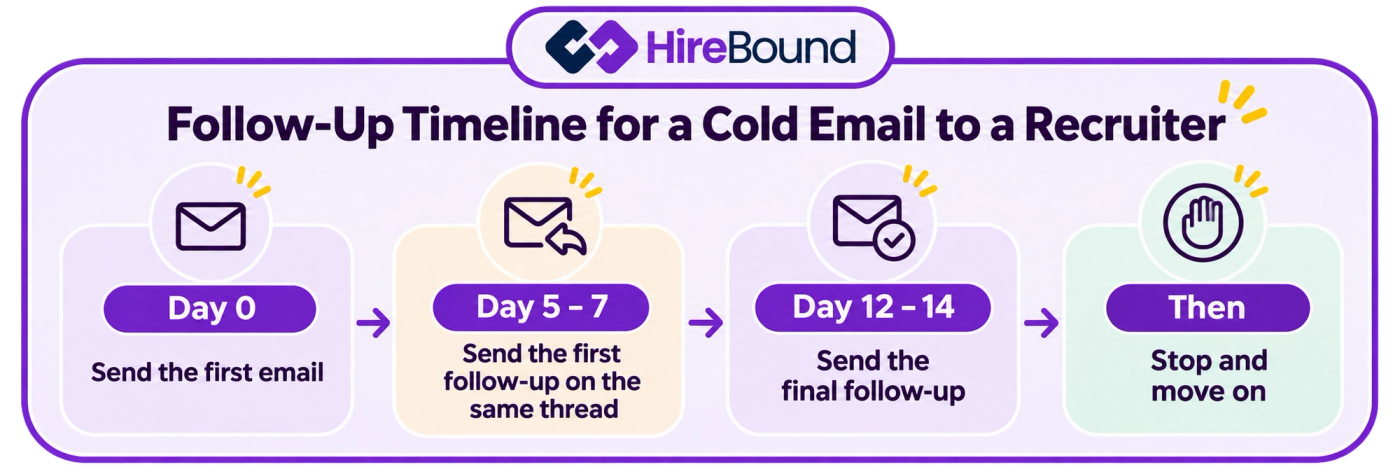
Two follow-ups across about two weeks gives a busy recruiter time to answer without crowding their inbox.
LinkedIn InMail and Connection Note Templates
On LinkedIn, write less than you would by email. Connection notes have a short character limit, so keep yours to two sentences.
Connection Note
Hi [Name], I am a [job title] with [number] years in [skill], interested in [type of role] at [Company]. I would be glad to connect and learn about the team's hiring.
InMail or Message After Connecting
Subject: [Role] at [Company]
Hi [Name], thanks for connecting. I applied for the [Role] role on [date], and my work in [skill], including [one result], fits the job description.
Would you be open to a short chat, or could you point me to the right recruiter for this team?
Thanks,
[Full name]
Do not paste your CV into the message. One line of proof and a link are enough.
Thank You Email to Recruiter
Send a thank you email to a recruiter within 24 hours of a screening call or interview. It confirms your interest and keeps your name near the top of their list.
Subject: Thank you for today's call, [Your Name]
Hi [Name],
Thank you for speaking with me today about the [Role] position. I enjoyed learning about [one specific thing they told you, such as the team's main project].
Our conversation confirmed my interest. Please let me know if you need anything else from me before the next round.
Best regards,
[Full name]
Thank a recruiter who helped you even if you did not get the role. A two-line note keeps the door open for the next opening they fill.
How Do You Write an Email to HR for a Job in India?
An email to HR for a job in India uses the same five parts, plus a short block of details Indian recruiters expect: total experience, current location, notice period, current CTC and expected CTC. An HR screening call asks these first, so answering them in the email saves a round.
Demand for good candidates is high. In ManpowerGroup's 2026 Global Talent Shortage Survey, 82% of employers in India said they are struggling to find the skilled talent they need.
Template: Email to HR for a Job Application (India)
Here is a filled-in example. Swap in your own details.
Subject: Application for Accounts Executive: Priya Sharma, 3 Years, Pune
Dear Ms. Mehta,
I am writing to apply for the Accounts Executive role on your careers page (Job ID AE-214). I have 3 years of experience in accounts payable, GST filing and Tally Prime, currently with a mid-size manufacturing firm in Pune.
Details for your reference:
Total experience: 3 years
Current location: Pune (open to Mumbai
Notice period: 30 days
Current CTC: Rs. 4.2 lakh per annum
Expected CTC: Rs. 5.5 lakh per annum
My CV is attached. I would be grateful for a chance to discuss the role.
Regards,
Priya Sharma
+91 [phone number]
Use "Dear Mr." or "Dear Ms." with the surname for a first email to HR in India, unless the job post uses first names. If you do not know the name, "Dear Hiring Team" is safer than "Dear Sir/Madam".
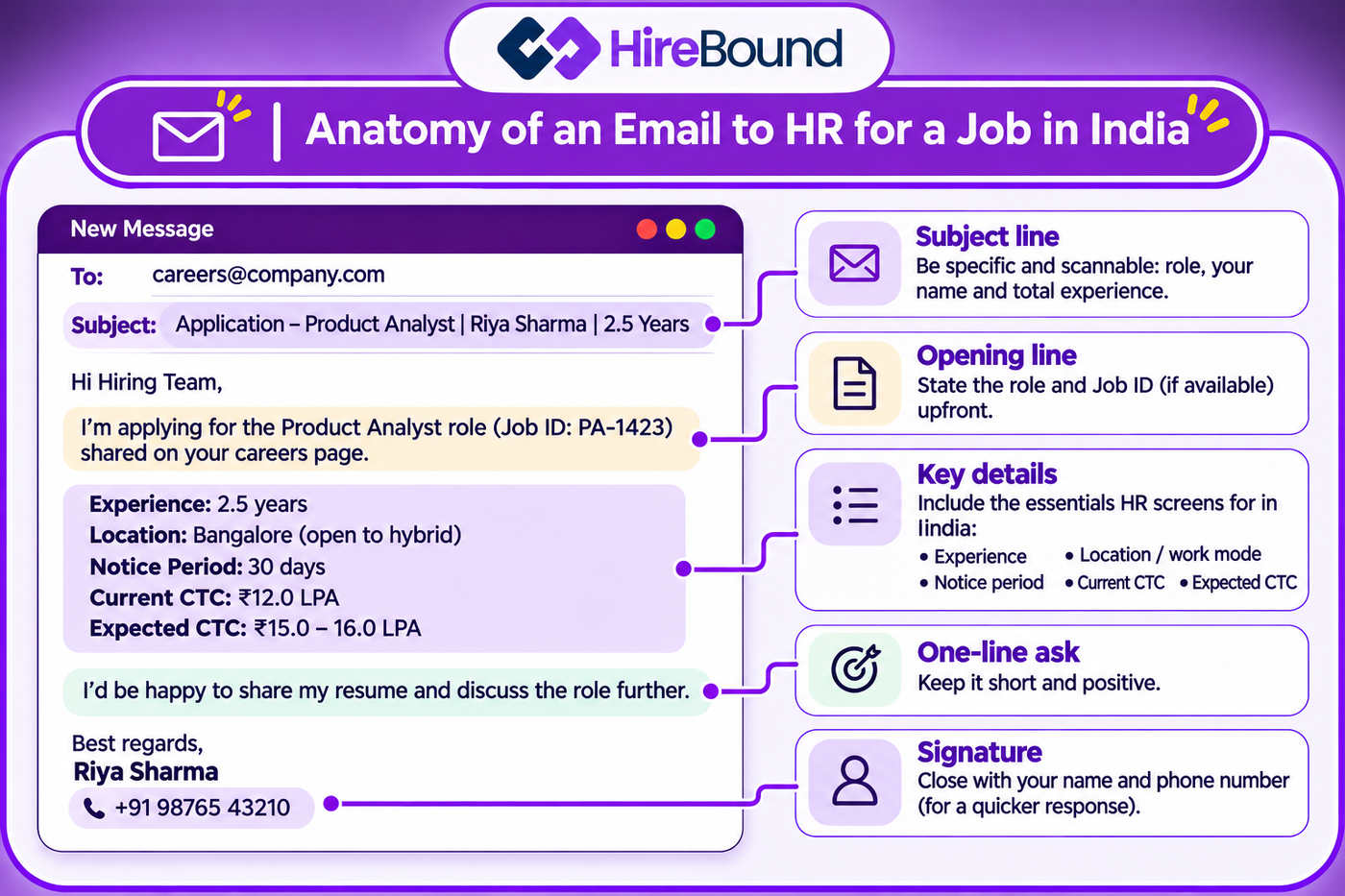
HR can copy the details block straight into a tracker, which is why this format gets read.
Many Indian recruiters move to WhatsApp once a candidate is shortlisted. HireBound's data shows a 64% response rate on WhatsApp in India, against about 12% for email. If HR shares a number and asks you to message there, reply promptly, but do not cold message a personal number nobody gave you.
Follow Up Email After Interview
Send a follow up email after an interview if you have not heard back by the date the recruiter gave you. If they gave no date, wait one week.
Subject: Following up: [Role] interview on [date]
Hi [Name],
I wanted to check in on the [Role] interview from [date]. I remain very interested and would be glad to share anything that helps the team decide.
Could you let me know the expected timeline for next steps?
Thank you,
[Full name]
While you wait, these HR interview questions and answers cover the screening questions that come up most in the next round.
Mistakes That Get a Cold Email Ignored
Check yours against this list before you hit send.
- A vague subject line. "Job enquiry" or "Resume" tells the recruiter nothing, so name the role.
- A long opening about yourself. Your career story belongs in the CV.
- No clear ask. "Hoping to hear from you" is not a request.
- The same email to 50 recruiters. Change at least the first line and the role.
- Wrong names or companies. A mismatch ends the conversation.
Which Email to Send When
Use this table as a quick reference for the whole search.
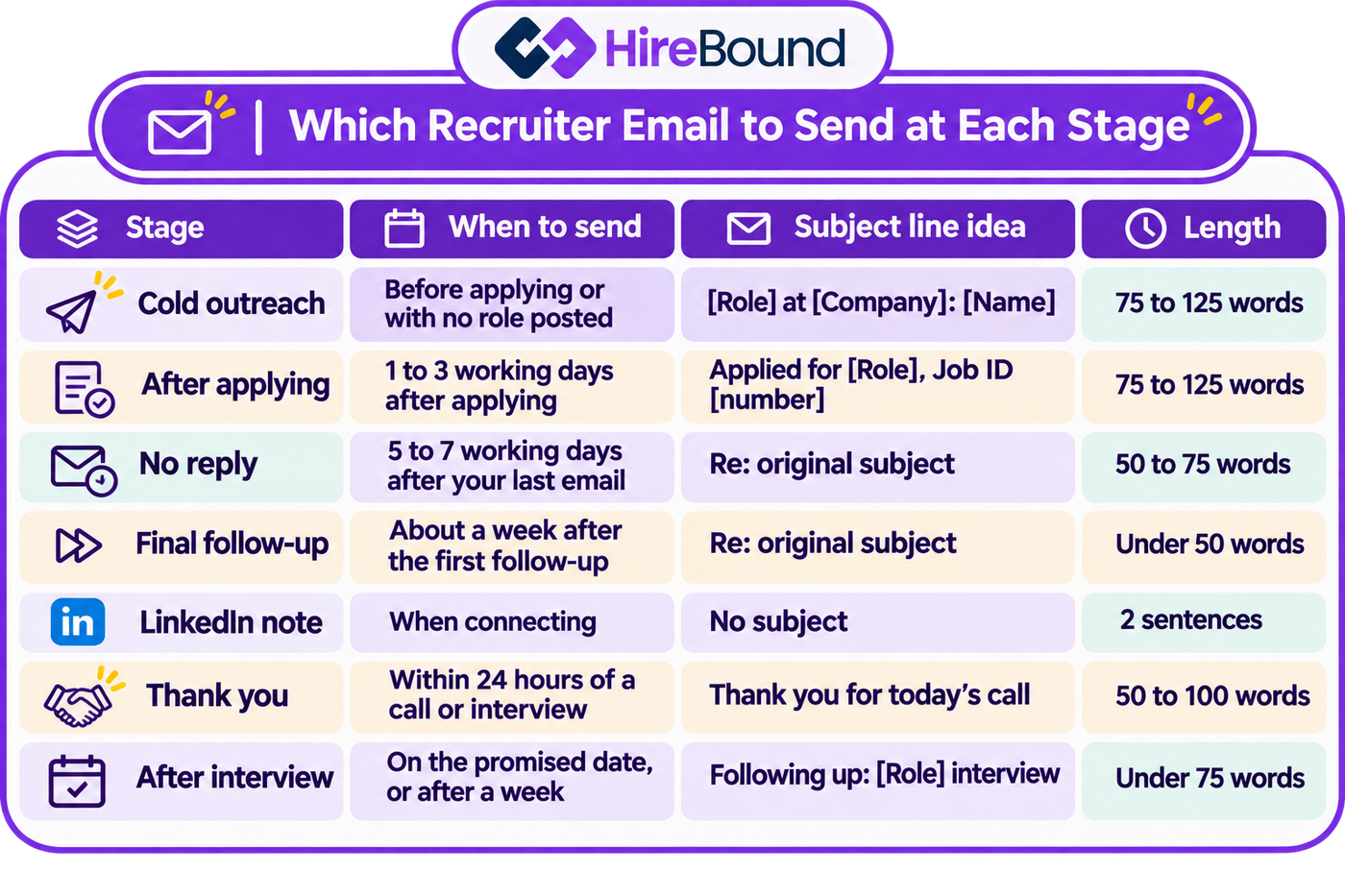
Every email in the table stays under 125 words, short enough for a 60-second skim.
Once an offer arrives, our offer letter acceptance email samples cover the reply, including notice-period cases.
Hiring at volume and want every candidate email answered on time? See how HireBound's AI agents handle candidate outreach and follow-ups while recruiters keep the decisions: talk to the HireBound team.
Write It for a 60-Second Skim
A cold email to a recruiter works when the role, your fit and your ask are clear in the first few lines. Keep it under 125 words, follow up twice, then move on to the next opening.


