HR Interview Questions and Answers: What Recruiters Ask in the HR Round
 Tanmey Goswami
 ·Oct 30, 2026·10 min read

Key Takeaways
- 1The HR round tests four things: role fit, pay, joining timeline and stability. Vague or inconsistent answers cost candidates more here than weak skills, because technical fit is usually settled earlier.
- 2Give salary as fixed plus variable pay, and quote a range tied to the role. India’s four Labour Codes took effect on 21 November 2025 (PIB), so ask how the offer is structured.
- 3Name your notice period as written in your appointment letter, then say whether a buyout or early release is possible. Never promise a date you cannot confirm.
- 4Each answer works best in three beats: a direct answer in one sentence, one specific example, and a link to the role. Aim for 60 to 90 seconds.
- 5Some first screens are automated voice calls, so be ready to answer short, direct questions on pay, notice and location, in the language you are most comfortable in.
The HR round is a short conversation where a recruiter checks whether you fit the company, the pay band and the joining timeline. Technical skill is usually settled by now. The common questions are “tell me about yourself”, “why do you want to leave”, salary expectation and notice period.
This guide covers 25 of them. For each, you get what the interviewer is checking, a sample answer and a common mistake. A separate section covers questions if you are applying for an HR job.
If you hire for a living, see how HireBound handles the first screening call: explore the AI recruiting platform.
What the HR Round Checks
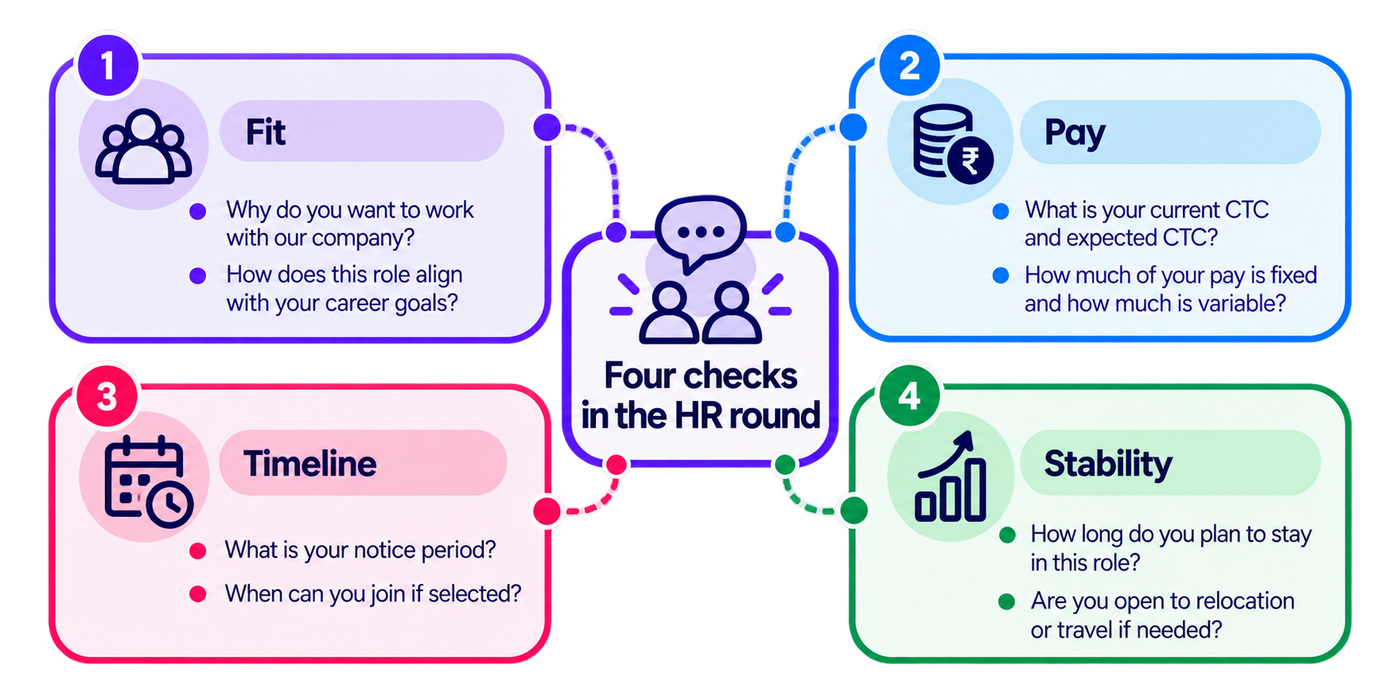
Recruiters run this round to filter out mismatches before a hiring manager spends time. They are listening for four things.
- Fit: do your goals match this role, team and working style?
- Pay: is your expected CTC close to the budget for the role?
- Timeline: can you join within the notice period the team can wait for?
- Stability: do your reasons for moving make sense, and will you stay?
Consistency matters more than polish. If your salary figure, reason for leaving and joining date do not line up, the recruiter will notice.
A simple answer pattern works for almost every question. Answer in one sentence, give one real example, then tie it to the role. The sample answers below follow it, so replace the details with your own.
Questions About You and Your Motives
1. Tell me about yourself
- Checking: whether you can summarise your career in a way that fits this role.
- Sample: “I am a customer support executive with three years in telecom. I handle about 60 chats a day and lead onboarding for new joiners. I want to move into a team-lead track, which is why this role interests me.”
- Mistake: reading out your CV from school onwards.
2. Why do you want to work here?
- Checking: whether you did any research, and whether your reason is about the work.
- Sample: “Your team is expanding in my city, and the role uses the same CRM I work in now. I can contribute from week one.”
- Mistake: naming only salary, brand or location.
3. Why are you leaving your current job?
- Checking: stability and attitude. Blame is a red flag.
- Sample: “I have learned a lot, but my role has not changed in two years. I want more ownership and a path to team lead.”
- Mistake: criticising your manager or company.
4. What are your strengths?
- Checking: whether your strength matches the job description.
- Sample: “I stay calm under pressure. During a billing outage I handled 40 escalated calls and kept our resolution rate steady.”
- Mistake: listing adjectives with no proof.
5. What is your biggest weakness?
- Checking: self-awareness and willingness to improve.
- Sample: “I used to take on too much myself. Now I share tasks and set a weekly priority list.”
- Mistake: a fake weakness such as “I work too hard”.
6. Where do you see yourself in five years?
- Checking: whether your ambition fits what the company can offer.
- Sample: “I want to grow into a senior role in this function and mentor new joiners.”
- Mistake: saying you will start your own company or switch fields.
7. Why should we hire you?
- Checking: whether you can match your skills to their stated needs.
- Sample: “You need someone who can handle volume from day one. I have done that for three years, and I learn new tools quickly.”
- Mistake: saying “I am hardworking and a quick learner” and stopping.
8. What do you know about our company?
- Checking: preparation and genuine interest.
- Sample: “You serve mid-sized retailers across India, and your latest launch targets tier-2 cities. I read that on your careers page.”
- Mistake: reciting the company’s founding year and nothing else.
Questions About Work Style and Conduct
9. Describe a challenge you handled
- Checking: problem-solving, with a real situation and result.
- Sample: “A client threatened to cancel after two delays. I called them, agreed a daily update and delivered in four days. They renewed.”
- Mistake: a vague story with no result.
10. How do you handle pressure and deadlines?
- Checking: whether you plan or panic.
- Sample: “I list tasks by urgency, tell my manager early if something will slip, and block time for the hardest one.”
- Mistake: “I thrive under pressure” with no method.
11. Tell me about a conflict with a colleague
- Checking: maturity and communication.
- Sample: “We disagreed on handover timing. I asked for a ten-minute call, we agreed a shared checklist, and it did not recur.”
- Mistake: a story where you were simply right.
12. How do you work in a team?
- Checking: collaboration and reliability.
- Sample: “I share updates early and offer help when I finish first. My last team used a weekly review, which I helped set up.”
- Mistake: saying you prefer working alone.
13. How do you take feedback?
- Checking: coachability.
- Sample: “My manager said my reports were too long. I cut them to one page and she now uses them in reviews.”
- Mistake: saying you have never received negative feedback.
14. Tell me about a failure
- Checking: honesty and what you learned.
- Sample: “I missed a data error in a report. I corrected it the same day and added a second check that I still use.”
- Mistake: claiming you have never failed.
15. What motivates you?
- Checking: whether the role will keep you engaged.
- Sample: “Solving a customer’s problem end to end, and seeing my targets improve month on month.”
- Mistake: “money” as the only answer.
16. Are you comfortable with shifts, targets or travel?
- Checking: honesty about the job’s real conditions.
- Sample: “Yes to rotational shifts. Travel is fine up to a few days a month, and I would like to confirm the pattern.”
- Mistake: agreeing to everything and quitting three months later.
17. What is your leadership or work style?
- Checking: how you would fit the team.
- Sample: “I set clear goals, check in weekly and let people own their work.”
- Mistake: giving a textbook definition rather than your habits.
Questions About Money, Notice, Gaps and Relocation
18. What is your current CTC?
- Checking: your pay level and whether you are transparent.
- Sample: “My current CTC is Rs 6 lakh, with Rs 5.4 lakh fixed and Rs 60,000 variable.”
- Mistake: inflating the number. Employers can ask for payslips later.
19. What is your expected CTC?
- Checking: budget fit.
- Sample: “Based on the role and my experience, I am looking at Rs 7.5 to 8.5 lakh, mostly fixed. I am open to discussing the structure.”
- Mistake: a very high number with no reasoning, or “anything is fine”.
20. What is your notice period?
- Checking: how soon you can join.
- Sample: “It is 60 days under my contract. I can ask about an early release, but I cannot promise it.”
- Mistake: saying “immediate” when your letter says otherwise.
21. Do you have any other offers?
- Checking: how fast you need to be moved and how serious you are.
- Sample: “I am in final rounds elsewhere, but this role is my first choice. I can share a decision date.”
- Mistake: inventing an offer as leverage.
22. Are you willing to relocate?
- Checking: flexibility and whether you will join and stay.
- Sample: “Yes, I can move to Pune within a month. I would like to know whether relocation support applies.”
- Mistake: saying yes, then asking for remote work after the offer.
23. Why do you have a gap in your CV?
- Checking: honesty, and whether you stayed current.
- Sample: “I took eight months to care for a family member, then finished a certification in data analysis. I am ready to return full time.”
- Mistake: avoiding the question or giving an inconsistent date.
24. Why have you changed jobs so often?
- Checking: stability.
- Sample: “My first two roles were contracts that ended. My last one lasted four years, and I am looking for a long-term team.”
- Mistake: blaming every employer.
25. Do you have any questions for us?
- Checking: interest and judgement.
- Sample: “What does success look like in the first 90 days, and how is the team structured?”
- Mistake: asking “nothing” or opening with leave and holidays.
Handling Salary and Notice Questions
Prepare these two questions first, because they set the terms of the offer. Treat the numbers as a package, and give a breakup instead of one figure.
For salary, split your answer into fixed pay, variable pay and benefits. India’s four Labour Codes came into effect on 21 November 2025, according to a Press Information Bureau release, and wage definitions changed. So ask how the employer structures the offer. HireBound’s guide to CTC meaning in salary explains fixed pay, variable pay and in-hand salary.
For notice, quote what your appointment letter says. Notice terms are set by your contract, and buyout policies differ by employer, so check yours. HireBound’s guide to the notice period in India explains how it works.
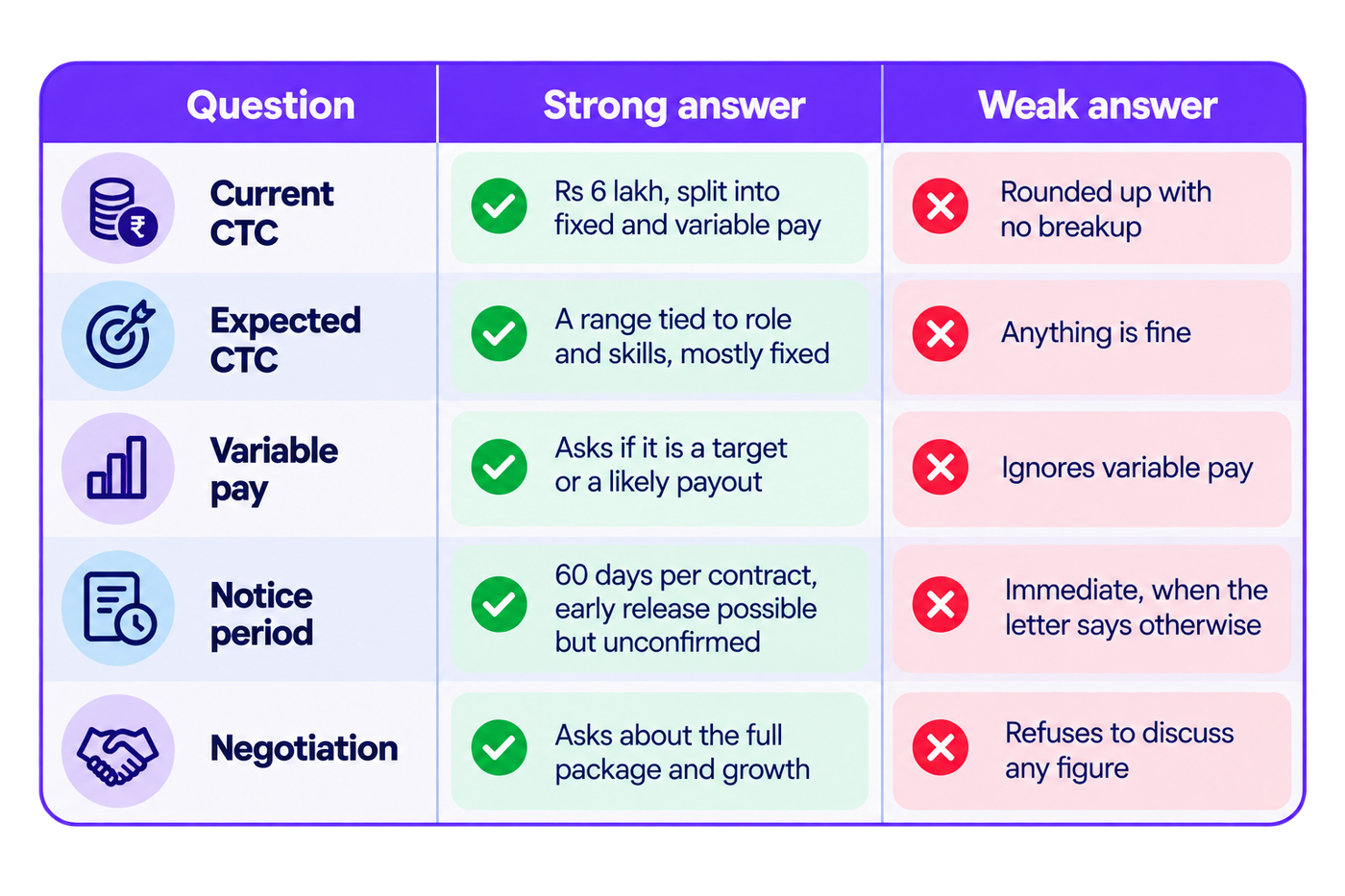
A clear number with a reason keeps the conversation moving.
Questions to Ask the Recruiter
Asking good questions shows judgement and protects you from a poor-fit offer. Pick three or four.
- What does success look like in the first 90 days?
- What are the next rounds, and how long does the process take?
- Is the pay structure fixed, variable or a mix, and how is variable pay measured?
- How is the team structured, and who would I report to?
- What does a typical day or week look like?
Avoid opening with leave, holidays or work-from-home. Raise those once you have an offer in hand.
Interview Questions If You Are Applying for an HR Role
This section is for candidates interviewing for HR executive, recruiter or HR generalist jobs. Interviewers use competency questions here, which test your judgement and process, not only your personality. The SHRM page of sample job interview questions shows how structured questions are framed.
Expect questions like these:
- How do you handle a candidate who accepts an offer and then stops responding? Show a follow-up routine and a backup plan.
- How would you handle two hiring managers who disagree on a candidate? Show that you use agreed criteria, such as a scorecard.
- Describe how you would resolve an employee complaint. Show confidentiality, fairness and documentation.
- How do you keep your hiring free of bias? Mention the same questions for every candidate and written scoring.
- Tell me about a time you filled a hard role. Give the number of days and the channels you used.
- How do you stay updated on labour law changes? Mention official notifications and your legal advisor.
- How do you handle a notice-period dropout? Show early contact and clear expectations.
- Which metrics do you track in recruiting? Name time to hire and offer acceptance.
For a structured way to score answers, see HireBound’s structured interview scorecard template. To see where an HR role can lead, read the recruiter career path guide.
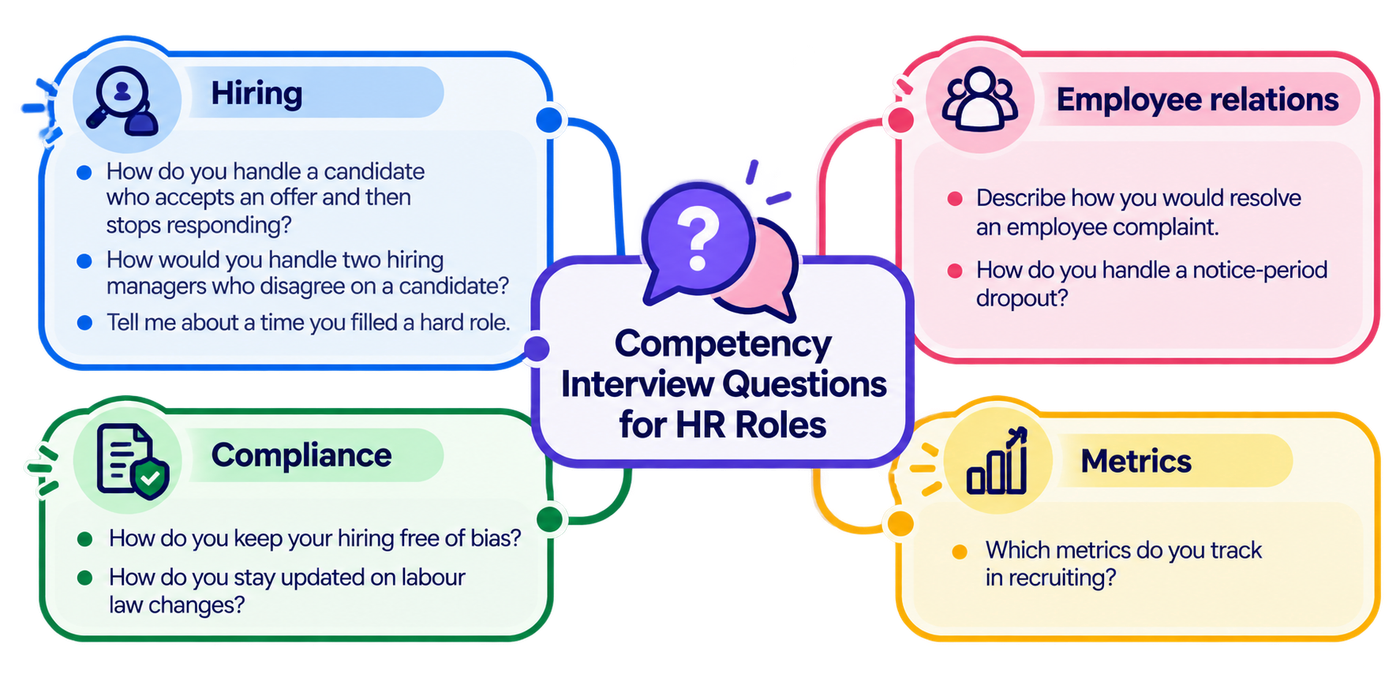
A strong HR-role answer names the situation, your action and the result. Practise each one with a real example from a past job.
Red Flags in HR Round Answers
Recruiters mark candidates down for the same few patterns. Check your own answers for these.
- Speaking badly about a former employer or manager.
- A current CTC that does not match your documents.
- A notice period that changes during the conversation.
- No reason for leaving beyond pay.
- No questions at the end.
- Answers that contradict your CV, for example the dates of a gap.
Consistency beats polish. If you are unsure of a fact, say you will confirm it rather than guess.
Hiring for volume and want the first screening call handled well? See how HireBound’s AI agents screen and schedule candidates while recruiters keep the decisions: talk to the HireBound team.
The First-Call Screening Round and Where HireBound Fits
Some screens happen on an automated voice call before the human HR round. Such a call can ask short, structured questions like current CTC, expected CTC, notice period and location. Answer plainly, one question at a time, and give the same facts you would give a person.
You can often take the call in the language you are most comfortable in. HireBound’s Voice AI works in 14 Indian languages, and its data shows a 64% WhatsApp response rate against about 12% for email. A recruiter reviews the shortlist and makes every decision about the candidate. HireBound does not guarantee any hiring outcome.


