Recruiter Career Path: From Coordinator to Talent Director, and the Skills Each Level Needs
 Devansh Dhawan
 ·Oct 11, 2026·9 min read
Key Takeaways
- 1Most recruiting ladders have six or seven levels, and each rung adds scope (roles, people, budget) before it adds a bigger title.
- 2SHRM’s competency model defines nine domains across four career levels, built from 111 focus groups with over 1,200 HR professionals.
- 3The hardest step is recruiter to senior recruiter, where the job moves from filling orders to advising hiring managers with data.
- 4Agency recruiters are measured on revenue and placements, while corporate recruiters are measured on headcount plans and hiring-manager satisfaction.
- 5Recruiters on HireBound handle 3× more candidates per day, so judgment, closing and stakeholder skills now matter earlier in a career.
A recruiter career path is the sequence of roles a recruiter moves through, from coordinator and sourcer to recruiter, senior recruiter, team lead, manager and talent director. Each step shifts the job from filling single requisitions to owning hiring outcomes, vendors and strategy.
Many recruiters learn what the next level asks for only after they are already in it. Titles change from company to company. Promotion criteria are rarely written down.
This guide lays out each level, the skills it needs and what usually gets people promoted. It covers agency and corporate routes in India.
If you run a team, you want recruiters spending less time on admin and more on the skills that earn promotion.
See how HireBound’s AI recruiting platform takes screening and scheduling off their plate.
What Does a Recruiter Career Path Look Like?
Most recruiting ladders have six or seven rungs. The names vary, but the jumps in responsibility are fairly consistent.
- Recruiting coordinator or sourcer (0 to 2 years): schedules interviews, runs searches and keeps the tracker clean.
- Recruiter (2 to 4 years): owns a requisition from intake to offer.
- Senior recruiter or specialist (4 to 7 years): fills harder roles and advises hiring managers.
- Team lead or principal recruiter (6 to 9 years): coaches a small pod and still carries roles.
- Recruiting or talent acquisition (TA) manager (7 to 11 years): owns a team’s hiring plan, metrics and budget.
- Head of talent acquisition (10 to 14 years): runs the function across business units.
- Talent director (12+ years): sets hiring strategy, owns vendors and technology, and reports results to leadership.
The year ranges are indicative. They reflect what we see working with recruiting teams in India, not a published statistic. Strong performers move faster, and agency recruiters often reach team lead sooner because revenue targets force the pace.
The diagram below shows the same ladder with the main change at each step.
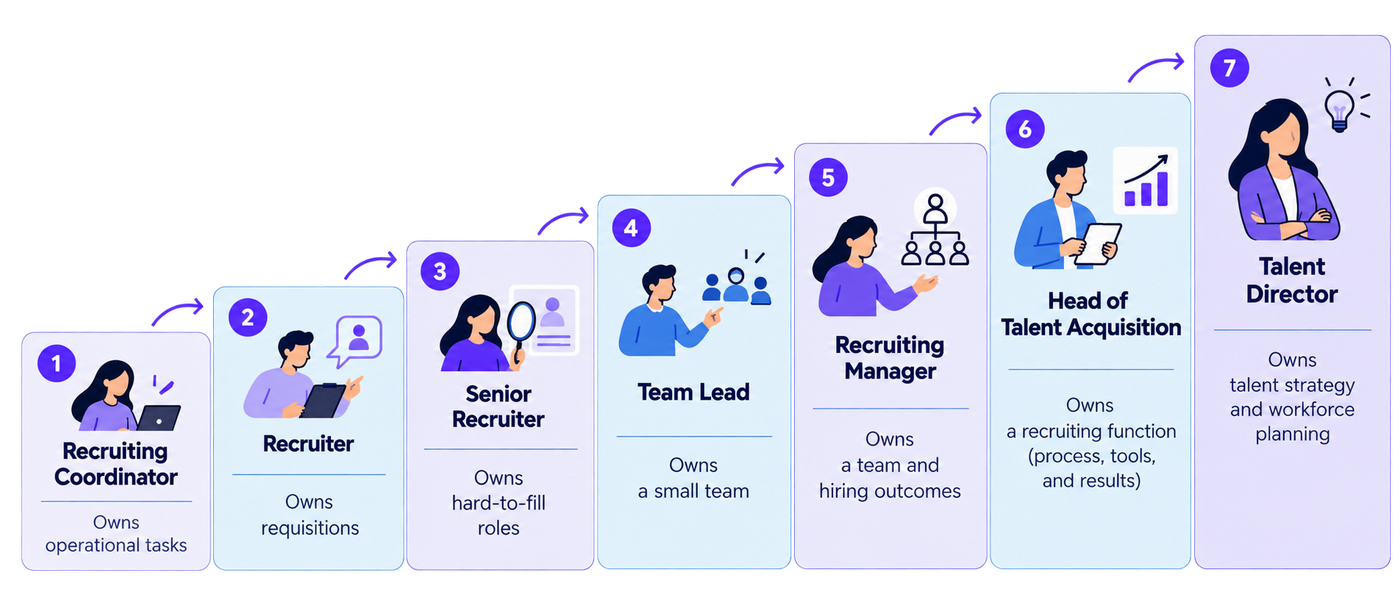
Each rung adds scope before it adds a bigger title.
Recruiting Job Titles Explained: Coordinator, Sourcer, Recruiter, Specialist
The same title can describe very different jobs. A title tells you less than what the role owns: tasks, requisitions, clients, revenue or a headcount plan.
Entry-level titles split into two groups. A coordinator handles logistics such as scheduling, reminders and offer paperwork. A sourcer finds candidates and starts conversations. Many people try both before choosing a direction.
“Recruiter” usually means full-cycle ownership, from intake call to offer. “Talent acquisition specialist” is more common in corporate teams. It often adds stakeholder work and employer-brand tasks.
Agency titles look different. Associate recruiter, account manager and delivery manager are common, and agency recruiters often work both sides, managing the client and the candidate.
India makes the gap wider. A recruiter at a BPO may fill frontline seats in bulk through walk-in drives and WhatsApp. A recruiter on niche tech roles may spend weeks on a single hire. The title is the same, but the daily work shares very little.
When you read a job post, ask what the role owns. That tells you which rung of the ladder it sits on.
How Do You Move From Recruiter to Senior Recruiter?
This is the step where many recruiters stall. They are good at the work, but the next level asks for a different kind of work.
Three shifts mark the move:
- From volume to quality: you stop being measured on how many candidates you handle and start being measured on how many make it through to offer.
- From taking orders to challenging them: you push back on unrealistic briefs at intake instead of accepting them.
- From sending offers to closing them: you handle counter-offers, notice periods and candidate doubts yourself.
SHRM describes this change as moving from an internal vendor that fills orders to a trusted advisor. In its 2021 article on how recruiters can become trusted advisors, talent acquisition expert Jeremy Eskenazi says recruiters should act as consultants who set expectations and manage timelines with data.
His example is a role that normally takes nine weeks to fill. Say so at the start, and show the evidence. Our time-to-hire benchmarks give you comparison figures to bring to that conversation.
Here is how the same request plays out at two levels. A hiring manager asks for a customer support team lead in three weeks.
- A recruiter opens the job post, starts searching and promises to try.
- A senior recruiter asks what the role must deliver in the first 90 days. They share how long similar roles took, agree on three must-have criteria and propose a scorecard. If the three-week deadline is unrealistic, they say so on day one.
Both recruiters work hard. Only the second one changes the outcome before sourcing begins.
Judgment matters as much as data. Our piece on the recruiter as sensemaker explains why reading a situation is the skill that automation does not replace.
What Skills Does Each Recruiter Level Need?
SHRM’s HR Competency Model is a well-known skills framework for HR. It defines nine competency domains across four career levels: entry, middle, senior and executive. It was built from 111 focus groups with more than 1,200 HR professionals and a validation survey of 33,000 responses, according to SHRM’s announcement of the model.
SHRM launched the model in 2012 and has said it would be updated every five years. It covers HR broadly, not recruiting alone, so we mapped its domains to the recruiting ladder below.
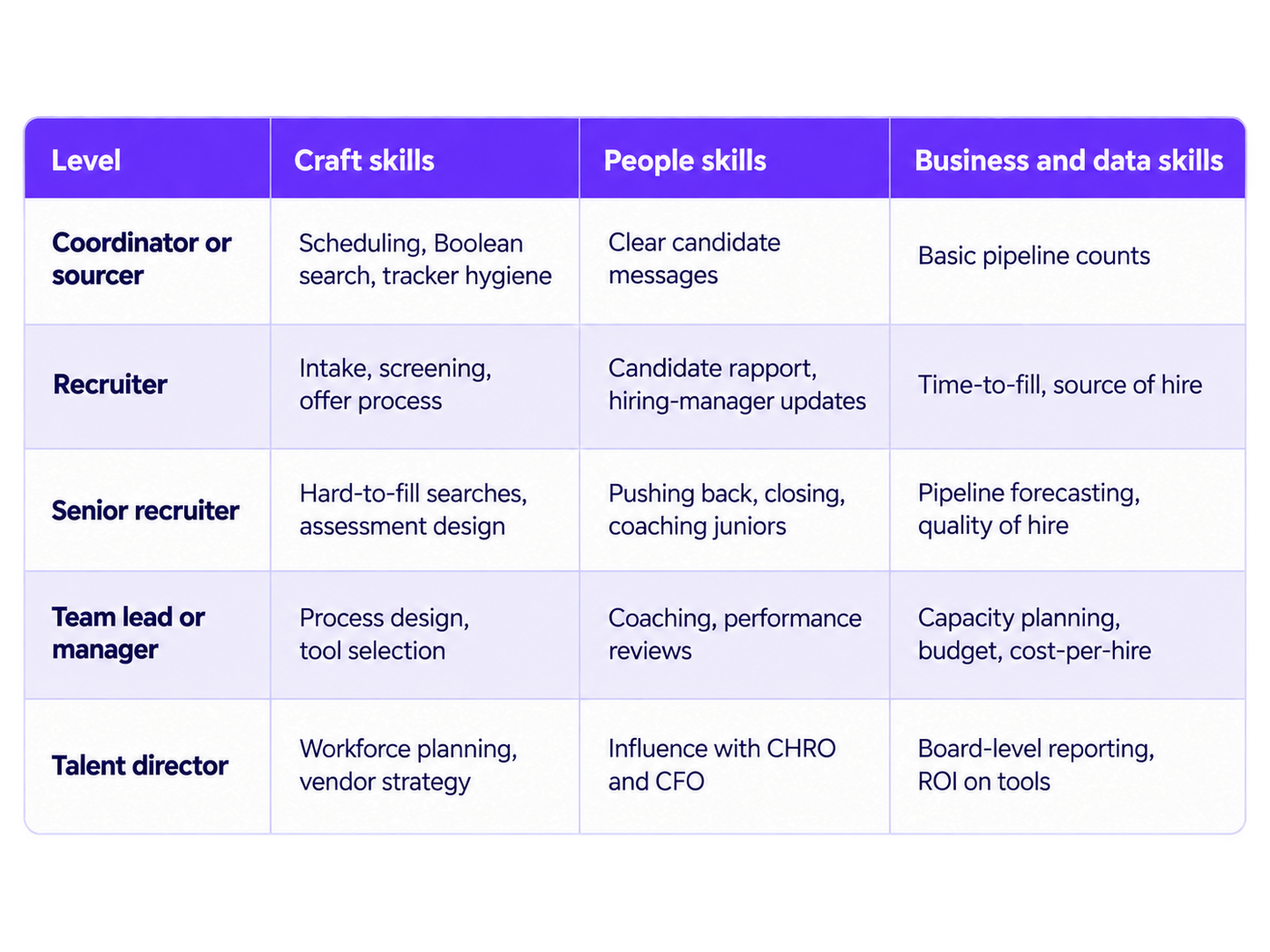
Craft skills matter most early on, and business skills matter most at the top.
Communication never drops off the list. A sourcer needs it to get a reply, and a director needs it to win a budget.
You can use the table as a self-check. Find your current row and rate yourself on each column. Then read the row below and note which skills you have not yet used at work.
Those gaps are your promotion plan. Ask for one project that exercises them, such as running an intake meeting alone or presenting a monthly hiring report to your manager.
Agency Recruiter Path vs Corporate Recruiter Path
The ladder looks similar on both sides, but the scorecard is different.
Agency recruiters are measured on placements and revenue. Corporate recruiters are measured on time-to-fill, hiring-manager satisfaction and headcount plans.
The agency route usually runs from associate recruiter to senior consultant, then desk head, branch head or delivery head. Success depends on selling to clients as well as finding candidates. Some people finish by running or owning a staffing business.
The corporate route usually runs from coordinator to recruiter, then senior recruiter, TA manager, head of TA and director. Success depends on workforce planning, employer brand and a good relationship with the CHRO.
There is plenty of room on the agency side. According to the Indian Staffing Federation’s FY25 annual report, released in July 2025, the sector grew 9.7% year on year and added 139,000 new formal flexi workers. That took the workforce employed by ISF members to about 1.8 million as of March 2025.
Here is an illustrative agency route. An associate recruiter spends two years learning to fill roles for one client. A senior consultant then owns two or three client accounts and trains juniors. A desk head owns a revenue target for a vertical, such as BPO or logistics, and a branch or delivery head owns a city or a service line.
At each step the recruiter does less sourcing and more selling, coaching and forecasting. That is why agency promotions often come faster, and why they are harder on people who prefer the craft of recruiting.
Moving between the two sides is common. Agency recruiters bring speed and commercial instinct to corporate teams. Corporate recruiters moving to agencies usually need to build sales skills first.
How Do You Become a Talent Director?
A talent director is accountable for how an organisation hires across every role. The job shifts from running a team to running a function.
Five skills change at this level:
- Workforce planning: forecast hiring needs 6 to 12 months ahead with finance and business heads.
- Budget ownership: defend spend on tools, job boards, agencies and recruiter headcount.
- Vendor and technology choices: decide what the team buys, and prove it worked.
- Reporting: present time-to-hire, cost-per-hire and quality of hire to leadership in business terms.
- Employer brand: shape how candidates see the company before they apply.
In our experience, a realistic route takes 12 to 15 years, though it varies a lot. Most directors have held a team lead or manager role and owned a metric that leadership cared about.
The first 90 days in the role usually follow the same order. Audit the funnel and find where candidates drop. Meet the business heads and learn their hiring plans for the next two quarters. Then pick one or two fixes, such as a faster scheduling process or a better source mix, and report the result in numbers.
Not every strong recruiter should aim for this role. A principal recruiter or executive search consultant can earn well and stay close to the work. The director track suits people who enjoy planning, budgets and influence more than daily closing.
How Is AI Changing Recruiter Skills at Every Level?
AI is changing which skills matter first. Screening and scheduling are the tasks that move to AI agents.
Recruiters using HireBound handle 3× more candidates per day than with a manual process. HireBound’s WhatsApp outreach gets a 64% response rate, against about 12% for email in India. Agents handle that conversation, which frees recruiters for the work that needs a person.
The bottom rung feels this most. Coordinator tasks such as scheduling and tracking are the easiest to automate. Entry roles are likely to need judgment, intake and candidate assessment sooner than they used to.
AI does not take over the human parts of the job. Reading a hiring manager, negotiating an offer and judging real skill are still done by people. Our guide to skills-based hiring covers how to judge what someone can do.
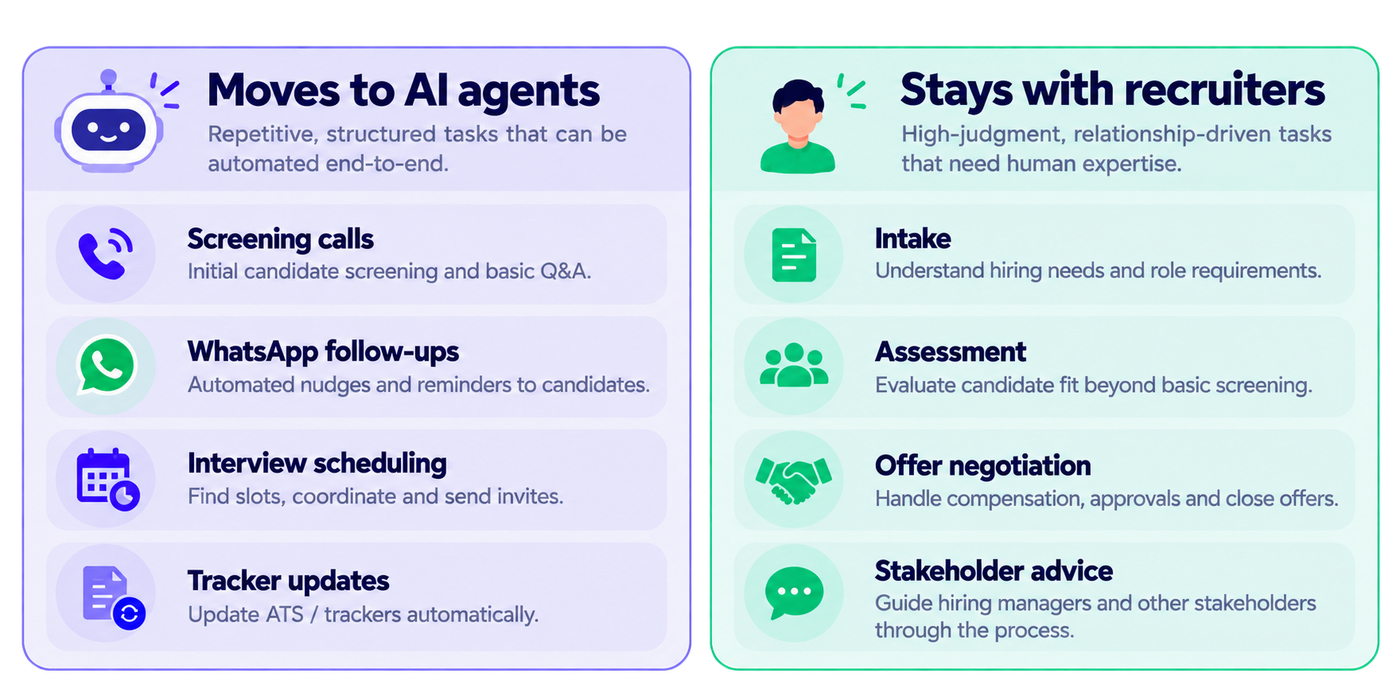
Juniors are likely to be promoted on judgment earlier, because routine work fills less of their day.
How to Build a Recruiter Career Ladder for Your Team
A written ladder helps retention. Recruiters stay longer when they can see the next step and what it takes to get there. For agency owners, it also stops your best recruiters leaving to start their own desks.
Follow these steps:
- Define four to six levels. Give each a title, scope and typical years of experience.
- Write promotion criteria. Use observable behaviours, such as “runs intake without support”, rather than vague traits.
- Tie each level to metrics. Choose two or three per level, such as offer-accept rate or revenue per desk.
- Add a skills checklist. Use the table above as a starting point and adapt it to your roles.
- Review once a year. Check promotions against the criteria and adjust.
Capacity matters too. Recruiters buried in admin cannot build the skills the next level requires. Our guide to recruiter workload benchmarks shows how to size a load that leaves time to grow.
Ready to see this in action? Book a free demo →
What Should Recruiters and Team Leads Do Next?
If you are a recruiter, pick the next level and ask your manager what it needs. Then own one metric that matters to the business.
If you lead a team, write down the ladder this quarter. Start with the step from recruiter to senior recruiter, because that is where talent leaves.
If recruiters spend most of their week on screening and scheduling, fix that first. No career ladder helps when the day is full of admin.


