Gig and Freelance Hiring Platforms vs Full-Time Recruiting: When to Use Each
 Tanmey Goswami
 ·Oct 9, 2026·10 min read
Key Takeaways
- 1Gig hiring buys a defined output from an independent worker; full-time recruiting builds employed capacity, so they differ in control, continuity and legal duty.
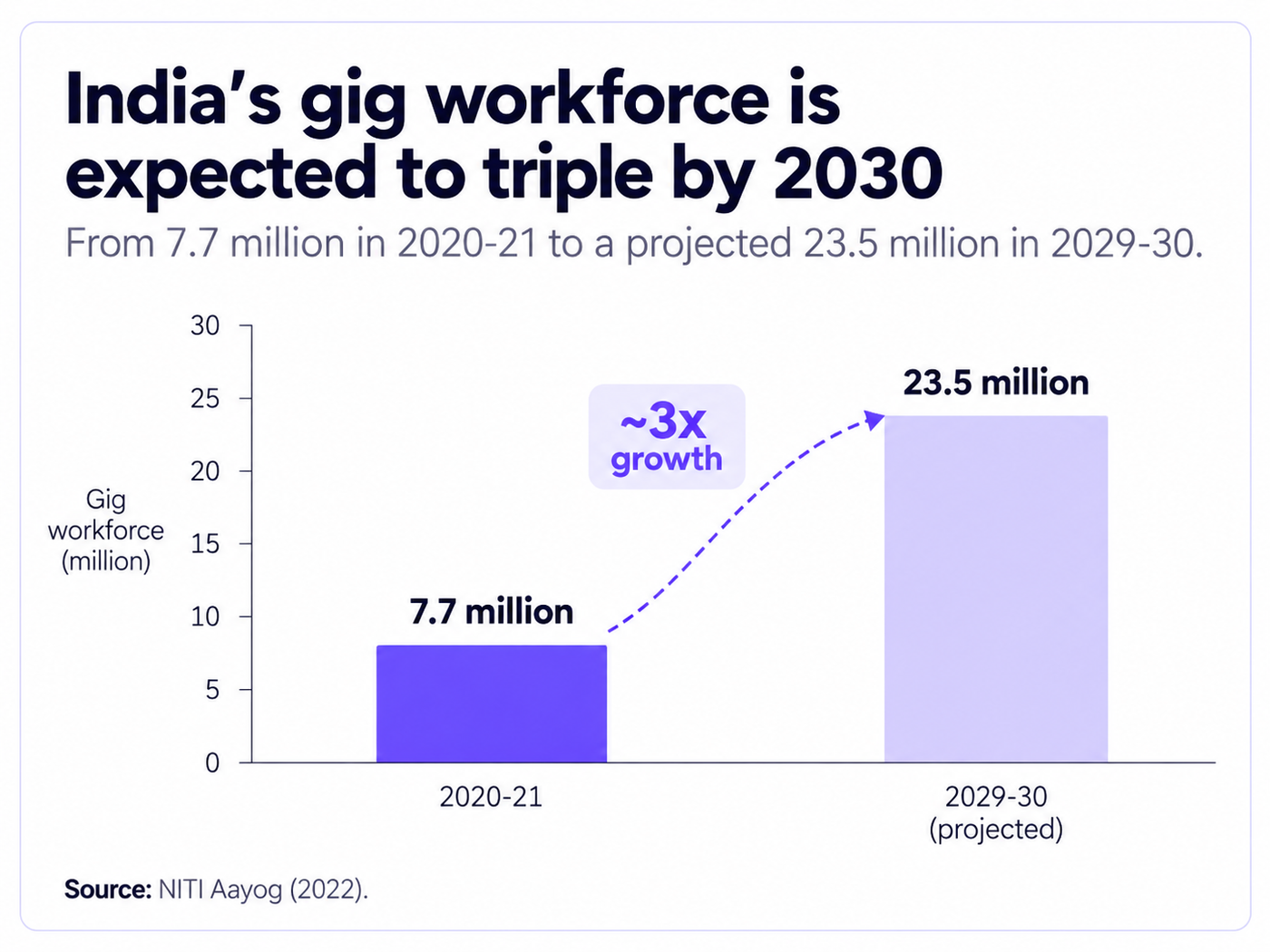
- 2NITI Aayog (2022) estimated 7.7 million gig workers in 2020-21 and projected 23.5 million by 2029-30, so India’s supply is growing fast.
- 3Gig work is cheaper for short projects, but cost per unit of output often rises for roles you need every day for a year or more.
- 4Under India’s Code on Social Security, aggregators can be required to contribute 1% to 2% of turnover, capped at 5% of payouts, and misclassified freelancers can be treated as employees.
- 5A hybrid works: keep core, continuous roles in-house and use gig capacity for peaks, projects and specialist tasks, with a written scope for each.
Gig hiring vs full-time recruiting is a choice between renting capacity for a task and building employed capacity for ongoing work. The right model depends on how long you need the work, how much control it requires, and how the law classifies the relationship.
If you run bulk hiring, a staffing desk or a growing HR team in India, you probably use both already. The trouble starts when a role that belongs in one model gets filled through the other. This explainer sets out the structural differences and the cases where each one wins.
Want candidate screening and scheduling handled before your recruiters get involved? See how HireBound works →
What Is the Structural Difference Between Gig Hiring and Full-Time Recruiting?
The structural difference is the relationship. In gig hiring, you buy an output from someone who runs their own work. In full-time recruiting, you employ someone, direct their work and take on the duties that come with it.
Here is how that plays out in practice.
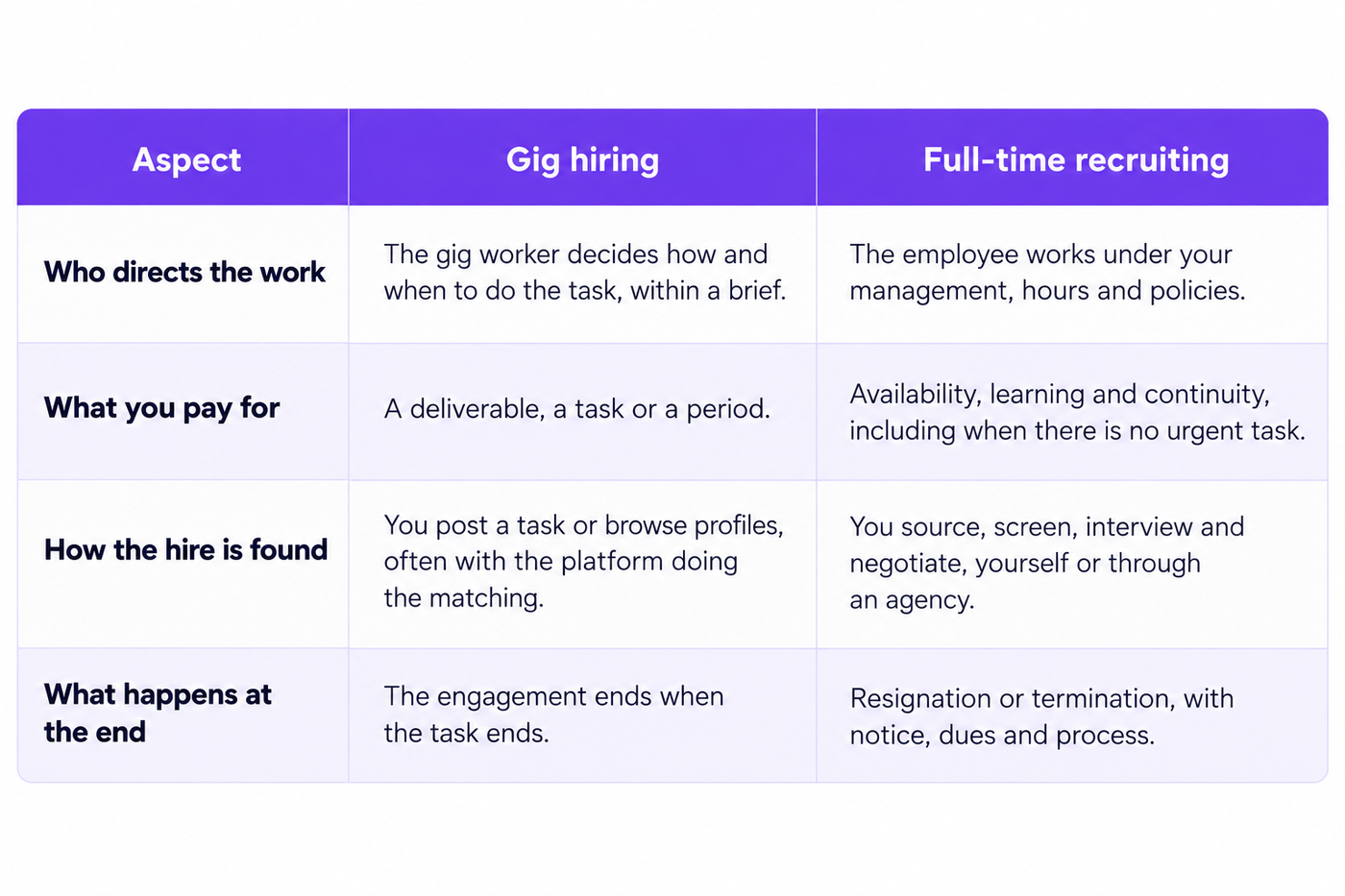
Gig platforms come in two broad shapes. Task platforms supply high-volume, location-bound work such as deliveries, field tasks and on-demand shifts. Freelance marketplaces supply skilled project work such as design, writing, development and analysis. Both are gig hiring, and the compliance picture below applies to each.
Two neighbouring models get confused with gig hiring. Contract staffing places workers on a staffing agency’s payroll for a fixed period, which is closer to employment than freelancing. Contract-to-hire is a trial that ends in a permanent offer, covered in HireBound’s report on contract-to-hire conversion rate benchmarks.
How Do Cost and Speed Compare?
Gig hiring is usually faster and cheaper to start. Full-time recruiting is usually cheaper per unit of output once the work is continuous. The crossover point depends on how many months of steady work the role really contains.
Speed: a marketplace can put a shortlist in front of you within days because profiles already exist and candidates are pre-registered. A full-time search runs longer because it includes sourcing, multiple interview rounds, an offer and a notice period. In India, a salaried candidate usually has to serve a notice period at the current employer, which adds weeks after the offer is accepted.
Cost to acquire: SHRM’s 2026 data puts the median time to fill a role at 39 calendar days, a US figure, so read it as a shape rather than an Indian average. Hiring full-time roles carries recruiter time, advertising and agency fees. Gig hiring replaces most of that with a platform fee or a margin built into the rate.
Cost to run: a gig rate typically carries a premium over the equivalent salary, because the worker pays for their own downtime, tools, taxes and benefits. For a two-month project, the premium is small next to the cost of recruiting and onboarding an employee. For a role you need forty hours a week for two years, the premium compounds and the employee is cheaper.
Hidden costs sit on both sides.
- Gig: time spent briefing and re-briefing new people, quality variance between workers, and rework when the brief was unclear.
- Full-time: onboarding, idle time between projects, and the cost of an error in selection. HireBound’s analysis of the cost of a bad hire by seniority shows how quickly that last one grows for senior roles.
A useful test: if the work fits a written statement of scope with a start, an end and a deliverable, price it as gig work. If you cannot write that statement because the work is ongoing and changes weekly, price it as a job.
What Are the Compliance and Misclassification Risks in India?
India’s compliance risk with gig hiring is real, and it sits in two places: the platform or aggregator rules, and the question of whether a worker is truly independent. Getting either wrong can turn a cheap engagement into an expensive one.
The platform rules: the Code on Social Security, 2020, is the first Indian law to define gig workers and platform workers. A gig worker is a person who works or takes part in a work arrangement and earns outside a traditional employer-employee relationship. An aggregator is a digital intermediary or marketplace that connects a buyer of a service with a service provider. Under the Code, aggregators in the listed categories can be required to contribute 1% to 2% of annual turnover to a social security fund, capped at 5% of the amount paid or payable to gig and platform workers.
The four labour codes came into force on 21 November 2025, according to the Ministry of Labour and Employment. Under the Social Security (Central) Rules, notified in May 2026, a gig worker qualifies for benefits after 90 days of engagement with one aggregator, or 120 days across several, in a financial year. State laws add another layer. Rajasthan passed a platform gig workers Act in 2023, and Karnataka followed in 2025 with an Act that allows a welfare fee of 1% to 5% on payouts to gig workers, which the state began collecting in February 2026 at rates that vary by service type.
The classification question: Indian courts do not accept a contract label at face value. They look at the substance, using several tests together:
- Control. Do you decide how, when and where the work is done?
- Integration. Is the worker part of your organisation, with a company email, a team, a seat and a manager?
- Economic dependence. Does the worker rely on you for most of their income and carry no real business risk?
- Mutual obligation. Is there an ongoing expectation that you offer work and they accept it?
The Supreme Court has said that control is important but not the only test, and other factors matter too. In practice, a freelancer who works fixed hours on your systems under your team lead for a year looks like an employee, whatever the invoice says. If a tribunal agrees, the exposure includes provident fund, insurance, gratuity, notice and back dues.
Contract labour is a separate issue: if you engage workers through a contractor rather than direct, the Occupational Safety, Health and Working Conditions Code applies to establishments and contractors with 50 or more workers, and restricts contract labour in core activities with limited exceptions. Fixed-term employees, meanwhile, become eligible for gratuity after one year of service under the new codes, as covered in the contract-to-hire report.
Tax and paperwork: payments to freelancers usually attract tax deducted at source, and an invoice with the worker’s tax details. Keep a written agreement covering scope, deliverables, intellectual property, confidentiality and data handling for every engagement, since gig workers who touch candidate or customer data create obligations under the DPDP Act.
What this means for your hiring: run every gig engagement through three questions. Is the scope written? Does the worker control how the work is done? Would the engagement look the same if the person also worked for two other clients? If any answer is no, treat the role as a job and hire it that way. Confirm state-specific rules and your own facts with counsel.
When Do Gig Platforms Make Sense?
Gig platforms make sense when the work is bounded, the skill is specialised or the demand is uneven. NITI Aayog (2022) estimated that 7.7 million workers were in India’s gig economy in 2020-21 and projected 23.5 million by 2029-30, so the supply side is deep and getting deeper.
Use gig hiring in these cases.
- Projects with a clear end. A website rebuild, a compliance audit, a one-time data clean-up or a training video series.
- Specialist skills you need once. A translator for a product launch, a legal drafter for a template or a designer for a campaign.
- Demand peaks. Festive-season delivery, campus drive logistics, a month of extra support volume. Task platforms supply people who are already registered and available in a city.
- Testing a capability before committing. Try an analyst or a social media manager for three months before creating the role.
- Geographic coverage without offices. Field verification, mystery audits and site checks in cities where you have no staff.
Gig hiring also works well as a supplement to your own bulk hiring drive. If you have to fill 300 warehouse roles by month-end, a task platform can cover shift gaps while your recruiters screen for permanent staff.
Expect the trade-offs. You get less control over quality, less loyalty and less institutional knowledge. Good gig workers are often booked, and they leave when the task ends, taking what they learned with them.
When Is Full-Time Recruiting the Right Call?
Full-time recruiting is the right call when the work is continuous, the knowledge compounds or the role carries decisions and risk. In these cases, employment gives you what a marketplace cannot: continuity, culture and accountability.
Choose full-time recruiting for:
- Core functions. Sales, customer support, operations and engineering that run every day. Paying a gig premium for these forever is expensive.
- Roles that build institutional knowledge. Account managers, product owners and process owners get more valuable each year they stay.
- Regulated or sensitive work. Anything involving customer money, personal data or safety.
- Roles that need direct management. If you need to set hours, train people, coach and review performance, you are managing an employee, and the law will see it that way.
- Culture and leadership roles. People who represent the company and hire others.
There is a hiring-process difference too. Full-time roles benefit from structured screening, and this is where automation pays back. In bulk hiring, an AI agent that runs WhatsApp screening and books interviews reduces the weeks spent chasing candidates. HireBound’s data shows a 64% WhatsApp response rate in India, compared with about 12% for email, which matters most when you screen hundreds of candidates for the same role.
For time-sensitive searches, see HireBound’s time-to-hire benchmarks to check where days are lost.
Can You Use Both for the Same Team?
Yes. Most teams do, and the best ones do it deliberately. The rule is to put the continuous, core work with employees and put the variable, bounded work with gig workers, then keep a clear boundary between the two.
Three patterns work well.
- Core plus flex. A permanent team handles baseline volume, and gig capacity absorbs peaks. A logistics firm might staff its hubs with employees and cover festive surges through a task platform.
- Project bench. A permanent lead owns the outcome and directs a rotating group of freelancers on specific deliverables. The lead is accountable, and the freelancers are scoped.
- Gig-to-hire pipeline. You engage a freelancer for a paid project, then offer a role to those who fit. You learn how they work and they learn how you work, though the offer should follow the compliance checks above.
To keep the mix safe, avoid three habits. Do not put gig workers into your team structure, such as company email addresses, team meetings and performance reviews, because that is how integration tests get met. Do not renew the same freelancer on the same duties for years without checking whether they have become an employee in fact. And do not give freelancers access to candidate or customer data without a written data-processing agreement.
When Is Gig Hiring the Wrong Choice?
Gig hiring is the wrong choice when the work is continuous, the person must follow your hours and instructions, or you would be unwilling to lose them at short notice. Marketplaces also underperform when the brief is vague, because independent workers price what you ask for, not what you meant.
It is also the wrong choice when the true reason is to avoid employment costs. Courts look at substance, and a role that is really a job will be treated as one. Full-time recruiting has its own failure modes: it is slow, it locks you into fixed cost, and a bad hire is expensive. Choose it when you are sure the role will exist in a year.
Ready to see how automated screening speeds up your full-time hiring? Talk to the HireBound team →
How Should You Make the Call?
Make the call role by role, using four questions. Answer them in order, and the answer usually becomes clear by the third.
- How long will the work last? Under three months with a clear end points to gig. Beyond a year points to full-time.
- How much control does it need? If you must direct how and when the work is done, hire an employee.
- How much does the person need to know about your business? The more institutional knowledge required, the stronger the case for employment.
- What is the cost of getting it wrong? Weigh the compliance exposure and the quality risk together, not just the rate.
Then write it down. For gig engagements, record the scope, deliverables, term, payment and data terms. For full-time hires, define the role, the scorecard and the screening steps before the search opens. Speed comes from deciding the model first, then running the process that suits it.


