Best Applicant Tracking Systems for Growing Hiring Teams
 Tanmey Goswami
 ·Nov 11, 2026·11 min read

Key Takeaways
- 1The best applicant tracking system removes your slowest stage. For teams hiring at volume, that is usually screening calls and interview scheduling.
- 2Seven options cover the common cases: Greenhouse, Lever, Workable, Zoho Recruit, Manatal, Keka and HireBound. Pick by the gap you need filled.
- 3Greenhouse says 7,500+ companies use it and Keka says 12,500+ (vendor sites, 10 November 2026). Scale alone does not show fit.
- 4HireBound data shows a 64% WhatsApp response rate in India against about 12% for email, so rank candidate channels above job-board counts.
- 5Test any ATS on one live role for two weeks. Compare recruiter hours per interview booked, reply rate by channel and days to first interview.
The best applicant tracking system for a growing hiring team is the one that removes your slowest stage. For some teams that is interview structure or job-board reach. For teams hiring at volume, it is the screening calls, follow-ups and scheduling that recruiters still do by hand.
This guide compares seven options: Greenhouse, Lever, Workable, Zoho Recruit, Manatal, Keka and HireBound. Each one is built around a different job, so the order below is not a ranking.
HireBound is one of the options compared. Details for the other six come from each vendor's own website, checked on 10 November 2026, and are attributed to the vendor.
Want agents to screen and schedule candidates for your team? See how HireBound works →
The diagram below groups the seven by what each is built around.
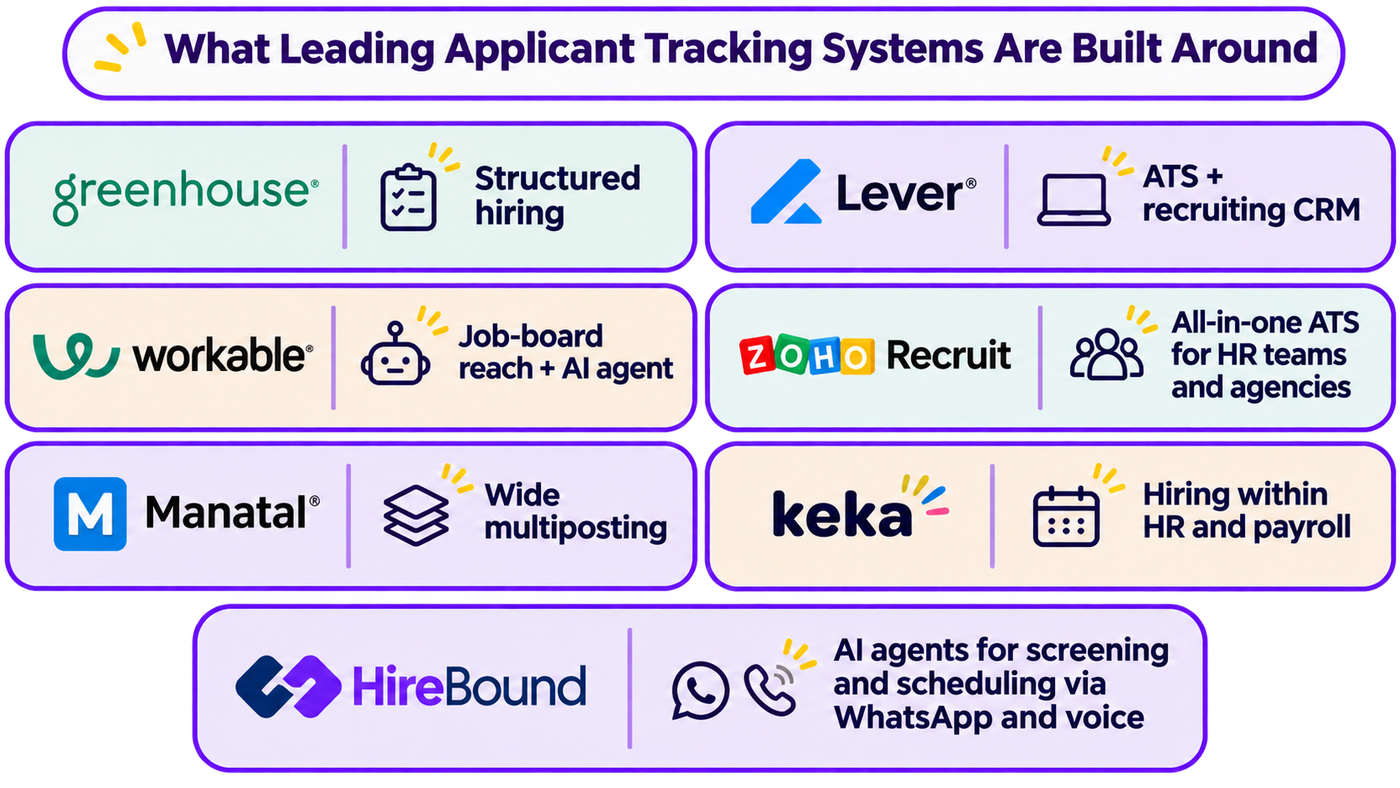
Start with the group that matches your bottleneck, then compare inside it.
What Does an Applicant Tracking System Do for a Growing Team?
An applicant tracking system (ATS) is software that collects applications, moves candidates through hiring stages and keeps a record of every decision. It replaces the spreadsheet and inbox once a team runs more than a handful of roles at once.
If you want the basics first, our guide to what an applicant tracking system is covers how one works stage by stage.
At ten hires a year, an ATS is a tidy record. At two hundred, the record matters less than the hours spent between stages: calling applicants, chasing replies and finding interview slots.
So newer ATS products compete on automation, and several now say on their sites that AI agents source, screen or interview candidates. They differ in which part of the work each one takes off a recruiter.
Two models are now on the market. In an assistive ATS, the software ranks applicants, drafts messages and suggests slots, and a recruiter still sends, calls and books. In an agent-led platform, software runs the first screening conversation and books the interview, and the recruiter steps in at the shortlist.
How We Chose the Criteria for This ATS Comparison
We picked criteria that describe a growing team's week, with extra weight on volume hiring and on hiring in India. Each vendor's claims come from its own homepage or product page, accessed on 10 November 2026.
These are the seven criteria:
- Who does the candidate-facing work. Does the tool help a recruiter screen faster, or run the screening conversation itself?
- Candidate channels. Which of voice, WhatsApp, SMS and email does the vendor list for reaching candidates?
- Screening and scheduling. Are qualification and interview booking automated, and how?
- Volume. How does the tool handle hundreds of applicants for one role?
- Sourcing reach. How many job boards or profiles does the vendor say it reaches?
- Structured evaluation. Does it support scorecards and consistent ratings?
- India fit. Language coverage, Indian job boards, and payroll or compliance tie-ins.
Weight the list to match your own hiring. A team filling ten senior roles a year should put structured evaluation first, while a team filling two hundred frontline roles should put channels and screening first.
How Do the Seven ATS Compare at a Glance?
The table sets each vendor's own description next to the strength it leads with on its site.
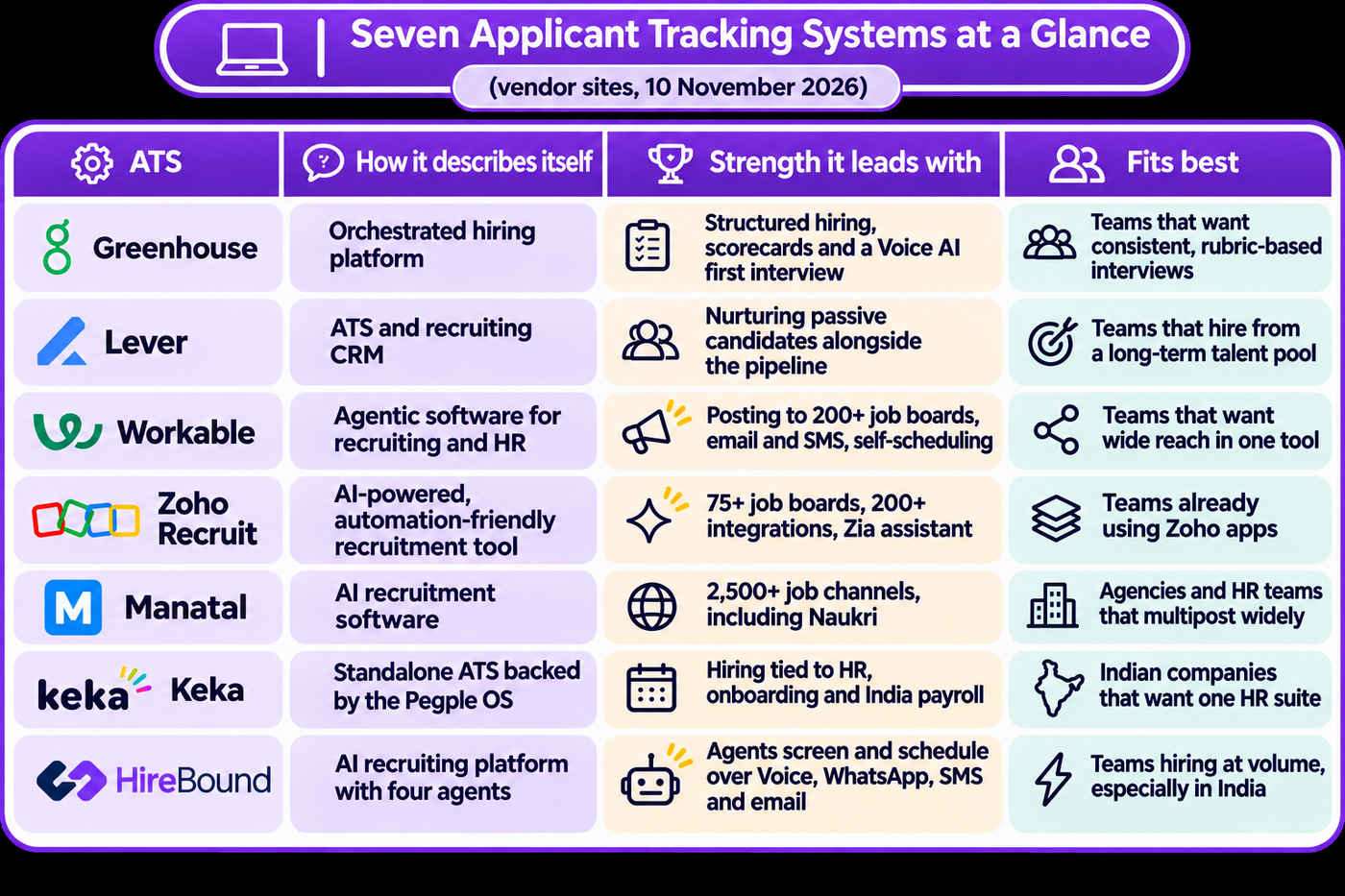
The third column shows how far each tool goes. Some help recruiters search and rank faster, and some run part of the candidate conversation themselves.
The Best Applicant Tracking Systems, Reviewed
Each review below draws on the vendor's own website. "Best for" names the team that gets the most from it.
Greenhouse
Greenhouse is an applicant tracking system built around structured hiring. It calls itself an orchestrated hiring platform and says it is "trusted by 7,500+ companies" (vendor site, 10 November 2026). It points to more than a decade of work on structured hiring, with interview kits built around scorecards.
Its newer features include Greenhouse Voice AI, which it describes as a two-way first interview using "your team's questions and rubric." It also lists an AI notetaker that maps notes to scorecard questions, fraud flags through Greenhouse Real Talent, and "hundreds of pre-built integrations."
Best for: Growing companies that want every interviewer to rate candidates the same way.
Lever
Lever is an ATS and recruiting CRM in one product, which it describes as a "modern applicant tracking system (ATS) and recruiting CRM" (vendor site, 10 November 2026). The pairing means sourcing and nurturing passive candidates sit in the same system as the active pipeline.
Its site says AI runs across the hiring journey, with candidate ranking, fit scoring and fraud detection. Automated nurture sequences keep past applicants warm for later roles. Our guide to recruitment CRM vs ATS explains how the two differ.
Best for: Teams that rehire from a talent pool and want CRM and ATS in one place.
Workable
Workable is an ATS with a built-in AI agent, and it calls itself "agentic software for recruiting and HR" (vendor site, 10 November 2026). It says one click posts a job to 200+ job boards.
Its AI agent, it says, "sources, screens and engages candidates inside the Workable ATS," searching 400M+ profiles and checking applicants against up to 14 job criteria. Candidate messages run through integrated email and SMS, and candidates can book their own interview slots.
Best for: Small and mid-size teams that want job-board reach, texting and self-scheduling in one tool.
Zoho Recruit
Zoho Recruit is the recruiting app in the Zoho suite. It describes itself as an "AI-powered, automation-friendly and all-things-recruitment tool" for HR teams and staffing agencies (vendor site, 10 November 2026). It cites 75+ job boards and integrations with over 200 applications.
Its assistant, Zia, helps write job descriptions and emails, build assessments, and source and shortlist candidates. WhatsApp Business appears among its integrations.
Best for: Teams that already run on Zoho apps and want hiring in the same ecosystem.
Manatal
Manatal is an ATS with a recruitment CRM and wide job multiposting. It calls itself AI recruitment software and says 10,000 recruitment teams in 135+ countries use it (vendor site, 10 November 2026). It serves HR teams, recruitment agencies and headhunters, with solution pages for BPOs and startups.
It says jobs can be posted to 2,500+ organic and premium channels, and Naukri is named among them. Its AI engine recommends candidates for each job.
Best for: Agencies and HR teams that post widely and want AI-ranked candidates.
Keka
Keka is an HR and payroll platform, with India payroll and compliance, that includes its own hiring module. It describes that product as "the power of a standalone ATS, backed by the People OS" (vendor site, 10 November 2026). The wider Keka platform says 12,500+ companies chose it, and it runs payroll with TDS, PF, ESI and PT calculations.
On the hiring side, Keka lists AI scoring of applications, AI-led screening interviews with transcripts, automated scheduling and structured interview plans. Because hiring sits inside the HR suite, a candidate who accepts an offer flows straight into onboarding.
Best for: Indian companies that want hiring, HR and payroll in one system.
HireBound
HireBound is an AI recruiting platform in which four agents carry out recruiting work: sourcing, screening, scheduling and evaluation. It combines a Smart ATS and Smart CRM with AI Discovery, which searches 500M+ profiles and the team's own past applicants.
The agents reach candidates over Voice, WhatsApp, SMS and email. The Screening Agent runs a structured conversation against your criteria, scores the candidate and keeps the transcript. The Scheduling Agent collects availability during that conversation and books the interview with reminders.
For corporate teams, the recruitment software for permanent hiring pairs the agents with expert screening and multi-round interview coordination. Pipeline stages move with an attributed activity log, so the record shows what an agent did and when.
HireBound has powered 8 million+ candidate conversations, and 60+ recruiting teams in India run on it. Recruiters using HireBound handle 3× more candidates per day than with a manual process. It can also sync with an existing ATS in supported workflows.
Best for: Teams hiring at volume, where recruiter hours on screening calls and scheduling limit how many roles they can fill.
What Changes When You Hire at Volume in India?
Hiring at volume in India changes three things in an ATS decision: the channel candidates reply on, the language of screening, and how consent is recorded.
The first is the channel. Candidates in India reply on WhatsApp and the phone far more readily than on email. The chart below shows the gap in HireBound's data.
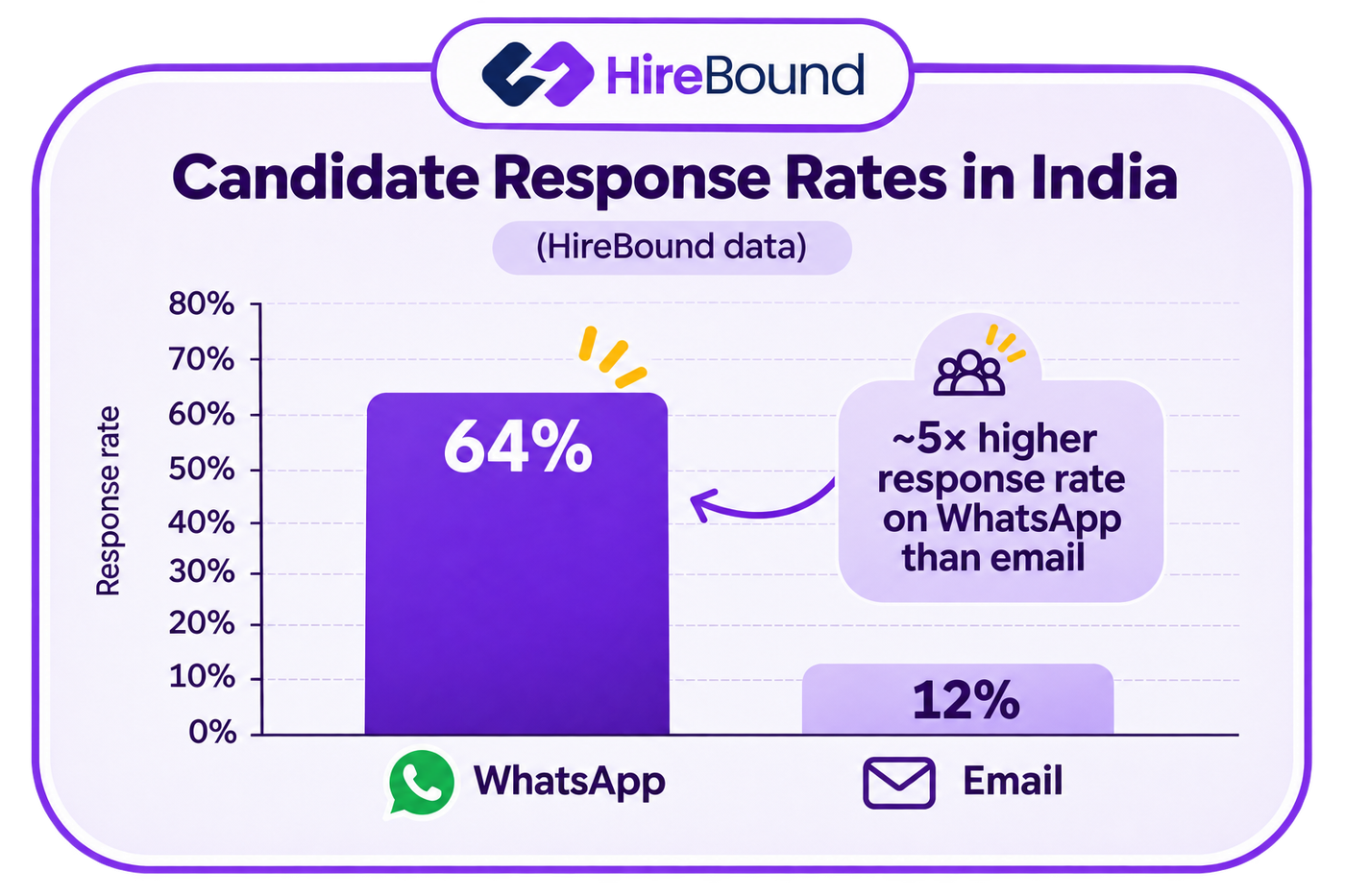
A screening invite that sits unopened in an inbox never becomes an interview.
Here is an illustrative example with assumed numbers. A team contacts 500 applicants for a batch of customer-support roles. At the rates above, that is about 320 replies on WhatsApp against about 60 by email, so treat the gap as a sizing guide, not a forecast.
The second is language. Many frontline and mid-level candidates are more at ease in Hindi, Tamil, Telugu or another regional language than in English. A screening conversation in the candidate's own language keeps people in the funnel who would drop out of an English-only process.
The third is consent. India's Digital Personal Data Protection Act, 2023 sets the rules for processing candidate data, and PRS Legislative Research's summary of the Act explains its consent and notice provisions in plain language. Ask every vendor how each channel records consent and where transcripts are stored.
Who Should Pick Something Else?
An agent-led platform is one route among several. Many teams get more from one of the other six tools, because those tools lead on strengths their hiring depends on.
- If your problem is inconsistent ratings across a large interview panel, Greenhouse's scorecards and interview kits are built for that problem.
- Lever's ATS and CRM in one system suits companies that nurture past applicants for months before a role opens.
- For a lean team, Workable's one-click posting to 200+ boards, texting and self-scheduling cover the basics for a small team in one tool.
- For teams already on Zoho apps, Zoho Recruit sits inside the tools they use, which keeps data and logins in one place.
- Manatal's 2,500+ channels suit teams whose sourcing starts with job ads.
- For Indian companies that want one HR suite, Keka connects hiring to onboarding and India payroll, so HR runs one system from offer to first salary.
If one of these describes your team, start your shortlist there. The two-week trial later in this guide works for any of them.
What Should You Ask Any ATS Vendor?
Put the same questions to every vendor on your shortlist and write the answers down. A vague answer in a demo often turns into a manual workaround once the tool is live.
- Which candidate channels run natively? Ask to see WhatsApp, calling and SMS working in a live account, not on a slide.
- What does a recruiter still do by hand? Ask for a step-by-step walkthrough of one role, from posting to booked interview.
- How does screening work at 500 applicants? Ask who asks the questions, who scores the answers, and where the transcript lives.
- Which languages does screening support? For hiring in India, ask to hear a call or read a chat in Hindi or another regional language.
- How is consent captured for each channel? Ask where the record is stored and who can see it.
- What can you export, and in what format? Candidate records, notes and activity history should all leave cleanly if you move again.
A vendor that answers plainly is easier to plan around than one that says yes to everything.
How Do You Test an ATS Before You Commit?
A two-week trial on one real role tells you more than a month of demos. Run it like this.
- Pick one live role with volume. Choose one with at least 100 applicants so automation effects show.
- Record a baseline. Note recruiter hours on screening and scheduling, reply rate by channel, and days from posting to first interview.
- Run the same role on the new tool. Keep the recruiter, the hiring manager and the job description the same.
- Compare three numbers: recruiter hours per interview booked, reply rate by channel, and days to first interview.
- Check the data trail. Confirm consent records, transcripts and exports before you scale.
If the new tool does not beat your baseline on at least two of the three numbers, keep looking. Ask each vendor for a reference customer of your size and hiring mix, and ask what took longest to set up.
Which ATS Fits Which Team?
Match the tool to your constraint instead of a ranking. The table pairs common team situations with the option that usually suits them.
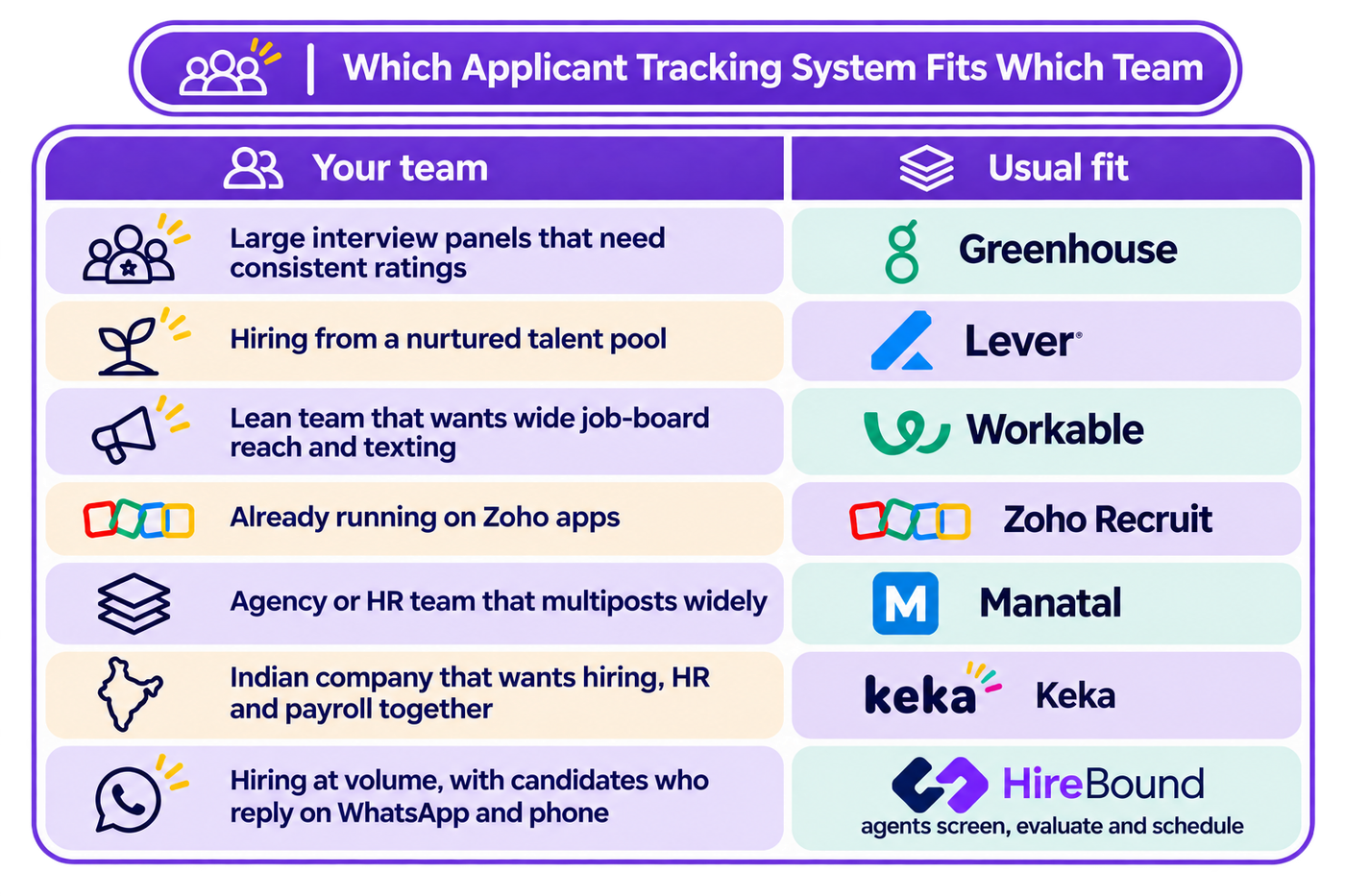
Most teams fit more than one row. A company can run senior hiring on structured interviews and send its volume roles through an agent-led workflow, then compare the two on the same three numbers.
Hiring at volume and short on recruiter hours? Talk to HireBound about a one-role pilot →
Our Recommendation
All seven belong on a top applicant tracking system shortlist, and the best one for you is built around your slowest stage. Greenhouse leads on structured interviews, Lever on talent pools, Workable and Manatal on reach, Zoho Recruit on ecosystem, and Keka on HR and payroll in one place.
Apply one decision rule. Count where your recruiters' hours go in a normal week.
If most of the week goes on interview design and panel feedback, weigh structured evaluation most heavily and start with Greenhouse or Lever. If most of it goes on calling applicants, chasing replies and booking interviews across WhatsApp and the phone, weigh agent-run screening and candidate channels most heavily, and test HireBound on one live role.


