How to Improve Candidate Experience at Every Hiring Stage
 Devansh Dhawan
 ·Nov 15, 2026·9 min read

Key Takeaways
- 1Cronofy's 2024 survey of 12,000 candidates found 42% had left a hiring process because interview scheduling took too long.
- 2Improve candidate experience one stage at a time: find where people wait, guess or repeat themselves, and fix that stage first.
- 3A meta-analysis of 86 samples by Hausknecht, Day and Thomas (2004) linked positive applicant perceptions to stronger intent to accept offers.
- 4Close the loop with every candidate by stage: a short note after early rejections, a call and two specific points after a final round.
- 5In India, HireBound sees a 64% WhatsApp response rate against about 12% for email, so send stage updates where candidates reply.
Candidate experience is how job seekers judge your hiring process, from the first job ad to their first day. To improve candidate experience, find the stages where candidates wait, guess or repeat themselves. Fix those first: clearer ads, shorter applications, faster scheduling, honest rejections and steady contact until joining.
Slow communication is the most common complaint. Cronofy's Candidate Expectations Report 2024 surveyed 12,000 candidates across seven countries. 28% named lack of responsiveness and poor communication as the most frustrating part of recruiting, and 42% had left a process because scheduling took too long.
This guide covers eight stages: job ad, application, screening, scheduling, interviews, decision and rejection, offer, and pre-joining. For each one you get the usual failure and the fix.
Want every candidate to hear back the same day? See how HireBound handles candidate conversations →
What Are the Signs of a Poor Candidate Experience?
A poor candidate experience shows up in candidate behaviour long before it shows up in a survey. Look for these signs in your own pipeline:
- Candidates start the application form and never finish it.
- Recruiters answer the same questions again and again: pay, location, shift timing, next steps.
- Interview no-shows rise, especially for slots booked several days ahead.
- Candidates stop replying after an interview round.
- Offers are declined late, or accepted and then not taken up.
- Candidates tell friends, or post publicly, that they never heard back.
If you see two or more of these, the process is probably costing you hires. Our guide to why candidates drop off during hiring covers where ghosting clusters and how to count it. This post is about what to change once you know.
How candidates see the process also shapes whether they accept. Hausknecht, Day and Thomas pooled 86 samples covering 48,750 applicants in a 2004 meta-analysis in Personnel Psychology. Applicants with positive views of the selection process saw the employer more favourably and reported stronger intentions to accept offers and recommend it.
How to Improve Candidate Experience: A Stage-by-Stage Map
The table below sums up the most common failure at each stage and the fix that addresses it.
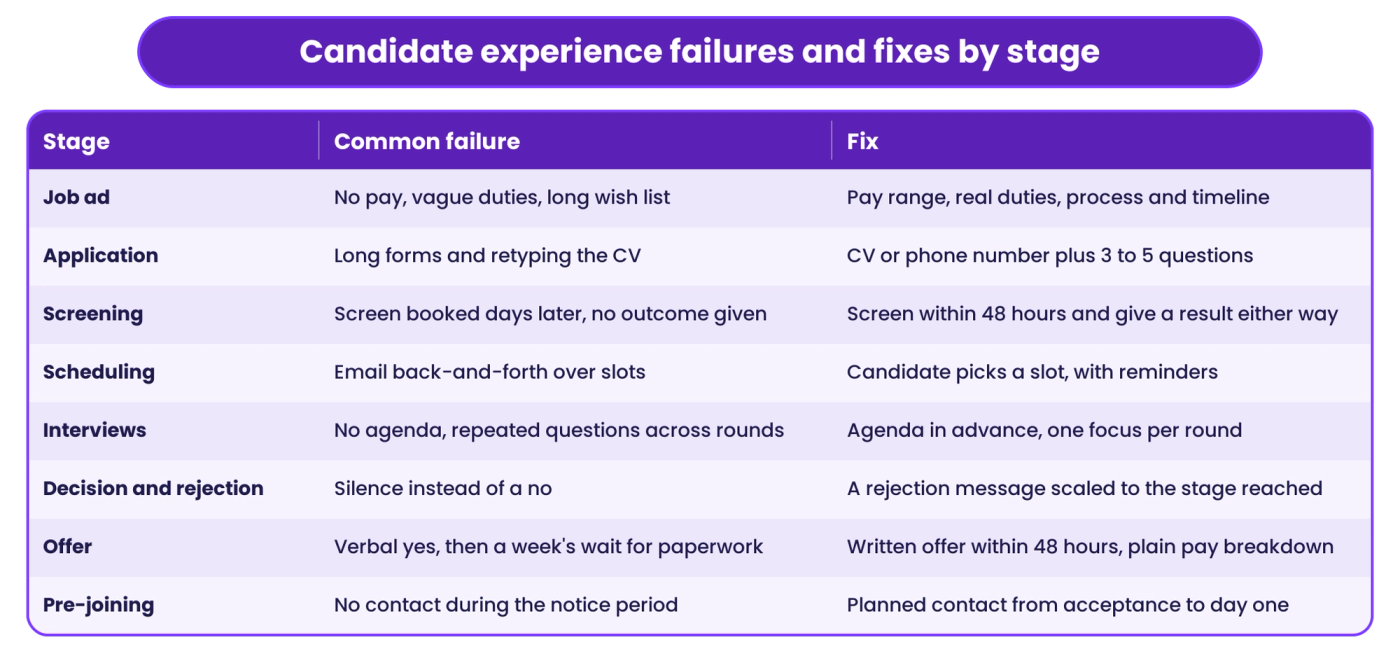
Most of these fixes cost nothing but a change of habit.
Stage 1: Write Job Ads That Answer the Obvious Questions
The most common job ad failure is hiding what candidates most want to know. Pay is missing. The duties are vague and the requirements read like a wish list, so good candidates rule themselves out and poor fits apply anyway.
Answer the questions recruiters get asked most. Put these in the ad:
- The pay range, or at least the band
- Location, work pattern and shift timing
- Five to seven duties the person will do each week
- The steps in the process and how long it usually takes
Pay transparency is also becoming law in some markets. The EU Pay Transparency Directive (2023/970) gives applicants the right to pay information in the vacancy notice or before the interview. Member states had until 7 June 2026 to bring it into national law. Check the national rules in each country you hire in, because the details and start dates can differ.
For frontline roles in India, write the ad in the language candidates read, often Hindi or a regional language. Say whether people can apply on WhatsApp, because many frontline applicants will never open a careers page.
Stage 2: Cut the Application Down to What You Need Now
The application fails when it asks for everything up front. A forced account, a CV upload followed by retyping the same CV into fields, and 30 questions on a phone screen all lose people.
Ask only for what you need to decide on a screen. A CV or phone number plus three to five knockout questions is usually enough. Collect documents, references and full work history later, from the people you move forward.
Candidates dislike repeating themselves. In Cronofy's 2024 survey, 67% said they would be annoyed to repeat information they had already given a recruiter. Once you have something, don't ask for it again.
Send an acknowledgement as soon as the application lands. Say what happens next and by when, and keep that promise.
Under Section 5 of the Digital Personal Data Protection Act 2023, a request for consent must come with a notice. The notice says what personal data you collect and why. The DPDP Rules, notified in November 2025, phase these duties in, so add a short, plain notice to the application now.
Stage 3: Make Screening Fast, Relevant and Final
Screening fails in three ways. The call is booked days after the application, the questions have little to do with the job, and the candidate is never told the result.
Fix the timing first. Aim to screen within 48 hours of the application, because interest fades fast and other employers are calling too. Then send a result to everyone screened, including a polite no.
Make the questions look like the job. The Hausknecht, Day and Thomas meta-analysis found that face validity, meaning how job-related a step looks, strongly predicted whether applicants saw the process as fair. Ask a delivery executive about routes and shift patterns, not where they see themselves in five years.
Here is the screening loop from the candidate's side.
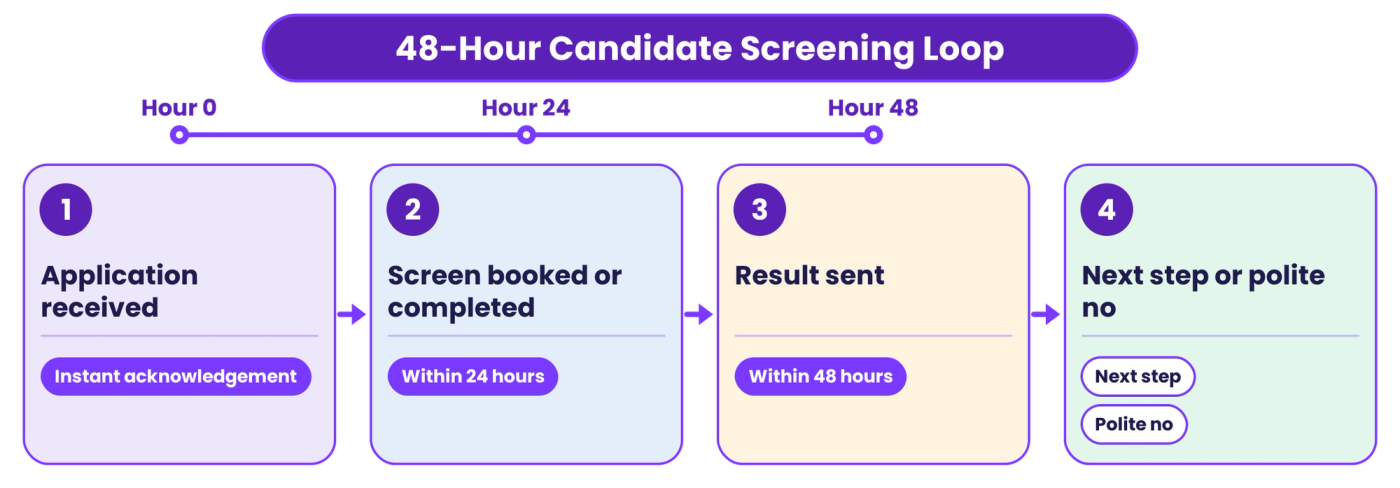
At every step the candidate knows where they stand and what comes next.
Stage 4: Take the Back-and-Forth Out of Interview Scheduling
Interview scheduling is where candidates wait longest. In Cronofy's 2024 survey, the largest group of candidates (31%) said their first interview took two to three weeks to schedule. 62% said scheduling time and experience shape their early view of an employer.
Candidates also prefer less coordination. 57% preferred an automated system that schedules interviews to lengthy back-and-forth, and 53% preferred choosing from time slots they were given.
The fix has four parts:
- Offer real slots to choose from, ideally during or right after screening.
- Send a calendar invite with the interviewer's name, the format and the length.
- Send reminders the day before and an hour before, on the channel the candidate uses.
- Include a one-tap reschedule option, so a clash becomes a new slot.
In India, that channel is usually WhatsApp, with the calendar invite as a backup. A reminder sent there is far more likely to be read than one sitting in an inbox.
Stage 5: Run Interviews Candidates Can Prepare For
Interviews fail when candidates walk in blind. A surprise panel, an interviewer who hasn't read the CV, or the same "tell me about yourself" in three rounds says their time doesn't matter.
Send an agenda two days before each round. Name the interviewers, the format, the length and what to prepare. If there is a task, say how long it should take and whether it will be discussed.
Give each round one focus and set questions, so rounds don't overlap. Hausknecht and colleagues found applicants rated interviews and work samples more favourably than personality inventories, honesty tests and biodata. Practical rounds that look like the job are also the ones candidates see as fair.
Leave ten minutes for the candidate's questions. Then get interviewer feedback in within 24 hours, because a slow debrief is what starts the silence that follows.
Stage 6: Make Decisions Quickly and Rejections Humane
At the decision stage, the most common failure is silence. Many employers let candidates learn they were rejected by never hearing back, and finalists sometimes get the same template as people who never got past the CV.
Set a decision deadline for every role and tell candidates what it is. Then close the loop with everyone, scaled to how far they got. Here is the standard we recommend.
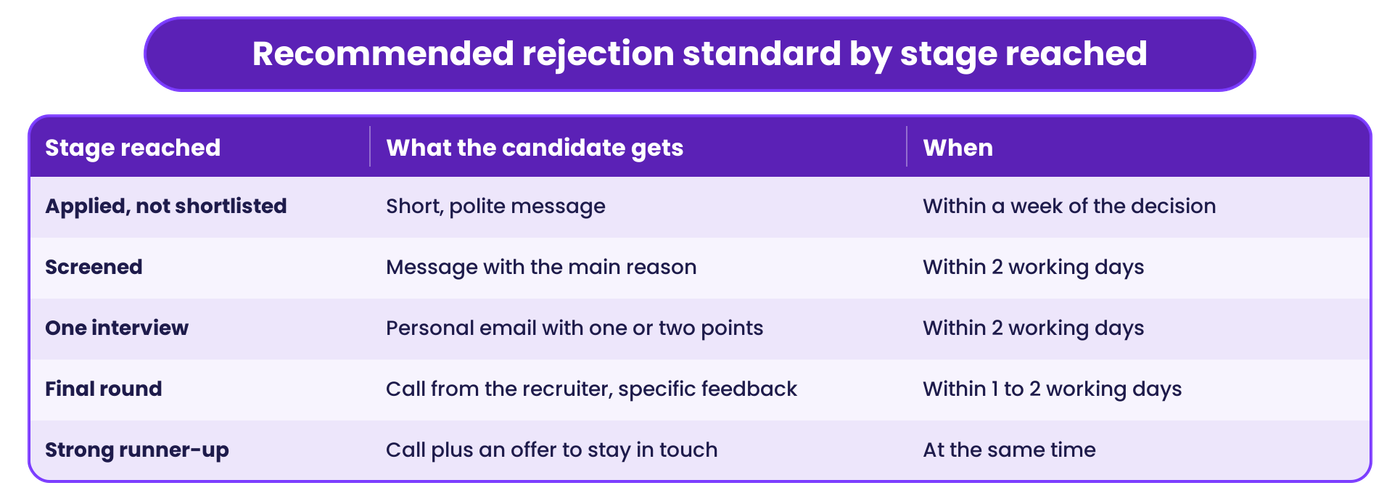
The further a candidate got, the more personal the rejection should be. Ask rejected candidates about their experience too, using a short stage survey like our candidate feedback survey sample.
Stage 7: Make the Offer Easy to Say Yes To
Offers fail on delay and confusion. The verbal offer goes well, then the letter takes a week. The pay breakdown is hard to read, or the deadline feels like pressure.
A smooth process is a selling point at this stage. In Cronofy's 2024 survey, 70% said they would weigh process smoothness as a key factor when choosing between offers.
Send the written offer within 48 hours of the verbal one. Name one contact who can answer questions that day, and give a reasonable deadline.
In India, explain CTC in plain terms. Show fixed pay, variable pay, benefits and an estimated monthly in-hand figure. Candidates often compare offers on take-home pay, and a confusing CTC letter invites a counter-offer.
Stage 8: Keep New Hires Close During the Notice Period
Pre-joining fails when the employer goes quiet after the candidate accepts. In India, notice periods commonly run for weeks or months. During that time a new hire may keep interviewing or receive a counter-offer, and silence from you makes either easier to accept.
Plan contact from acceptance to day one:
- A welcome message from the hiring manager in the first week.
- Paperwork and background-verification steps early, by WhatsApp where possible.
- A short call every two weeks to check in and answer questions.
- An introduction to the team and a buddy before the start date.
- A day-one plan sent the week before, with time, place and contact.
Ask about counter-offers directly and early. It is a normal conversation in Indian hiring, and an open question beats finding out on the joining date.
Which Candidate Experience Best Practices Should You Fix First?
The fastest way to improve the candidate experience is to fix the stage that loses the most people you wanted to hire. Use your own funnel to find it. Our guide to candidate experience metrics shows how to measure each stage, so this section only covers the order of work.
When you have no data yet, start with communication and scheduling. Of all the candidate experience best practices, these two address the most common frustrations in Cronofy's 2024 survey, and both can be fixed in weeks.
This four-week plan works for most teams.
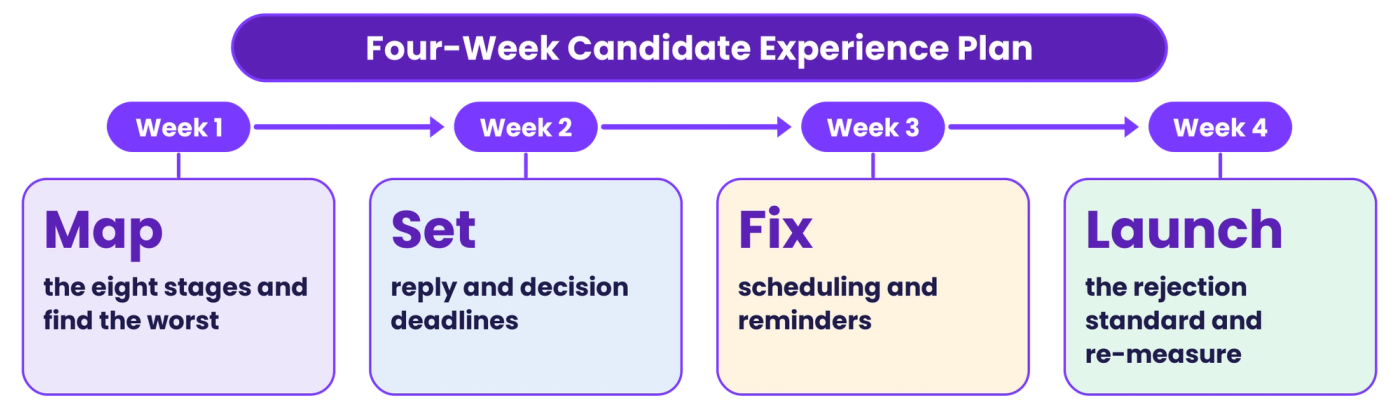
Change one stage at a time, so you can tell which fix worked.
- Week one: list the eight stages and mark where candidates wait longest.
- Week two: set reply and decision deadlines and tell candidates what they are.
- Week three: replace scheduling back-and-forth with slot choice and reminders.
- Week four: roll out the rejection standard, then compare drop-off with the month before.
Where HireBound Fits
Most of the fixes above depend on fast replies on the channel candidates use. HireBound has powered 8 million+ candidate conversations. In India it sees a 64% WhatsApp response rate, against about 12% for email.
HireBound's AI agents handle the parts of the process where candidates usually wait:
- The Screening Agent runs role-specific screening over Voice, WhatsApp and email, and Voice AI screens in 14 Indian languages.
- The Scheduling Agent collects availability during screening and books the interview, with automatic reminders. Our interview scheduling software page shows how it removes the email back-and-forth.
- The Smart CRM keeps every message in one inbox, so candidates are never asked for the same details twice.
Recruiters and hiring managers stay in charge of the judgement calls. They make the decisions, run the offer conversations and call finalists who didn't get the job.
Ready to stop losing candidates between stages? Book a free demo →
Start With the Stage That Loses the Most People
Pick the stage where your funnel loses the most candidates you wanted to hire. Fix that one stage this month, then compare its drop-off with the month before.


