Candidate Feedback Survey Sample: Questions for Every Hiring Stage
 Tanmey Goswami
 ·Nov 5, 2026·10 min read

Key Takeaways
- 1A candidate feedback survey works best as six short pulse surveys, one per stage, with one to five questions each, instead of one long form at the end.
- 2SHRM (2024), reporting Talent Board’s 2023 data from 240,000 candidates, found disrespected time from poor communication or no feedback is the first of the top three reasons candidates withdraw.
- 3The same SHRM report said 36% of US candidates had not heard back from employers one to two months after applying, so a question on whether they heard back is worth asking.
- 4The 10-question core survey below takes about two minutes and covers clarity, speed, fairness, recruiter conduct, effort, and likelihood to recommend.
- 5Wait for at least 30 responses per stage before changing a process, then fix one stage at a time and re-measure after a full hiring cycle.
A candidate feedback survey is a short set of questions that asks applicants to rate and comment on your hiring process. The best version is six small surveys, one per stage, sent right after each stage ends: application, screening, interview, offer, rejection, and joining.
This post gives you the questions, the rating scale for each, when to send them, and a copy-paste 10-question core survey. It also covers a second meaning of the search: sample feedback you send to candidates after an interview or rejection. If you want the scoring definitions first, read our guide to candidate experience metrics. This post does not repeat them.
Want candidate feedback collected without chasing replies by hand? See how HireBound automates candidate conversations →
Why Survey Candidates at Every Stage?
You survey at every stage because candidates leave at specific moments, and a single end-of-process survey cannot tell you which one. It also reaches only the people who stayed, which flatters your results.
SHRM (April 2024) reported Talent Board’s 2023 research, which drew on 150 organisations and survey feedback from 240,000 candidates. The top three reasons candidates withdrew were their time being disrespected through poor communication or never receiving feedback, the process taking too long, and pay not meeting expectations. In the US, 36% of candidates had not heard back from employers one to two months after they applied. You can read the SHRM report on the research for the full findings.
Two of those three reasons are about communication and speed. Both are things a stage-level survey can measure directly. Our post on why candidates drop off covers what to do once you know where they leave.
When Should You Send Each Candidate Survey?
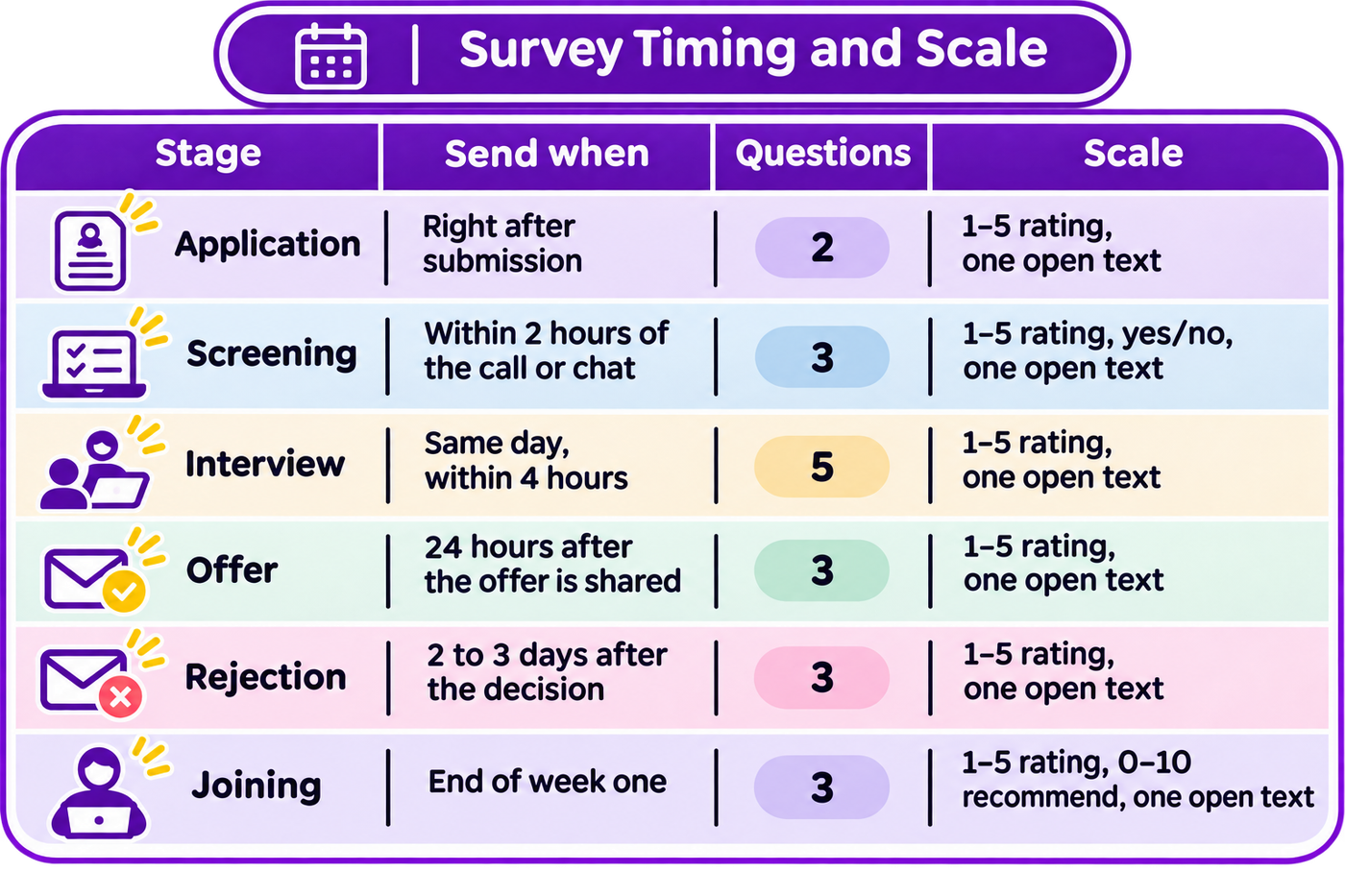
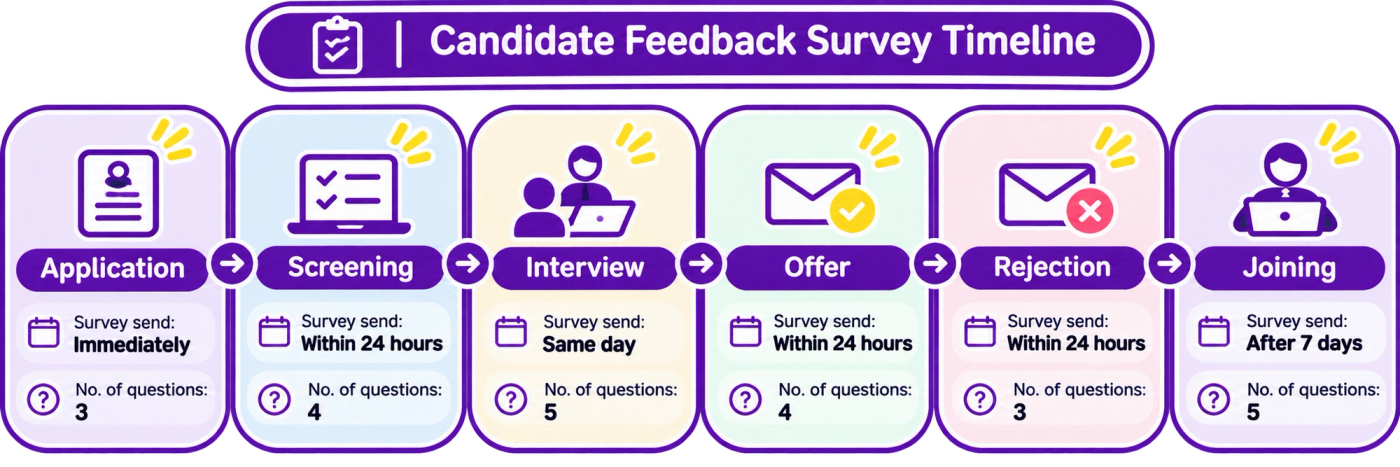
Send each survey within a few hours of the stage ending, while the memory is fresh. Keep it to one to three questions for early stages and up to five for the interview and rejection stages. The table below sets out timing and scale for all six.
Use a 1 to 5 scale for stage questions, because a stage score is a satisfaction reading, not a loyalty one. Use a 0 to 10 scale only for the “would you recommend” question, as in Net Promoter Score, the loyalty measure Fred Reichheld described in Harvard Business Review in December 2003. The official Net Promoter System site gives the standard question: how likely are you to recommend us to a friend or colleague, scored from zero to ten. You can read the original Harvard Business Review article for the background.
Label every scale end (“1 = very unhappy, 5 = very happy”). Say how long the survey takes in the first line of the message.
Sample Candidate Feedback Questions by Stage
These questions are written to be pasted into a form or a message. Each has a scale in brackets. Rewrite them in the language your candidates use, such as Hindi, Tamil, or Telugu, before sending them to frontline or regional audiences.
Application Stage
- How easy was it to apply? (1-5, 1 = very difficult)
- What, if anything, slowed you down while applying? (open text)
Send this on the same device the candidate applied from. A mobile applicant who gets a desktop-only link may not reply.
Screening Stage
- How clear was the recruiter about the role, location, and pay range? (1-5)
- Did you know what would happen next after the call? (yes/no)
- What would have made this conversation better? (open text)
Interview Stage
- Were you given enough information to prepare? (1-5)
- Did the interview start on time? (yes/no)
- Did the interviewer seem prepared and respectful of your time? (1-5)
- How fair did the questions feel for this role? (1-5)
- What one thing should we change about our interviews? (open text)
Offer Stage
- How clear were the salary, benefits, and joining date in your offer? (1-5)
- Did the offer match what you were told earlier? (1-5)
- What would make it easier for you to decide? (open text)
For candidates serving notice, add: “How well did we support your notice-period timeline?” (1-5). Notice periods are common in India, so timing can matter as much as pay when a candidate decides.
Rejection Stage
- How clearly did we explain the decision? (1-5)
- How respectful was the way we told you? (1-5)
- Would you apply to us again for a different role? (yes/no/maybe)
Rejected candidates are usually the largest group, and they often answer most candidly. Do not skip them.
Joining Stage
- How well did the onboarding and joining steps match what we promised? (1-5)
- How likely are you to recommend our hiring process to a friend? (0-10)
- What should we keep, and what should we change? (open text)
A Copy-Paste 10-Question Core Survey
If six stage surveys feel like too much, start with one core survey. Send it after the interview, or after the final decision for candidates who did not get that far. It takes about two minutes.
Copy this block as is:
- How easy was it to apply for this role? (1-5)
- How clear was the job description compared with what you were told later? (1-5)
- How quickly did we respond at each step? (1-5)
- Did you always know what would happen next? (yes/no)
- How respectful was the recruiter of your time? (1-5)
- How prepared and professional was the interviewer? (1-5)
- How fair did the process feel? (1-5)
- How much effort did it take to complete the steps? (1 = very easy, 5 = very hard)
- How likely are you to recommend applying to us to a friend or colleague? (0-10)
- What is the one thing we should change? (open text)
Questions 1 to 8 give you stage-level CSAT. Question 9 gives you candidate NPS, and question 10 tells you why people scored the way they did. If you must cut, cut question 2 and question 8 first, and keep 9 and 10.
Tell candidates how you will use the answers. Under India’s Digital Personal Data Protection Act, 2023, consent must be free, specific, informed, unconditional, and unambiguous, and limited to the personal data needed for the stated purpose (Section 6). Candidates must receive a notice saying what data you collect and why (Section 5). A data fiduciary must erase personal data once consent is withdrawn or the purpose is no longer served, unless a law requires retention (Section 8). Ask your counsel how the Act applies to identifiable survey responses and how long you may keep them.
Should You Send Surveys by WhatsApp or Email?
For frontline and high-volume roles in India, send the survey on WhatsApp. For senior or professional roles, a short email link works. The choice should follow where your candidates already reply.
HireBound’s WhatsApp recruiting software data shows a 64% response rate against about 12% for email in India. That figure measures recruiter outreach replies, not survey completion. Survey response rates are lower on both channels, so do not expect 64% on a feedback form. The useful point is that recruiter outreach on WhatsApp gets answered far more often than email, so a survey sent there is more likely to be seen.
WhatsApp suits tap-to-reply questions. Send the rating as numbered options and ask the open-text question as a separate message. For email, put the first question in the body and link to the rest. Our guides to WhatsApp recruiting and recruiting email templates cover message format and send windows.
HireBound’s permanent-hiring service includes feedback collection, and its WhatsApp conversations are two-way, with media and document exchange. Whatever tool collects the answers, a person should decide what to change.
How Do You Score and Read the Results?
Score each stage separately, then look at the open text before you act. Do not average all stages into one number, because a strong offer stage will hide a weak interview stage.
For each 1-5 question, report the share of candidates who answered 4 or 5. For the 0-10 recommend question, report NPS as defined in our candidate experience metrics guide. Then read the comments and group them into themes.
Use these working rules. They are our suggested practice, not industry benchmarks.
- Treat your first 30 days as a baseline. Judge yourself against that, not against another employer.
- Wait for about 30 responses per stage before you change anything. Fewer than that, and one angry comment can mislead you.
- Split results by hired, rejected after interview, and rejected at screening. The groups answer very differently.
- Track response rate for each survey. A falling rate usually means the survey is too long or sent too late.
Survey scores have limits. Candidates who reply are often the happiest or the angriest, so a low response rate can skew the result. Candidates also soften answers when they think a score will affect a live application. Say that responses are separate from the hiring decision, and pair survey scores with behavioural signals such as stage drop-off.
Turning Feedback Into Fixes: A Worked Example
A fix starts with the lowest-scoring stage and the most repeated comment. Here is an illustrative example with assumed numbers, not real data.
A retail chain hires store associates and runs the interview-stage survey for a month. It collects 120 responses. Question 3, on interviewer preparation, scores 4 or 5 from only 45% of candidates. In the open text, 31 comments mention waiting at the store with no one aware of the appointment.
The team makes one change. The store manager now gets the candidate list and slot times the evening before, and the candidate receives a WhatsApp reminder with the manager’s name. They re-run the same question after a full hiring cycle and compare the share scoring 4 or 5.
Change one thing at a time. If you fix the form, the call script, and the reminder together, you will not know which one worked.
Close the loop with candidates as well. A single line such as “You told us interviews started late, so we now confirm slots the day before” can build trust and may help future response rates.
Sample Feedback to Send Candidates After an Interview
The second meaning of this search is feedback you give to candidates. SHRM (2024) reported that poor communication or no feedback is among the top three reasons candidates withdraw. A short, specific note costs a recruiter two minutes and protects your employer brand.
Keep three rules. Be specific about one or two reasons. Be kind and factual, not vague. Never share another candidate’s details.
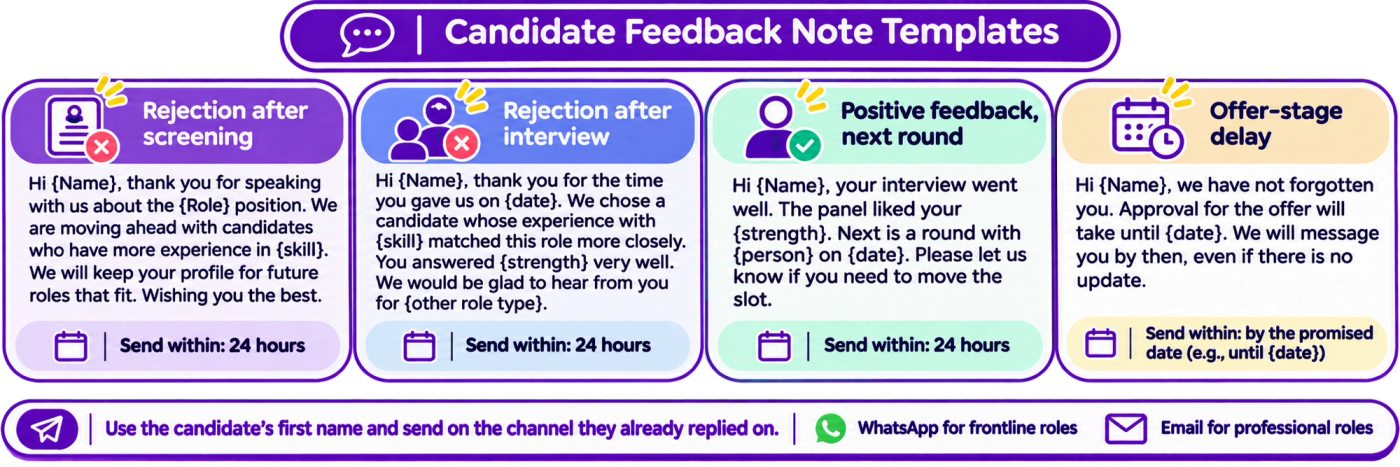
Rejection after screening:
“Hi {Name}, thank you for speaking with us about the {Role} position. We are moving ahead with candidates who have more experience in {skill}. We will keep your profile for future roles that fit. Wishing you the best.”
Rejection after interview:
“Hi {Name}, thank you for the time you gave us on {date}. We chose a candidate whose experience with {skill} matched this role more closely. You answered {strength} very well. We would be glad to hear from you for {other role type}.”
Positive feedback, next round:
“Hi {Name}, your interview went well. The panel liked your {strength}. Next is a round with {person} on {date}. Please let us know if you need to move the slot.”
Offer-stage delay:
“Hi {Name}, we have not forgotten you. Approval for the offer will take until {date}. We will message you by then, even if there is no update.”
Use the candidate’s first name and send on the channel they already replied on. In India, that is often WhatsApp for frontline roles and email for professional ones.
Start With One Stage
Pick the stage where candidates leave most often, usually screening to interview. Send the three-question version of its survey for a month, read every comment, and fix the one theme that repeats.
Ready to collect candidate feedback automatically and act on it? Book a free demo →
What to Do Next
Add the 10-question core survey to your next batch of interviews. Review it at 30 responses, and re-run it after your first fix.


