BPO Interview Questions and Answers: Voice, Non-Voice and Support Roles
 Tanmey Goswami
 ·Nov 4, 2026·10 min read

Key Takeaways
- 1BPO interviews in India usually test spoken communication, shift flexibility and customer handling before anything else, so a clear and calm voice matters more than a long CV.
- 2Nasscom’s BPM page puts India’s BPM industry revenue for FY24 at an estimated $54.6 billion, which is why entry-level BPO hiring is high volume and repeated all year.
- 3Voice roles are judged on speech and listening. Non-voice roles are judged on written accuracy and typing. Support roles are judged on problem solving and tone.
- 4A good answer to “How would you handle an angry customer?” has four steps: listen, apologise for the experience, fix or escalate, and confirm.
- 5For recruiters, a short structured first call with the same five questions for every candidate keeps high-volume screening fair and easy to compare.
BPO interview questions and answers cover how you speak, how you handle people and whether you can work the shift. The common questions are “Tell me about yourself”, “Are you comfortable with night shifts?” and “How would you handle an angry customer?” Voice roles add a spoken English or Hindi check. Non-voice roles add a typing or written test.
This guide gives 26 questions. Each has what the interviewer checks, an illustrative sample answer and a common mistake. Replace the facts in the samples with your own, and do not memorise them.
If you hire for BPOs, see how HireBound runs the first screening call: explore the AI recruiting platform.
How Does BPO Hiring Work in India?
BPO hiring is high volume. Nasscom’s BPM industry page describes India’s BPM industry as a global leader and estimates its FY24 revenue at $54.6 billion. Large teams tend to mean frequent openings, and many employers keep their interview steps short.
The flow differs by company and client account, so treat the table as a common pattern.
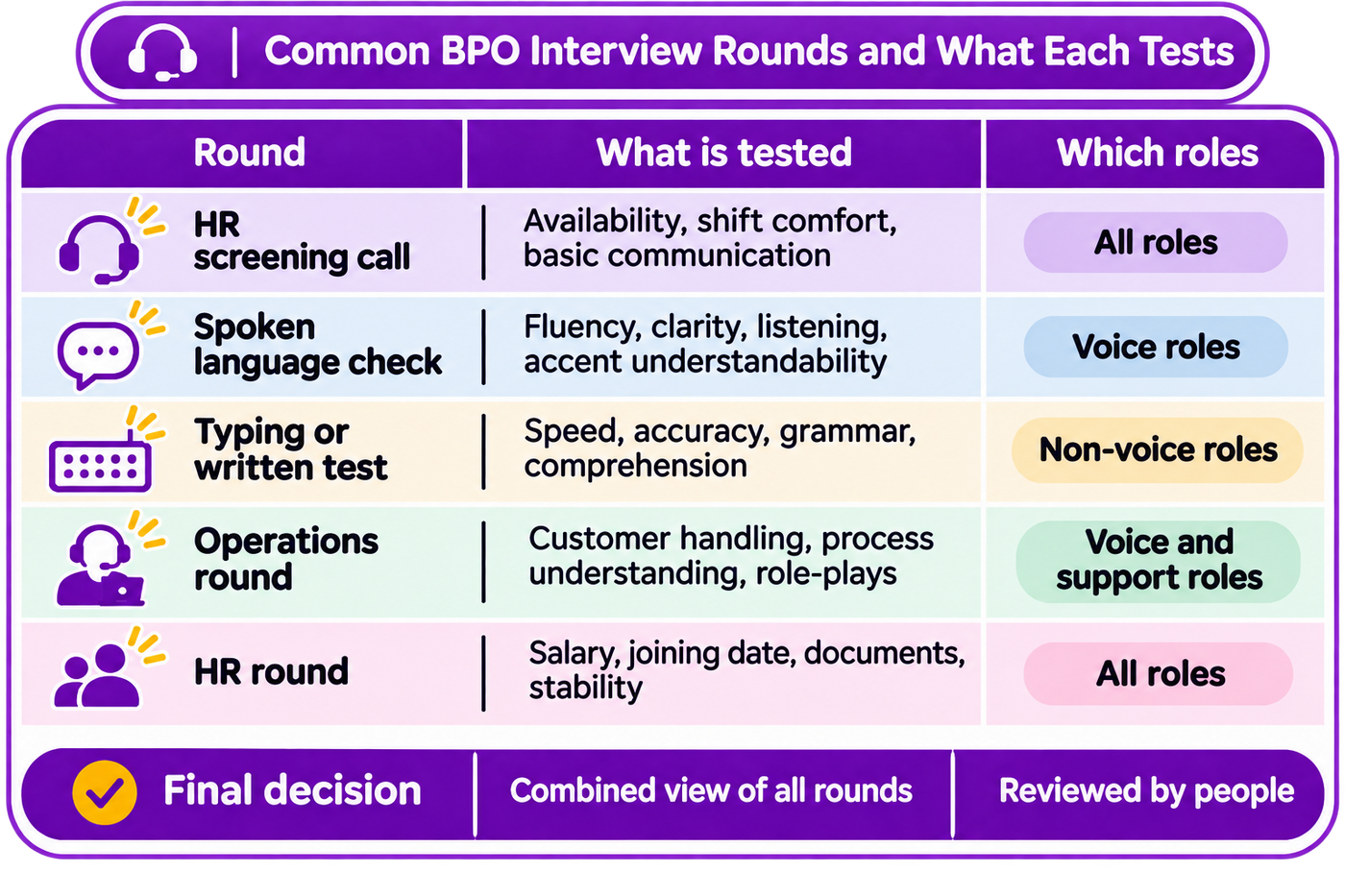
Some employers merge rounds, and some skip the operations round for entry-level hiring. Ask the recruiter for the exact sequence.
What Differs Between Voice, Non-Voice and Support Roles?
The role type decides which questions you will face most.
- Voice process: you speak to customers on calls, inbound or outbound. Interviewers listen to clarity, pace and tone.
- Non-voice process: you work by email, chat or back-office tasks. Interviewers check typing, written accuracy and attention to detail.
- Customer support: you solve problems, often with tickets and a knowledge base. Interviewers check patience, logic and the way you explain things.
Employers often hire freshers into all three and train them on the process. Check the job description for the minimum education and language needs.
How to Answer: The Four-Line Method
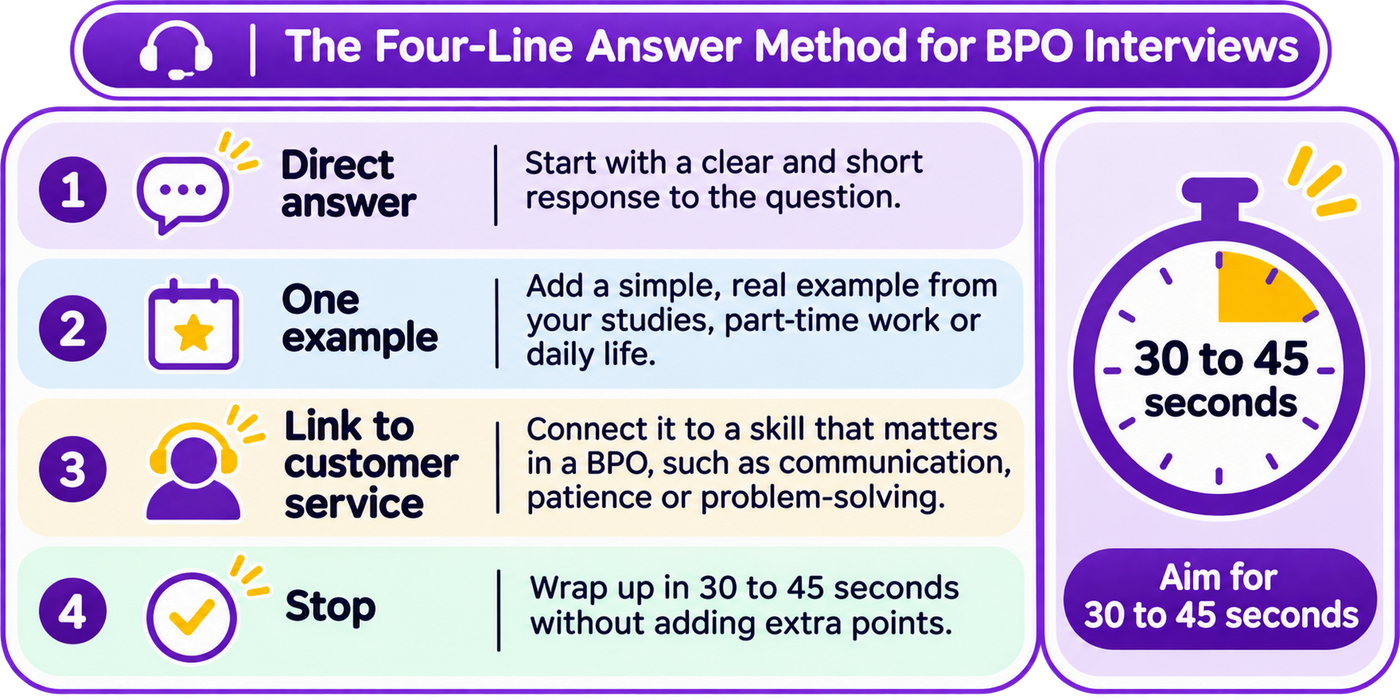
Use the same shape every time and keep it to 30 to 45 seconds.
- Answer in one direct sentence.
- Add one real example from college, a job or daily life.
- Show the link to customer service or teamwork.
- Stop. Do not add filler.
All samples below are illustrative. They show structure and tone only.
Common BPO Interview Questions and Answers: Screening and Motivation
Questions 1 to 5 come first, usually on the screening call.
- Tell me about yourself.
- Checking: Clear speech and a short, organised answer.
- Sample: “I am a B.Com graduate from Jaipur. I worked part-time at a mobile store and enjoyed helping customers. I am applying for the voice process because I like talking to people.”
- Mistake: Reading out your CV or talking for three minutes.
- Why do you want to work in a BPO?
- Checking: Whether you have realistic reasons.
- Sample: “I want to build customer service skills. A BPO gives me structured training and a team to learn from, and I can grow into a senior role.”
- Mistake: Saying it is only a temporary job until something better comes.
- Why do you want to join this company?
- Checking: Basic research and real interest.
- Sample: “I read that you support banking customers. I have used banking apps for years and I would like to help others with them.”
- Mistake: Saying you applied everywhere.
- You have no experience. Why should we hire you?
- Checking: Learning attitude and confidence.
- Sample: “I do not have BPO experience, but I learn quickly. I handled customers at a retail store and I am willing to complete training and follow quality guidelines.”
- Mistake: Apologising for being a fresher.
- Where do you see yourself in three years?
- Checking: Whether you plan to stay.
- Sample: “I would like to become a senior associate and then a team leader. I want to learn the process well first.”
- Mistake: Naming a role that has nothing to do with the job.
For more questions of this type, read HireBound’s fresher interview questions guide.
Communication and Fluency Questions
For voice roles, how you answer matters as much as what you say. Speak slowly, finish each sentence and avoid long pauses.
- How is your English or Hindi, and which languages do you speak?
- Checking: Honest self-rating and the languages the process needs.
- Sample: “I am comfortable in Hindi and English. I speak English with customers in my retail job and I am working to improve my grammar every week.”
- Mistake: Claiming perfect English, then failing the spoken check.
- Speak for one minute on a topic of your choice.
- Checking: Fluency, structure and calm under a time limit.
- Sample: “I will speak about my morning routine. I wake up at six, walk for twenty minutes, then plan my day. This habit keeps me focused.”
- Mistake: Choosing a topic you cannot extend, or stopping after twenty seconds.
- Explain how to make tea to someone who has never made it.
- Checking: Clear step-by-step explanation, a skill used in support calls.
- Sample: “First, boil water. Then add tea leaves and let it simmer for two minutes. Add milk and sugar, and strain it into a cup.”
- Mistake: Skipping steps or using words the listener may not know.
- What makes good customer communication?
- Checking: Whether you know the basics.
- Sample: “Listening first, using simple words, a polite tone and confirming that the customer understood the answer.”
- Mistake: Saying “speaking good English” and nothing else.
- How do you handle a customer who speaks very fast or has a strong accent
- Checking: Patience and listening.
- Sample: “I stay calm, ask the customer to repeat politely, and confirm what I understood in my own words.”
- Mistake: Interrupting or sounding irritated.
Shift, Night Work and Availability Questions
BPO processes often run for long hours or through the night, so recruiters ask about this early. Be honest, because a wrong yes becomes an early resignation.
- Are you comfortable with night shifts?
- Checking: Real willingness, not a rehearsed yes.
- Sample: “Yes. I have worked late during exams and I understand the effect on sleep, so I plan my routine around it. Can you tell me the exact shift timing?”
- Mistake: Saying yes without thinking, then refusing at the offer.
- Are you willing to work on weekends and holidays?
- Checking: Flexibility.
- Sample: “Yes, if the roster is shared in advance. I can plan my commitments if I know the week off pattern.”
- Mistake: Agreeing to everything, or refusing with no discussion.
- How will you travel to the office, especially at night?
- Checking: Reliability and planning.
- Sample: “I live about 40 minutes away and I can use my own two-wheeler. I would also ask about the company cab policy.”
- Mistake: Having no plan, which suggests future late arrivals.
- How will you manage your health and sleep on a night shift?
- Checking: Self-management.
- Sample: “I fix my sleep hours, avoid heavy food at night and take short breaks away from the screen.”
- Mistake: Saying “I do not need much sleep”.
- When can you join?
- Checking: Availability and honesty.
- Sample: “I can join within a week of the offer. I have no notice period because I am not currently employed.”
- Mistake: Giving a date that you cannot meet.
Customer-Handling Questions
These are the heart of the operations round. Use a simple order: listen, empathise, act, confirm.
- How would you handle an angry customer?
- Checking: Calm and a clear method.
- Sample: “I let the customer finish, apologise for the problem and repeat it back. Then I fix it or escalate with a clear timeline, and I confirm the customer is satisfied before closing.”
- Mistake: Arguing, or promising something you cannot deliver.
- What do you do if you do not know the answer?
- Checking: Honesty and resourcefulness.
- Sample: “I tell the customer I will check, use the knowledge base or ask my team lead, and return with the right answer. I do not guess.”
- Mistake: Guessing to avoid sounding weak.
- A customer asks to speak to your manager. What do you do?
- Checking: Process awareness.
- Sample: “I try to resolve the issue first. If the customer still asks, I follow the escalation process and explain the next step clearly.”
- Mistake: Refusing, or passing the call without context.
- A customer calls for the third time about the same issue. How do you respond?
- Checking: Ownership.
- Sample: “I apologise, review the earlier notes so the customer does not repeat the story, and own the case until it is resolved.”
- Mistake: Blaming the previous agent.
- How would you handle targets and average call time?
- Checking: Whether you balance speed with quality.
- Sample: “I try to stay within the time limit, but I never rush a customer into a wrong answer. Good notes and practice help me do both.”
- Mistake: Saying quality does not matter, or that speed does not matter.
- Tell me about a time you helped someone who was upset.
- Checking: Real examples of empathy.
- Sample: “A customer at my store was unhappy about a late refund. I checked the status, explained the steps and followed up the next day.”
- Mistake: Giving a hypothetical answer when asked for a real event.
Process, Tools and Typing Test Questions
These are common for non-voice and support roles. Employers usually train you on their own tools, so honesty about what you know works best.
- What computer skills do you have?
- Checking: Basic system comfort.
- Sample: “I use MS Office, email and web browsers daily. I can type without looking at the keys and I learn new software quickly.”
- Mistake: Listing tools you cannot demonstrate.
- What is a ticket or a CRM, and have you used one?
- Checking: Familiarity with support workflows.
- Sample: “A ticket records a customer issue and its status. A CRM stores customer details and history. I have not used one professionally, but I understand why notes must be clear.”
- Mistake: Pretending to know a tool by name.
- How do you make sure your work has no errors?
- Checking: Attention to detail.
- Sample: “I re-read before sending, use a checklist for repeated steps and ask for feedback on mistakes.”
- Mistake: Saying “I never make mistakes”.
The table below shows how typing and written tests usually work. Test names, scoring and pass marks differ by employer, so confirm them with the recruiter.
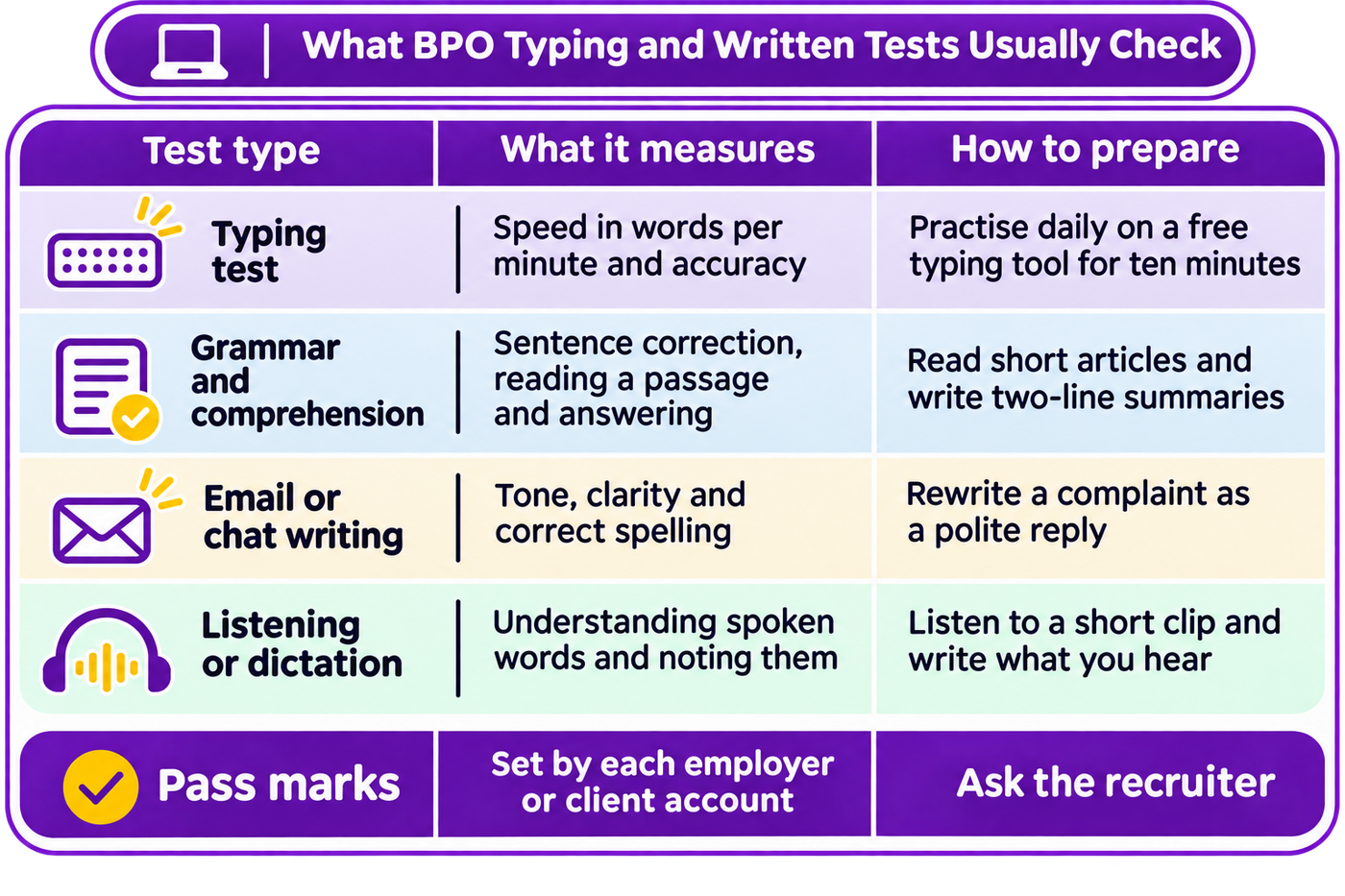
Accuracy usually matters at least as much as speed, so do not rush at the cost of errors.
Salary and Joining Questions
Salary talks usually come in the last round. Keep them honest and tied to the role.
- What is your salary expectation?
- Checking: Whether your figure fits the role.
- Sample: “I am open to the range for this role. As a fresher I care about learning, and I would like to know the fixed and variable parts.”
- Mistake: Naming a number far above the role with no reason.
- Do you have any other offers or interviews in progress?
- Checking: Competition and commitment.
- Sample: “I have one other interview next week. This role is my first choice because of the training.”
- Mistake: Inventing offers to push the figure up.
For pay and notice period answers in more detail, read HireBound’s HR interview questions guide.
For BPO Recruiters: Structuring High-Volume Screening
BPO teams may screen hundreds of candidates a week. When each recruiter asks different questions, results are hard to compare. A fixed first call solves that.
- Ask the same five questions in the same order: language, shift comfort, availability, commute and one role-play.
- Score each answer on a simple 1 to 5 scale with written anchors.
- Record the shift answer and the joining date in a field, not in a note.
- Hand only the candidates who clear the call to the operations round.
HireBound’s pre-screening questions guide covers what to ask before a call. For campaign-level planning, read HireBound’s guide to bulk hiring in India.
Where HireBound Fits in BPO Hiring
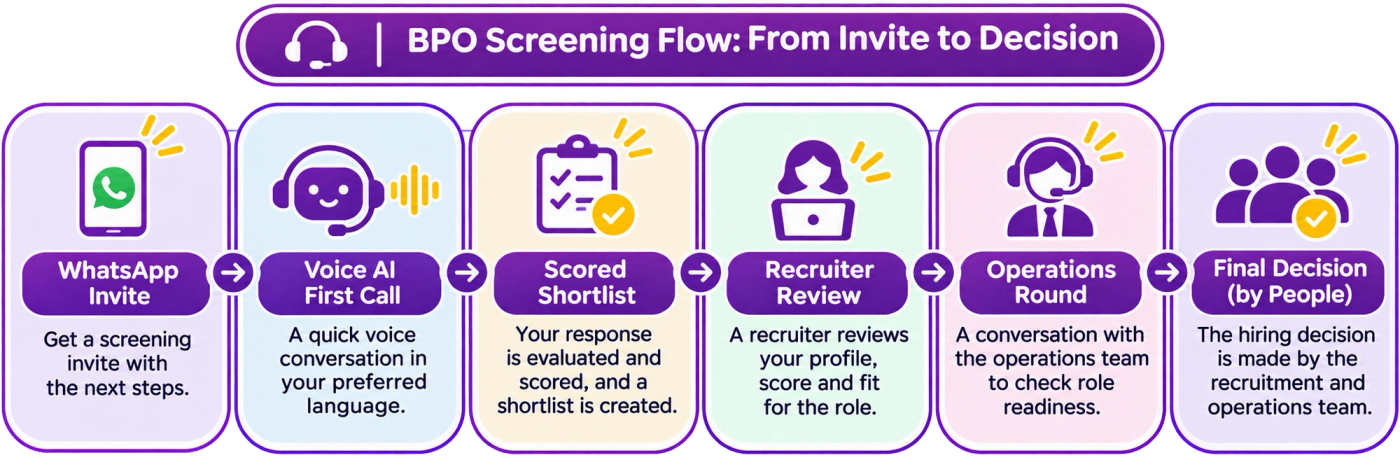
Some BPO teams automate the first call. HireBound’s Voice AI runs screening calls in 14 Indian languages, scores the transcript against criteria the recruiter sets, and passes a shortlist to a person. WhatsApp handles scheduling and follow-up, and HireBound’s India data shows a 64% response rate on WhatsApp against about 12% for email.
HireBound’s data shows recruiters handling 3 times more candidates per day than with a manual process. People stay in charge of the operations round, the final interview and every hiring decision. HireBound does not guarantee hiring outcomes.
Candidate Prep Checklist for the Day Before
- Read the job description and note whether it is voice, non-voice or support.
- Practise questions 1, 6, 11 and 16 aloud and record one answer.
- Prepare a one-minute talk on a simple topic.
- Test your phone, headset and network. Pick a quiet room.
- Practise typing for ten minutes if the role is non-voice.
- Decide your honest answer on shifts, travel and joining date.
- Keep your documents ready and sleep well.
Hiring hundreds of agents a month? See how HireBound’s AI agents screen and schedule candidates while your recruiters keep every decision: talk to the HireBound team.


