7 Most Common Interview Questions and Answers (With Examples)
 Tanmey Goswami
 ·Oct 30, 2026·10 min read

Key Takeaways
- 1The seven most common interview questions are tell me about yourself, why this role, strengths, weaknesses, why you are leaving, where you see yourself in five years, and salary expectations.
- 2Every common question tests one of four things: role fit, self-awareness, motivation or practicality, so an answer should name evidence, not adjectives.
- 3The STAR method (situation, task, action, result) fits behavioural questions in roughly 90 seconds, with most of the time spent on your own action and the result.
- 4The US Office of Personnel Management says structured interviews assess candidates equally and consistently, which is why many employers score answers against a fixed rubric.
- 5Three steps prepare you for most rounds: map your resume to the job description, write five STAR stories, and rehearse aloud, including for a recorded or AI-led first call.
The seven most common interview questions are: tell me about yourself, why do you want this role, what are your strengths, what is your weakness, why are you leaving your current job, where do you see yourself in five years, and what are your salary expectations. Interviewers ask them at every level because each one tests a different thing: fit, self-awareness, motivation and practicality. A strong answer is short, specific and backed by one example.
This guide gives you the intent behind each question, an answer structure, a sample reply and the mistake to avoid. It then covers 18 more questions by category, the STAR method, how interviewers score you and a three-step prep plan.
If you are on the hiring side and want to see how HireBound runs the first conversation with candidates, explore the AI recruiting platform.
The 7 Most Common Interview Questions and How to Answer Them
For each question, think about what the interviewer is checking. Answering that hidden question, as well as the spoken one, makes your reply more relevant. The sample answers below are original and use a fictional candidate, a customer support executive moving to an account management role.
1. Tell Me About Yourself
What they check: whether you can summarise your career in a way that matches the job. It is a communication test as much as a content test.
Answer structure: present, past, future. Start with your current role, add one or two achievements, then say why this role is the next step. Keep it to about 60 to 90 seconds.
Sample answer: “I am a customer support executive at a logistics firm, handling about 60 cases a day. Last year I cut repeat complaints in my team by tracking the top three causes and fixing them with operations. I enjoy the part of support where I help a customer renew, so I am looking at account management, where I can own that relationship end to end.”
Common mistake: reciting your resume from school onwards or sharing family and hobby details. The interviewer already has the resume.
2. Why Do You Want This Role (or This Company)?
What they check: motivation, and whether you did any homework. Generic answers suggest you would accept any offer.
Answer structure: one reason about the work, one about the company, one about your fit. Use facts from the job description or the company’s own careers page.
Sample answer: “The role covers renewals for mid-size clients, which is where I have done my best work. I also noticed from your careers page that account managers here handle both onboarding and renewals, so I would see the full customer journey.”
Common mistake: talking only about what you would gain, such as salary or location. Show what you would bring.
3. What Are Your Strengths?
What they check: whether your strengths match the role, and whether you can prove them.
Answer structure: pick two strengths the job needs. Give a one-line example for each. Avoid a list of five adjectives.
Sample answer: “My strengths are follow-through and clear communication. When a client escalated a delayed shipment, I called them daily with a written update until it arrived, and they renewed their contract that quarter.”
Common mistake: claiming strengths with no evidence, such as “I am a hard worker and a team player”. Interviewers hear it constantly and it proves nothing.
4. What Is Your Weakness?
What they check: self-awareness and whether you act on feedback. They are not looking for a confession.
Answer structure: name a real but non-critical weakness, say what you did about it, and show progress.
Sample answer: “I used to take on too many tasks myself instead of delegating. I now plan my week on Monday, hand over routine work to a colleague and review progress on Friday. My on-time delivery has improved as a result.”
Common mistake: a disguised strength such as “I work too hard”, or a weakness that rules you out, such as poor punctuality for a shift-based job.
5. Why Are You Leaving Your Current Job?
What they check: reliability and attitude. A recruiter listens for blame, instability or a pattern of short stints.
Answer structure: keep it forward-looking. Name what you want more of, such as scope or learning, not what you dislike about your employer.
Sample answer: “I have learned a lot in support, and I now want a role with more ownership of client outcomes. My current team does not have an account management track, so this move is the natural next step.”
Common mistake: criticising your manager or company. Even if it is true, it signals how you may talk about this employer later.
6. Where Do You See Yourself in Five Years?
What they check: ambition that is realistic and compatible with the role. Employers want to know whether the role can hold you.
Answer structure: describe the skills and responsibility you want to grow into, tied to the path that exists in this team.
Sample answer: “In five years I want to be managing a portfolio of larger accounts and mentoring newer account managers. I would like to build that foundation here.”
Common mistake: naming a job that does not exist at the company, or saying you want your interviewer’s job. Also avoid “I have not thought about it”.
7. What Are Your Salary Expectations?
What they check: whether your expectation fits the budget, and how you handle negotiation.
Answer structure: research the market range for the role and city, state a range, and stay open on the full package. If the stage is early, ask for the budgeted range first.
Sample answer: “Based on my research for account managers in Pune with my experience, I am looking at a range of X to Y lakh a year, and I am flexible depending on the full package and role scope.”
Common mistake: quoting a figure with no research, or confusing take-home pay with annual CTC. Annual CTC is the employer’s total yearly cost, so it is always higher than monthly take-home pay.
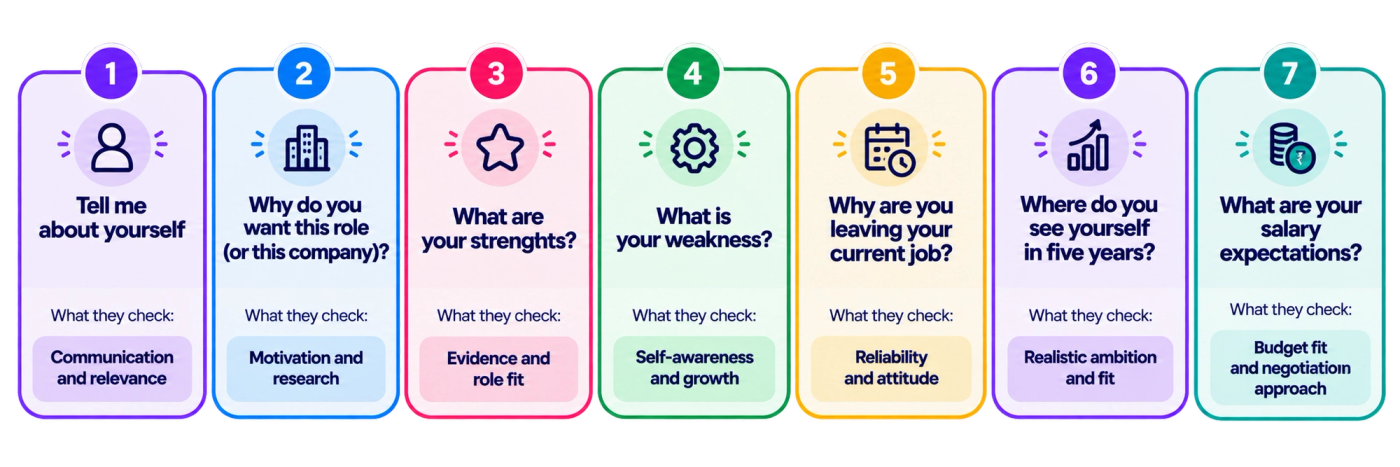
The pattern is the same across all seven: be specific, be brief and attach one fact.
18 More Common Interview Questions by Category
The seven above come up early in many interviews. The questions below often follow them, grouped by what the interviewer wants to learn, so you can practise each one aloud.
About you, to check values and working style:
- What motivates you to do your best work?
- How would your colleagues describe you?
- What kind of manager do you work best with?
Role and company, to check skills and homework:
- What do you know about our company?
- Why should we hire you?
- What makes you different from other candidates?
- How do you prioritise when everything is urgent?
- What would you do in your first 30 days here?
Behavioural, to check past conduct:
- Describe a time you handled conflict with a colleague.
- Tell me about a mistake you made and what you learned.
- Give an example of a goal you missed and what changed afterwards.
- Describe a time you worked under a tight deadline.
- How do you handle feedback you disagree with?
Situational, to check judgement:
- What would you do if a client or customer was upset?
Practical, to check availability and commitment:
- Are you open to relocation or rotating shifts?
- What is your notice period, and can it be reduced?
- Do you have other offers in hand?
Closing:
- Do you have any questions for us?
The last one deserves preparation. Ask about success measures for the role, how the team works and what the first quarter looks like. Do not ask about leave on your first call.
Behavioural Questions and the STAR Method
Behavioural questions begin with “tell me about a time”. Interviewers ask them because past behaviour is a useful clue to future behaviour. The STAR method keeps your answer organised.
- Situation: the context, in one or two sentences.
- Task: what you were responsible for.
- Action: the steps you personally took. This should be the longest part.
- Result: the outcome, with a number if you have one, and what you learned.
Here is a sample for “tell me about a time you handled conflict”. “Two of us shared the same client queue and kept duplicating replies (situation). I was asked to fix the overlap (task). I proposed a simple split by client region, agreed it with my colleague and shared it with our lead (action). Duplicate replies dropped to almost none, and we kept the split afterwards (result).”
Prepare five stories in advance: a success, a failure, a conflict, a time you led and a time you learned something quickly. One of the five can answer most behavioural questions, and your own stories sound more natural than anything memorised.
How Interviewers Score Your Answers
Many employers use a structured interview instead of gut feel, where each candidate gets the same questions and is rated on the same criteria. The US Office of Personnel Management states that structured interviews are designed to give candidates equal opportunities and to assess them accurately and consistently (OPM, Structured Interviews).
In practice, the interviewer scores each answer on a simple scale, often one to five, against criteria such as communication, role knowledge and ownership. The table shows how a rating of one, three and five typically sounds for the same question.
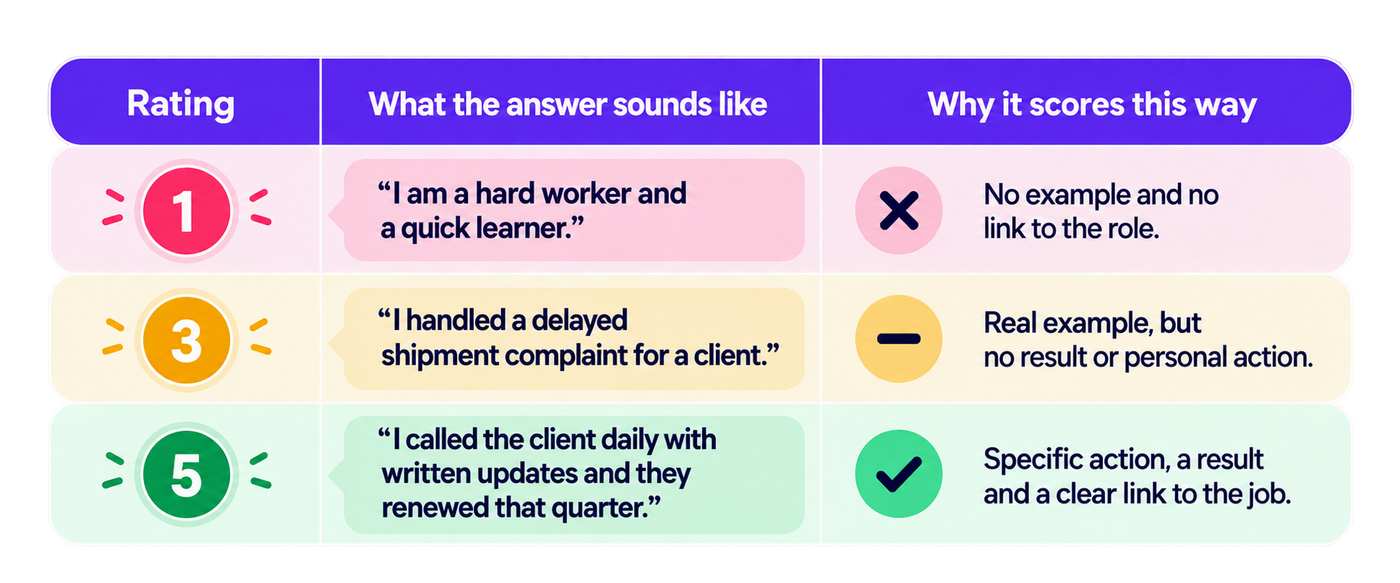
Notes are written during or right after the interview, so a clear answer with a concrete example is easy to record. A vague answer is hard to score and usually scores low.
You can use the same lens for practice. After each mock answer, ask yourself whether it contained a specific example, a result and a link to the job. If the answer is no to any of these, rework it. Recruiters who want to see what a scoring sheet looks like can read HireBound’s structured interview scorecard template.
Rubrics also reward skills evidence over pedigree. This is the logic behind skills-based hiring: a story about work you actually did counts for more than a long list of titles.
What to Expect When the First Call Is Automated
Some employers in India now run the first conversation by phone, WhatsApp or a recorded video, handled by an automated system. You may be asked a few of the common questions above, in Hindi, English or a regional language. The answers are recorded and then reviewed by a recruiter, who decides who moves ahead.
The advice is the same as for a human interviewer, with two additions. Answer in the language you are most comfortable in if the call offers a choice, and keep each answer to under two minutes. A system cannot read your face, so say your example in words and state the result clearly.
HireBound’s Voice AI runs these first screening calls in 14 Indian languages. A recruiter reviews the shortlist and makes the hiring decision, so the call collects your answers and a person decides what happens next. If your hiring team wants to know how this works in practice, see the section on recruiters below.
Prepare for Common Interview Questions in 3 Steps
Preparation works best as a short routine.
- Map the job. Highlight five requirements in the job description, then write one achievement from your own work for each. These become the evidence for questions 1 to 3.
- Write your five STAR stories and your salary range. Keep each story to about 90 seconds and your range to a number you can defend with research.
- Rehearse aloud. Record yourself on a phone, listen for filler words and check the length. Do two mock rounds with a friend, ideally one that includes a phone-only call.
On the day, carry a copy of your resume, arrive or log in ten minutes early and prepare two questions for the interviewer.
If you are a fresher, the questions shift towards education and projects. The guides linked at the end of this post cover that and the HR round.
What Recruiters Take From These Answers
For a recruiter, a common question is a screening tool. The answers show whether a candidate matches the role, is available on the right dates and can communicate clearly. Teams hiring at volume often cannot hold each of these conversations by hand, so some automate the first call.
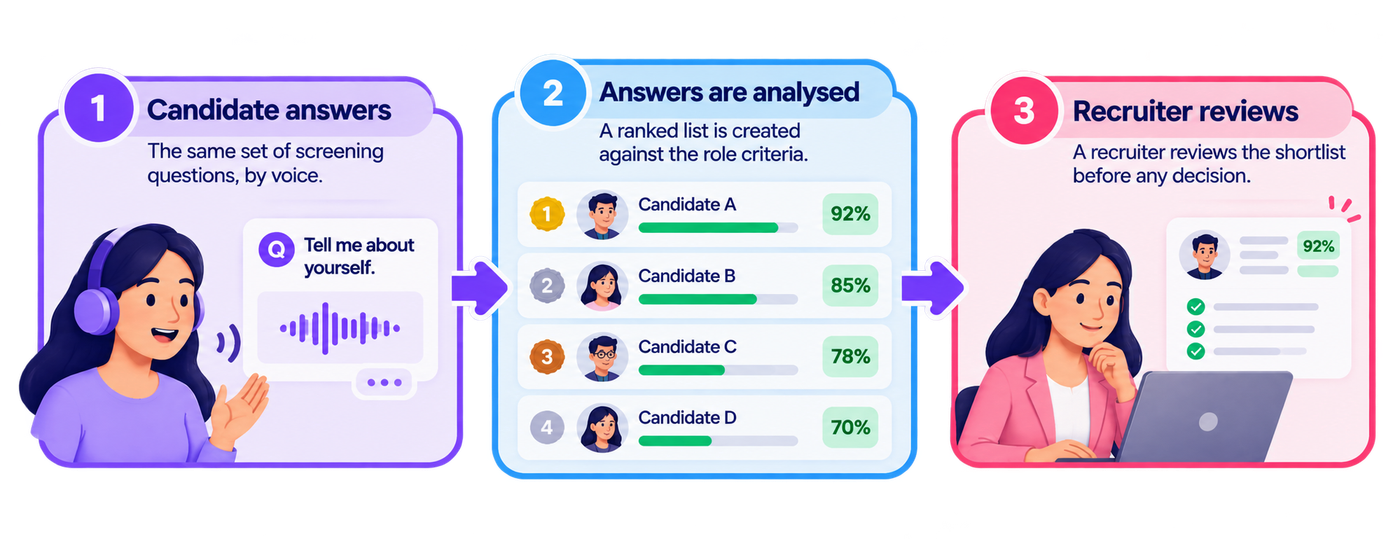
HireBound’s AI agents screen and schedule candidates over WhatsApp, SMS, email and Voice AI. Across India, HireBound sees a 64% WhatsApp response rate against about 12% for email, and recruiters using the platform handle 3x more candidates per day than with a manual process. HireBound has powered more than 8 million candidate conversations, and 60+ recruiting teams in India run on it. Recruiters review every shortlist and make every hiring decision.
Screening hundreds of candidates with the same questions? See how HireBound’s AI agents run the first conversation while your recruiters keep the decisions: talk to the HireBound team.
Where to Go Next
Practise your seven core answers first, then your five STAR stories. After that, use the interview guide that fits your stage: fresher interview questions for early careers, and HR interview questions for the HR round on salary, notice period and joining.


