Blue Collar Hiring in India: A Practical Guide
 Devansh Dhawan
 ·Nov 12, 2026·10 min read

Key Takeaways
- 1Screen blue collar candidates on role facts first: a delivery rider needs a valid licence, a hub within reach and the shift, checked in that order.
- 2PLFS 2025 puts regular salaried work at 23.6% of India's workers, so most blue collar applicants have never filled a corporate application form.
- 3The e-Shram portal held 31.89 crore unorganised worker registrations by August 2026, with 55.21% aged 18 to 40, the core blue collar age band.
- 4HireBound data shows a 64% WhatsApp response rate in India against about 12% for email, so WhatsApp and voice should lead blue collar outreach.
- 5Plan the first month like the hire itself: five check-ins on days 1, 3, 7, 14 and 30, each owned by a named supervisor.
Blue collar hiring is the recruitment of workers for manual, technical and on-site roles, such as delivery riders, drivers, warehouse associates, technicians, security guards and hospitality staff. In India, most of it happens by phone. Candidates are reached by WhatsApp, calls and referrals, and screened on licence, location and shift availability.
Each role has its own weak point. A warehouse picker may drop out over the shift, a driver over the licence, and a field sales executive over the incentive structure. This guide goes role by role through sourcing, screening, document checks, the gap between offer and joining, and the first 30 days.
Hiring drivers, technicians or warehouse staff across cities? See how HireBound reaches and screens frontline candidates →
What Is Blue Collar Hiring?
Blue collar hiring covers roles where the work is physical, skilled with the hands, or done on a site rather than at a desk. Pay is often daily, weekly or shift-based, and incentives can make up a large share of take-home pay. Requirements are concrete: a licence, a certificate, a shift, a distance.
The candidate pool looks different from office hiring. According to the Periodic Labour Force Survey Annual Report 2025 from MoSPI, 56.2% of India's workers are self-employed and only 23.6% are in regular wage or salaried work. The rest, about a fifth, are casual labourers.
Many blue collar applicants therefore come from informal or self-run work, with no CV and no corporate email address. A process that starts with a portal form and an email shortlist loses them in the first step.
The diagram below groups the six role families this guide covers by what decides fit.
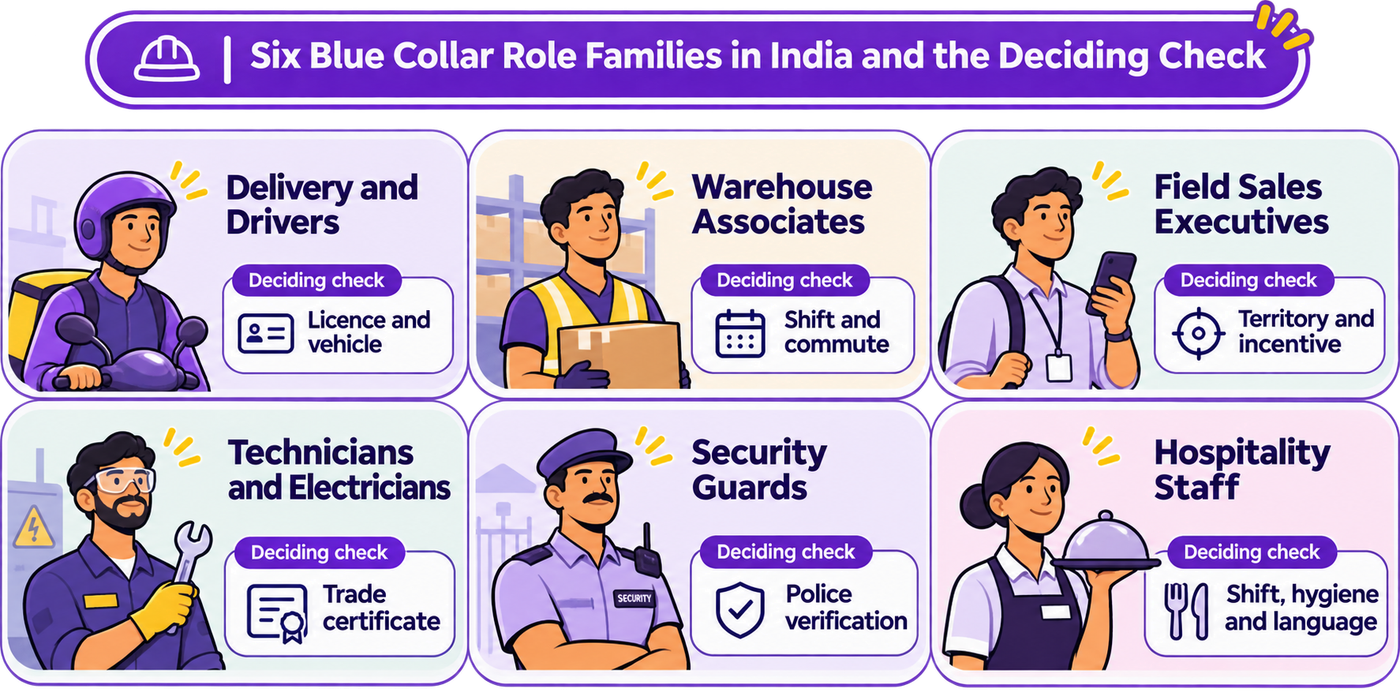
Each family has one check that rules candidates in or out, so the screen should ask it first.
Why Is Blue Collar Hiring Hard in India?
Blue collar hiring in India is hard because employer demand is high and most of the workforce sits outside formal payroll, so good candidates can choose. Bulk hiring, which our guide to bulk hiring in India covers in detail, is about volume. This post is about the roles themselves.
ManpowerGroup's Employment Outlook Survey for October to December 2026, which covered 3,055 Indian employers, put India's net employment outlook at 54%, up 11 points on the year. With hiring plans that strong, a frontline worker who hears nothing for three days takes the next offer.
The workforce is large and mostly outside formal payroll. The Press Information Bureau's factsheet for the fifth anniversary of the e-Shram portal reported 31.89 crore registrations of unorganised workers as of 18 August 2026. Of those registered, 55.21% were aged 18 to 40, and around 11.5 lakh were platform workers.
The PIB factsheet also notes that e-Shram added support for 22 languages in 2025. An employer that screens only in English is asking more of these workers than the government's own registry does.
Where Do You Find Blue Collar Workers in India?
Use the channels workers already use, and send every applicant into one pipeline. No single source works for every role or town, so count how many joiners each source produces.
These channels tend to reach blue collar candidates:
- WhatsApp: HireBound data shows a 64% WhatsApp response rate in India, compared with about 12% for email. Send the role, pay, location and shift in the first message, with a way to apply inside the chat.
- Referrals from current staff: drivers know drivers and guards know guards. Pay the reward after the referred person completes 30 days, so it rewards a hire who stays.
- Vernacular voice calls: many candidates speak more comfortably than they type. A call in Hindi, Tamil or Marathi gets answers a text form will not.
- QR codes at local sites: posters at depots, factory gates, ITIs and markets let a candidate scan and apply from the phone in under a minute.
- Past applicants: people who applied for an earlier drive and were not placed already know your company, so contact them before you spend on advertising.
- Training institutes and skilling centres: ITIs and local skilling partners are a steady source for technicians and electricians.
Write the job message in the local language and put pay first. A candidate deciding between two warehouse jobs compares the weekly figure before anything else.
For hiring outside the metros, our guide to frontline hiring in tier 2 and tier 3 cities covers local channels and town-by-town tracking.
Which Checks Matter for Each Blue Collar Role?
Screen for the facts that decide whether the person can do the job and turn up for it. For most blue collar roles, those are a licence or certificate, where the candidate lives and which shifts they can work.
The table maps each role family to the channels that tend to reach it and the checks to run in the first screen.
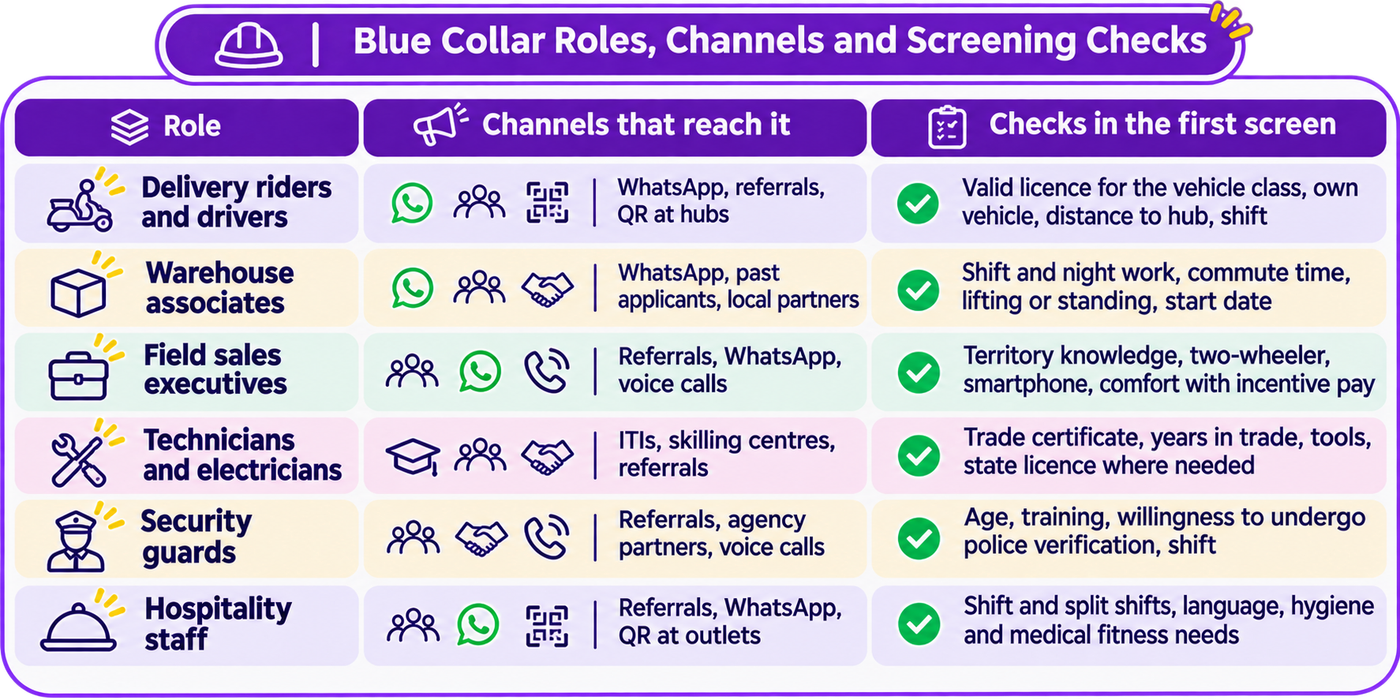
A rider without a valid licence should leave the screen at question one, not after a 15-minute call.
How Should You Run the Screening Conversation?
A blue collar screening conversation should be five to seven questions, in the candidate's language, on the channel they replied from. Short, structured questions give comparable answers and take a candidate a few minutes to finish.
Here is a sample screen for a warehouse associate. Adjust the wording for your own site.
- Which area do you live in, and how long does it take you to reach the warehouse?
- Can you work the 10 pm to 6 am shift, six days a week?
- Have you worked in a warehouse, factory or store before, and for how long?
- Are you comfortable lifting boxes and standing for most of the shift?
- The weekly pay is shown in the job post. Does that work for you?
- When can you start?
Send borderline answers to a recruiter rather than rejecting them by rule. A candidate 70 minutes away may still be a good fit if a company bus runs past their area.
HireBound's Voice AI runs screening calls in 14 Indian languages, including Hindi, Tamil, Telugu, Bengali and Bhojpuri. The same questions can run on WhatsApp for candidates who prefer to type or send a voice note.
What Documents Should You Verify Before Joining?
For blue collar roles, collect identity, address and role-specific documents before the joining date, not on the first day. Ask for consent before you process them, as India's Digital Personal Data Protection Act, 2023 requires, and record which channels you will use.
Role-specific checks to plan for:
- Drivers: check that the licence is valid for the vehicle class. In November 2024, a Supreme Court Constitution Bench held that a light motor vehicle licence holder can drive a transport vehicle with an unladen weight under 7,500 kg without a separate endorsement. Heavier vehicles still need the transport licence class.
- Security guards: the Private Security Agencies (Regulation) Act, 2005 and the state rules under it require verification of a guard's character and antecedents, along with training. Start police verification early, because it is often the slowest step.
- Technicians: ask for the ITI or trade certificate, and check the state's rules for electrical or similar licences.
- Hospitality staff: check whether your food business licence conditions require medical fitness records for food handlers.
Every hire also needs a written appointment letter. The Press Information Bureau reported on 21 November 2025 that the four labour codes had come into force and made appointment letters mandatory for all workers. Put role, pay, shift, site and joining date in the letter.
This section is general information, not legal advice. Rules vary by state and role, so confirm the current position with counsel or your payroll provider.
How Do You Reduce Offer-to-Join Drop-Off?
Treat the days between offer and joining as part of the hiring process, with planned contact at each step. Some candidates accept two offers and join the one that calls back, pays a little more or is closer to home.
The common reasons are practical. A second offer arrives, a family member objects, the commute turns out longer than expected, or the candidate hears nothing for a week and assumes the job is gone.
The timeline below shows a contact plan for a seven-day gap between offer and joining.
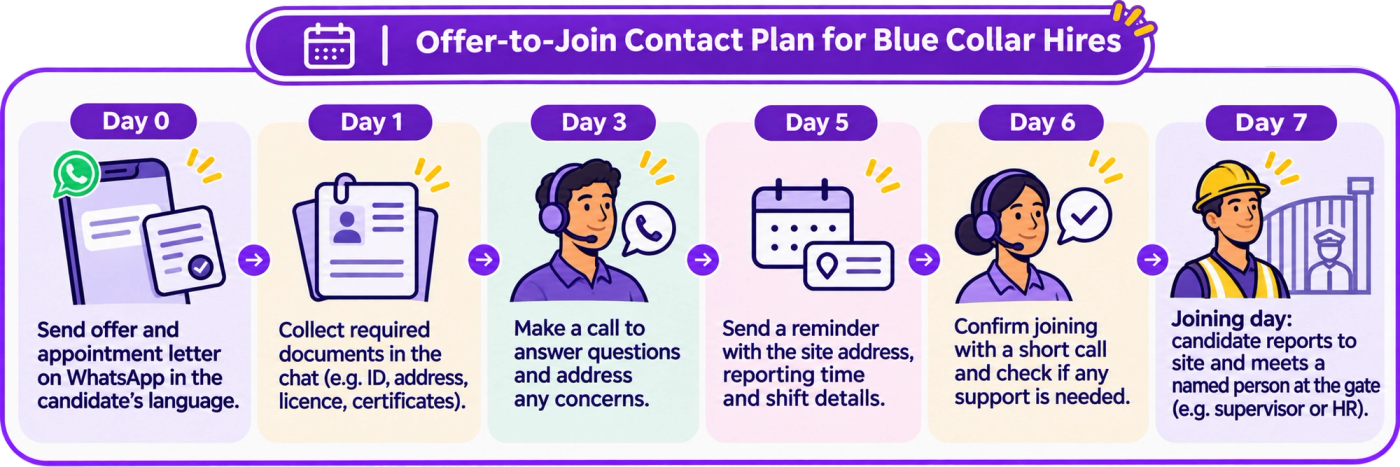
With five contacts in seven days, a candidate who is wavering shows it early enough for you to act.
Keep a ranked reserve list for every batch. If a confirmed candidate goes quiet two days before joining, offer the seat to the next person while they are still available.
How Do You Keep New Hires Through the First 30 Days?
Retaining blue collar hires depends on planned contact in the first 30 days, owned by a named supervisor. A new rider or picker who feels lost on day two has other offers to fall back on, and leaving costs them little.
A simple 30-day plan:
- Day 1: a named supervisor meets the hire, shows the site and explains how pay and incentives are calculated.
- Day 3: a short check-in call or WhatsApp message asks one question: is anything stopping you from coming in next week?
- Day 7: confirm the first pay or incentive figure is what the hire expected. A first payment that differs from the promised figure gives a new hire a reason to leave.
- Day 14: ask about the shift, the commute and the team, and fix what you can.
- Day 30: review attendance and output, pay any referral bonus, and ask the hire to refer a friend.
Give each step a named owner, or the check-ins tend to stop after the first week.
Track 30-day retention by source and by supervisor. A source that sends many joiners who leave in week two costs more than it looks, and a supervisor whose team keeps leaving needs support.
Should You Use a Blue Collar Hiring Company or Hire In-House?
Use a blue collar hiring company or staffing partner when you need workers on someone else's payroll, across many locations or for a fixed term. Hire in-house when the roles are permanent, the volume is steady and you want the relationship with the worker.
Many employers mix both. A logistics firm might hire hub supervisors in-house and bring in riders through a contract partner for festive-season peaks. Our guide to contract staffing in India covers the models, margins and compliance duties for that route.
Whichever route you take, ask the partner three questions. How do they reach candidates, which checks do they run, and how do they report on joiners and 30-day retention? A count of profiles sent tells you little about who joined or stayed.
Where Does HireBound Fit?
HireBound runs the repeated contact work in blue collar hiring, so recruiters can spend their time on interviews, offers and new joiners. It reaches candidates by Voice AI, WhatsApp, SMS and email, and its Screening Agent asks your role-specific questions and scores the answers.
For high-volume roles, HireBound's bulk and frontline hiring platform adds campaign setup, skills testing, bulk offers, e-signatures, digital onboarding with document management, background verification and certificate expiry alerts. Candidates can apply through a smart career page by form, WhatsApp or QR code, into the same pipeline.
The table shows how the work divides between the agents and your team.
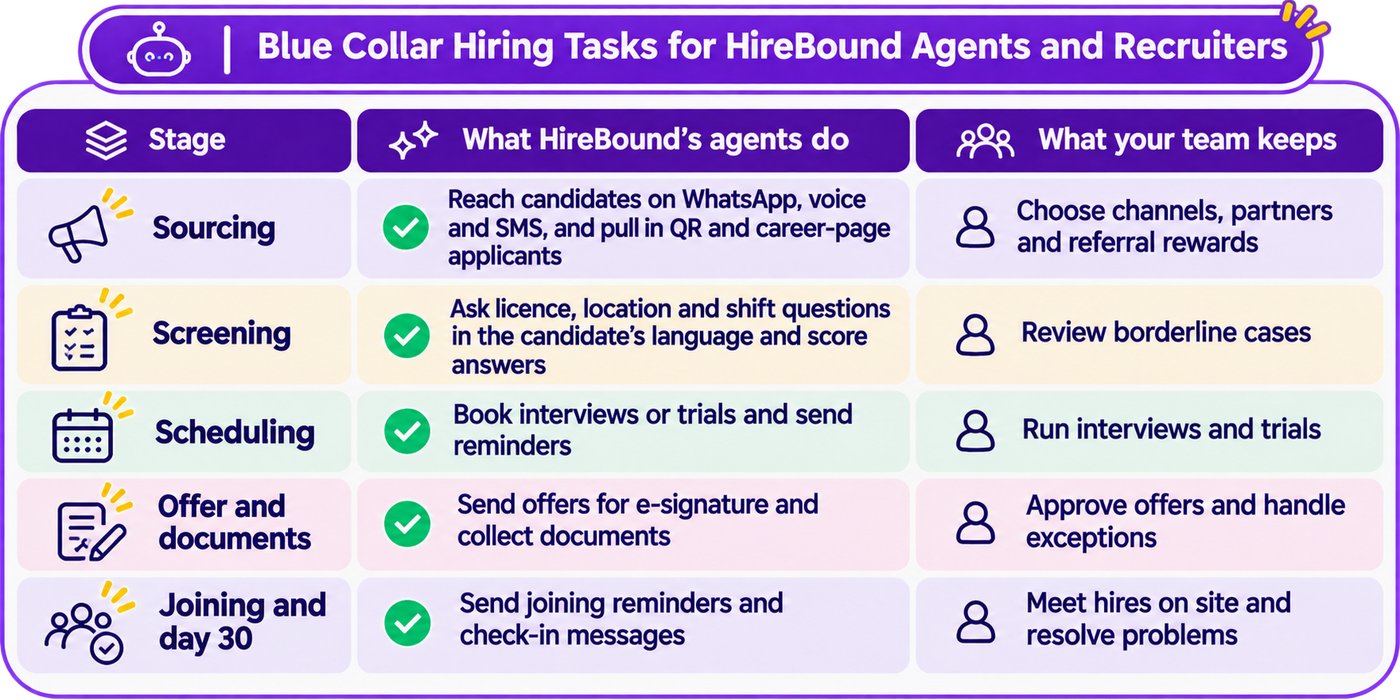
The agents handle the repeated messages, and recruiters make the decisions about people.
HireBound has powered 8 million+ candidate conversations, and recruiters using it handle 3× more candidates per day than with a manual process.
Planning a blue collar hiring drive? Talk to HireBound about reaching, screening and onboarding frontline workers →
Conclusion: A Decision Rule for Blue Collar Hiring
For each blue collar role, reach people on WhatsApp and voice in their language, screen the deciding check first, verify documents before joining day, and plan the first 30 days.
One rule to start with: if you fill the same frontline roles every month, set up a standing WhatsApp and voice screening flow with one pipeline, and measure 30-day retention by source. If you hire a handful of skilled technicians a year, referrals and a careful in-person interview may be enough.


