Recruitment Marketing: How to Attract Candidates Before You Need Them
 Devansh Dhawan
 ·Nov 12, 2026·8 min read

Key Takeaways
- 1Recruitment marketing builds a warm audience of potential candidates before a role opens, moving them through four stages: awareness, interest, application and nurture.
- 2CIPD's 2024 survey found 81% of UK organisations acted to improve their employer brand, yet only 14% measured whether it worked.
- 3Only 38% of employers in CIPD's 2024 survey rated their own careers website effective, down from 54% in 2021, so keep it current.
- 4ManpowerGroup's 2026 survey found 82% of employers in India struggle to find skilled talent, which makes a pipeline built in advance worth the effort.
- 5Track one metric per funnel stage, such as careers-page conversion or talent-community reply rate, and judge every channel by hires, not clicks.
Recruitment marketing is the use of marketing methods to attract potential candidates before and during hiring. It builds awareness of your company as an employer, gives people reasons to care and keeps them in touch until a suitable role opens. Recruiting then turns that interest into applications and hires.
Most hiring teams start talking to candidates only after a requisition is approved. SHRM's 2026 benchmarking puts the median time-to-fill for nonexecutive roles at 39 days, and the seat sits empty for all of them.
The talent market makes waiting harder. ManpowerGroup's 2026 Global Talent Shortage Survey found that 82% of employers in India struggle to find the skilled talent they need. If you hire at volume across several channels, see how HireBound's AI recruiting platform handles sourcing, screening and scheduling.
What Is Recruitment Marketing?
Recruitment marketing is the part of talent acquisition that applies marketing methods to hiring. You pick an audience, write a message for it, choose channels and measure the response. The audience is potential employees, and success is counted in applications and hires.
It is wider than job advertising. A job ad speaks to people who are looking right now. Recruitment marketing also reaches people who are not looking yet, so that your name comes up first when they are ready to move.
It is also different from sourcing. Sourcing is outbound: a recruiter finds a person and contacts them about a specific role. Recruitment marketing is mostly inbound, and it feeds sourcing by giving recruiters a pool of people who already know the company.
How Does the Candidate Funnel Work?
The recruitment marketing funnel has four stages. Each stage has its own goal, so each needs different content and a different metric.
- Awareness. People in your target talent pool learn that your company exists and what it is like to work there. Social posts, employee stories, events and search results do this work.
- Interest. A candidate starts to look closer. They read the careers page, check the team, and compare pay, location and growth paths.
- Application. The candidate applies, joins a talent community or replies to a message. A clear job description and a short application form decide how many people get this far.
- Nurture. Candidates who were not hired, or not ready, stay in touch. Regular, relevant messages keep them warm for the next opening.
The diagram shows the four stages and the channels that usually serve each one.
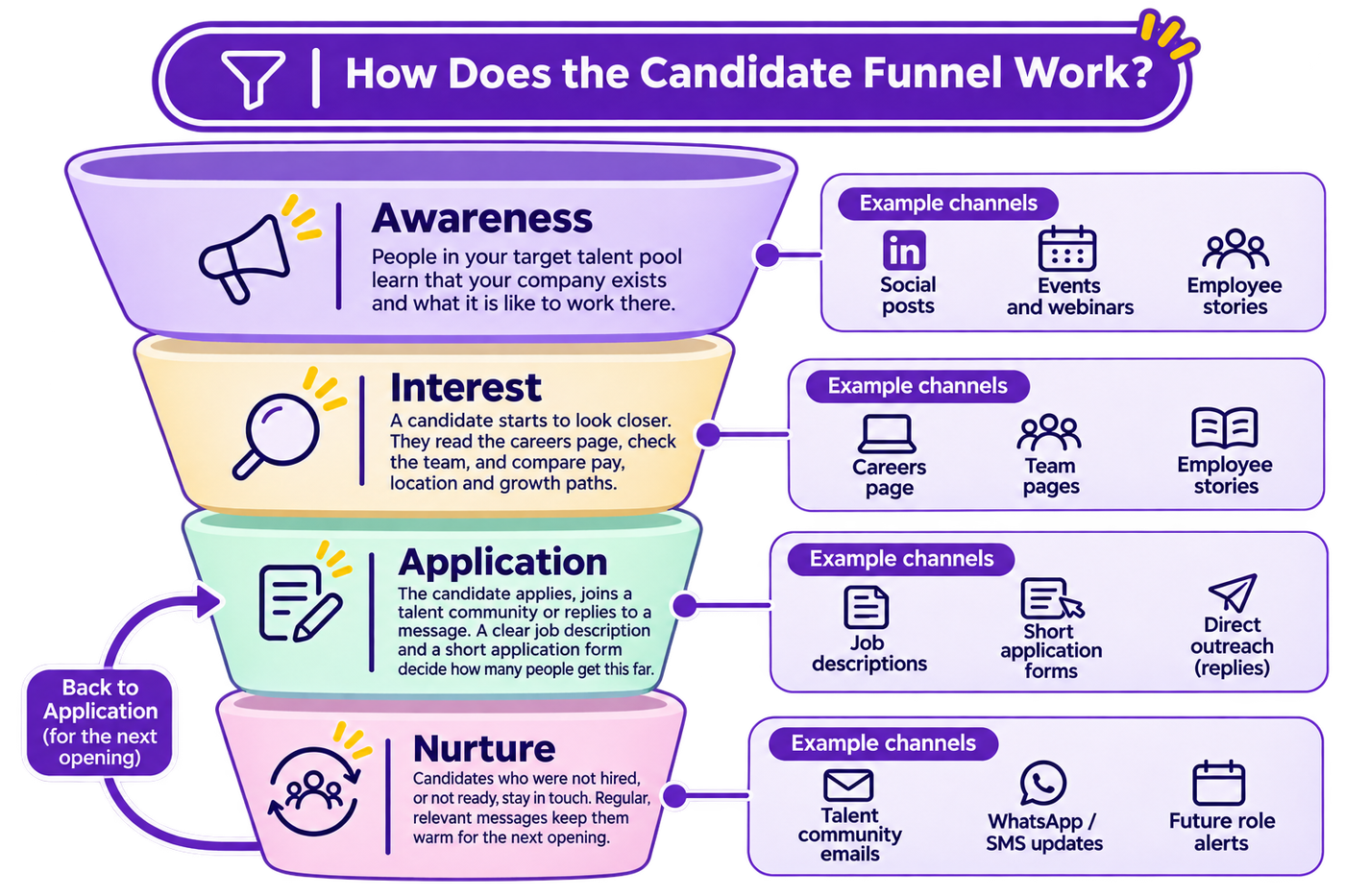
Candidates who come back through the nurture loop already know the company, so they usually need less convincing at the application stage.
Recruitment Marketing vs Employer Branding
Employer branding is what people believe about working at your company. Recruitment marketing is how you get that message in front of the right candidates when they are deciding where to work. You need both, and they fail in different ways.
A good place to work that nobody hears about gets few applicants. A big ad budget behind a vague message gets clicks from people who were never a fit. Most teams need a small set of specific, checkable facts per role family, such as shift patterns, the tech stack, learning budgets or growth paths.
Few teams check whether their brand work pays off. In the CIPD Resourcing and Talent Planning Report 2024, 81% of over 1,000 UK organisations surveyed took action to improve their employer brand. Only 14% took steps to measure its impact.
Which Channels Make Up Digital Recruitment Marketing?
Digital recruitment marketing uses six main channels: the careers site, job ads, social media and content, employee referrals, talent communities, and events. Few teams need all of them at once, so pick by role and audience. For a fuller channel-by-channel view, see our guide to candidate sourcing channels.
Careers Site
The careers site is where interest turns into an application. It should show real teams, real locations and how hiring works, step by step. In CIPD's 2024 survey of UK employers, 38% of employers that recruited rated their own corporate website an effective attraction method, down from 47% in 2022 and 54% in 2021.
A static page with stock photos is probably part of the reason. Keep the site current, make it load fast on a phone and keep the form short.
Job Ads and Job Descriptions
Job ads still carry most hiring. CIPD found that 56% of organisations that recruited sourced most new starters through company adverts, which covers careers sites, job boards and social media.
The ad is only as good as the job description behind it. Our guide on how to write job descriptions that attract candidates is a good place to start.
Social Media and Content
Social content builds awareness long before a role opens. Posts written by employees and honest "day in the role" videos usually feel more believable than polished brand ads. CIPD found that only 16% of organisations focused on employee-led content in 2024, so a team that does it regularly is in a small group.
Employee Referrals
Referrals turn employees into the channel. They work best when the ask is specific: a named role, a short description employees can forward and a quick update on what happened to each referral. Our post on employee referral programs covers conversion rates and incentive design.
Talent Communities and Nurture
A talent community is an opt-in list of people interested in working for you, grouped by skill, location and seniority. It turns one-time visitors into a pipeline. Send a message only when you have something useful: a new role, a team update or an event.
Events and Campus
Career fairs, meetups and campus drives give candidates a direct look at the team. CIPD found more organisations attending career fairs and networking events in 2024 than in 2022. Capture every contact into the talent community, or the event leaves nothing behind.
How to Build a Recruitment Marketing Strategy
A recruitment marketing strategy is a one-page plan that names priority roles, target candidates, proof points, one channel per funnel stage, tracking and a review rhythm. A small team can usually set it up in about two weeks.
- Pick two or three priority role families. Choose roles you hire often or struggle to fill, and leave the rest to standard job ads.
- Write a candidate profile for each. Note what these people care about, where they spend time online and what would make them move.
- List three proof points per role family. Use facts a candidate can check, such as pay ranges, shift patterns, the tools they will use or recent promotions.
- Choose one channel per funnel stage. For example, use employee posts for awareness, the careers page for interest, a short form for applications and a monthly message for nurture.
- Set up tracking. Tag every link with its source, and ask "where did you hear about us?" on the application form.
- Review every month. Cut the channel that brings applications but no interviews, and move that time to the one that brings hires.
The timeline below spreads the six steps across a quarter.
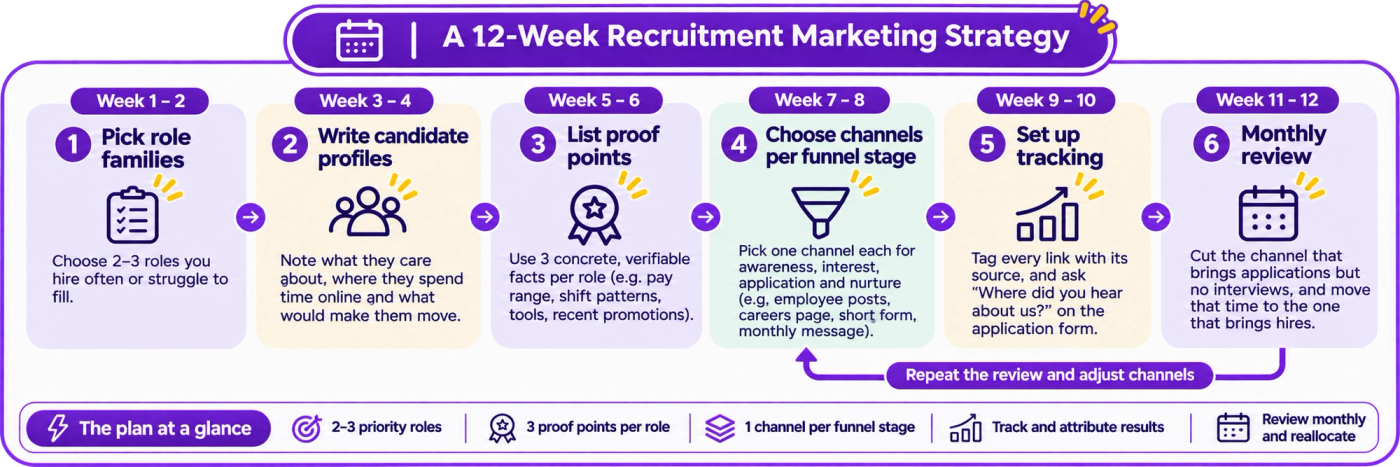
Without the monthly review, budget and recruiter time keep going to channels that stopped producing hires months ago.
Recruitment Marketing Ideas You Can Use This Quarter
These recruitment marketing ideas work on a small budget. Each takes a few hours a week.
- Record a hiring manager explaining what a good first 90 days looks like in the role, and use it on the careers page and in outreach.
- Publish your hiring process: each stage, how long it takes and who candidates will meet. Candidates ask fewer questions and drop out less.
- Message silver medallists, the candidates who reached the final round in the past year, when a similar role opens.
- Ask new joiners why they said yes, and use their exact words in job ads.
- Run a one-hour online open house for a role family. The sign-up list becomes the start of a talent community.
- Add a WhatsApp apply option. In India, a "message us to apply" link or a QR code on posters and job ads makes applying much easier.
What Changes When You Hire in India?
Start with the channel. Many Indian candidates, especially in frontline, BPO and field roles, reply fastest on WhatsApp. HireBound sees a 64% response rate on WhatsApp in India against about 12% for email.
Language matters too. A Hindi or regional-language message reaches candidates that English-only content misses, particularly outside the big metros.
Then there is consent. India's Digital Personal Data Protection Act, 2023 requires a clear purpose and consent for processing personal data. Collect explicit opt-in when people join a talent community, say what you will send, and make it easy to leave.
Which Recruitment Marketing Metrics Should You Track?
The most useful recruitment marketing metrics are careers-page conversion, application completion rate, talent-community reply rate and source of hire. Track one or two per funnel stage, and connect each to hires. A channel that brings thousands of visitors and no interviews is costing you money.
This table maps each stage to its channels and the metric that shows whether it works.
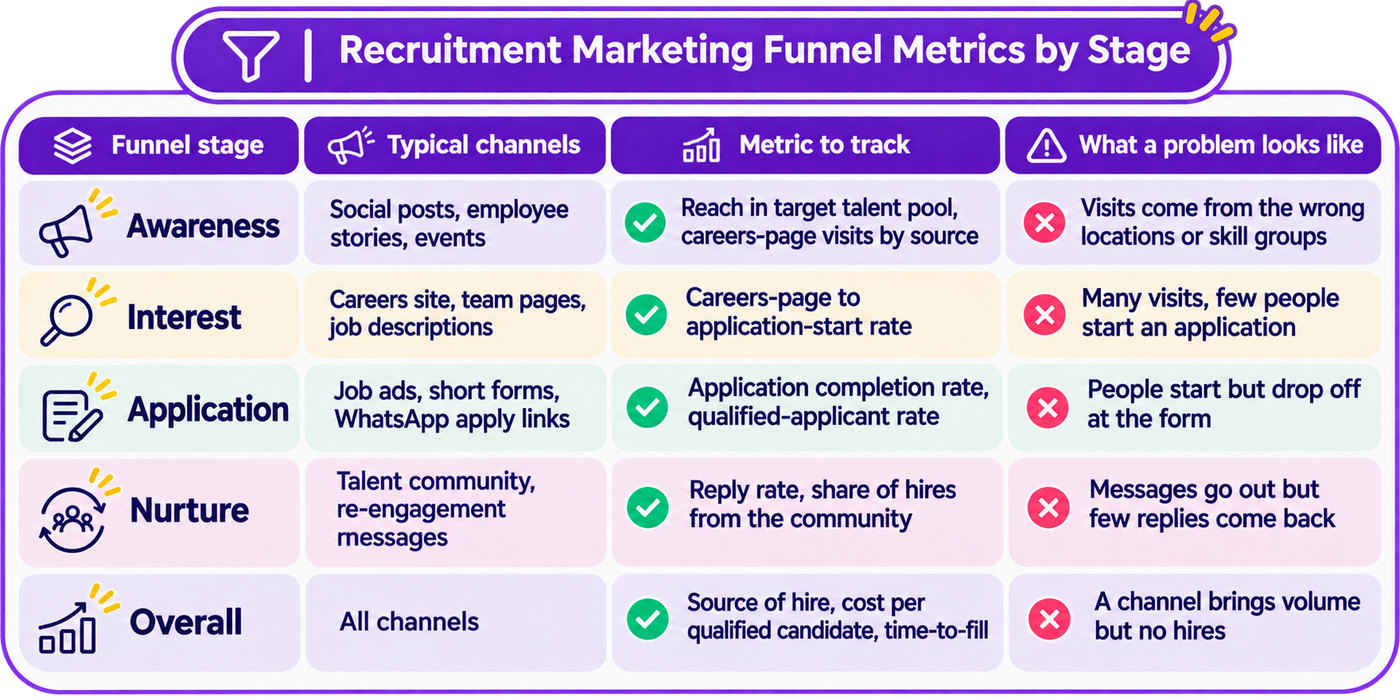
Review these numbers monthly. The overall row matters most, because it shows which channels end in hires.
Where HireBound Fits
Recruitment marketing creates interest, and that interest fades if nobody follows up. HireBound helps teams reply and screen quickly, while candidates still remember why they applied. Its agents handle sourcing, screening, scheduling and evaluation, so recruiters spend time on conversations and closing.
HireBound's Smart CRM includes a branded career page where candidates apply through a form, WhatsApp or a QR code, all into one pipeline. For the nurture stage, HireBound's AI candidate sourcing software can rediscover past applicants in your own database against a new role before you search outside. It also searches across 500M+ profiles and ranks candidates with plain-English fit reasons.
Outreach runs over WhatsApp, voice, SMS and email, and Voice AI screens candidates in 14 Indian languages. HireBound has powered 8 million+ candidate conversations.
Want to turn candidate interest into interviews faster? Book a demo with HireBound
Start Small and Build the Pipeline Early
Recruitment marketing works best when it starts before the need. Pick two role families, choose one channel per funnel stage and start a talent community this month. When the next requisition opens, you will have people to call on day one.


