Recruitment Chatbot Examples: What Good Candidate Conversations Look Like
 Devansh Dhawan
 ·Nov 12, 2026·9 min read

Key Takeaways
- 1A good recruitment chatbot asks one question per message, explains why it is asking, and always offers a route to a person.
- 2Pew Research Center (2023) found 66% of US adults would avoid applying where AI helps make hiring decisions, so show where humans decide.
- 3Census 2011 data shows Hindi is the mother tongue of 43.63% of Indians, so WhatsApp flows should offer regional languages beyond Hindi and English.
- 4Re-engaging past applicants on WhatsApp needs an approved template outside the 24-hour service window and recorded consent under India's DPDP Act, 2023.
A recruitment chatbot is software that talks to candidates by text or voice to answer questions, screen against set criteria and book next steps. The recruitment chatbot examples below show what a useful conversation looks like: one question at a time, a reason for each question, and a quick route to a person when judgement is needed.
The six transcripts cover screening, FAQs, scheduling, re-engagement, a Hindi WhatsApp flow and a hand-off to a recruiter. Each notes why it works and where it usually fails.
Want candidate conversations that screen and schedule on WhatsApp, voice and email? See how HireBound works →
What Is a Recruitment Chatbot?
A recruitment chatbot, also called a recruiting chatbot, is a conversational interface that talks to candidates on a career site, WhatsApp, SMS or a voice call. It replaces the repetitive first exchanges a recruiter would otherwise type or say by hand.
Chatbots range from scripted decision trees to AI systems that understand free-text answers and ask follow-ups. The second kind is closer to an AI agent, because it can act on the answer: score it, update the pipeline or book an interview. Our explainer on what AI in recruiting means covers that wider picture. The transcripts below are illustrative, not recordings of real candidates.
What Do Good Recruitment Chatbot Examples Have in Common?
Good recruitment chatbot examples share five habits. The bot asks one question per message, says why it is asking, accepts answers in the candidate's own words, confirms what it understood, and gives a clear way to reach a person.
The table summarises the six examples.
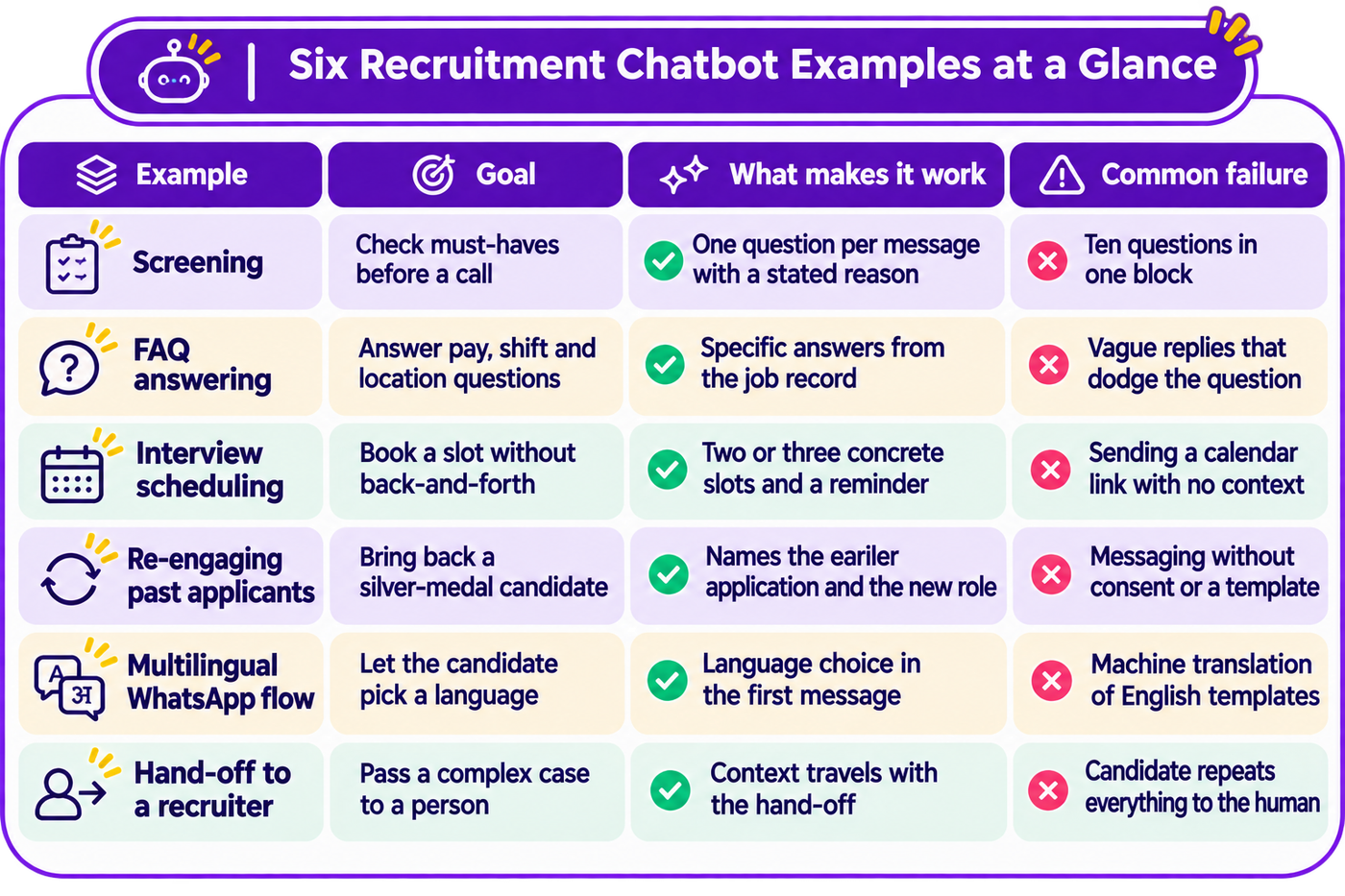
Most failures in the last column save the company effort by pushing it onto the candidate.
Example 1: A Screening Conversation for a Warehouse Role
Screening is the most common job for a recruitment chatbot. The goal is to check a few must-haves so a recruiter only calls candidates who qualify.
Bot: Hi Ravi, thanks for applying for the warehouse picker role in Bhiwandi. I have 4 quick questions to check the basics. It takes about 2 minutes. Shall we start?
Candidate: ok
Bot: The role runs on rotating 9-hour shifts, including nights. Can you work night shifts?
Candidate: yes but not sunday
Bot: Noted: night shifts are fine, Sundays are not. The team plans one weekly off, so I'll flag Sunday as your preferred off day. How far do you live from Bhiwandi?
Candidate: 8 km bhiwandi phata
Bot: Thanks. Last one: when could you start?
Each message carries one question and its reason. The bot also restates a messy answer and records the condition instead of forcing a yes or no.
The common failure is a bot that pastes every question into one message, or rejects a conditional answer. Our guide on how to automate candidate screening covers writing the criteria and rubric behind a screen like this.
Example 2: Answering Candidate FAQs About Pay and Shifts
A recruiting chatbot that answers FAQs well gives specific facts from the approved job record. Candidates ask the same questions about pay, shifts, location and documents, and good answers cut the number of calls a recruiter has to take.
Candidate: what is the salary
Bot: The role pays ₹18,500 a month in hand, plus a ₹1,500 night-shift allowance for months with 10 or more night shifts. Would you like the full breakdown?
Candidate: is transport there
Bot: Yes. A company bus runs from Kalyan and Thane stations at shift change. I can send you the pickup points.
The answers are specific and come from the job record the recruiter approved. The bot also offers a next step.
This conversation usually fails on a vague answer such as "Salary will be as per company norms." Candidates read that as evasion, and many stop replying.
Example 3: Scheduling an Interview Without Back-and-Forth
A scheduling bot offers a few concrete slots, confirms one and sends reminders.
Bot: Priya, you're shortlisted for the customer support role. The hiring manager has three video interview slots. Reply 1, 2 or 3.
Thursday 14 Nov, 11:00 am
Thursday 14 Nov, 4:00 pm
Friday 15 Nov, 10:30 am
Candidate: 2
Bot: Booked for Thursday 14 Nov at 4:00 pm with Anjali Mehta. I'll send the video link and a reminder 2 hours before. Reply CHANGE any time if you need a different slot.
The diagram below shows the steps behind a booking like this one.
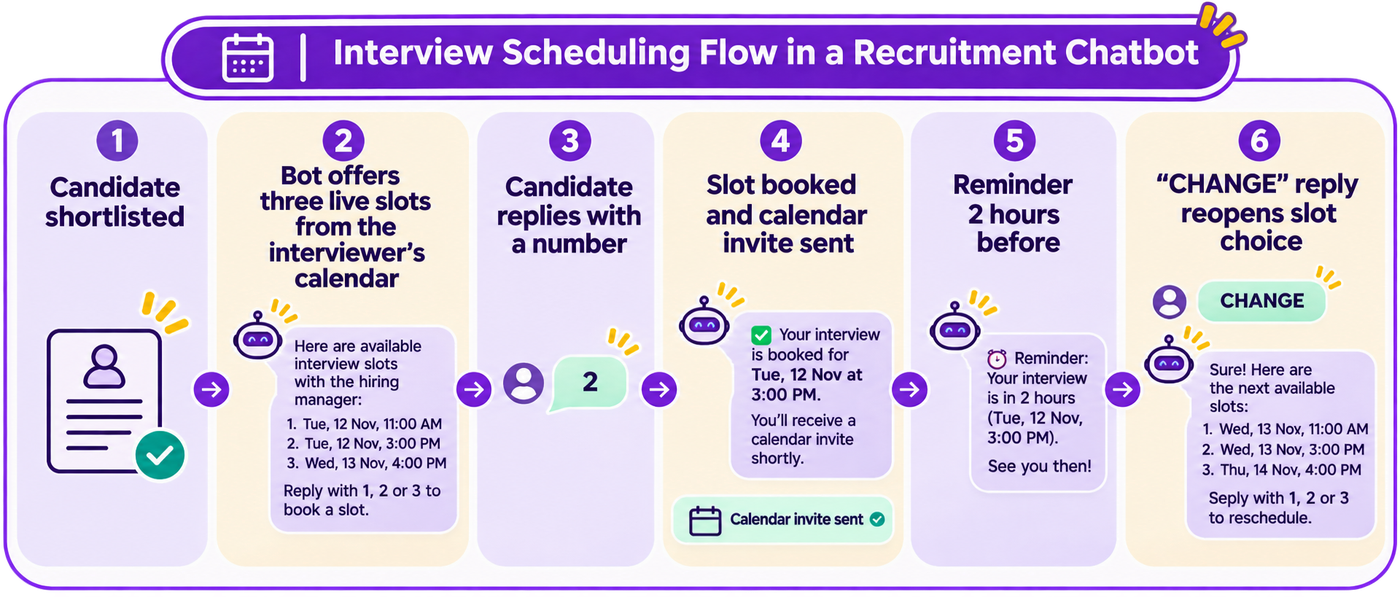
Each step either books the slot or reopens the choice, so the candidate never gets stuck.
The slots are real, the choice takes one tap, and the candidate knows how to change it.
Scheduling bots most often fail by sending a bare calendar link with no context. The candidate has to work out the role and format alone.
Example 4: Re-Engaging a Past Applicant
Past applicants who reached a late stage are often the fastest hires for a new opening, if the first message earns a reply.
Bot: Hi Sameer, this is Neha from the hiring team at [Company]. You interviewed with us for a dispatch coordinator role in March and reached the final round. A similar role has opened in Pune. Would you like to hear about it? Reply YES or NO.
Candidate: YES what is the pay
Bot: It pays ₹28,000 to ₹32,000 a month, depending on experience, with day shifts only. I'll ask 2 questions to check it still suits you, then a recruiter will call.
The message names the earlier application and the stage reached, so the candidate knows why they are being contacted.
The common failure is messaging old applicants without consent or the right message type. On the WhatsApp Business Platform, a business can send free-form messages only within a 24-hour customer service window after the user's last message. Outside it, the first message must be a pre-approved template. In India, the Digital Personal Data Protection Act, 2023 also requires a lawful basis, usually consent, before candidate data is reused.
Example 5: A Multilingual WhatsApp Flow in Hindi
Many frontline candidates in India prefer to reply in Hindi or another regional language. A good multilingual flow lets them choose in the first message and stays in that language.
Bot: Namaste Sunita ji. Aap kis bhasha mein baat karna chahengi? Reply 1 Hindi, 2 English, 3 Marathi.
(Hello Sunita. Which language would you like to talk in?)
Candidate: 1
Bot: Dhanyavaad. Yeh delivery associate ki naukri Andheri mein hai. Kya aapke paas do-pahiya vaahan aur licence hai?
(Thank you. This delivery associate job is in Andheri. Do you have a two-wheeler and a licence?)
Candidate: haan bike hai, licence 2 mahine mein aayega
(Yes, I have a bike. The licence will arrive in 2 months.)
Bot: Samajh gayi. Licence ke bina joining abhi nahi ho sakti. Main aapka profile recruiter ko bhej rahi hoon.
(Understood. Joining isn't possible yet without a licence. I'm sending your profile to the recruiter.)
It works because the candidate picks the language, and the bot handles a mixed Hindi-English reply without asking them to rephrase.
The common failure is running English templates through machine translation. The result reads stiffly and gets terms like "notice period" wrong.
Hindi and English alone leave many candidates out. Census of India 2011 data, released in 2018, shows Hindi as the mother tongue of 43.63% of the population, so most Indians grew up speaking another language. Our guide to WhatsApp recruiting covers opt-in, timing and message design for this channel.
Example 6: Handing Off to a Human Recruiter
Salary negotiation, accommodation requests, complaints and questions the bot cannot answer all need a person.
Candidate: i have a 60 day notice but my company may release me early if you give a letter. can you do that
Bot: That's a good question for a recruiter, because it depends on the offer terms. I've passed your message to Karan, who handles this role, with your screening answers. He'll reply here today before 6 pm.
Recruiter (Karan): Hi Arjun, Karan here. I've seen your answers and the 60-day notice. Yes, we can issue a provisional offer letter once the final interview clears. Are you free for a 10-minute call at 3 pm?
The diagram below shows what travels with the conversation when a bot hands off.
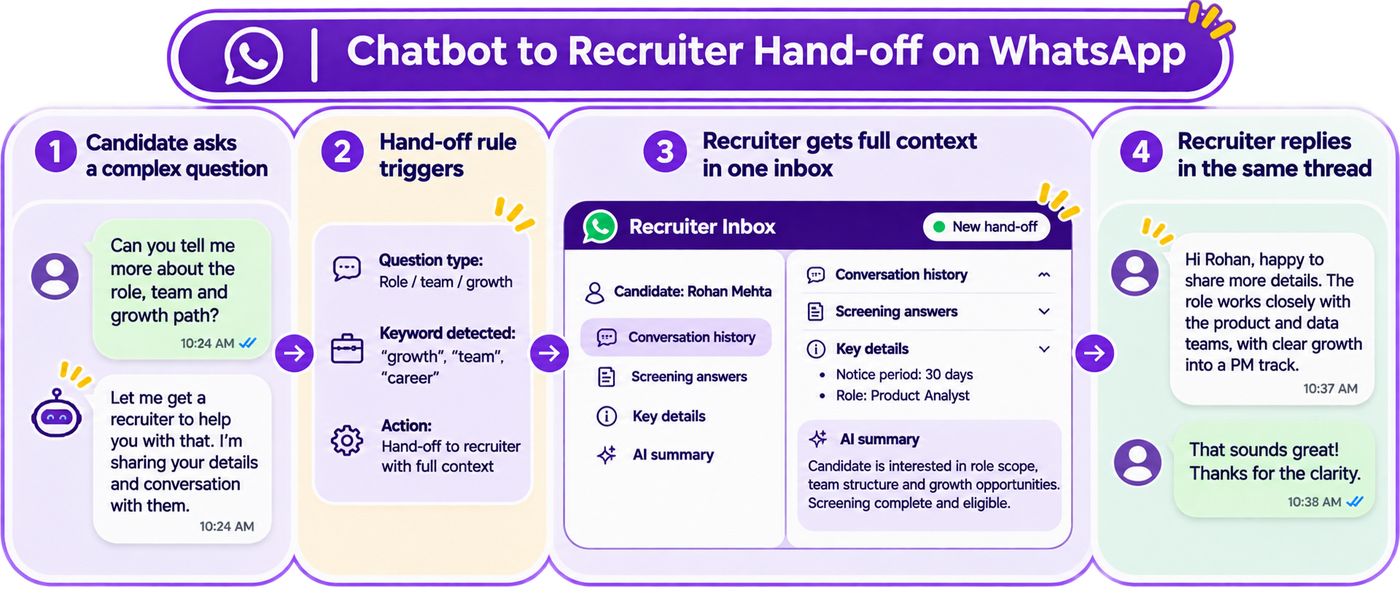
The bot names the person, sets a time and passes the context, and Karan's first reply shows he has read it.
Hand-offs most often fail by dropping the history, so the recruiter starts with "How can I help you?" Arjun would then have to explain his notice period a second time.
Recruitment Chatbot vs Recruiter: Who Should Handle What?
A recruitment chatbot should handle the repetitive, factual and time-sensitive parts of a conversation. A recruiter should handle anything that changes a candidate's prospects or needs negotiation.
Pew Research Center found in 2023 that 66% of US adults would not want to apply for a job with an employer that uses AI to help make hiring decisions. The survey covered 11,004 adults in December 2022.
Say in the first message what the bot does and who decides. A line such as "A recruiter reviews every shortlist" answers the worry before the candidate raises it.
How to Test a Recruiting Chatbot Before It Talks to Candidates
Test a recruiting chatbot on a phone, with messy answers, in every language it offers. Four checks catch most problems.
- Reply with typos and mixed Hindi-English. "Haan" should count as "yes".
- Ask about pay, shift, location and joining date. Each should get a specific answer.
- Type "talk to someone". A person should reply, with the history attached.
- Reply STOP. Messages to that number should end at once.
Where HireBound Fits
In HireBound, AI agents run these conversations. The Screening Agent holds structured conversations over Voice, WhatsApp and Email, with Voice AI in 14 Indian languages, and scores candidates against the criteria you set. The Scheduling Agent collects availability during screening, books the interview and sends reminders.
Every reply lands in one unified inbox with the candidate record, so a recruiter who takes over sees the full thread. HireBound's WhatsApp recruiting automation supports two-way multilingual conversations, CV collection and screening on the channel candidates in India reply on.
HireBound data shows a 64% WhatsApp response rate in India against about 12% for email. HireBound has powered 8 million+ candidate conversations, and 60+ recruiting teams in India run on the platform.
Want to see these candidate conversations running on one of your live roles? Talk to HireBound →
A Simple Rule for Judging Any Recruitment Chatbot
Read one transcript as the candidate. If every message asks one clear thing, every answer is specific and a person is one reply away, the bot works. If the candidate has to repeat themselves or guess the next step, fix the conversation before you scale it.


