Contract Staffing in India: Models, Margins and Compliance
 Tanmey Goswami
 ·Oct 16, 2026·10 min read
Key Takeaways
- 1Billing is wage plus statutory and other costs plus markup. In the illustrative example, a 10% markup on cost gives only about a 9.1% gross margin.
- 2The OSH Code requires a licence from contractors supplying 50 or more contract workers, and makes the principal employer liable for unpaid wages on contractor default.
- 3PIB reports the EPF wage ceiling rose from ₹15,000 to ₹25,000 on 17 September 2026, expected to add about 51 lakh employees to coverage.
- 4In the illustrative agency, 1,000 deployed workers at 5% monthly attrition mean 50 replacements a month, so sourcing and screening capacity caps growth.
- 5The Indian Staffing Federation reports staffing employment up 7.5% year on year in Q1 2026-27, so replacement and ramp-up hiring grows with the market.
Contract staffing in India is an arrangement where a staffing agency hires workers, pays them, and deploys them to a client for a fixed period or project. The client directs the daily work, while the agency carries payroll, statutory contributions and replacement risk. The agency earns a markup on what the worker costs.
That markup looks generous until statutory costs, bench time and replacement hiring are counted. This guide covers the main models, shows how margin is calculated in an illustrative example, summarises the contract labour rules in the new labour codes, and explains where recruiter capacity becomes the constraint.
Running a staffing agency that deploys at volume? See how HireBound runs outreach, screening and scheduling for agencies →
What Is Contract Staffing in India?
Contract staffing is the supply of workers to a client on the agency’s payroll, not the client’s. The worker is employed by the agency, paid by the agency, and billed to the client at a rate that covers wages, statutory costs and the agency’s margin. The contract ends when the assignment or work order ends.
The Occupational Safety, Health and Working Conditions Code, 2020 defines a contractor as a person who undertakes to produce a given result through contract labour, or who supplies contract labour for any work of the establishment as mere human resource. The definition includes a sub-contractor. How a given arrangement is classified depends on its structure, so the label on the contract matters less than who directs and pays for the work.
Four models appear most often in Indian staffing. The table summarises typical arrangements by who employs the worker, how the agency earns, and what the agency carries. Contracts vary, so treat each row as a common pattern and not a legal definition.
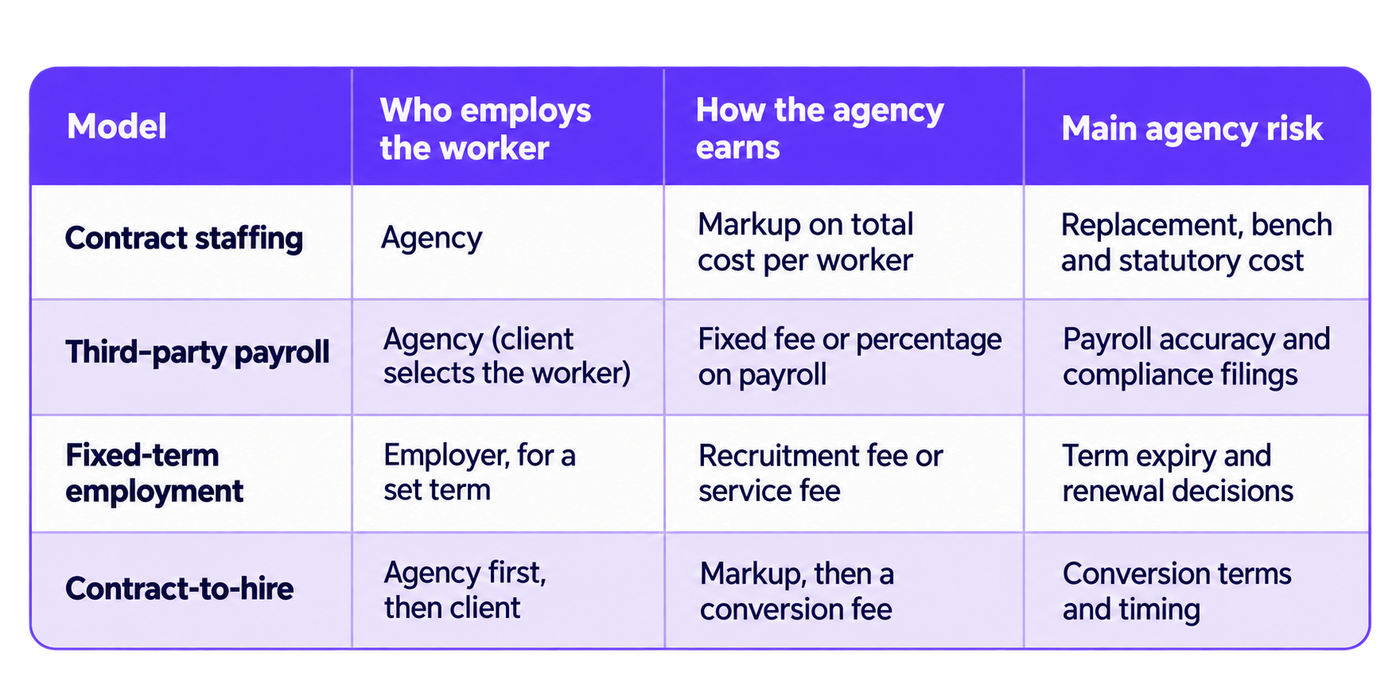
Each model moves risk to a different party, and the margin should reflect that.
How Do Markup and Margin Differ?
Markup is the percentage added to cost. Margin is the share of the bill that remains as profit. They are not the same number, and mixing them up is the most common pricing error in small agencies.
Billing rate equals total cost times (1 plus markup), and gross margin equals the markup amount divided by the billing rate. A 10% markup on cost yields a gross margin of about 9.1%, and a 25% markup yields a 20% margin.
Total cost is more than the wage. It includes the employer’s provident fund contribution, insurance, paid leave, bonus provisions and the agency’s own admin cost. The number that matters is cost per deployed worker per month, including the days when a seat sits empty.
Contract staffing margins also run on a different scale from permanent placement. A placement fee is a one-time percentage of annual pay, covered in our guide to recruitment agency fee percentages. A contract worker pays the agency a small amount every month for as long as the assignment lasts.
Price from cost per worker, then check what margin the markup really delivers.
What Do the Labour Codes Say About Contract Labour?
The Press Information Bureau (PIB) announced on 21 November 2025 that the four labour codes took effect: the Code on Wages, the Industrial Relations Code, the Code on Social Security and the OSH Code. PIB says the contract worker provisions make the principal employer responsible for health and social security benefits for contract workers.
The contract labour rules sit in Chapter XI of the OSH Code, 2020 (Gazette of India), which we read on 11 October 2026. These are the provisions most relevant to an agency:
- Applicability (section 45): Part I applies to establishments with 50 or more contract workers on any day in the preceding twelve months, and to manpower supply contractors with 50 or more. It does not apply to work that is only intermittent or casual.
- Licence (sections 47 and 48): A contractor to whom the Part applies needs a licence, valid for five years, that states how many contract workers it covers. A work-specific licence is available to contractors that do not meet the qualification criteria.
- No worker fees (section 49): A contractor cannot charge any fee or commission from the contract worker, directly or indirectly.
- Wages (section 55): The contractor pays wages by bank transfer or electronic mode. If the contractor fails to pay, the principal employer must pay the unpaid wages and can recover them from the contractor.
- Core activities (section 57): Contract labour in core activities is prohibited, with three exceptions: work ordinarily done through contractors, work that does not need full-time workers for most of the day, and a sudden rise in volume that must be completed in a set time.
Licence forms, fees and procedures are set by rules, so confirm what applies in the state where you deploy. The wage-recovery rule in section 55 means a client may add payment-security terms to your contract.
What Does One Contract Worker Cost and Earn?
An illustrative example shows how the pieces combine. All numbers below are assumptions for one contract worker for one month, not market benchmarks.
The assumptions are a monthly wage of ₹18,000 that counts fully as provident fund wage, an employer provident fund contribution of 12% (the employer rate PIB states in its September 2026 release), and other on-costs of 8% of wage for insurance, leave, bonus provision and admin. The markup scenarios are 10% and 15% on total cost.
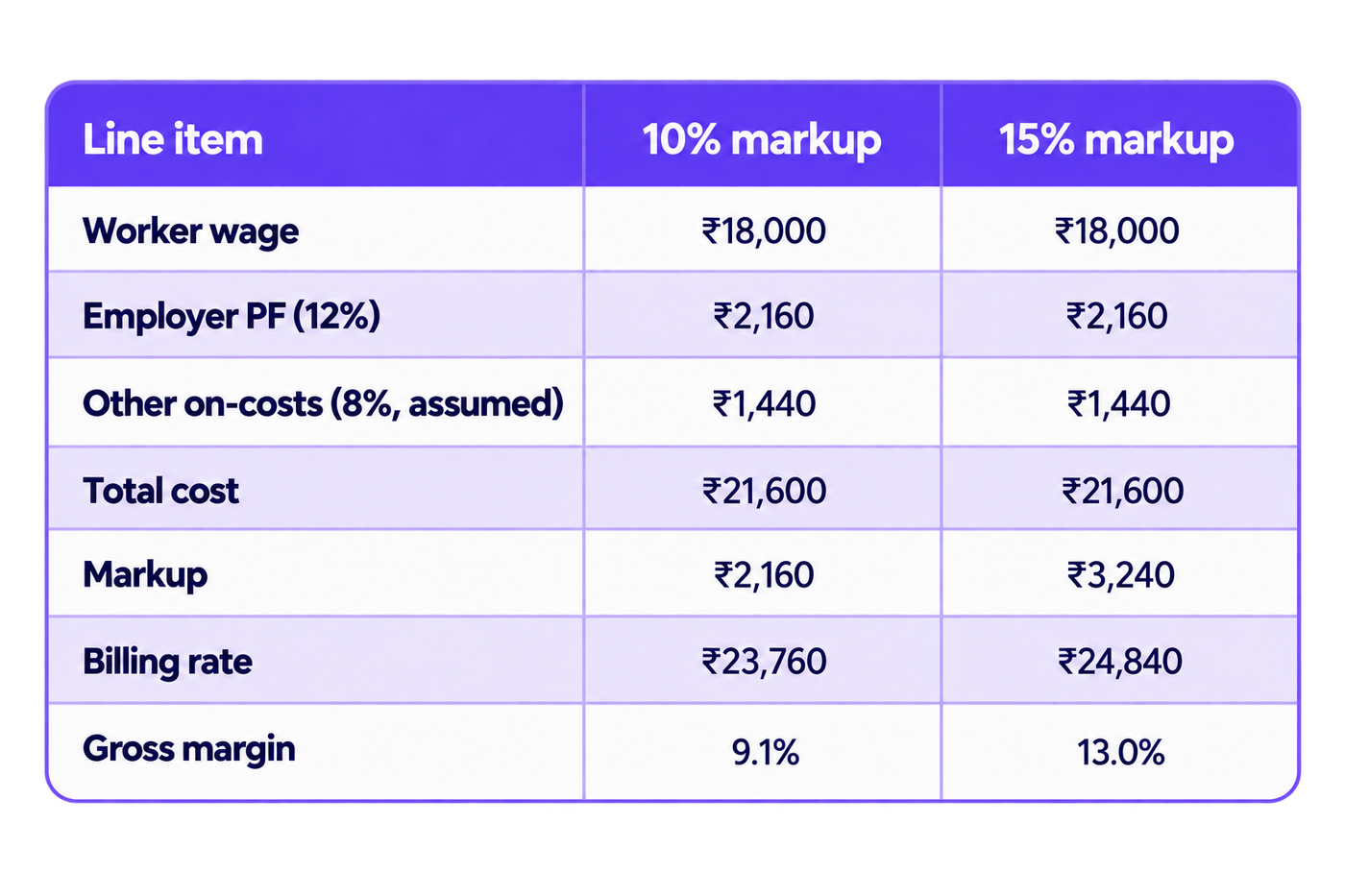
The client sees a bill of ₹23,760, and the agency keeps ₹2,160 before its own recruiting, sales and finance costs. Across 100 deployed workers that is about ₹2.16 lakh a month in gross margin at the 10% markup.
Small changes in cost move the margin fast, so a rate card should be rechecked whenever a statutory rate changes.
How Does the New EPF Wage Ceiling Affect Pricing?
PIB reported on 17 September 2026 that the Union Cabinet raised the wage ceiling for mandatory EPF coverage from ₹15,000 to ₹25,000 a month, effective that day. The change comes after nearly 12 years. PIB says it is expected to bring around 51 lakh additional employees within the framework.
For an agency, the question is which of your deployed workers now fall inside mandatory coverage. A worker paid ₹20,000 was above the old ceiling and is below the new one. If your client rates were set on the old cost base, the employer contribution is a new cost line.
PIB states the contribution split: 12% from the employee and 12% from the employer, with 8.33% of the employer share going to the pension scheme and 3.67% to the PF account. Check how your payroll team treats basic wages under the new ceiling, then reprice or invoke a pass-through clause where your contract has one.
A client contract without a statutory-change clause leaves the agency carrying the rise.
What Happens When Workers Leave Mid-Contract?
Most agency pricing ignores attrition. Each exit creates a vacancy the agency must refill, usually within days, while the client waits and the margin on that seat stops.
Take an illustrative agency with 1,000 deployed workers on the ₹23,760 billing rate above. Monthly billing is about ₹2.38 crore and gross margin is about ₹21.6 lakh at the 10% markup. Assume 5% of workers leave each month and that one in eight contacted candidates joins.
Those assumptions mean 50 replacements a month and about 400 candidates contacted just to hold the headcount steady. New client mandates come on top of that. Each unfilled seat also earns nothing, so the margin lost per day is small but the client relationship risk is large.
These are assumptions, so substitute your own attrition and conversion rates before using the figures.
Where Does Recruiter Capacity Limit a Contract Staffing Business?
Contract staffing scales with deployed headcount, and headcount depends on how fast recruiters can source, screen and place. The Indian Staffing Federation’s Q1 2026-27 report (accessed 11 October 2026) shows overall staffing employment up 7.5% year on year. Its members added 1.14 lakh new formal flexi jobs in the last four quarters and represent 1.95 million formal flexi workers.
A growing market means more mandates and more replacement hiring for the same recruiter team. The work that consumes the day is repetitive: calling candidates, checking availability and rescheduling.
What we see at HireBound: recruiters using the platform handle 3x more candidates per day than with a manual process, and 60+ recruiting teams in India run on it. HireBound data shows a 64% WhatsApp response rate in India against about 12% for email, which matters when a seat must be filled in days. Voice AI covers 14 Indian languages, which helps when candidates are spread across regions.
The diagram shows where recruiter hours go in a contract staffing cycle.
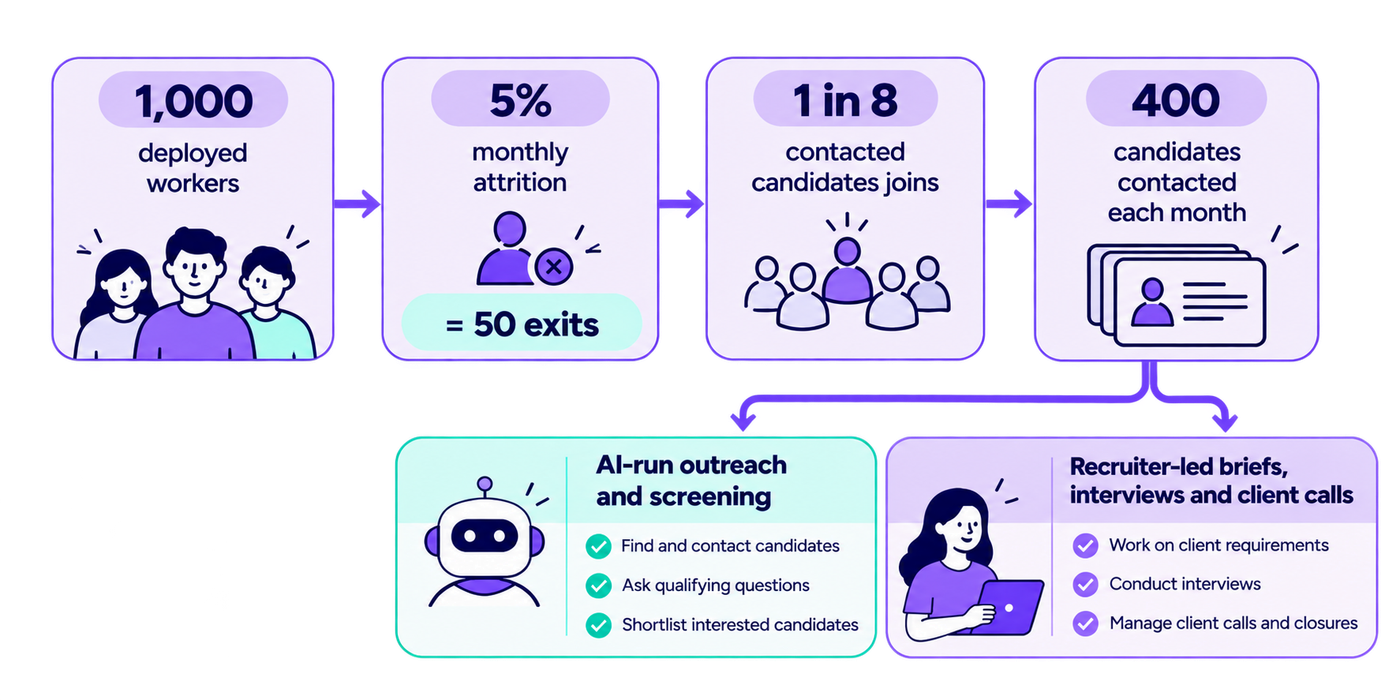
The recruiter hours that decide growth go to repeatable contact work, so that is the first place to add capacity. For the metrics that track this, see our guide to staffing agency KPIs.
Contract Staffing, Fixed-Term or Contract-to-Hire: Which Fits?
The right model depends on how long the client needs the worker and whether they might stay. Contract staffing suits project work and seasonal peaks where the client wants flexibility without taking on payroll.
Fixed-term employment is a different arrangement, where the employer hires directly for a set term. PIB states that under the labour codes, fixed-term employees get benefits equal to permanent employees, and become eligible for gratuity after one year of continuous service. That narrows the cost gap between a fixed-term hire and a permanent one.
Contract-to-hire starts as contract staffing and ends in a conversion if the client keeps the worker. Our post on contract-to-hire conversion rates covers how to draft conversion terms and why reported rates vary so much. For clients weighing an agency against building a team, see agency vs in-house recruiting.
Match the model to the client’s time horizon, then price each model for the risk it puts on you.
When Is Contract Staffing the Wrong Fit?
Contract staffing is not always the right answer for the client or the agency. Three situations call for a different structure.
If the work sits in the client’s core activities and does not fit one of the three section 57 exceptions, contract labour may be prohibited there. If the role is long term and central, direct hiring or fixed-term employment is usually simpler. If your agency cannot fund payroll between invoices, the cash cycle can be a bigger threat than margin.
Cash flow is a separate risk. You pay wages and statutory contributions every month, even when a client pays weeks late. Put payment-term assumptions in the rate card.
The OSH Code’s licence and wage rules also add admin work as deployment grows. An agency below the 50-worker threshold may fall outside Part I, but confirm that against the rules in your state.
What Should You Check Before Taking On a Client?
A short pre-signing check protects margin and keeps the contract aligned with the rules above. Run these steps for each new client mandate.
- Confirm the work is not in a core activity of the client, or that it fits a section 57 exception.
- Check whether you hold a licence that covers the number of workers and the states involved.
- Cost the worker line by line: wage, employer PF, other on-costs and admin.
- Choose a markup and compute the resulting margin, not just the markup.
- Add a clause for statutory changes, such as the EPF ceiling.
- Agree payment terms and the client’s wage-default protections.
- Plan the replacement pool so a vacant seat is refilled in days, not weeks.
The checklist figure shows the sequence.
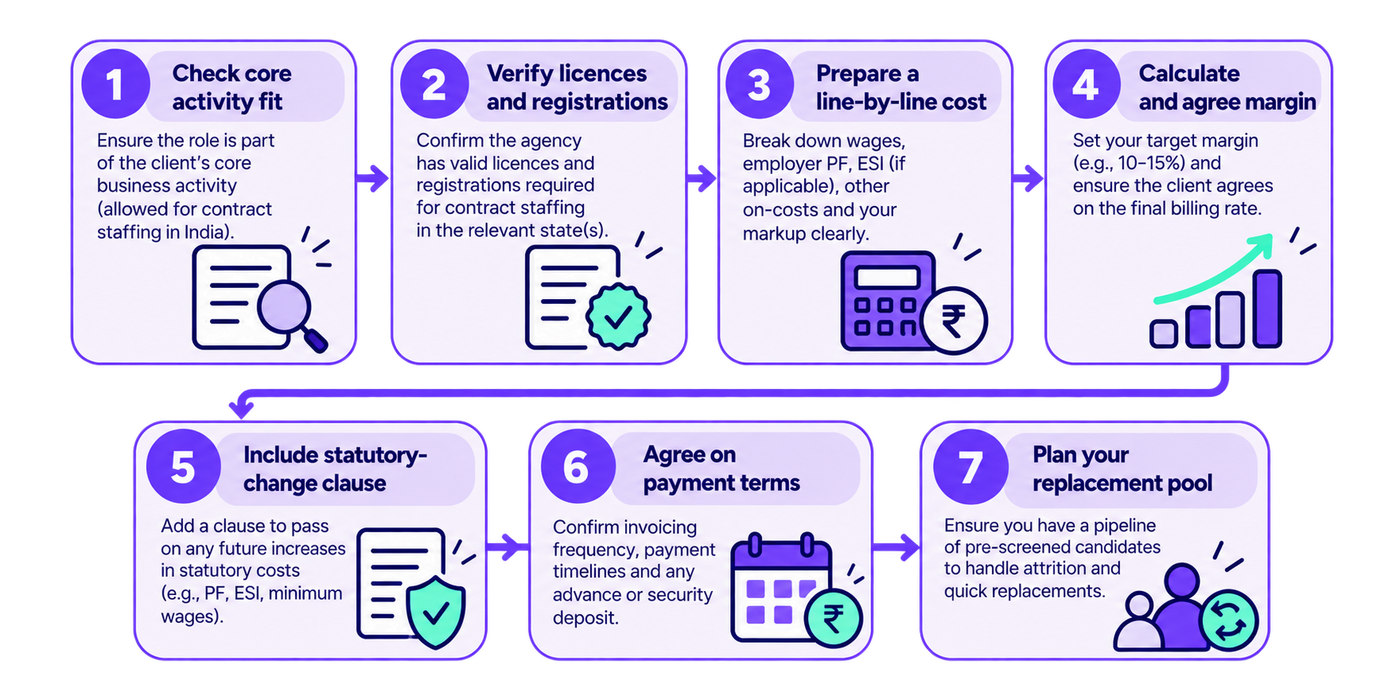
If you cannot complete steps 3 and 4, you are pricing on instinct rather than cost.
Need replacement candidates in days, not weeks? Talk to HireBound about sourcing, screening and scheduling for your mandates →
Conclusion: How to Price and Staff a Contract Mandate
Price contract staffing in India from cost per worker, check the rules before each mandate, and keep a replacement pool ready. The labour codes add duties on licensing and wages, and the EPF ceiling change shows how fast the cost base can move.
One decision rule: if most of your recruiters’ week goes on re-contacting and rescheduling candidates for replacements, weigh screening and scheduling capacity most heavily, since that is what limits how many workers you can keep deployed.


