AI Recruiting Platform Checklist: 15 Questions to Ask Vendors
 Tanmey Goswami
 ·Oct 16, 2026·10 min read
Key Takeaways
- 1Ask 15 questions in five groups: autonomy, data and consent, accuracy and bias, human review, and exit terms. Score answers on evidence, not claims.
- 2India’s DPDP Rules (PIB release, 14 November 2025) set an 18-month phased timeline. Ask each vendor how consent and deletion work today.
- 3NIST’s AI Risk Management Framework (released 26 January 2023) is voluntary, but gives buyers neutral language for asking how a vendor governs its AI.
- 4HireBound data shows a 64% WhatsApp response rate in India against about 12% for email, so test language and channel coverage yourself.
- 5Run a two-week pilot on one role family. Count overrides and escalations, and get a full data export commitment in writing.
An AI recruiting platform is software that uses AI to run parts of the hiring workflow, such as finding candidates, messaging them, screening replies and booking interviews. To evaluate one, ask 15 questions in five groups: autonomy, data and consent, accuracy and bias, human review, and integrations, exit and cost. A vendor that answers each with a document, a log or a live test is worth a pilot. A vendor that answers with a slide is not.
Demos are built to look good. A checklist moves the conversation from what the product can do on stage to what it does with your candidates, your data and your recruiters. This post gives you the questions, what a strong answer sounds like, and a way to score them.
Want to see how an AI recruiting platform runs a hiring workflow end to end? See how HireBound works →
What Is an AI Recruiting Platform?
An AI recruiting platform, also called an AI recruitment platform or AI hiring platform, is a system where AI agents carry out recruiting tasks and a person reviews the output. The tasks usually include candidate search, outreach, screening, scheduling and reporting. Our guide to what AI in recruiting means covers the category in detail.
The label is applied loosely. Some products add a text generator to an old workflow, and some run multi-step work with their own logic. We explain how to tell them apart in AI wrapper vs real AI and agentic AI vs recruiting automation.
A checklist helps because the label tells you little. Two platforms can both say “AI recruiting” and differ in who acts, what data they keep and who is accountable. The questions below expose those differences without needing a technical background.
How Should You Run an AI Recruiting Vendor Evaluation?
Send the questions in writing before the demo, then score the written answers. Written answers can be compared across vendors, shared with legal and IT, and checked later against the contract. Spoken answers vanish.
Score each question from 0 to 2. A 0 means no answer or a promise only. A 1 means a clear answer without evidence. A 2 means a clear answer backed by a document, a log, a configuration screen or a live test. Fifteen questions then give a maximum of 30.
Weight the groups for your situation. A staffing agency may weigh integrations and cost more heavily, while a larger company may weigh data and consent. The table lists all 15 questions so you can paste them into an RFP.
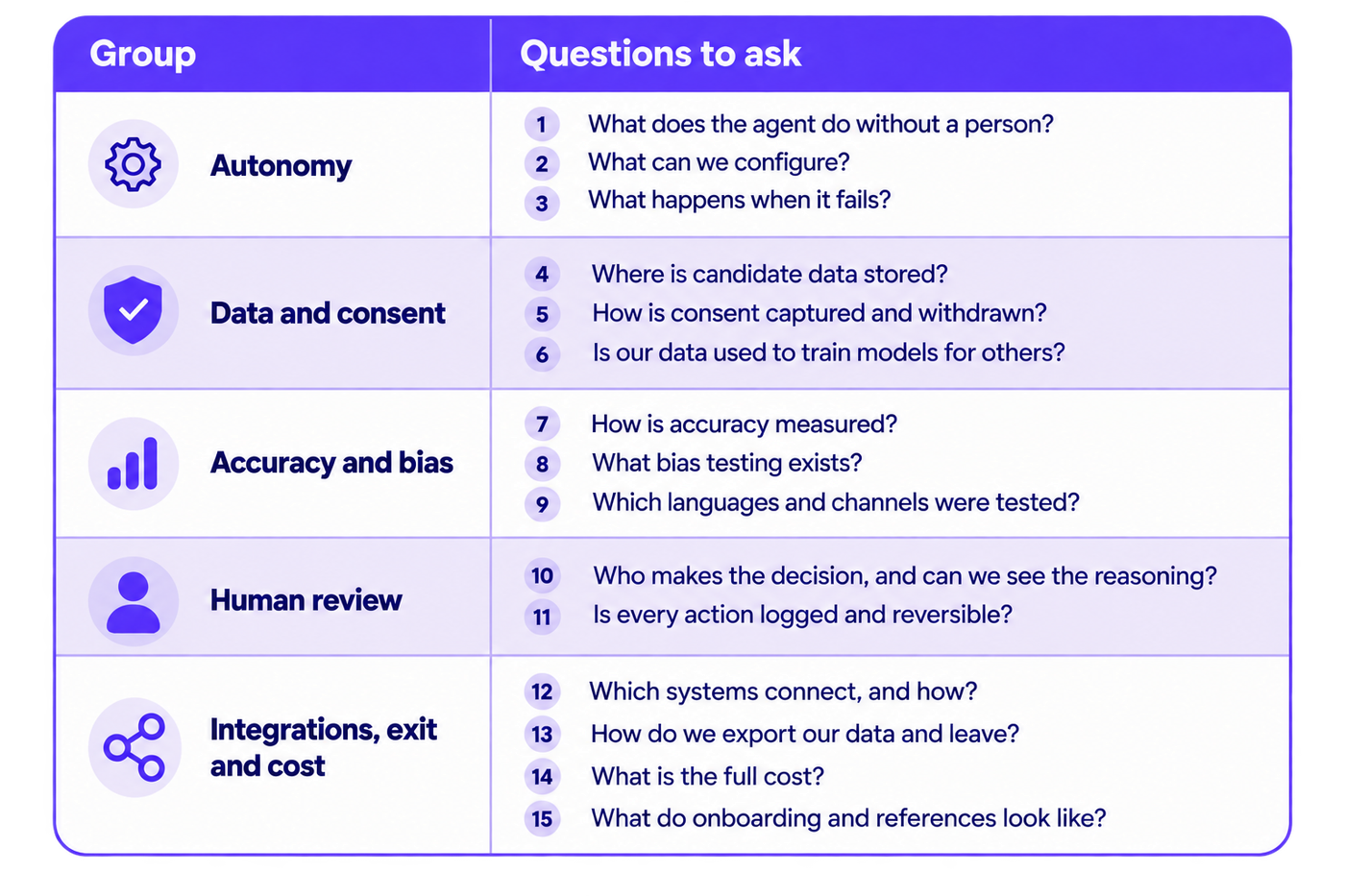
Use the table as the cover sheet, and the next sections to judge the answers.
Autonomy: What Will the Platform Do Without You?
Autonomy is the most misunderstood part of an AI recruiting platform, because vendors describe it in different words. Pin it down with three questions.
1. What tasks does the agent complete on its own, and where does it stop? A good answer lists the tasks by stage, for example sending first messages, asking screening questions and offering interview slots. It also names the points where the agent hands over to a recruiter. Be wary of an answer that says “everything” or a list with no handover points.
2. What can we configure? You should be able to set screening criteria, working hours, message tone, languages, escalation rules and how many follow-ups go out. Ask to see the settings screen. If a vendor must change these for you, ask how long a change takes and whether it costs extra.
3. What happens when the agent fails or a candidate goes off script? Candidates ask about pay, notice periods, locations and shifts in ways no script predicted. A strong answer describes the fallback: the agent says it will pass the question on, flags it in the recruiter’s inbox and stops guessing.
The practical test is to ask the vendor to show one real conversation where the agent could not answer. If every sample is perfect, you have only seen marketing.
Data and Consent: Where Does Candidate Data Go?
Candidate data is personal data. In India, the Digital Personal Data Protection Act 2023 and its Rules apply to it. The Press Information Bureau’s release of 14 November 2025 on the DPDP Rules, 2025 says the Rules set an 18-month phased compliance timeline and require clear, standalone consent notices.
The same release says organisations must respond to requests to access, correct or erase personal data within 90 days. It also says Significant Data Fiduciaries may face government-specified restrictions, including localisation where required. Your legal team decides how these apply to you, but your vendor should be able to explain how its product behaves.
4. Where is candidate data stored and processed, and who can access it? Ask for the cloud region, the sub-processors and the access controls. If the vendor uses a third-party AI model, ask whether candidate messages leave India and under what terms. A vague answer here is a risk, because you are the one answering to candidates.
5. How is consent captured, recorded and withdrawn? Ask what the candidate sees before the first conversation, where the consent record is stored, and how a candidate withdraws. Test it yourself: opt out in a sandbox and watch what happens next.
6. Is our candidate data used to train models that serve other customers? Ask for the answer in the contract, not on a call. Also ask how long data is retained after a role closes and how deletion works. For the Indian legal picture, see our guide to AI hiring laws in India.
Data answers belong in the contract. If a vendor will not commit to them in writing, treat the answer as a 0.
Accuracy and Bias: How Does the Vendor Prove It Works?
AI output needs testing before it is trusted. The NIST AI Risk Management Framework, released on 26 January 2023, is a voluntary framework for managing risks in the design, use and evaluation of AI systems, according to the National Institute of Standards and Technology. You do not need to adopt it, but it gives you neutral vocabulary for asking how a vendor governs and measures its system.
7. How is accuracy measured, and can you share the results? Ask what the test set was, who labelled it and what was measured, such as shortlist agreement with recruiter decisions. Ask how often the results are refreshed. A single headline percentage with no method is not evidence.
8. What bias testing exists, and can we see the outputs? Ask which groups were tested, how often, and who ran the test. Ask what happens when a test shows a gap. The EU AI Act lists recruitment and candidate-evaluation systems as high risk in Annex III, according to the European Commission’s AI Act Service Desk, and the Commission states that rules for employment systems apply from 2 December 2027. Even if you hire only in India, it shows what documentation buyers in other markets may ask vendors for.
9. Which languages and channels were tested, and with what results? In India this question matters more than most. A platform tested in English email can behave differently on WhatsApp in Hindi, Tamil or a mixed-language message. Ask for test results in the languages your candidates use.
What we see at HireBound: HireBound reports a 64% WhatsApp response rate in India against about 12% for email, and Voice AI in 14 Indian languages. Channel and language choice changes who replies at all, so run your own sample before accepting any vendor’s figures, ours included.
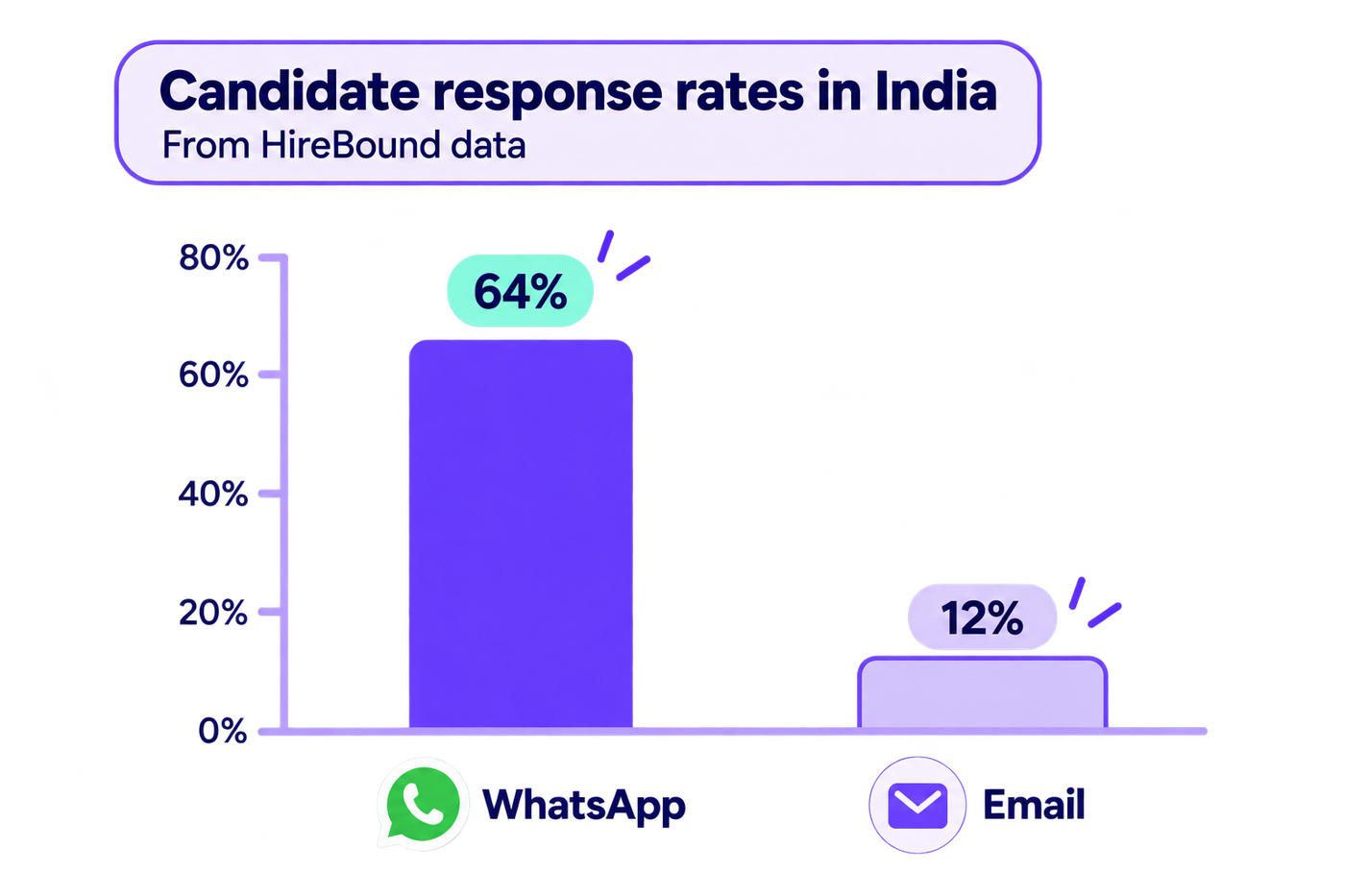
The gap is the reason channel coverage belongs on your checklist.
Human Review: Who Decides and Who Can Check?
Human review is only real if a person can see what the AI did and change it. Two questions test that.
10. Who makes each hiring decision, and can the recruiter see the reasoning? A good platform produces a ranked shortlist with a reason for each ranking, such as which skills matched and which requirements were missing. Ask whether a recruiter can overrule a ranking and whether the override is recorded. If the product only shows a score, the recruiter is trusting a number.
11. Is every agent action logged, and can it be reversed? Ask for a sample audit trail for one candidate: each message sent, each answer received, each score and each human action, with time stamps. Ask who in your team can view it. When a candidate complains, or a regulator asks, that log is your evidence.
A short rule helps here. The agent may prepare and act on routine steps, and a person owns the final decision on who is shortlisted, interviewed and hired. A vendor that agrees with this and shows you where it is enforced is easy to work with.
Integrations, Exit and Cost: What Happens After You Sign?
The last four questions cover the contract and the long run. A platform that works well but cannot connect to your systems, or cannot let you leave, becomes a liability.
12. Which systems does the platform connect to, and is the connection two-way? List your applicant tracking system, job boards, calendar and messaging tools. Ask whether data flows both ways or only one way, and who builds and maintains each connection. Our post on how a recruiting platform connects your hiring workflow shows what to trace.
13. How do we export all our data, and what happens when we leave? Ask for the export format, the timeline and the deletion confirmation. Ask whether candidate conversations and consent records come with the export. Put the answer in the contract.
14. What is the full cost? Ask for the price per user, per conversation or per hire, and separately for messaging fees, voice minutes, extra languages, integrations and support. Ask what changes at twice your volume. Our total cost of AI recruiting software post breaks down these line items.
15. What do onboarding, support and references look like? Ask for the onboarding plan with dates, the support hours that match your recruiters’ working day, and two references with a similar hiring profile. Speak to a reference without the vendor in the room.
Keep cost as one group of questions, not the main story. A cheaper platform that fails the earlier groups costs more once you count re-work.
How Do You Pilot an AI Recruiting Platform Before You Buy?
Run a two-week pilot on one role family before you commit. Pick a role where you hire often, so you get enough candidates to see patterns. Agree the success measures first, then compare against your current process.
- Week 0: set the rules. Write down the screening criteria, the handover points and the escalation contact. Capture your current numbers for time to first response, interviews booked and recruiter hours spent.
- Week 1: run live, with review. A recruiter reads every agent conversation for the first days, then samples. Tag each case as correct, corrected or escalated.
- Week 2: test the edges. Try an opt-out, a deletion request, a candidate who writes in a second language, and a data export.
- Close: score and decide. Re-score the 15 questions with what you saw and compare it with the written answers.
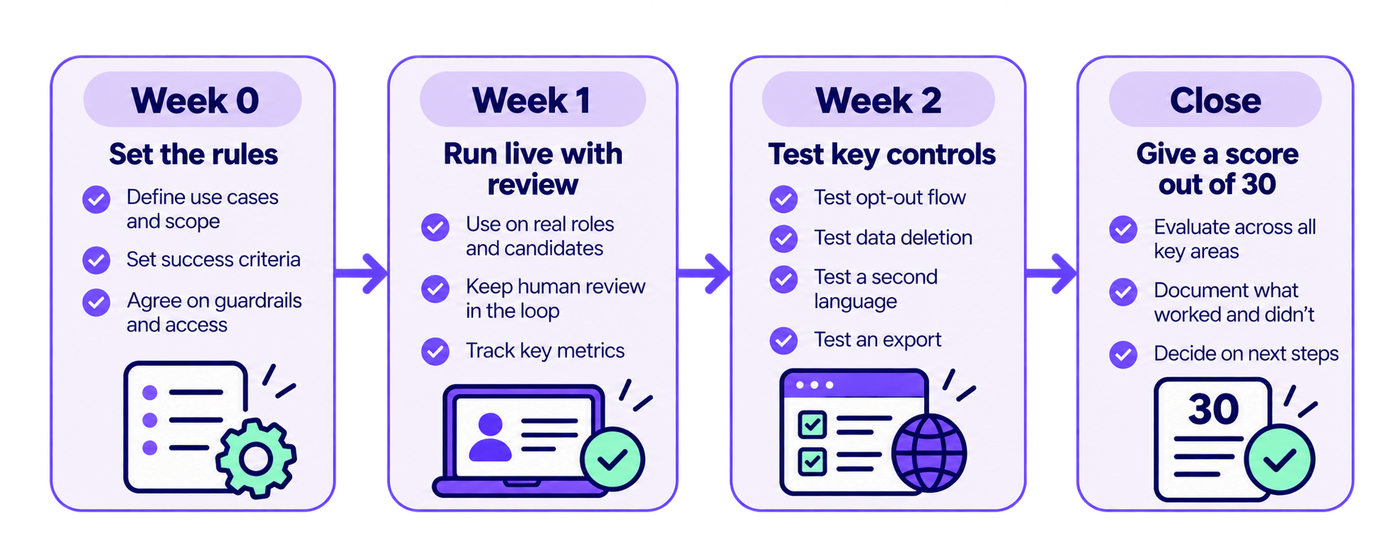
The pilot is where written answers meet real candidates.
Ready to put these questions to a vendor? Talk to the HireBound team →
When Does This Checklist Not Apply?
A checklist is not the right tool every time. For a team that hires a handful of people a year, a 15-question evaluation is too heavy, and a simple tool with a short trial may be enough. In that case, keep questions 4, 5, 6, 13 and 14 and skip the rest.
The checklist also does not replace legal advice or a security review. It helps you ask better questions and compare answers, and your counsel and IT team still need to review the contract. And a high score on paper does not guarantee results in your hiring process, which is why the pilot exists.
The strongest counterargument is that questionnaires reward vendors who are good at writing answers. That is fair. It is why the scoring gives a 2 only for evidence you can inspect, and why the pilot has the last word.


