Frontline Hiring in Tier 2 and Tier 3 Cities
 Devansh Dhawan
 ·Oct 21, 2026·9 min read

Key Takeaways
- 1NSO’s 2025 telecom survey found 96.8% of rural 15-29 year-olds used a mobile phone and 92.7% used the internet, so phone-first hiring works.
- 2ManpowerGroup’s Q4 2026 survey of 3,055 Indian employers found 65% plan to add staff, so smaller-city employers compete for the same workers.
- 3Screening in the candidate’s own language, over voice or WhatsApp, removes the main barrier of an English-only form for frontline roles.
- 4HireBound data shows a 64% WhatsApp response rate in India against about 12% for email, so lead with WhatsApp and use calls as the fallback.
- 5A 5-step drive covers brief, reach, screen, book and confirm, and the joining-day confirmation call is where most no-shows can still be saved.
Frontline hiring in tier 2 and tier 3 cities is the recruitment of operational staff, such as warehouse workers, drivers, sales associates, technicians and customer-service agents, in India’s smaller cities and towns. It relies on phone-based reach, local-language screening and fast scheduling, because candidates there are less likely to read email or fill in long forms.
This guide is for corporates that need to fill many roles outside the metros. It covers what changes, where to find candidates, how to screen them and how to get them to turn up on day one.
Hiring for many roles across several towns? See how HireBound works →
Why Are Employers Hiring Beyond the Metros?
Hiring demand is broad. ManpowerGroup’s Employment Outlook Survey for October to December 2026 covered 3,055 Indian employers. It found that 65% plan to increase staffing, and that hospitality showed the largest quarterly rise, at 21 points (ManpowerGroup India).
Location also matters. India has no single official definition of tier 2 and tier 3, so teams usually mean cities and towns outside the largest metros. What matters in practice is that your plant, store or hub sits where the workers are.
The labour data shows that urban and rural job markets behave differently. The PLFS annual report for 2025, from the Ministry of Statistics, put youth unemployment at 13.6% in urban areas and 8.3% in rural areas. Unemployment rates do not count people outside the labour force, so read them as a sign that the two markets behave differently, not as a measure of spare supply.
Our guide to bulk hiring in India covers the volume side. This post covers what changes when the roles sit in smaller towns.
What Changes When You Hire in Smaller Cities?
Five things change: the channel, the language, the speed, the paperwork and the distance. The table shows what teams often change in each area. It is HireBound’s practical view and not survey data.
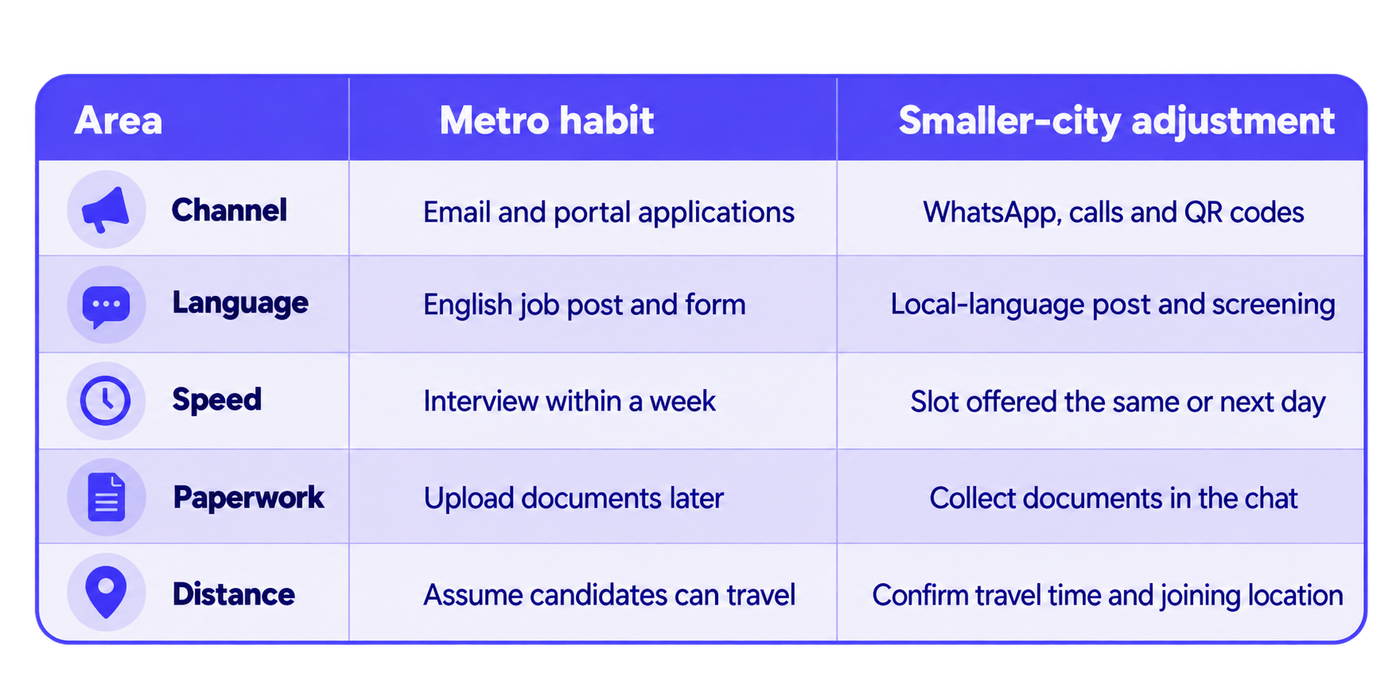
Each row removes a step where a candidate would give up, and a fix in one area helps little if the other four stay as they were.
How Reachable Are Candidates Outside the Metros?
Very reachable by phone. The National Statistics Office ran its Comprehensive Modular Survey: Telecom in January to March 2025. It found that 96.8% of rural people aged 15 to 29 had used a mobile phone in the previous three months. In urban areas the figure was 97.6% (Ministry of Statistics, press note, 29 May 2025).
The same survey found that 92.7% of rural people in that age group had used the internet, against 95.7% in urban areas. Among rural mobile owners aged 15 to 29, about 95.5% owned a smartphone. Across all households, around 85.5% had at least one smartphone.
The IAMAI and Kantar report on internet use in India for 2024 points the same way. It estimated 886 million active internet users, of whom 488 million, or 55%, lived in rural areas.
For a recruiter, the gap between metro and smaller-city phone use is small. The gap in habits is larger: a candidate may use WhatsApp daily and open email once a month.
Where Do You Find Frontline Candidates in Tier 2 and Tier 3 Cities?
Use several channels together and let one pipeline absorb them. No single source covers every town. These are the channels that matter most here:
- Job boards: HireBound integrates with Naukri, Shine, Apna and WorkIndia, so applicants from each land in one pipeline.
- WhatsApp campaigns: Send a job message to people who have already given consent, with a link to apply inside the chat.
- QR codes: Print a code on posters at factory gates, training centres and local markets. A scan opens the application on the phone.
- Referrals: Current staff often know friends and relatives in the same town. Offer a small joining-linked reward.
- Past applicants: Rediscover people who applied for earlier drives and were not placed. They already know your name.
- Local partners: Training centres, technical institutes and community groups know who is looking for work. Share the job with them and track the joiners they send.
HireBound’s smart career page lets candidates apply through a form, WhatsApp or a QR code into the same pipeline. Recruiters then see every source in one place and can judge which channel gives joiners, not just applicants.
For the job post itself, keep the role, pay range, location, shift and joining date in the first lines. Our post on how to write job descriptions covers the structure.
How Do You Screen in the Candidate’s Own Language?
Screen in the language the candidate speaks, and keep the questions short. India’s Constitution lists 22 languages in its Eighth Schedule, and a town’s working language is often not the one on your job form. A candidate who cannot follow the form will leave it, and you will not know why.
A language-first screen asks a few role-specific questions by voice or WhatsApp. Typical questions cover location, shift availability, experience, expected pay, notice period and documents. HireBound’s Voice AI runs screening calls in 14 Indian languages and scores the answers. The same questions run on WhatsApp for candidates who prefer to type or send a voice note.
Here is a sample set of five questions for a delivery-associate role. Adjust them for your own roles.
- Which town do you live in, and how far is the pickup point?
- Can you work the 6 am to 2 pm shift, six days a week?
- Do you hold a valid two-wheeler licence and own a vehicle?
- What was your last job, and why did you leave?
- When can you join if selected?
The flow below shows the sequence.
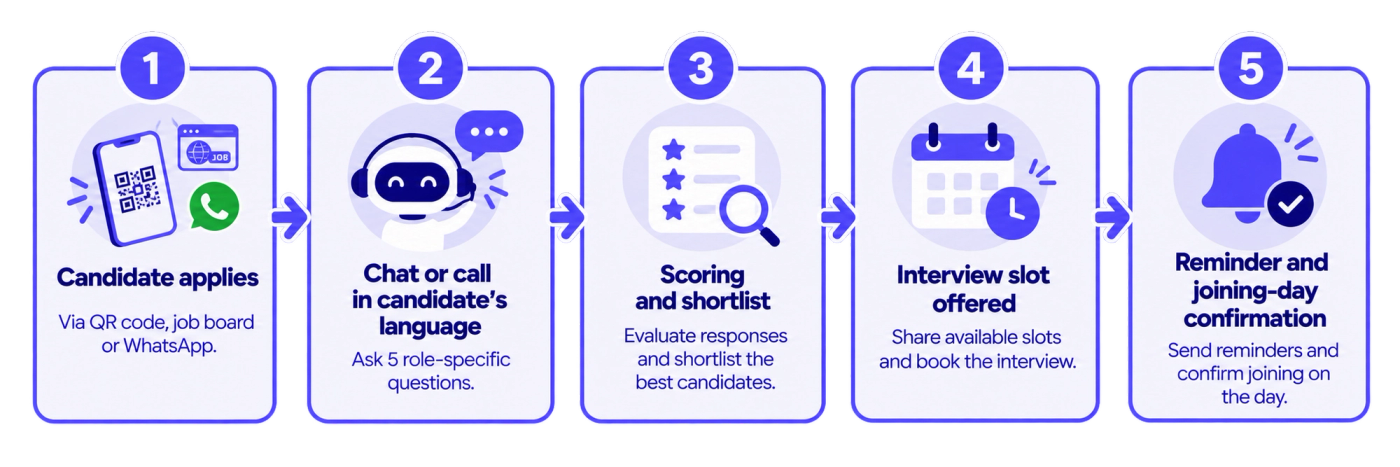
Each step is short and the candidate never has to leave the phone. Our WhatsApp recruiting guide covers consent, templates and message design.
What Does a Step-by-Step Hiring Drive Look Like?
A drive needs five steps, from the brief to the joining confirmation. Run them in this order.
- Write the brief. Fix the number of roles, towns, shifts, pay range and joining date. Decide the must-haves, such as a licence or a minimum shift length.
- Open the channels. Publish the job in the local language and switch on the job boards, WhatsApp and QR code. Send every applicant into one pipeline.
- Screen at once. Send the screening chat or call within minutes of the application. Speed matters most while the candidate still has the phone in hand.
- Book the interview or trial. Offer two or three slots and confirm the location. Send a reminder the day before and again on the morning.
- Confirm joining. Call the selected candidate two days before the joining date, and again on the day. Collect documents in the chat while you wait.
Here is an illustrative example with assumed numbers. A distribution firm needs 120 packers across three towns and expects about 4 applicants for each opening, so it plans for 480 applicants. If only a quarter pass the first screen, that leaves about 120 candidates, so the firm widens the channels until the shortlist is larger than the headcount. The ratio is an assumption, so measure your own.
How Do You Cut Joining No-Shows?
Treat the gap between offer and joining as part of the hiring process. Candidates in smaller towns may hold two offers, wait for a family decision or be unsure about travel and housing. Silence in that gap is a warning sign.
Four habits help:
- State pay, shift, location and joining date in the offer message, in the candidate’s language.
- Answer questions on WhatsApp the same day.
- Send documents and joining instructions early, so the candidate feels committed.
- Call two days before the date and again on the morning.
Our guide to why candidates drop off shows where silence costs the most. HireBound data shows a 64% WhatsApp response rate in India against about 12% for email, so WhatsApp is the best first channel for these reminders, and a call the second.
Which Numbers Show the Drive Is Working?
Track a short set by town and by source. Compare towns with each other and drives with earlier drives. The table lists the set.
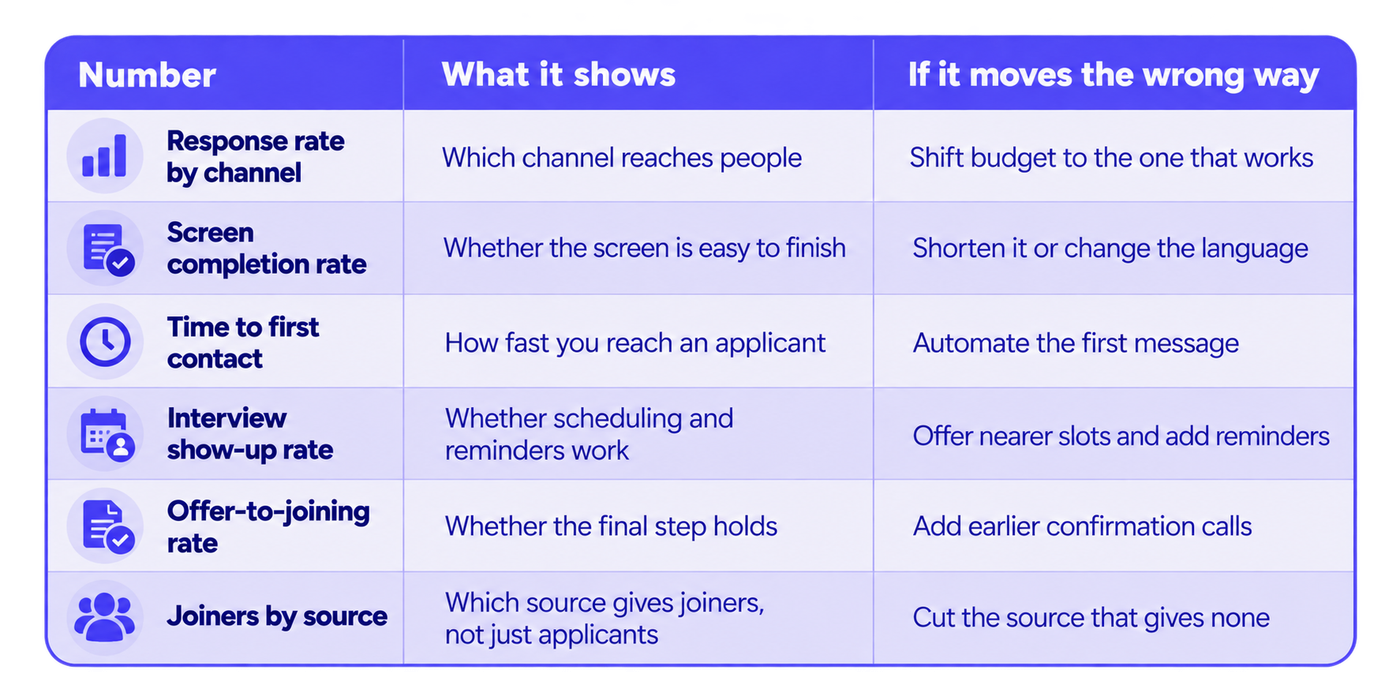
A source with many applicants and few joiners costs more than it looks.
What About Compliance and Records for Frontline Hires?
Keep the records for each hire from the first message. Wage rules, shop and establishment rules and registrations differ by state, so confirm the local position with your legal or payroll adviser before the drive.
The records usually include proof of identity and address, the signed offer, joining date, shift and site, and the consent the candidate gave to be contacted. India’s Digital Personal Data Protection Act, 2023 requires consent or another permitted use before personal data is processed. Ask for consent once at application and note the channels you will use.
HireBound’s bulk-hiring offering includes offer generation, e-signatures, digital onboarding with document management and compliance tracking. Keep the consent record with the candidate’s profile.
What Mistakes Do Teams Make in Smaller Cities?
Four mistakes recur:
- Copying the metro process. An English form and an email-first flow filter out good candidates.
- Slow first contact. A candidate who applies in the morning and hears back in three days has moved on.
- No travel check. A candidate who lives 90 minutes from the site may accept and not come.
- Counting applicants, not joiners. A busy funnel can still produce few staff.
Fixing them mostly means treating the phone as the main tool.
Where Does HireBound Fit?
HireBound supports a frontline drive from the first message to the joining confirmation. Its Omnichannel Outreach runs Voice AI, WhatsApp, SMS and email, and the Screening Agent asks role-specific questions and scores the answers. The Scheduling Agent books interviews and sends reminders, and replies from every channel land in one unified inbox.
HireBound has powered 8 million+ candidate conversations, and recruiters using it handle 3× more candidates per day than with a manual process. The diagram shows how a drive moves through the platform.
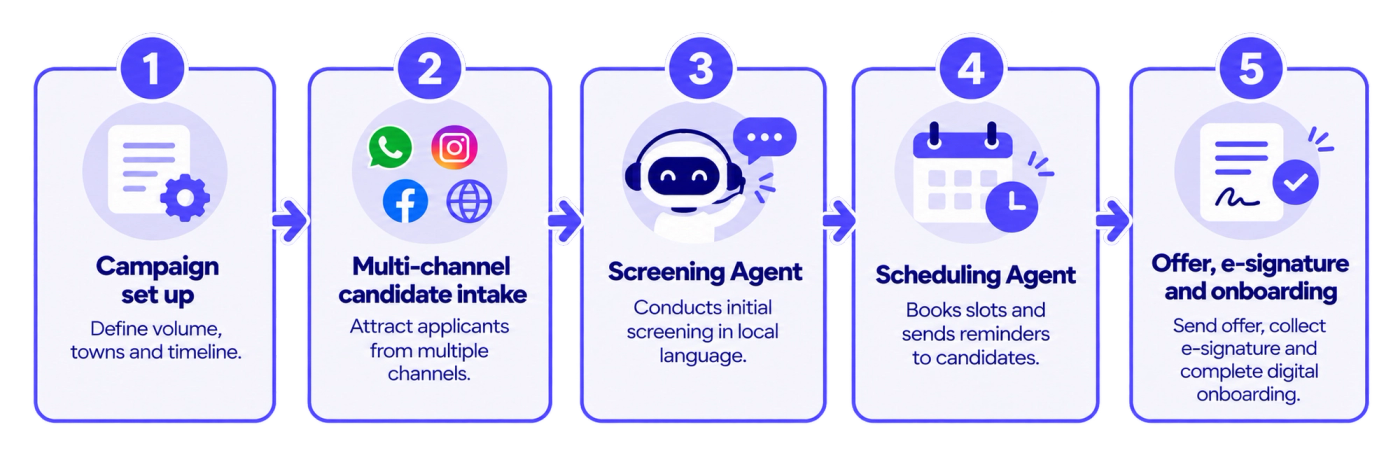
Teams keep their own judgement on who to hire. The agents handle the repetitive contact work between those decisions.
Planning a hiring drive across several towns? Talk to HireBound about frontline hiring →
Conclusion: A Decision Rule for Smaller-City Hiring
Use the phone as the main tool, screen in the candidate’s language, and measure joiners by source.
Apply one rule. If you hire more than a few dozen people a quarter outside the metros, set up a standing WhatsApp and voice screening flow with one pipeline. If your volume is small and your roles skilled, a lighter process with a few local referral channels may be enough.


