How to Use AI in Hiring: A Stage-by-Stage Guide
 Tanmey Goswami
 ·Nov 17, 2026·11 min read

Key Takeaways
- 1Use AI for repeatable work at each hiring stage, such as drafting, searching, first screens and booking, and keep decisions and offers with a recruiter.
- 2SHRM's 2025 Talent Trends survey of 2,040 HR professionals found AI use in HR tasks reached 43%, up from 26% in 2024.
- 3ManpowerGroup's Q3 2026 survey of 40,592 employers ranked human resume review (57%) above AI resume screening and sourcing (44%) as the most valued hiring resource.
- 4HireBound data shows a 64% WhatsApp response rate in India against about 12% for email, so conversational outreach is the highest-return place to start.
- 5Roll out in 30 days: map one role in week 1, pilot in weeks 2 and 3, then compare against your baseline in week 4.
To use AI in hiring, give it the repeatable work at each stage and keep the judgement calls with a recruiter. AI drafts job descriptions, searches and ranks candidates, runs first screens, handles follow-ups, books interviews and summarises feedback. Recruiters set the criteria, review borderline cases and make every offer and rejection decision.
This guide goes through seven hiring stages. Each one covers what AI does, what the recruiter still does, a worked example and what to watch for. It ends with the rules in India, a 30-day rollout and the metrics that show whether it is working.
Want AI handling the repetitive stages of your hiring? See how HireBound's AI agents source, screen and schedule candidates →
What Does Using AI in the Hiring Process Look Like?
AI in the hiring process means software that reads, ranks, writes or converses on a recruiter's behalf, inside a workflow the recruiter controls. Our explainer on what AI in recruiting is covers the definition and the types. This guide is about the practice, and our guide to choosing an AI hiring platform covers buying decisions.
Tasks that are repetitive, high volume and rule-based suit AI. Tasks that need trust, negotiation or accountability stay with a person. The table below sets out that split for all seven stages, with the metric to track at each one.
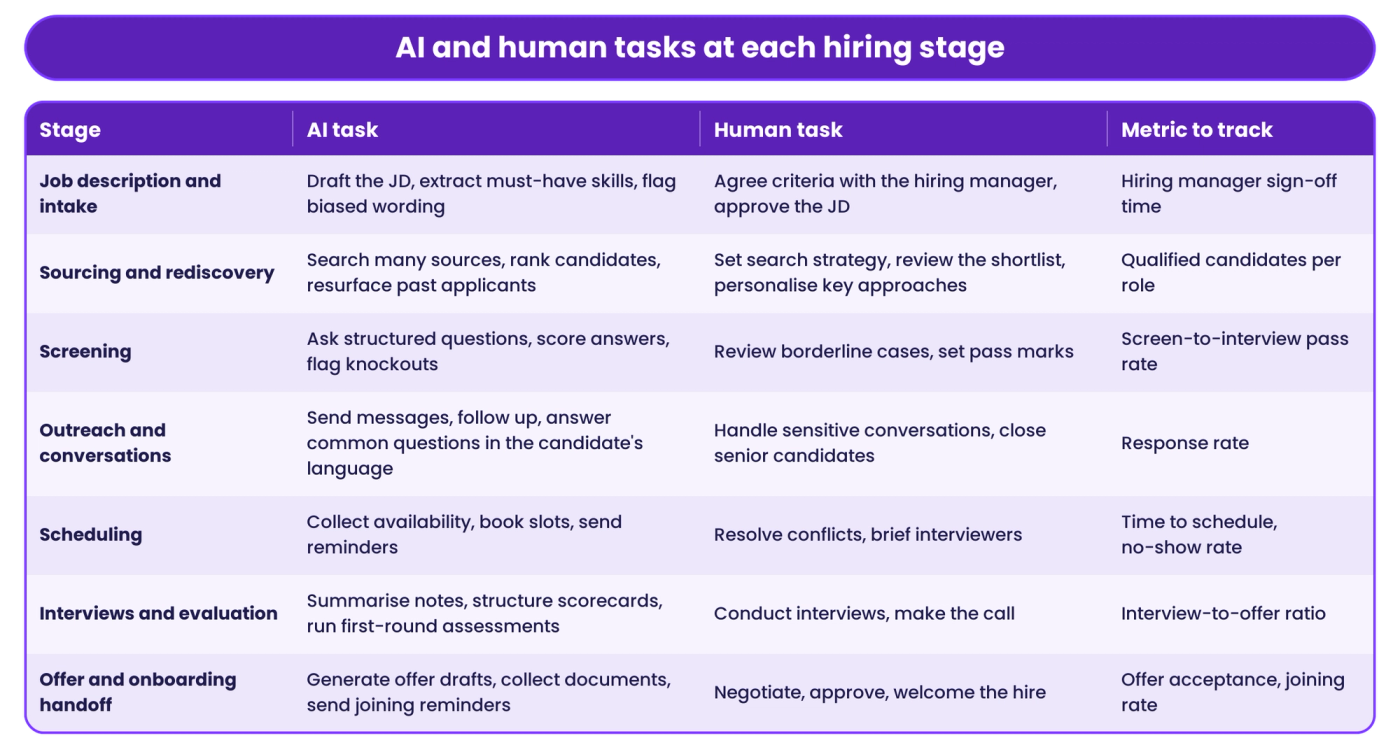
The table shows that AI carries the volume work at every stage while a person owns the decision.
How Many Companies Use AI in Hiring?
The answer depends on how you count, so quote the survey and not just the number. SHRM's 2025 Talent Trends research surveyed 2,040 US HR professionals in February 2025. It found AI use in HR tasks had climbed to 43%, up from 26% in 2024. The sample is US-only and unweighted.
ManpowerGroup's Employment Outlook Survey for Q3 2026 covered 40,592 employers in 42 countries, with fieldwork in April 2026. Employers ranked human resume review as the most valued hiring resource at 57%. AI-assisted job description writing came next at 46%, and AI-driven resume screening, parsing and sourcing at 44%.
A separate ManpowerGroup study in June 2026 surveyed 80 senior talent leaders in the US and UK. More than 90% said they had deployed AI in talent acquisition, but fewer than 5% described the results as transformational. The sample is small, so do not compare it with the larger surveys.
Use is common and uneven. Most teams use AI for drafting, sourcing and screening.
Stage 1: How Do You Use AI for Job Descriptions and Intake?
AI does the first draft. Give it the role, the team, the must-have skills and the location, and it produces a job description, a list of screening criteria and a note on any wording that could discourage applicants.
The recruiter does the intake. A hiring manager who says "someone senior with good communication" has not given a criterion. Ask what a strong candidate has done in the last two years, then check that the criteria are testable in a first screen.
Here is an example with stated assumptions. A logistics firm in Pune needs a hub supervisor and the manager's brief is two lines. AI turns it into five must-haves and three nice-to-haves. The recruiter takes the list back to the manager, who drops one must-have that would have excluded most of the local pool.
Watch for criteria that copy the last hire. AI will treat the previous hire's degree as a requirement unless you say otherwise, so drop filters the work does not need.
Stage 2: How Does AI Help With Sourcing and Rediscovery?
AI searches many sources at once, ranks candidates against the role and explains the ranking. It can also search your own database first. Rediscovery, which means finding past applicants and silver medallists who fit a new role, is often the fastest way to a first shortlist.
The recruiter decides where to look, reads the reasoning behind the ranking and personalises the first message to any candidate who is hard to land. AI widens the net, and the recruiter judges who is worth the call.
Good people are often already in your system. Our post on why good candidates get missed and the fix covers how keyword filters and one-database searches drop strong profiles. Fit-based ranking and a check of past applicants close much of that gap.
HireBound's AI sourcing for recruiters turns a role brief into a ranked shortlist from 500M+ profiles and your internal pool, with a match score, strengths, concerns and a plain-English reason for each candidate. Recruiters can shortlist, message or push candidates to an ATS from the same screen.
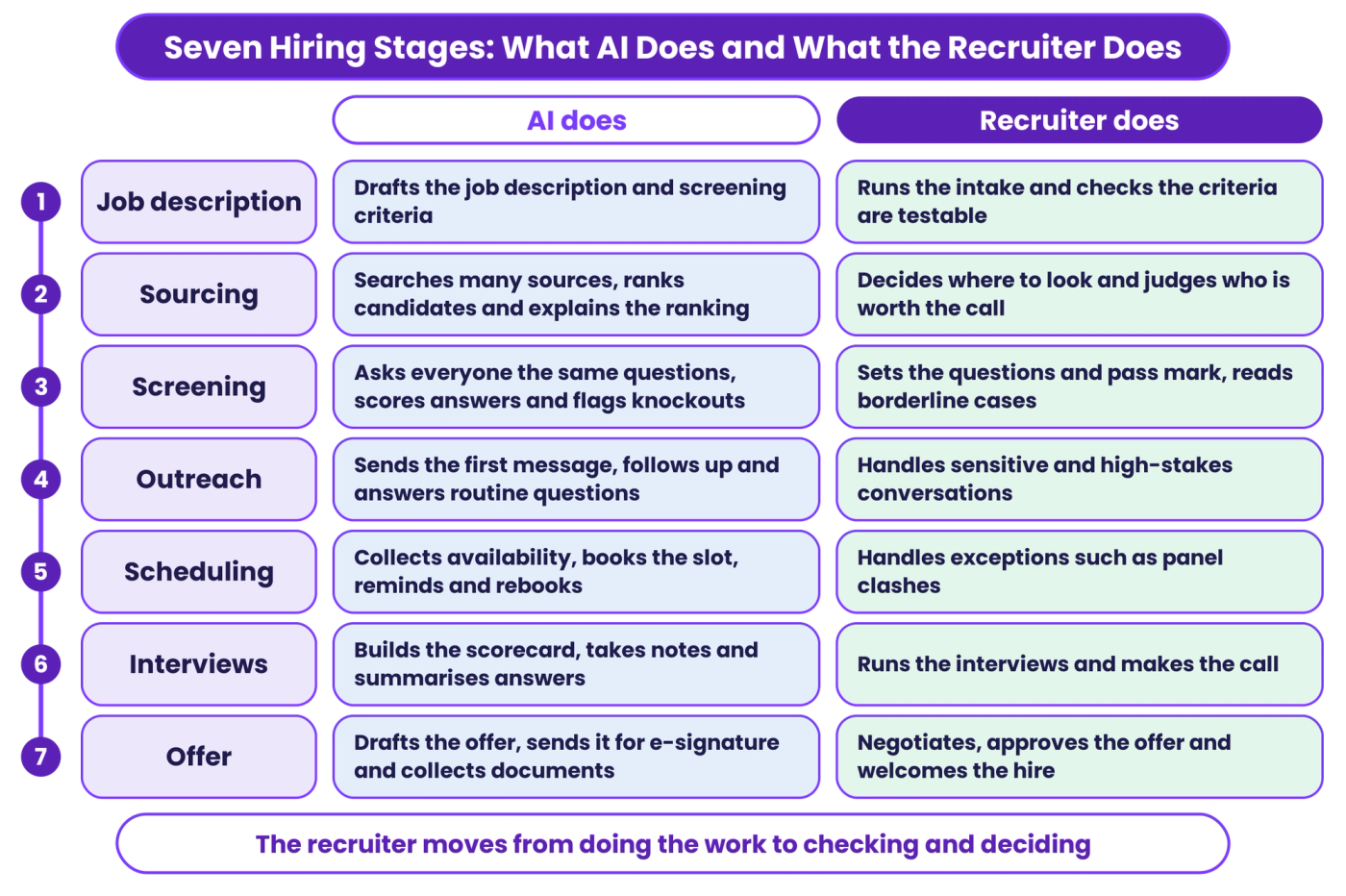
The diagram shows that the recruiter's role shifts from doing the work to checking and deciding.
Watch for source bias. If AI searches one pool, the shortlist will look like that pool, so check that rankings reflect skills and not school or employer brand.
Stage 3: How Do You Use AI to Screen Candidates?
AI asks every applicant the same structured questions, scores the answers against your criteria and flags knockouts such as a missing licence or the wrong location. Our detailed guide on how to automate candidate screening covers the steps and the question design.
The recruiter sets the questions and the pass mark, then reads the borderline cases and a sample of rejections. Reading rejected profiles is the quality check. If good people are being filtered out, the criteria need changing.
Here is an example with stated assumptions. A BPO gets 400 applicants for 30 voice process roles. Three knockout questions on language, shift and notice period cut the pool to about 150, and AI scores those on answers to four role-specific questions. The recruiter reviews the top 60 and a sample of 20 rejections, and calls the best 35.
Watch for questions that screen on proxies. A career gap question can filter out women returning to work. Ask about the job, not the person.
Stage 4: How Does AI Handle Outreach and Candidate Conversations?
AI sends the first message, follows up when there is no reply and answers routine questions about pay, location and shift. It can hold the conversation in the candidate's language and across WhatsApp, voice, SMS and email.
Channel choice matters in India. HireBound data shows a 64% WhatsApp response rate in India, compared with about 12% for email. For frontline roles, lead with WhatsApp and voice.
The recruiter handles anything sensitive or high stakes. That includes a candidate who is negotiating, one with a competing offer, and any senior hire who expects to speak to a person. AI should hand over the conversation with the full history, so the candidate never repeats themselves.
Watch for disclosure. Candidates should know when they are talking to an AI. HireBound's Voice AI covers 14 Indian languages, but test any language on real calls before relying on it.
Stage 5: How Do You Use AI for Interview Scheduling?
AI collects availability during the screen, books the slot with the interviewer, sends reminders and rebooks when someone cancels. Scheduling is a clean first use because the task is rule-based and every email back and forth adds a day.
The recruiter handles exceptions. That means a panel that cannot meet before the deadline, a candidate who needs an accommodation and an interviewer who is not briefed.
Here is an example with stated assumptions. A team interviews eight candidates a week and loses about a day per candidate to messaging. Automated booking and an evening-before reminder move confirmations to the same day, and the team tracks the no-show rate.
Watch for calendar permissions. Give the tool access to free and busy times only.
Stage 6: How Does AI Support Interviews and Evaluation?
AI structures the evaluation. It can build a scorecard from the role criteria, take notes, summarise answers against each criterion and run a first-round assessment for volume roles.
The recruiter and hiring manager run the interviews and make the call. A summary is a prompt for discussion and not a verdict. Panels should score independently before they see the AI summary.
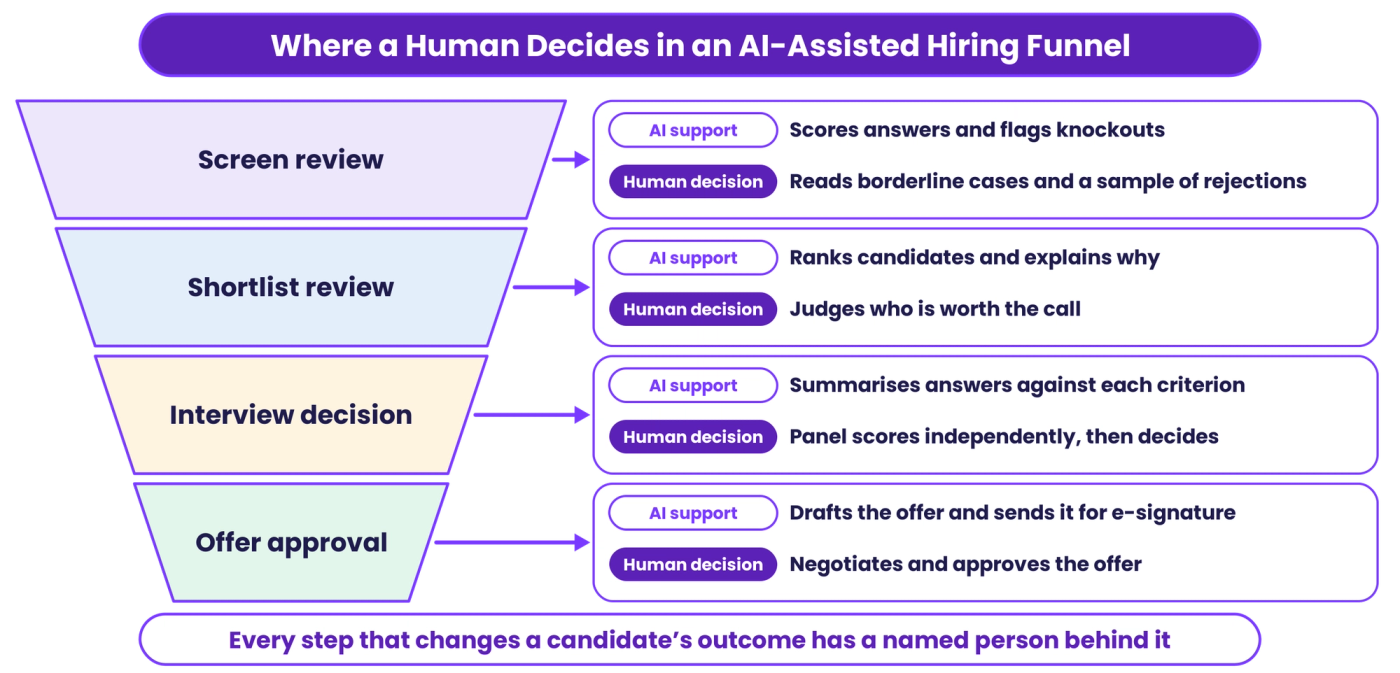
The infographic shows that every step that changes a candidate's outcome has a named person behind it.
Watch for candidates using AI too. ManpowerGroup's June 2026 study found that 54% of leaders said AI-assisted candidate behaviour made it harder to assess true capability. Use live, job-relevant tasks and follow-up questions.
Stage 7: How Does AI Help With Offers and the Onboarding Handoff?
AI drafts the offer from a template, sends it for e-signature, collects documents and sends joining reminders. Between offer and day one it can check in with the candidate, which is where offer-to-join drop-off happens.
The recruiter negotiates, approves the offer and welcomes the hire. Pay, joining date and special terms are human decisions.
Watch for document handling. Offer letters and ID documents are personal data, so confirm where they are stored, who can see them and when they are deleted.
Where Must a Human Stay in the Loop?
A human must stay in the loop wherever a decision changes a candidate's outcome or carries legal accountability. That includes rejection, shortlisting for interview, offer, pay and termination of an application. AI can recommend, and a named person decides.
If you could not explain a decision to the candidate or a regulator, AI should not make it alone.
Three habits keep people in control.
- Set criteria in writing before the AI runs, and keep them under version control.
- Review borderline scores and a sample of rejections each week.
- Give candidates a route to ask for a human review.
What Are the Rules on Using AI for Hiring in India and Elsewhere?
In India, candidate data is covered by the Digital Personal Data Protection Act, 2023. According to a Press Information Bureau document from November 2025, the Government notified the DPDP Rules, 2025 on 14 November 2025. The Rules set an eighteen-month period for phased compliance, which runs to around May 2027.
The same document says each data fiduciary must issue a separate, clear consent notice that explains the purpose for which personal data is collected and used. It lists seven principles, including purpose limitation, data minimisation, accuracy, storage limitation and security safeguards. Penalties reach up to ₹250 crore for failing to maintain reasonable security safeguards, and the Act gives individuals the right to seek correction or removal of their data. Read the PIB summary of the DPDP Rules for the full text.
In practice, tell candidates what you collect and why, collect only what the role needs, and secure and delete screening recordings on a schedule. Check with your payroll or legal team on how the Rules apply to your hiring data.
Outside India, rules are moving. New York City requires bias audits and candidate notice for automated employment decision tools, and the EU AI Act classes recruitment AI as high risk. Dates and details are changing, so confirm the current position for each place you hire.
How to Use AI in Hiring: A 30-Day Rollout Sequence
Start with one role and a baseline. A narrow pilot gives a clean comparison and limits risk.
- Days 1 to 3: Pick one high-volume role and record its baseline: time to shortlist, response rate, time to schedule and interview-to-offer ratio.
- Days 4 to 7: Write the criteria and screening questions with the hiring manager, and decide the human review points.
- Days 8 to 10: Check data handling. Prepare the candidate notice, retention period and access list.
- Days 11 to 14: Set up sourcing and rediscovery for the role and review the first shortlist by hand.
- Days 15 to 21: Switch on screening and outreach on the pilot role. Read every borderline case and 20 rejections.
- Days 22 to 25: Add scheduling and reminders, and check the no-show rate.
- Days 26 to 28: Compare the pilot against the baseline and list what the AI got wrong.
- Days 29 and 30: Adjust the criteria, decide whether to extend to a second role and brief the team.
HireBound runs the sourcing, screening and scheduling agents inside one pipeline, with each agent's activity logged against the candidate profile. That makes the review in steps 5 to 7 a matter of reading one record.
Which Metrics Show AI in the Hiring Process Is Working?
Judge the pilot on outcomes at each stage and not on how much the AI did. Compare each metric with the baseline you recorded on day 1, and track the same role over the same period.
- Time to shortlist and time to schedule should fall first.
- Response rate by channel shows whether outreach changed.
- A screen-to-interview pass rate that is too high or too low means the criteria need work.
- Interview-to-offer ratio shows whether shortlists are better, not just faster.
- Offer acceptance and joining rate show whether candidates stay engaged.
- Recruiter hours per hire is the cost measure.
- The share of sampled rejections you would have interviewed checks for missed talent.
If speed improves and interview-to-offer ratio gets worse, the AI is sending hiring managers weaker candidates faster. Fix the criteria before you scale.
Ready to pilot AI on one of your own roles? Talk to HireBound about running a stage-by-stage pilot →
Conclusion: Start With One Stage and Keep a Person on Each Decision
Start with one stage, measure it against a baseline and add stages as results hold. Give AI the volume work and keep decisions and accountability with people.


