What Is an AI Interview? A Guide for Recruiters and Candidates
 Suvam Moitra
 ·Nov 14, 2026·7 min read

Key Takeaways
- 1An AI interview is a structured interview where software asks the questions, records the answers and scores them against criteria a recruiter sets. A person still makes the hiring decision.
- 2Pew Research Center (2023) found 71% of US adults oppose AI making the final hiring decision, so tell candidates who reviews the result.
- 3NYC Local Law 144 requires a bias audit within one year of use and candidate notice 10 business days before an automated tool is used.
- 4The EU AI Act lists AI used to evaluate candidates as high-risk, with those duties applying from 2 December 2027 under Regulation (EU) 2026/1744.
- 5In India, AI interviews by phone or WhatsApp reach more candidates: HireBound data shows a 64% WhatsApp response rate against about 12% for email.
An AI interview is a job interview in which software asks the questions, records the answers and scores them against criteria the employer sets. It can run by voice call, chat or recorded video. The recruiter gets a transcript and a score, and a person still decides who moves forward.
This guide is for recruiters deciding whether to use AI interviews, with one section for candidates on what to expect. It covers how an AI interview agent works, the main formats, fairness, and the laws in New York, the EU, Illinois and India.
Want AI agents to screen and interview candidates while your recruiters focus on decisions? See how HireBound works →
What Is an AI Interview?
An AI interview replaces the first structured conversation a recruiter would otherwise hold by hand. The software asks a fixed set of role-specific questions, follows up on vague answers and scores each reply against a rubric.
It usually sits after the application and before the hiring manager round. It does not replace the final interview, the offer conversation or the decision.
The image below shows the four parts of a typical AI interview.
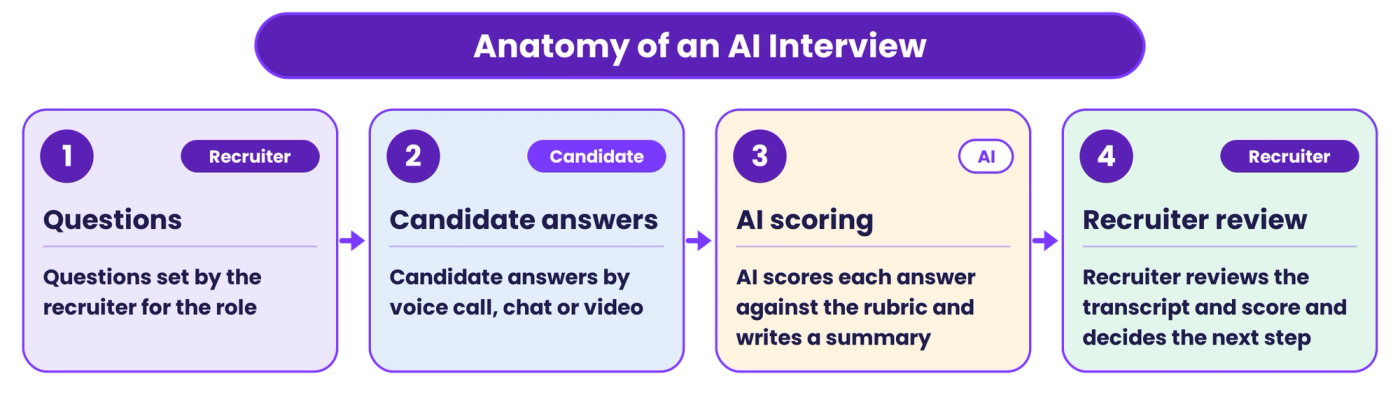
The recruiter sets the questions at the start and makes the call at the end, and the AI runs the conversation between.
How Does an AI Interview Work?
An AI interview runs in five steps.
- The recruiter sets the criteria. They choose the must-have questions, the skills to probe and what a strong answer looks like.
- The candidate gets an invite. It arrives by SMS, WhatsApp or email, with a link or a time for a call.
- The AI asks and follows up. If a candidate says "I've handled customer complaints," the agent asks for an example, the volume and the outcome.
- The AI scores and summarises. Each answer is rated against the rubric, and the recruiter gets a transcript, a recording where one is made and a short summary.
- A person decides. The recruiter or hiring manager reads the evidence and moves the candidate on, or not.
Step 3 is the difference from an online form, which accepts whatever the candidate types. An AI interview asks for an example when the first answer is thin.
AI Interview vs AI Interview Agent vs Screening Call
An AI interview is one conversation, an AI interview agent is the software that runs it, and a screening call is a shorter check of eligibility. Vendors use the three terms loosely, so the detail below helps when you compare tools.
An AI interview is the event: one structured conversation that produces a score. An AI interview agent is the software that runs it. A good agent also handles the work around the interview, such as sending invites, chasing no-shows, rescheduling and updating the candidate's stage in your pipeline.
A screening call checks eligibility: location, shift, notice period and salary range. An AI interview goes further and tests ability, such as how a candidate explains a process or handles a customer scenario. Many teams run both in one conversation, with the screening questions first.
What Formats Do AI Interviews Take?
AI interviews come in four common formats. The table compares them.
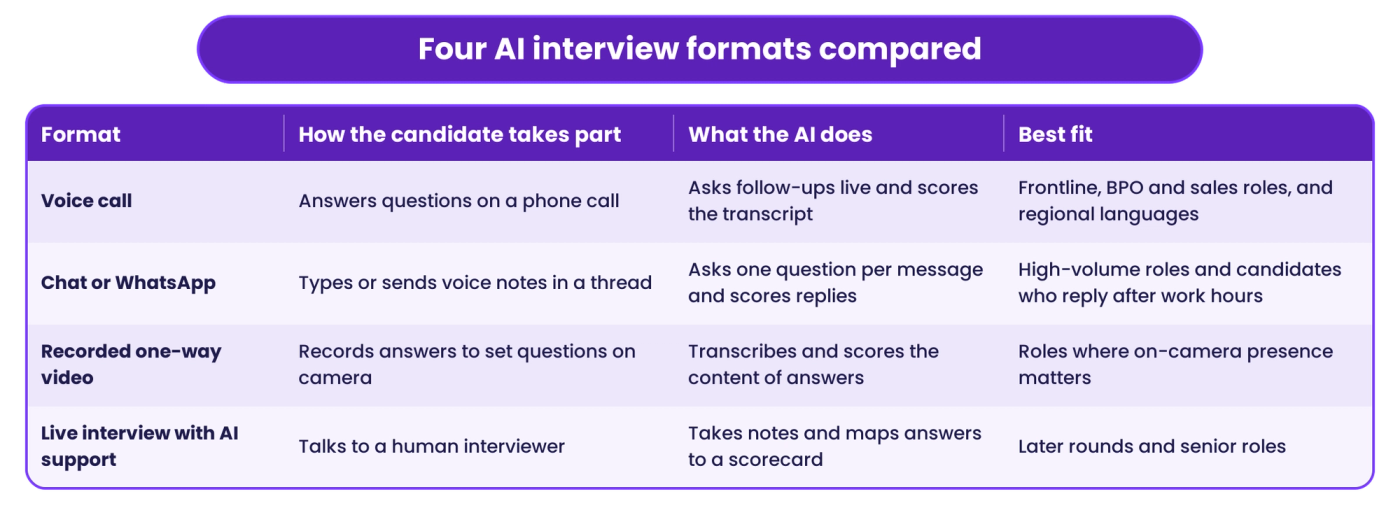
Voice and chat formats need only a phone, which matters when many applicants never open email.
Recorded video has its own trade-offs, covered in our guide to one-way interviews. If you want candidates to take any format whenever suits them, see how on-demand interviews change scheduling.
Where AI Interviews Help Recruiters, and Where They Don't
AI interviews help most when volume is high and the first-round questions repeat. A recruiter filling 40 customer support seats asks the same 10 questions 200 times. An AI interview agent asks them in parallel, at any hour, and gives every candidate the same questions.
SHRM's 2026 benchmarking puts the median time-to-fill at 39 days. First-round interviews wait on recruiter calendars, so running them in parallel removes one queue from that time.
AI interviews help less in three cases.
- Senior and niche roles. Candidates expect a person, and the questions rarely repeat.
- Roles where the rubric is unclear. If the hiring manager cannot say what a strong answer sounds like, the AI cannot score it.
- Final decisions. Use the score as evidence, not as a verdict.
Are AI Interviews Fair to Candidates?
AI interviews can be fairer than unstructured human interviews, because every candidate gets the same questions and the same rubric. They can also repeat bias at scale if the scoring uses proxies such as accent, school or location.
Candidates are wary. Pew Research Center surveyed 11,004 US adults in December 2022. It found 71% oppose AI making the final hiring decision and 66% would not want to apply where AI helps decide.
Pew also found that 47% said AI would do better than humans at treating all applicants the same, against 15% who said worse.
Four practices reduce that risk.
- Score what the candidate says, not how they sound or look.
- Let candidates answer in the language they are most comfortable in.
- Test score outcomes across groups before and after launch.
- Give every candidate a route to a person.
Which Laws Apply to AI Interviews?
No single law covers AI interviews worldwide. The table lists four rules recruiters most often meet, as of November 2026.
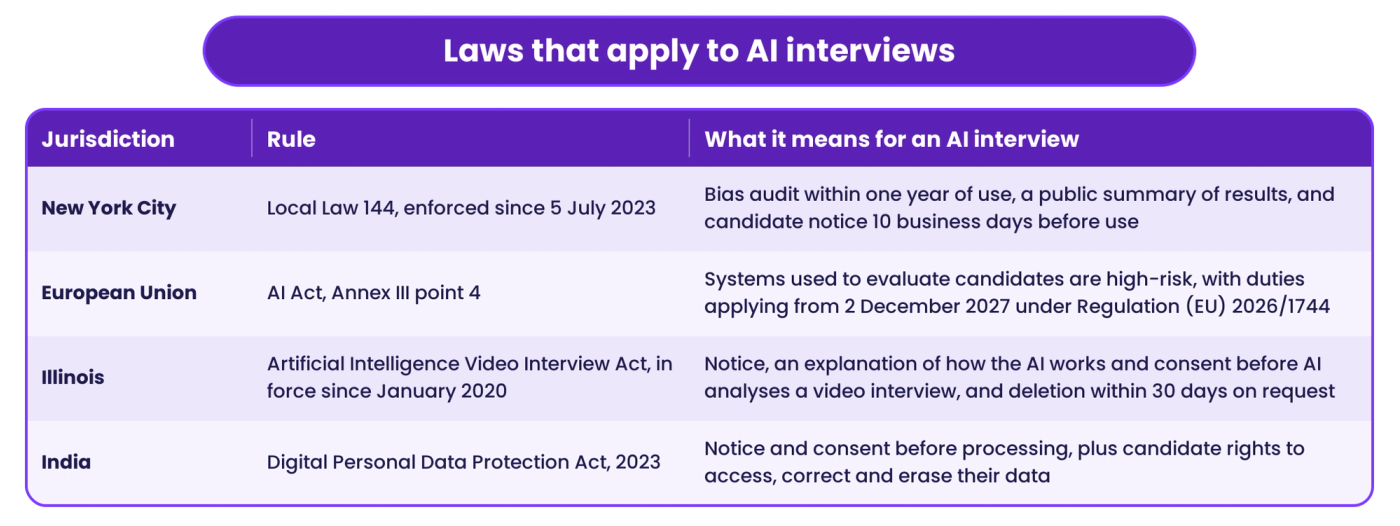
Each rule applies to the employer using the tool, so ask vendors for the documents you need to comply.
The EU AI Act has a second rule that matters for video. Article 5(1)(f) has banned AI that infers emotions from biometric data in the workplace since February 2025, so do not score facial expressions.
New York City's Department of Consumer and Worker Protection publishes guidance on automated employment decision tools, including the audit and notice rules.
In India, PRS Legislative Research lists penalties of up to ₹250 crore under the DPDP Act for failing to protect data against a breach. Recordings and transcripts from AI interviews are personal data, so set retention periods and a deletion process before launch. Our guide to AI hiring laws in India covers the DPDP Act and related rules in more detail. This is not legal advice; confirm your obligations with counsel.
What Should Candidates Expect in an AI Interview?
If you are a candidate, an AI interview feels like a structured phone screen or a chat. Here is what usually happens.
- You usually get an invite with a deadline. You can often take it at a time that suits you, within a deadline.
- You should get a notice about AI and recording. Read it. You can ask how your answers are scored and who sees them.
- The questions are set in advance. The agent may ask for an example if your first answer is short.
- The questions match the job description, so prepare as you would for a recruiter screen.
Three tips help. Answer with specific examples, including numbers where you can. Take the interview somewhere quiet, because background noise hurts transcription. If you need an adjustment, such as more time or a different language, ask before you start.
How to Run AI Interviews Well
Five practices make AI interviews work in a live hiring process.
- Write the rubric with the hiring manager. Agree what a 1, 3 and 5 answer sounds like for each question.
- Keep it short. Six to eight questions cover a first round for most frontline roles.
- Tell candidates up front. Say that AI runs the interview, what is recorded and that a person decides.
- Review a sample by hand. Read 20 transcripts in the first week and check the scores match your judgement.
- Keep a human route open. Offer a callback to anyone who asks, and log those requests.
Where HireBound Fits
In HireBound, AI agents run the interview as part of the hiring workflow. The Screening Agent holds structured conversations over Voice, WhatsApp and Email and scores candidates against the criteria you set. The Evaluation Agent runs an AI telephonic interview round that cross-questions candidates and scores technical skills, communication and culture fit.
Recruiters see a Candidate Match Score broken into Overall, Skills, Experience and Culture Fit, with the transcript and recording on the candidate profile. The Scheduling Agent then books the next round with your team.
The diagram below shows how the agents hand work to each other and to the recruiter.
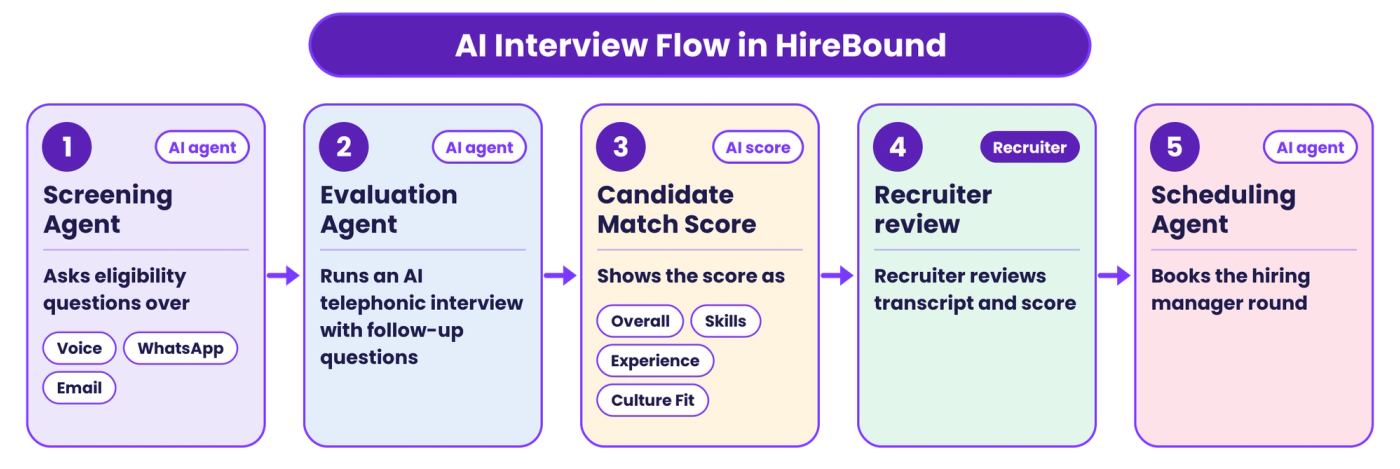
The recruiter stays in the decision seat at every hand-off.
In India, language and channel decide whether candidates take part at all. HireBound's AI voice recruiter runs calls in 14 Indian languages, so a candidate in Lucknow or Coimbatore can answer in Hindi or Tamil. HireBound data shows a 64% WhatsApp response rate in India against about 12% for email, and the platform has powered 8 million+ candidate conversations.
Want to see an AI interview running on one of your live roles? Talk to HireBound →
A Simple Test Before You Roll Out AI Interviews
Take the AI interview yourself as a candidate for your own open role. If the questions match the job, the follow-ups feel fair and you know who reviews your answers, it is ready. If any of those is unclear to you, it will be unclear to candidates too.


