On Demand Interviews: How Async Interviews Fit Modern Hiring
 Tanmey Goswami
 ·Oct 22, 2026·7 min read

Key Takeaways
- 1An on demand interview lets candidates finish a screen at a time they choose within a set window, so the first round needs no booking.
- 2Cronofy found 49% of 6,500 candidates in 2023 and 42% of 12,000 in 2024 had left over slow scheduling, mainly in the US and Europe.
- 3The delay does not disappear, it moves to review, so set a review target and track the hours from submission to score.
- 465% of 3,055 Indian employers plan to add staff in Q4 2026 (ManpowerGroup), and HireBound data shows 64% WhatsApp response against about 12% for email.
- 5Keep live interviews for senior roles and final rounds, and use on demand for first screens where volume and shifts make booking slow.
An on demand interview is an interview that a candidate completes at a time of their choosing within a set window, without a live interviewer. The employer reviews the responses afterwards. The format removes the scheduling step from the first screen, which is a point where some candidates drop out.
This guide covers how on demand interviews work, what they change for recruiting teams, where they fit in the funnel, and how they suit shift workers in India. It is written for talent acquisition leads who run high-volume hiring.
Want a first screen candidates can complete without booking a slot? See how HireBound works →
What Is an On Demand Interview?
An on demand interview gives the candidate control over timing. The invite arrives with a deadline, and the candidate answers the questions when it suits them, in the evening, on a break or at the weekend. Nobody has to be online at the same moment.
The answers can be video, audio, text or a recorded call. The timing defines the format, whatever the medium. The same idea is called an asynchronous interview, and in a one way interview the candidate answers fixed questions with no live exchange.
On demand interviews work best as a first screen. They narrow a large pool before anyone spends time on a live conversation.
How Does an On Demand Interview Differ From a One Way Interview?
The two terms overlap, and many tools offer both. A one way interview describes the format: fixed questions and no live interviewer. An on demand interview describes the timing: the candidate chooses when to answer. Most on demand interviews are one way in format, and most one way interviews are on demand in timing.
The difference matters for how you run it. Format decisions cover the questions, the medium and the scoring. Timing decisions cover the window, the reminders and the review target, which is what this guide covers.
How Is an On Demand Interview Different From a Scheduled One?
A scheduled interview needs two calendars to line up. An on demand interview needs one, and only the reviewer’s. The table compares the steps.
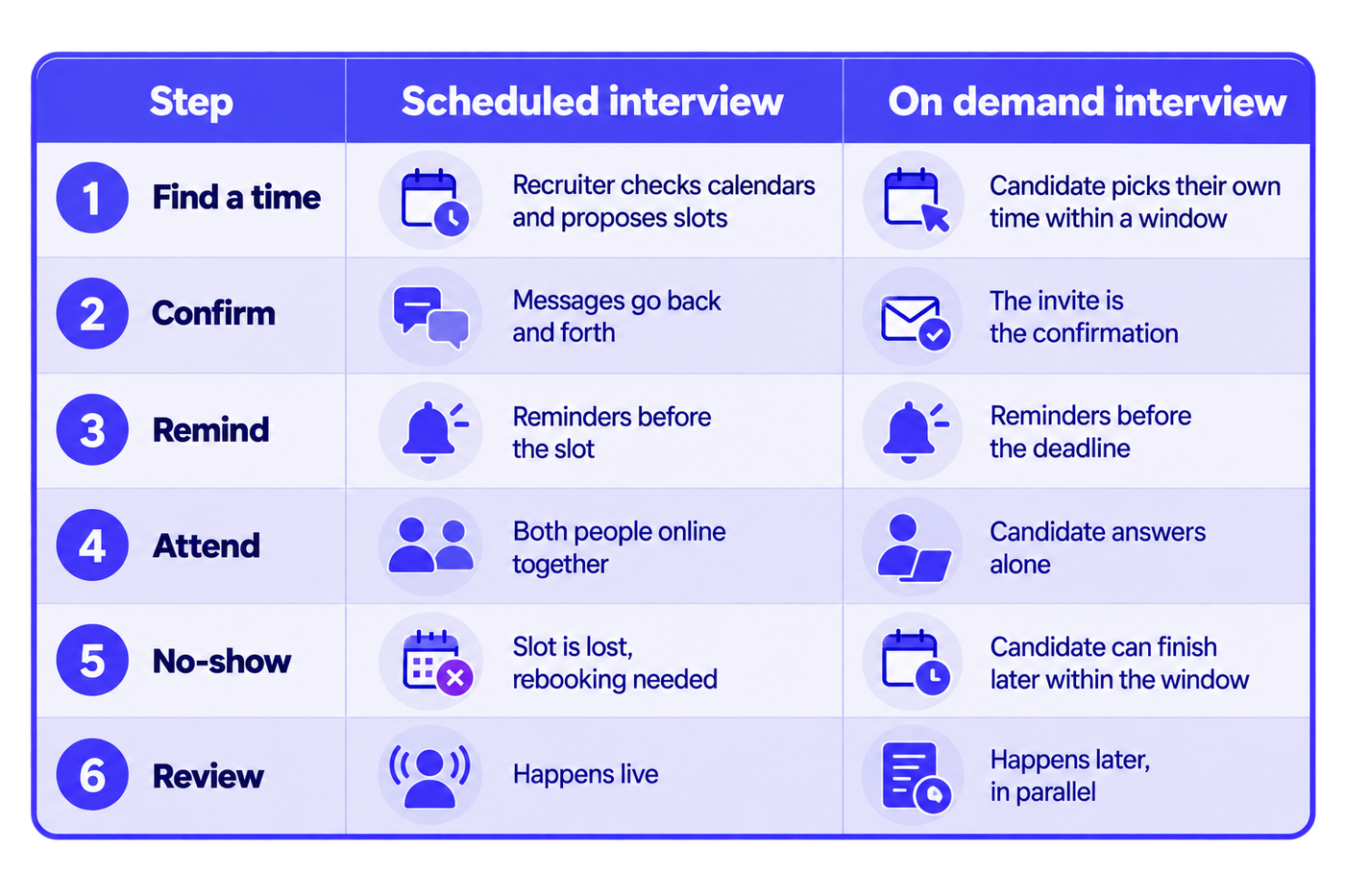
Each removed step is a place where a candidate can drop out or a recruiter can lose time. The first three rows hold the largest saving, because they are where scheduling happens.
Why Does Removing Scheduling Matter?
Candidates leave when the wait gets long. In Cronofy’s Candidate Expectations Report 2023, a survey of 6,500 candidates, 49% said they had left a recruitment process because it took too long to schedule an interview. In its 2024 report, which surveyed 12,000 candidates, the figure was 42% (Cronofy, 2024).
Cronofy is a scheduling software company, and both surveys ran mainly in the US and Europe. Treat the numbers as general evidence, not an Indian benchmark.
The finding explains why teams look at on demand formats. If the scheduling step is where candidates leave, removing it from the first screen removes that exit. Our guide to AI interview scheduling covers how to automate the rounds that still need a slot, and our comparison of self-scheduling and recruiter-scheduled interviews looks at no-show data.
Where Do On Demand Interviews Fit in the Hiring Funnel?
They fit between application and the first live conversation. The candidate applies, completes an on demand screen, and only those who pass book a live round.
The diagram below shows the position.
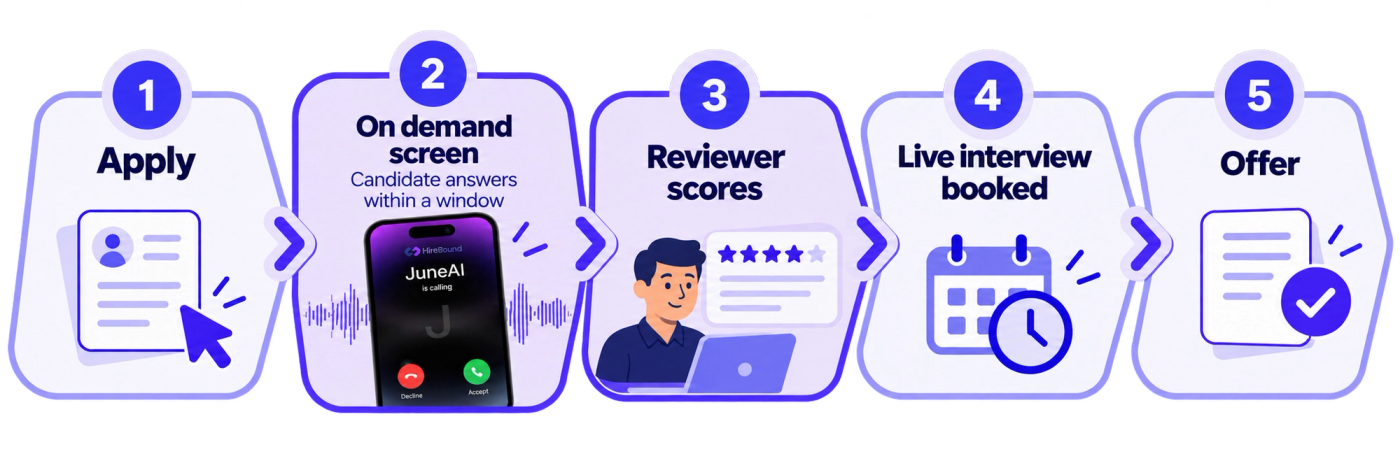
Putting the on demand step first means recruiters spend live time only on candidates who cleared the screen.
How Do You Run On Demand Interviews Well?
Five operating rules keep the format working.
- Set a window and state it. Give candidates a few days, and say the deadline in the invite.
- Say what it involves. Tell them the number of questions, the time needed and the medium.
- Send reminders on the channel they answer. One reminder partway through the window and one near the end is a sensible start.
- Set a review target. Decide how many hours reviewers have to score each batch.
- Keep a human contact. A name and a reply option let candidates ask questions.
Without the review target, the delay moves from scheduling to review. A pool of completed answers that nobody scores is just a new queue.
What Are the Limits of On Demand Interviews?
On demand interviews have clear limits. There is no live follow-up, so a vague answer cannot be probed on the spot. Questions have to be clear enough to stand alone.
Candidate reactions can also be cooler than for live formats. Hiemstra and colleagues found negative fairness perceptions of asynchronous job interviews in studies of 160 panelists and 103 actual applicants (Journal of Personnel Psychology, 2019). The applicants were highly educated, so the finding is a caution and not a verdict on every candidate group.
Three more cases need a different approach:
- Senior and leadership roles, where the first conversation is part of the pitch.
- Candidates without a private space, a device or a stable connection.
- Roles that depend on rapport from the first contact.
For these, keep a live first conversation.
How Do On Demand Interviews Work for Shift Workers in India?
India’s volume makes the format relevant. ManpowerGroup’s Employment Outlook Survey for Q4 2026 covered 3,055 employers in India and put the Net Employment Outlook at 54%. It found that 65% of employers plan to increase staffing between October and December (ManpowerGroup India, September 2026).
Shift and field workers are hard to reach during office hours, and some have only a phone. An on demand screen lets them answer after a shift or on a break. The infographic below shows three typical windows.
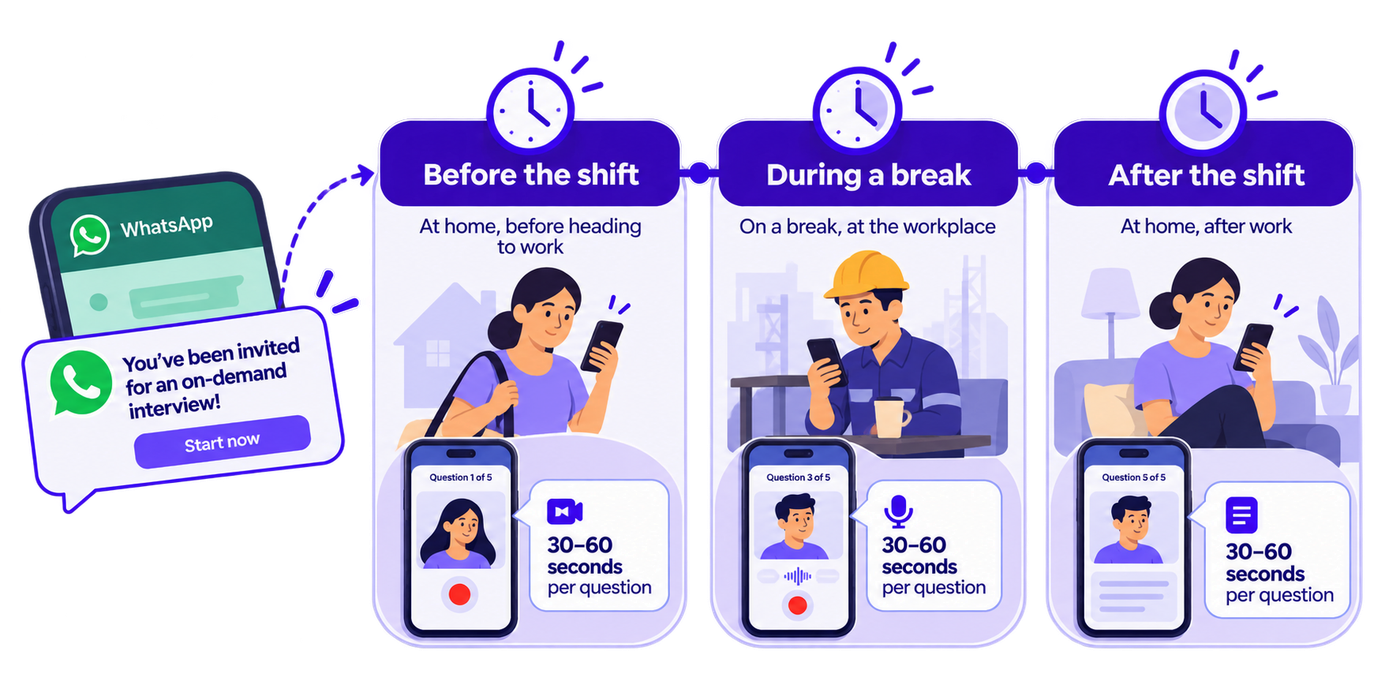
For people who work fixed hours, the window matters as much as the medium.
Channel matters too. HireBound data shows a 64% WhatsApp response rate in India, compared with about 12% for email, so send invites and reminders on WhatsApp. Our guide to WhatsApp recruiting covers opt-in, timing and message design.
Language also affects completion. Candidates may answer more fully in Hindi, Tamil, Telugu or another regional language than in English.
How Do You Keep On Demand and Asynchronous Interviews Fair?
Fairness comes from structure and choice. Ask every candidate the same questions in the same words, and score against written anchors. Sackett, Zhang, Berry and Lievens report a mean validity of .42 for structured interviews and .19 for unstructured ones in the Journal of Applied Psychology (2022).
Offer more than one way to answer, such as video, audio or a voice call. Do not score on appearance, accent or background.
Tell candidates about recording before they start. India’s Digital Personal Data Protection Act, 2023 requires consent, or another use the Act specifically permits, before personal data is processed. The DPDP Rules, 2025 were notified in November 2025, with most obligations phased in over 18 months.
Which Numbers Show Whether It Works?
Track a small set of numbers for the first month, and compare them with your scheduled first screen. The table lists six.
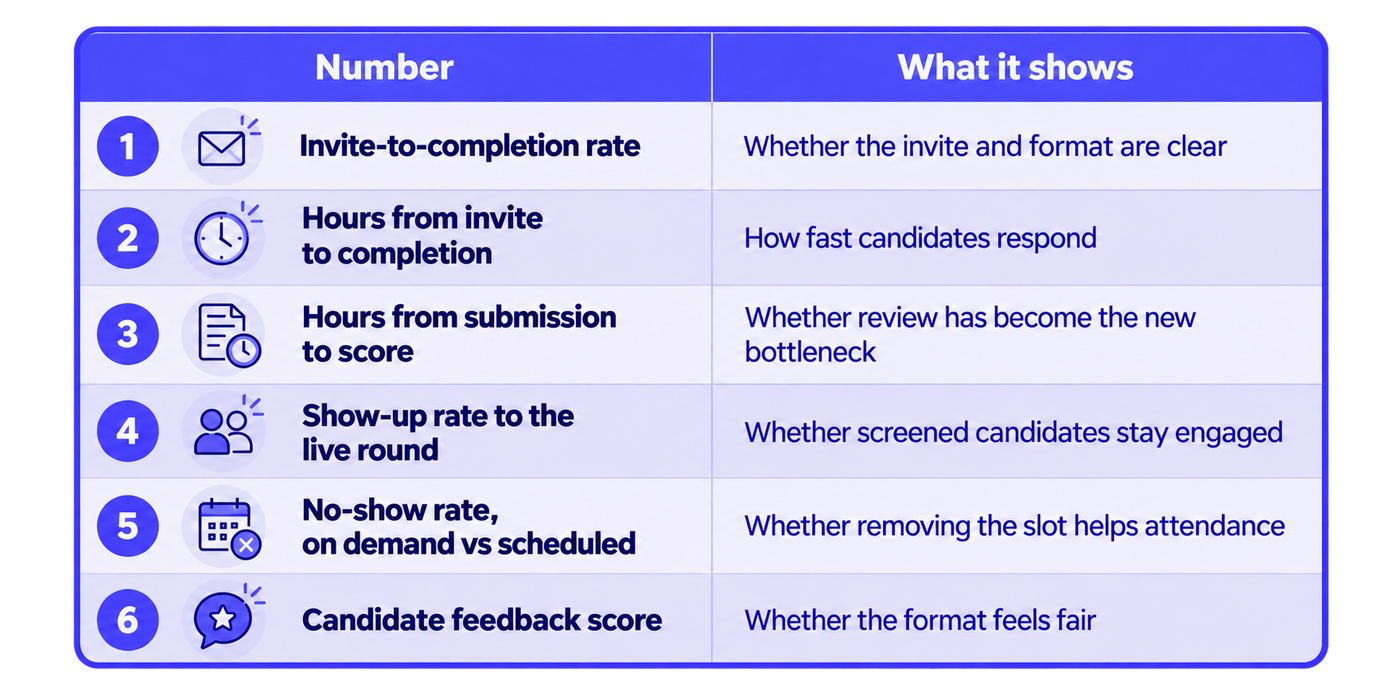
If completion is low, shorten the screen or change the channel. If review time is high, add reviewers or narrow the pool before the screen.
Where Does HireBound Fit?
HireBound’s Screening Agent holds structured, role-specific conversations over Voice, WhatsApp and Email, in multiple languages, and scores them against your criteria. WhatsApp conversations are asynchronous and two-way, so candidates reply when they can. Voice AI works in 14 Indian languages.
After the screen, the Scheduling Agent collects availability and books the live round with your team, with automatic reminders and no email back-and-forth. A recruiter reviews the shortlist and makes the hiring decision.
Want an on demand first screen that books the live round for you? Talk to HireBound about screening →
Conclusion: A Decision Rule for On Demand Interviews
Use an on demand interview for the first screen when many candidates apply for the same role and scheduling slows you down. Set a window, ask structured questions, score against anchors, and track review time so the delay does not move.
Apply one rule. If most of your recruiters’ week goes on booking and chasing first-round calls, weigh an on demand screen most heavily. If most of it goes on senior searches, keep the first conversation live.


