Interview Video Questions That Improve Screening
 Devansh Dhawan
 ·Oct 21, 2026·9 min read

Key Takeaways
- 1Good video questions test one competency, take one to two minutes to answer and go to every candidate unchanged, so scores stay comparable.
- 2Structured interviews have a mean validity of .42 against .19 for unstructured ones (Sackett et al., 2022), which supports fixed questions.
- 3Keep a first screen to three to five questions, which holds candidate effort near 15 minutes and protects completion on mobile.
- 4Write and test questions in the candidate’s language, because candidates often answer better in a regional language, and HireBound’s Voice AI covers 14.
- 5Pilot each question set on about 20 candidates, and drop any question that nearly everyone scores the same.
Interview video questions are the prompts a candidate answers on camera in a recorded, asynchronous screen. Good ones are tied to the job, answerable in one to two minutes, and asked in the same words to every candidate. They are scored against one rubric, so reviewers compare like with like.
This guide covers how to write them, 24 sample questions for frontline, sales and corporate roles, how to score the answers, and how to adapt questions for India. It is written for recruiters who screen many candidates for the same role.
Want the same questions asked and scored for every candidate? See how HireBound works →
What Makes a Good Interview Video Question?
A good video question gives a candidate one clear thing to talk about. Five rules cover most of it.
- One competency per question. If a question tests teamwork and problem solving at once, you cannot score either cleanly.
- Tied to the job. Ask about situations the role will actually involve.
- Answerable in one to two minutes. A longer answer wears out the candidate and the reviewer.
- No trick or trivia. The screen should reveal how a person works, not whether they can guess your intent.
- The same words for everyone. Changing the wording changes the test.
Fixed wording has evidence behind it. Sackett, Zhang, Berry and Lievens report a mean validity of .42 for structured interviews and .19 for unstructured ones in the Journal of Applied Psychology (Sackett et al., 2022). Asking the same job-related questions of everyone is what makes an interview structured.
The diagram below shows the parts of a well-built question.
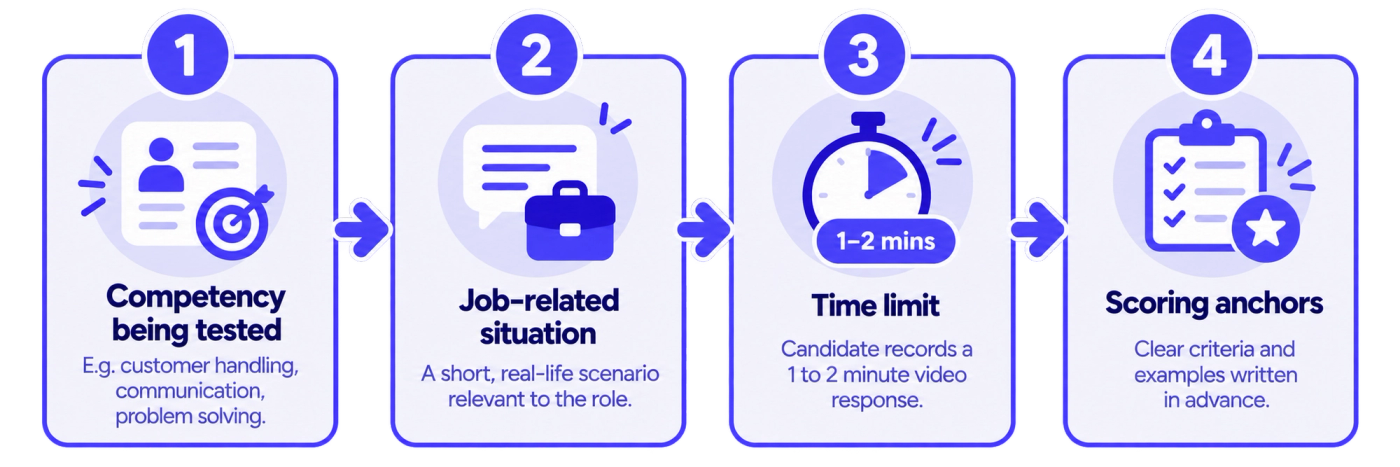
A question with all four parts can be scored the same way by two different reviewers.
How Many Video Interview Questions Should a Screen Include?
Three to five video interview questions is the practical range for a first screen. That keeps candidate effort near 15 minutes, which candidates can finish in one sitting on a phone.
More questions add reviewer time and may add little new information. If you need to test more than five competencies, split the screen across two stages and shortlist between them.
Match the number to the role. Entry-level roles may need three questions, because the screen only has to confirm basics and communication. A role with several required skills may need five.
Which Types of Questions Work Best?
Four types cover almost every first screen. Pick one or two types per question set and keep the set short.
- Behavioural. The candidate describes something they did. “Tell us about a time you handled an upset customer.”
- Situational. The candidate says what they would do. “A customer asks for a refund you cannot give. What do you say?”
- Role knowledge. The candidate shows a basic skill. “Explain how you would count stock at the end of a shift.”
- Motivation and fit. The candidate explains why this role. “What would make you stay in this job for two years?”
Behavioural questions tend to suit candidates with work history. Situational questions tend to suit freshers, because they do not need past experience.
Which Interview Video Questions Work for Frontline and BPO Roles?
Frontline and BPO screens test reliability, communication and basic problem solving. Keep the wording plain, and avoid terms a candidate may not know.
- Tell us about a time you had to reach work on time despite a problem. What did you do?
- A customer is angry and talking quickly. How do you respond?
- You see a coworker making an error that could affect a customer. What do you do?
- Explain, in your own words, what good customer service means to you.
- You have three tasks due at once. How do you decide the order?
- Why are you interested in working shifts in this role?
- Describe a time you learned something new quickly at work or school.
- What would you do if you did not understand an instruction from a supervisor?
These suit retail, logistics, hospitality and voice processes. Add one language question if the role needs a specific language.
The infographic below shows how a five-question frontline screen can cover five competencies, one question each.
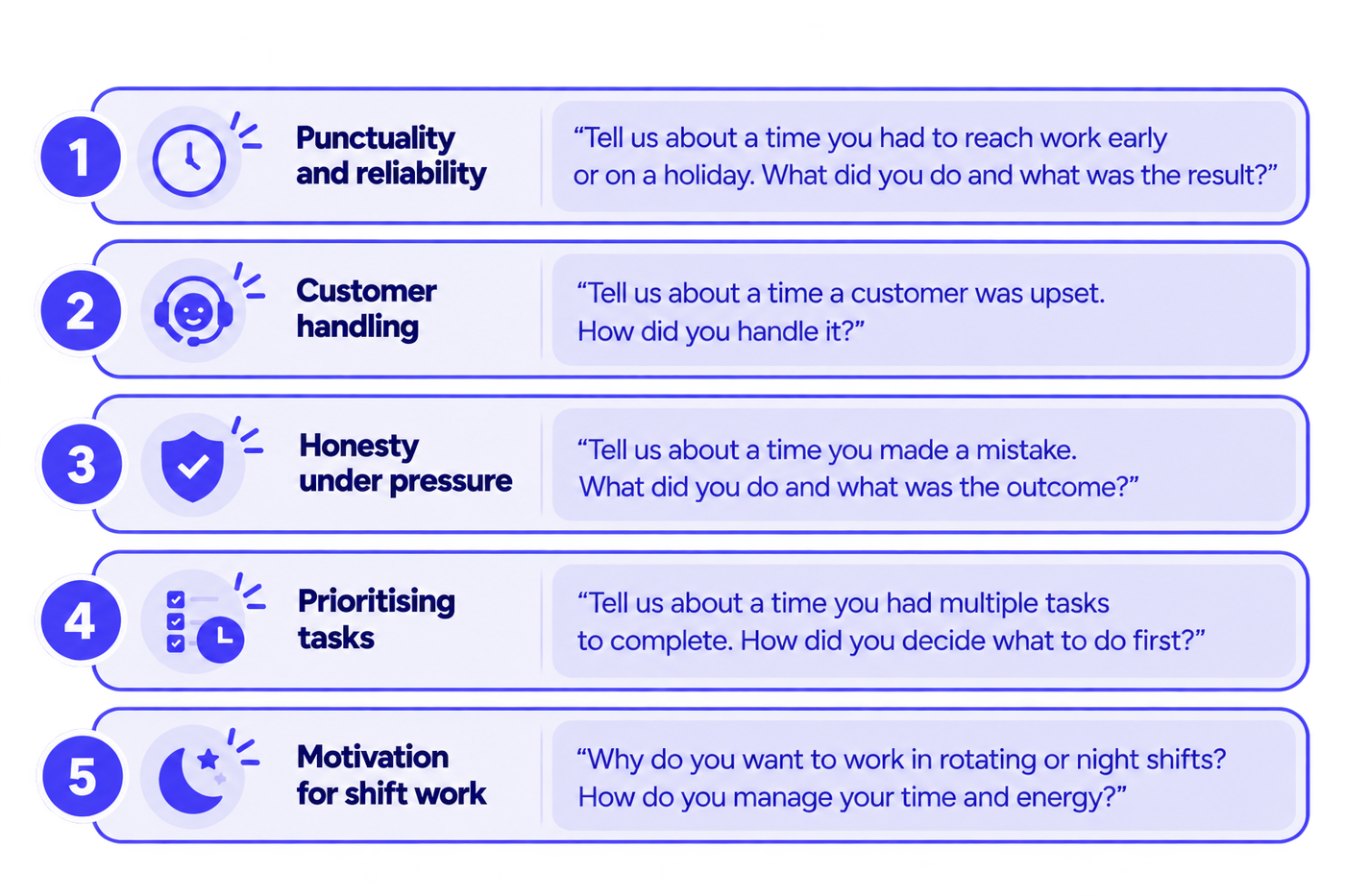
One question per competency keeps the screen short and each score easy to read.
Which Interview Video Questions Work for Sales and Customer-Facing Roles?
Sales and customer-facing screens look for persuasion, resilience and listening. A reviewer should hear how the candidate structures a message.
- Sell us a product you use every day in 60 seconds.
- Tell us about a time you lost a sale or a customer. What did you learn?
- A prospect says your price is too high. How do you respond?
- How do you prepare before calling someone for the first time?
- Describe a time you hit a hard target. What did you do differently?
- A customer says they will think about it. What do you say next?
- How do you handle a day when most calls end in a no?
- Tell us about a time you built trust with a difficult person.
Ask one pitch question and one resilience question, and let the rest of the set test the role’s specific demands.
Which Interview Video Questions Work for Corporate and Technical Roles?
For corporate and technical roles, test judgment, ownership and clear explanation. Ask for reasoning, not recall.
- Describe a project you owned from start to finish. What was your role?
- Tell us about a time you disagreed with a decision. What did you do?
- Explain a technical idea from your work to someone with no background.
- You find a mistake in work you already delivered. What happens next?
- How do you decide what to do first when priorities clash?
- Describe a time you had to learn a new tool or skill under time pressure.
- What kind of feedback has helped you most, and what did you change?
- What would you want to achieve in your first 90 days in this role?
Pair a corporate set with a short skills test if the role needs hands-on proof. Our guide to skills-based hiring covers how to judge what someone can do.
What Should You Avoid Asking?
Keep every question tied to the job. Do not ask about caste, religion, marital status, pregnancy, family plans, age or health unless a lawful, job-related reason exists. These questions add legal risk and tell you nothing about ability.
Also avoid questions that reward confidence over content. A fluent speaker can talk about nothing for two minutes, and a nervous candidate can give a strong answer in few words.
Collect only the data you need. India’s Digital Personal Data Protection Act, 2023 requires consent, or another use the Act specifically permits, before personal data is processed. Tell candidates when you are recording and why.
How Should You Brief Candidates Before They Record?
A clear brief helps candidates finish and answer well. Candidates who know what to expect can spend their effort on the answer and not on guessing the rules.
The invite should state four things: how many questions there are, how long each answer can be, whether a retake is allowed, and the deadline. Add one line on what happens next.
Here is a sample WhatsApp invite. Replace the bracketed items.
- “Hi [Name], thank you for applying for [role] at [Company]. The next step is a short recorded screen: four questions, about 15 minutes, and you can answer any time before [date]. You get one retake per question. Reply HELP if you want to ask something. We will message you by [date] with the result.”
A practice question before the real ones removes the fear of the first recording. Make it easy, such as “Tell us your name and where you are from.”
How Do You Keep Video Screens Accessible?
Accessibility decides who can finish the screen at all. Plan for it before you invite the first candidate.
- Offer an alternative format. A voice call or audio-only answer helps candidates without a camera or a private space.
- Allow extra time on request. Some candidates need it, and a rule that bars them tells you nothing about the job.
- Add captions or transcripts for reviewers so that accent or audio quality does not drive the score.
- Test the screen on a basic phone with a weak connection before you launch.
Tell candidates how to ask for an adjustment, and name a person who will answer.
How Do You Score Video Answers?
Score each answer against written anchors, and score before you compare candidates. Use a five-point scale with a description for a weak, an adequate and a strong answer.
The table turns four common competencies into scoring cues.
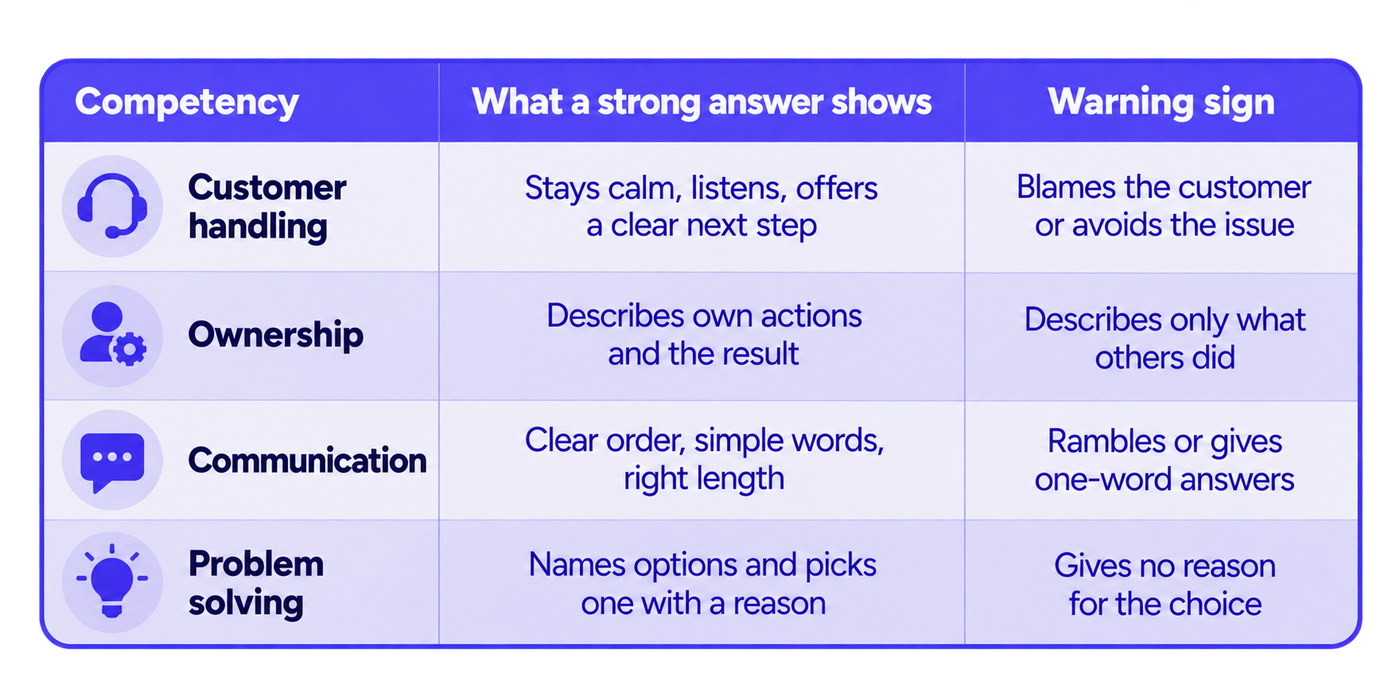
Two reviewers scoring independently catch most inconsistency. Our structured interview scorecard template shows how to build and calibrate anchors.
Do not score on appearance, accent or background. None of these is a job-related criterion.
How Do You Write Video Questions for Indian Languages?
Write the question in the language the candidate will answer in, and test it with a native speaker. A literal translation can sound stiff or change the meaning.
Use short sentences and everyday words. Avoid idioms such as “think outside the box”, which may not translate. If the role involves a second language, ask one question in that language and score it separately.
Allow candidates to answer in the language they are most comfortable in, unless the role needs a specific one. HireBound’s Voice AI works in 14 Indian languages, which helps when a candidate would rather talk than type.
Offer a lighter option beside video. HireBound data shows a 64% WhatsApp response rate in India, compared with about 12% for email. A voice note or a short call keeps candidates in when a video upload fails on weak mobile data.
How Do You Test and Improve Your Questions?
Pilot every new question set before you use it at scale. Run it on about 20 candidates and look at four numbers.
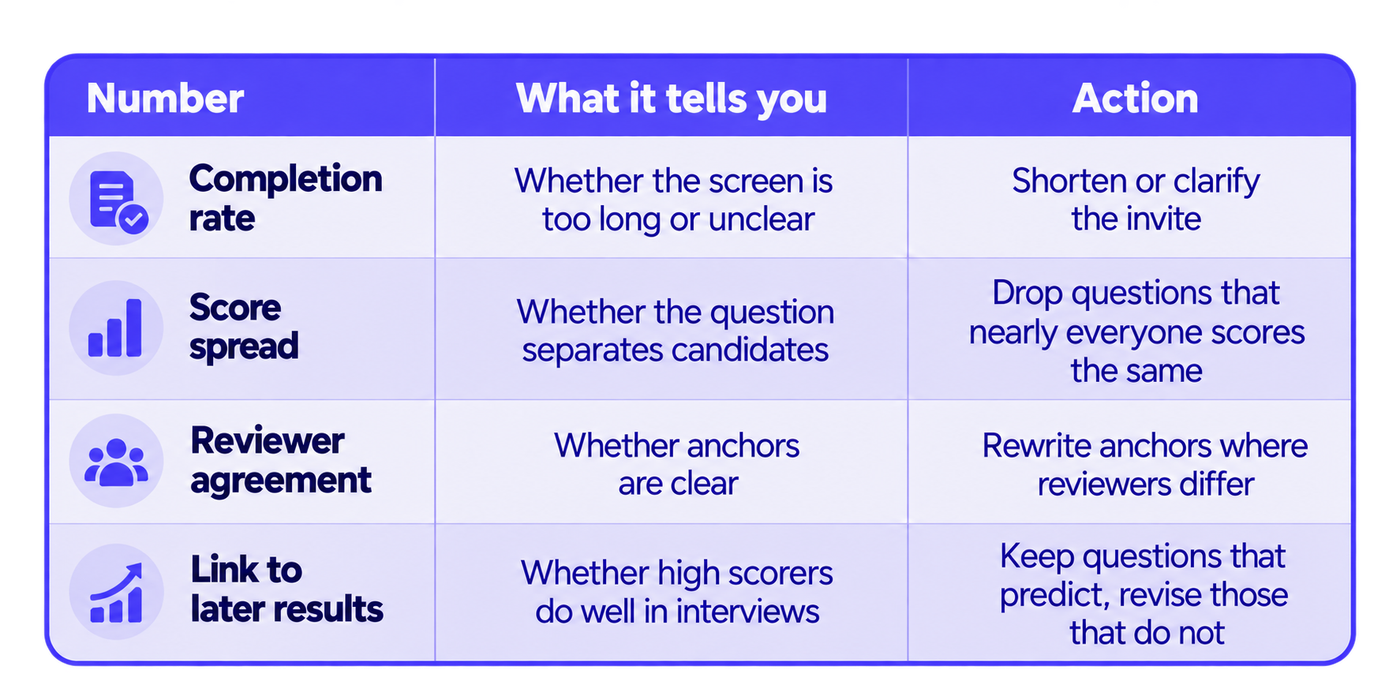
Review the questions every quarter. A question that worked in January may have been shared online by June.
Where Does HireBound Fit?
HireBound’s Screening Agent asks the same role-specific questions to every candidate over Voice, WhatsApp and Email, in multiple languages. It asks adaptive follow-ups, scores answers against the criteria you set, and keeps the recording and transcript with the candidate record. A recruiter reviews the shortlist and makes the hiring decision.
HireBound has powered 8 million+ candidate conversations, and 60+ recruiting teams in India run on the platform.
Want your question set run and scored for every candidate? Talk to HireBound about screening →
Conclusion: A Decision Rule for Video Questions
Start with three to five job-related questions, write the scoring anchors first, and ask every candidate the same words. Pilot the set, keep what separates candidates, and offer a lighter way to answer.
Apply one rule. If your recruiters repeat the same first-round questions across many candidates, move those questions into a structured, scored screen. If the role depends on rapport, keep the first conversation live.


