Employee Alumni Network Sourcing: How to Rehire Former Employees
 Suvam Moitra
 ·Oct 19, 2026·9 min read

Key Takeaways
- 1Rehired managers matched other hires in year one, then improved less and left more often (Journal of Management, 2020), so screen alumni normally.
- 2Aon’s 2025-26 India survey puts attrition at 16.2% in 2025, so a 1,000-person company adds roughly 160 potential alumni a year.
- 3Ask why a former employee left first, because boomerang managers who left again generally cited the same reasons as before.
- 4HireBound data shows a 64% WhatsApp response rate in India against about 12% for email, so reach alumni on WhatsApp first.
- 5Collect alumni opt-in at exit, because India’s Digital Personal Data Protection Act, 2023 requires consent or another use the Act permits.
Employee alumni network sourcing is the practice of hiring from your own former employees. You keep a list of people who left on good terms, stay in light contact, and invite the right ones back when a role opens. They already know your culture, which shortens the path to a productive start.
This guide covers who to invite, how to write the first message without awkwardness, what research says about rehires, and how consent works in India. It is written for talent acquisition leads and HR heads at companies that hire regularly.
Want alumni outreach to run on the channels candidates answer? See how HireBound works →
What Is an Employee Alumni Network?
An employee alumni network, sometimes called a corporate alumni network, is a managed list of former employees who have agreed to hear from you. It usually includes people who left in good standing, plus former interns and long-term contractors. A rehired person is often called a boomerang employee.
The network is a talent pool with a policy attached: who qualifies, who contacts them, how often, and what happens when someone says yes.
The diagram below shows the cycle from exit to rehire.
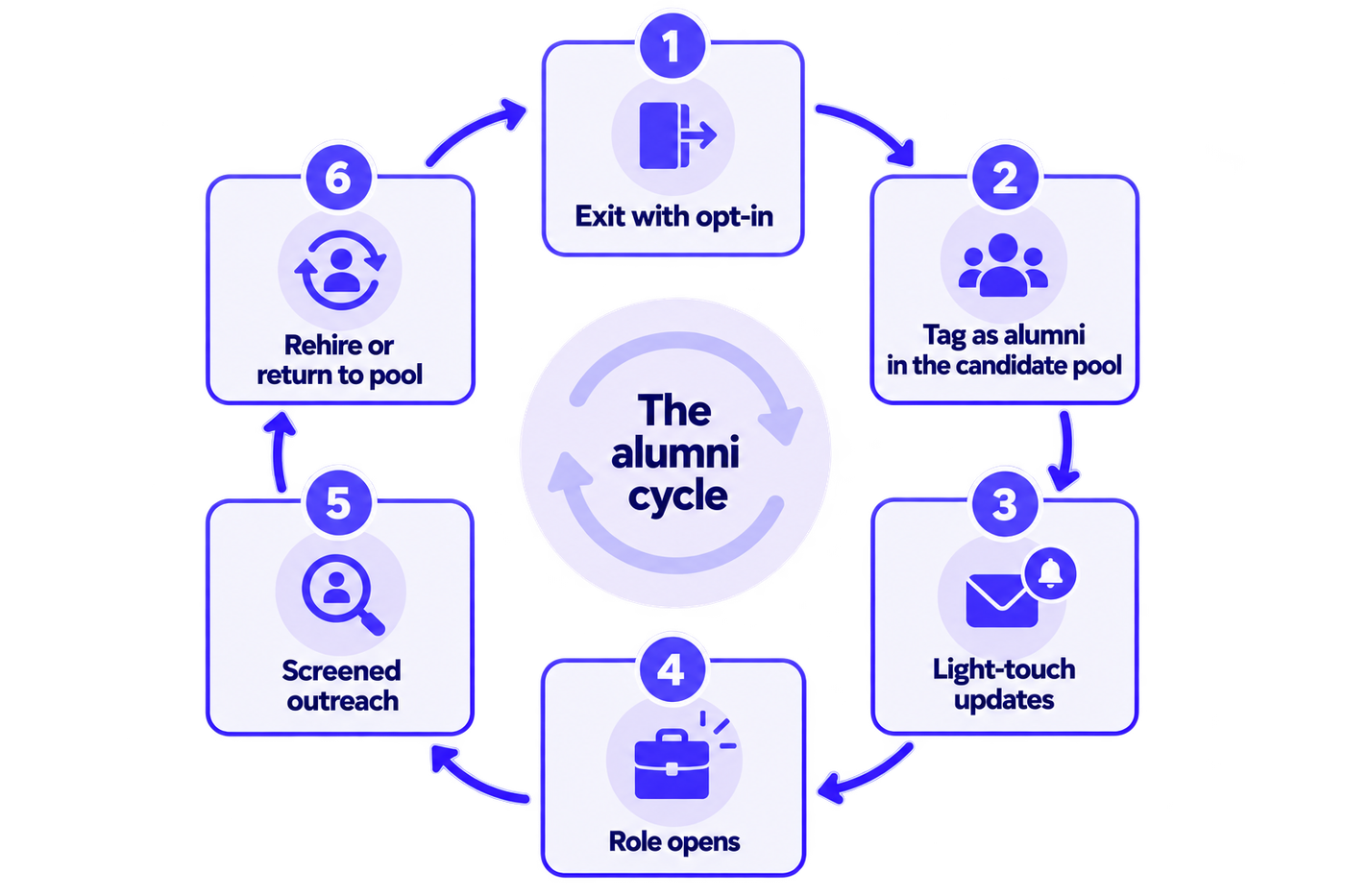
Each stage is small. The value comes from running all six every time someone leaves.
Why Source From Former Employees in India?
Attrition keeps the pool growing. Aon’s Annual Salary Increase and Turnover Survey 2025-26 India covered more than 1,400 organisations across 45 industries. It found attrition of 16.2% in 2025, down from 17.7% in 2024 and 18.7% in 2023 (Aon, February 2026).
Here is an illustrative example with an assumed starting point. A company with 1,000 employees whose attrition matches the survey average loses about 162 people a year. After three years of leavers, and ignoring people who never wanted to return, that is roughly 480 former employees. Your own figure will differ, so use your HR records.
Three practical benefits follow.
- A shorter search. You start with people you already know, so sourcing time falls.
- Faster ramp-up. A returning person needs less onboarding on culture, tools and people.
- A better read on fit. Their performance history is on file, which is more evidence than a CV gives you.
Long notice periods in India add a fourth point. A returning employee may need weeks to join, so start the conversation early.
What Does the Research Say About Rehiring Boomerang Employees?
The strongest evidence comes from a Journal of Management study in 2020 by Arnold, Van Iddekinge, Campion and Bauer. It tracked managers at a large retail organisation: 1,318 rehires, 20,850 external hires and 8,546 internal promotions (Journal of Management, 2020).
Rehired managers performed about as well as other hires in their first year, and their performance then tended to stay flat. Internal and external hires improved more over time. Internal and external hires were also less likely to leave than rehires, and rehires who left again generally gave the same reasons as the first time.
The table turns those findings into process rules. It comes from one retail organisation, so treat it as direction and not as a universal rate.
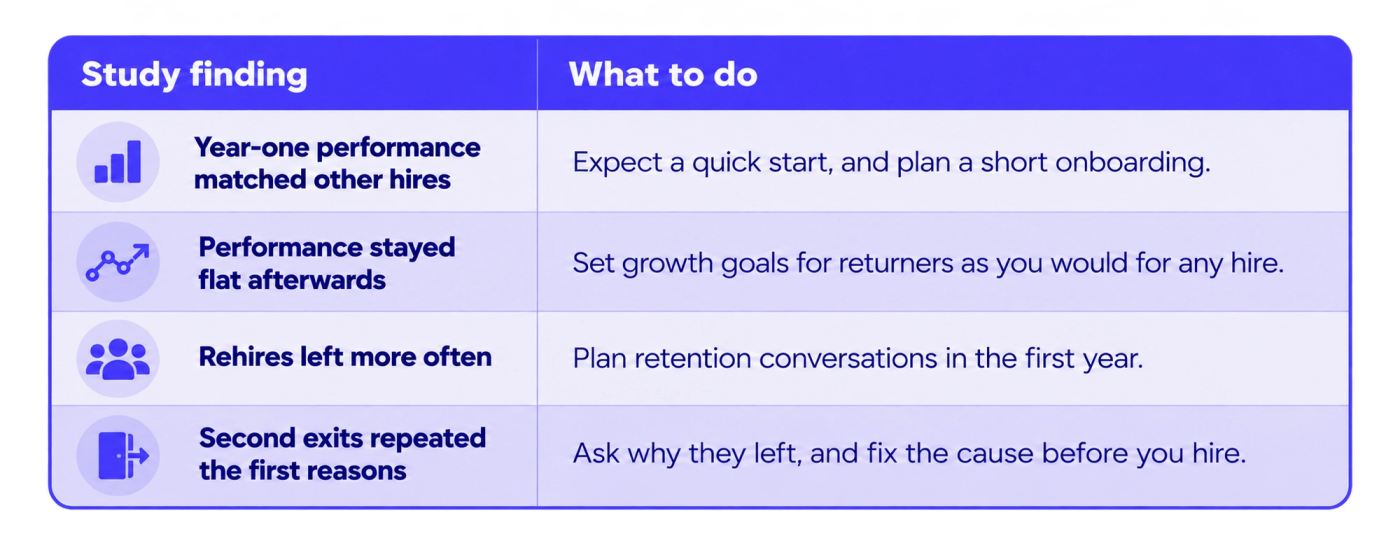
The study supports alumni hiring with a screen in place, because a returning person is not automatically a safer hire.
Who Should You Invite Back, and Who Should You Not?
Write the rule down before you contact anyone. A clear policy protects you from favouritism and from awkward one-off decisions.
Invite people who meet these conditions:
- They left in good standing, with no open disciplinary or legal matter.
- Their last performance rating was strong, because that is the best evidence you hold.
- The role they would fill matches skills they have today, not only the ones they had when they left.
- Their former manager would work with them again.
Do not invite people who left over conduct, who are in a notice or non-compete dispute, or whose exit is still being handled. Do not promise a job. An invitation is a conversation, and the usual screen and interview follow.
Treat every returner as a hire. Our guide to employee referral programs covers a related channel, and the same fairness checks apply to both.
How Do You Build an Employee Alumni Network Step by Step?
Start small and run it as a process. Six steps are enough for a first year.
- Ask for opt-in at exit. In the exit conversation, ask whether the person would like to hear about openings, on which channel, and for how long. Record the answer.
- Tag alumni in your candidate pool. Keep one record per person, with the fields listed below.
- Add a light touch. Send one useful update a quarter, such as a company milestone or a relevant opening. Avoid weekly messages.
- Match alumni to new roles. When a role opens, search the alumni tag before external sourcing.
- Contact with context. Ask the former manager or a former peer to make the first approach where you can.
- Close the loop. If the person declines, thank them and keep them in the pool with their updated preference.
Each alumni record should hold:
- Role, team and dates of service.
- Skills, plus any new skills they have shared since leaving.
- Last manager and last performance rating.
- Reason for leaving, in the person’s own words where you have them.
- Consent status, preferred channel and preferred language.
- Date of last contact and what was said.
Our guide to candidate relationship management explains how to keep these records useful over time, and the same habits apply to alumni.
How Do You Approach Former Employees Without Awkwardness?
Keep the first message short, specific and easy to decline. Awkwardness comes from vague flattery and pressure, so remove both.
A good first message has five parts: who is writing, what has changed at the company, the specific role, a no-pressure ask, and an easy way to reply. The infographic below shows them in order.
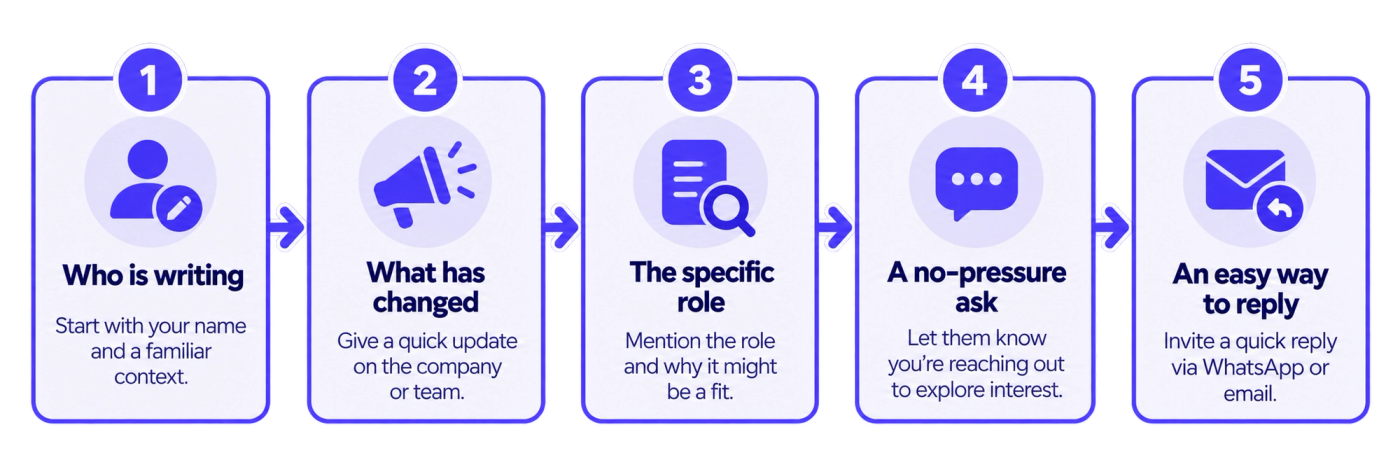
Short messages get answered, and the five parts fit in a few lines.
Here is a sample for WhatsApp. Replace the bracketed items with real details.
- “Hi [Name], this is [Recruiter] from [Company]. We have opened a [role] role in [team], where [one real change since they left]. Your work on [project] came to mind. Would you be open to a 15-minute chat this week? A no is completely fine.”
Avoid lines such as “we miss you” or “the door is always open”. They are generic and add pressure without information.
Where you can, have the former manager send the first note. A familiar name gets a reply faster than a recruiter’s message from an unknown number.
If the person says no, do not ask twice for the same role. Note their reason and any change in timing, then follow up when something new opens.
How Do You Handle Pay and Fairness When Alumni Return?
Returners often ask for more than their old pay, and current peers may earn less. Set the offer from your pay band for the role and not from the person’s old salary, and be ready to explain the logic to both sides.
Recognise past service only where your policy allows it. Tell the team about a returning colleague the way you would announce any new joiner. Avoid fast-track promotions that current employees would read as unfair, because one visible exception can undo the trust the programme depends on.
A written rule helps. Decide in advance whether returners keep their earlier tenure for leave and benefits, and apply the same rule to everyone.
What Do Data Protection Rules Mean for Alumni Outreach?
Former employees are people whose data you hold for a different original purpose. Using it to approach them about a new job needs a clear basis.
India’s Digital Personal Data Protection Act, 2023 requires consent, or another use the Act specifically permits, before personal data is processed. The Ministry of Electronics and Information Technology notified the DPDP Rules, 2025 on 13 November 2025, with most obligations phased in over 18 months.
The simplest route is the opt-in at exit. Record what the person agreed to, the channel they chose, and the date. Honour withdrawals quickly, and delete or archive records you no longer have a reason to hold.
Check your policy with your legal team, because contracts and sector rules vary.
Which Channels Work Best for Alumni Outreach in India?
Reach people where they already reply. HireBound data shows a 64% WhatsApp response rate in India, compared with about 12% for email. Our guide to WhatsApp recruiting covers opt-in, timing and message design.
The table pairs common alumni messages with the channel that usually suits them.
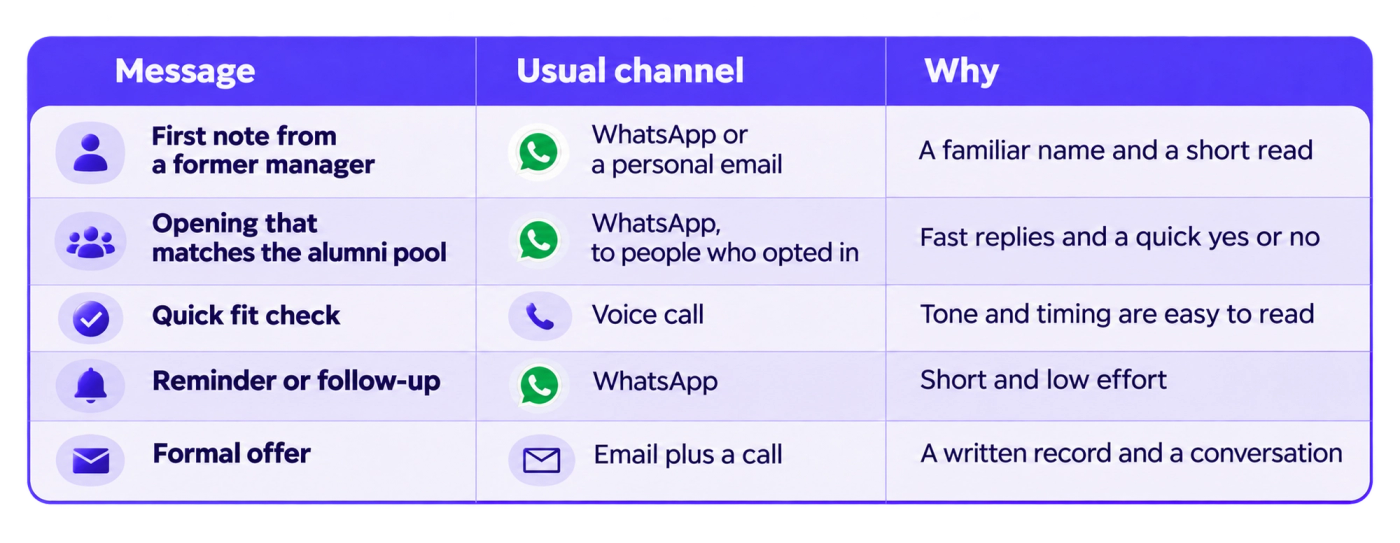
HireBound’s Voice AI works in 14 Indian languages, which helps when a former colleague in another city prefers a regional language. Pick the channel the person chose at exit when you have it.
How Do You Measure an Alumni Hiring Programme?
Track a few numbers each quarter, and compare them with your external hires.
- Alumni in the pool: the number of opted-in former employees.
- Response rate: replies to first messages, by channel.
- Alumni hires: the number and share of all hires.
- Time to hire: days from contact to accepted offer, against external hires.
- Retention: how many returners remain after 12 months.
Retention matters most, because the research shows rehires leave more often than other hires. If your returners stay as long as external hires, the programme is working.
When Does Alumni Hiring Not Make Sense?
Alumni sourcing suits some situations and not others.
- Fast-changing roles. If the skills have moved on since the person left, the benefit of familiarity shrinks.
- A culture you are changing. Bringing back old habits can slow a reset.
- Small teams with few leavers. If you lose three people a year, a managed programme costs more than it returns. A simple list is enough.
- Roles that need fresh ideas from outside. A new perspective can matter more than speed.
Alumni network recruiting works best as one channel among several, next to passive candidate sourcing and referrals.
Where HireBound Fits
HireBound’s AI Discovery searches your internal candidate pool before external sources, and Omnichannel Outreach contacts people on WhatsApp, voice, SMS and email, in multiple languages. Once your alumni records sit in the pool, an agent can match them to a new role brief and start a short, structured conversation. A recruiter reviews the shortlist and makes the hiring decision.
HireBound has powered 8 million+ candidate conversations, and 60+ recruiting teams in India run on the platform. Recruiters using HireBound handle 3× more candidates per day than with a manual process.
Want to bring alumni back faster? Talk to HireBound about your alumni pool →
Conclusion: A Decision Rule for Alumni Hiring
Start with a written policy, an opt-in at exit and a tagged pool. Invite back people whose past performance was strong, ask why they left, and run the usual screen.
Apply one rule. If you lose more than a handful of good people a year and often hire for roles they could fill, build a managed alumni programme. If you lose only a few, keep a simple list and contact people one at a time.


