One Way Interviews Explained for Recruiting Teams
 Devansh Dhawan
 ·Oct 21, 2026·7 min read

Key Takeaways
- 1A one way interview has candidates answer fixed questions on their own time while recruiters review later, which removes scheduling from the first screen.
- 2Structured interviews have a mean validity of .42 against .19 for unstructured ones (Sackett et al., 2022), so consistent questions and scoring matter most.
- 3Applicants rated asynchronous interviews negatively on fairness in two studies of 160 panelists and 103 applicants (Hiemstra et al., 2019), so explain the format clearly.
- 4HireBound data shows a 64% WhatsApp response rate in India against about 12% for email, so offer a voice or WhatsApp option beside video.
- 5Use one way interviews for high-volume first screens, and keep live interviews for senior roles, panels and any conversation that sells the job.
A one way interview is a screening format in which a candidate answers a fixed set of questions on their own time. The answers can be video, audio or text, and no interviewer is present. The recruiter reviews them later. It is also called an asynchronous interview, an on-demand interview or a pre-recorded interview.
This guide explains how the format works, what research says about it, how to score it, and where it fits in India. It is written for recruiting leads and TA heads who screen many candidates for each role.
Want screening that runs on the channels candidates answer? See how HireBound works →
What Is a One Way Interview?
A one way interview replaces the first live conversation with a set of questions the candidate answers alone. The candidate gets a link or a message, reads or hears each question, and replies within a deadline. Nobody is on the other end at that moment.
Three terms describe the same idea from different angles. “One way” describes the direction of the conversation. “Asynchronous” describes the timing, because the two sides are not online together. “On demand” describes the candidate’s control over when they answer, so a team may call the format an on demand interview.
The format is a first screen. It narrows a large pool to a shortlist that earns a live conversation.
The diagram below shows how the three terms relate to a live interview.
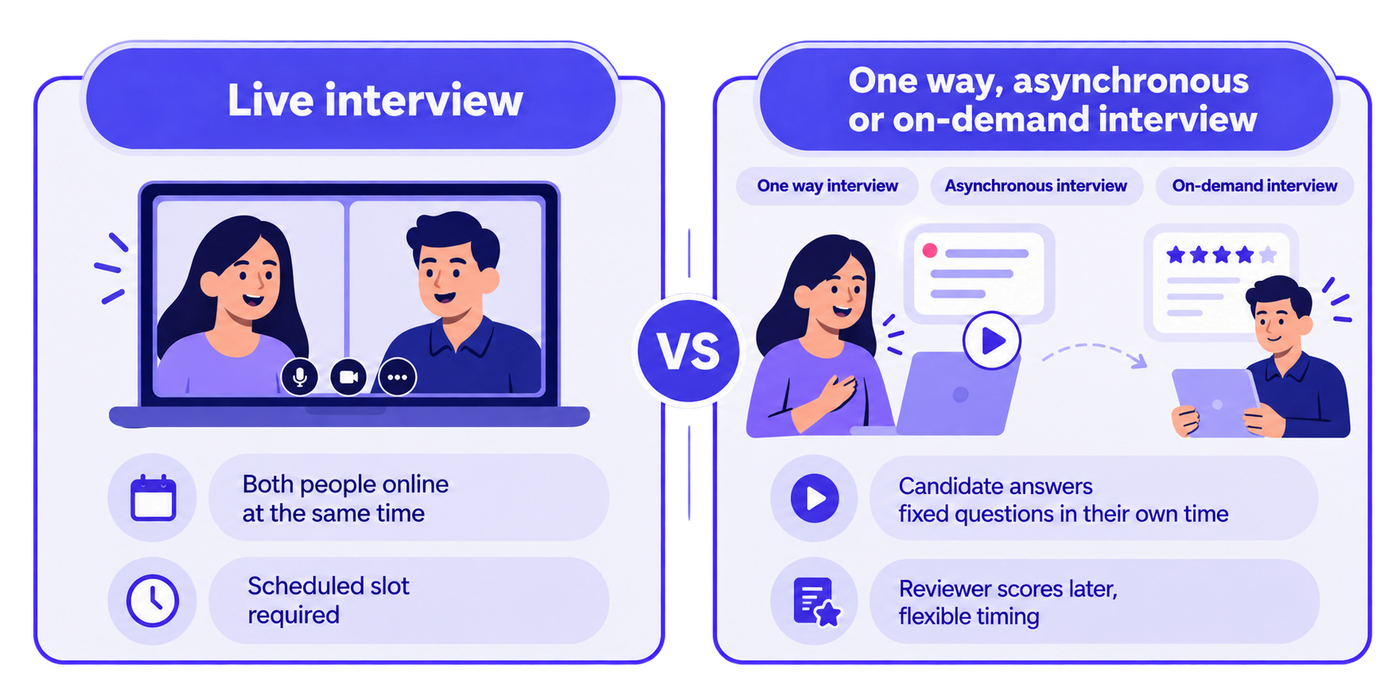
The names differ, but the mechanism is the same: fixed questions, answers on the candidate’s schedule, review later.
How Does a One Way Interview Work?
A one way interview runs in six steps. Each step is a place where you can lose candidates or lose consistency, so set them up before the first invite.
- Set the questions and the criteria. Write three to five questions that map to the role, and decide in advance what a strong answer looks like.
- Invite the candidate. Send a link or message on the channel they answer, with a deadline and an estimate of the time needed.
- The candidate answers. They see each question, may get a short preparation time, and respond. Some formats allow one retake.
- The system stores the answers. Recordings or transcripts sit with the candidate record.
- Reviewers score. They rate each answer against the same rubric, ideally before they see anyone else’s score.
- You decide who progresses. Candidates above your threshold move to a live round.
Reviewers can work through answers whenever they have time, in any order, and in parallel. That is the main efficiency gain over a phone screen.
How Does It Compare With a Live Interview or a Phone Screen?
A one way interview trades conversation for speed and consistency. The table sets the three first-screen formats side by side.
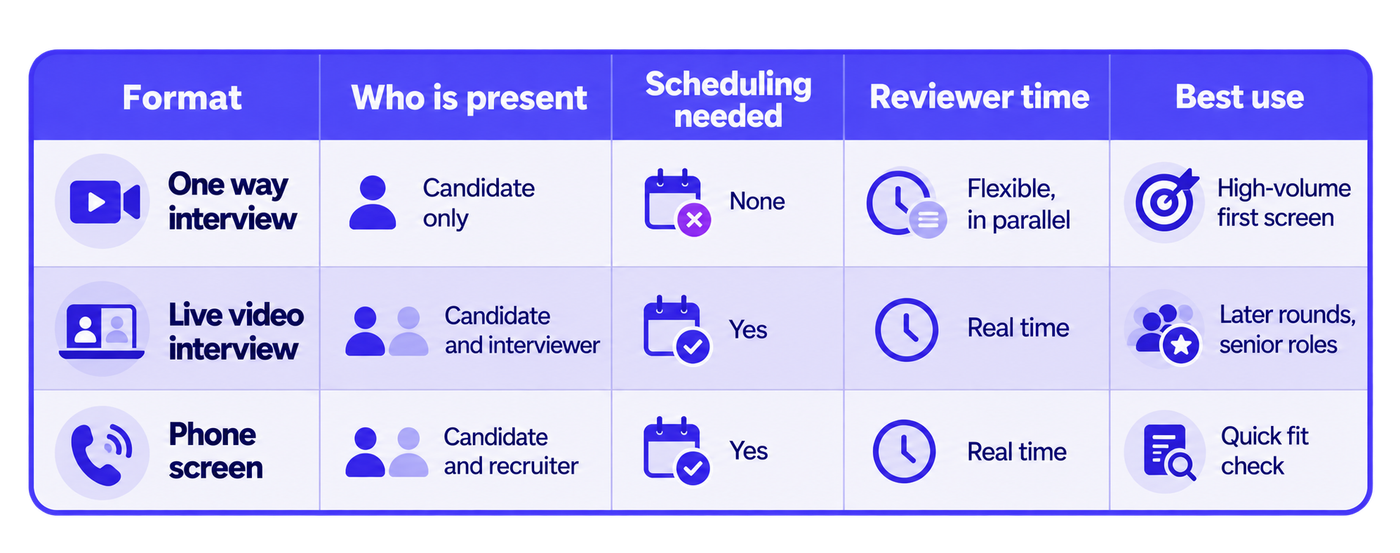
The saving comes from removing scheduling and letting reviewers work in parallel. The cost is the loss of live follow-up, so write questions that stand on their own.
What Does the Research Say About One Way and Asynchronous Interviews?
Two findings matter most: one about structure and one about how candidates feel.
On structure, Sackett, Zhang, Berry and Lievens revisited the validity of selection methods in the Journal of Applied Psychology. They report a mean validity of .42 for structured interviews and .19 for unstructured ones, and rank structured interviews first among the procedures they reviewed (Sackett et al., 2022). A one way interview asks every candidate the same questions, so it is structured by design. That helps only if the questions are job-related and the scoring is consistent.
On reactions, Hiemstra and colleagues studied 160 panelists and 103 actual applicants. Participants, particularly the applicants, had negative perceptions of the fairness and procedural justice of asynchronous job interviews (Hiemstra et al., Journal of Personnel Psychology, 2019). The applicants were highly educated, and the samples were small, so treat this as a caution and not a verdict on every candidate group.
The format can improve consistency and can also cost goodwill, so explain it clearly and offer help.
When Do One Way Interviews Make Sense?
Use a one way interview when volume or timing makes live screening slow. The format fits these cases:
- High-volume roles. Hundreds of applicants for the same role share the same questions.
- Shift and field workers. Candidates answer after a shift instead of finding a slot in office hours.
- Spread-out candidates. Different cities and schedules stop mattering.
- Early screens. The aim is to narrow a pool.
Avoid it, or offer a call instead, in these cases:
- Senior and leadership roles. These candidates expect a conversation, and the scheduling exchange is part of the pitch.
- Roles that depend on rapport. Client-facing hires may need a live read early.
- Candidates without a private space or a stable connection. The format can penalise them for reasons unrelated to ability.
Here is an illustrative example with assumed numbers. A team has 300 applicants for 20 roles. A 12-minute live first call for each is 3,600 minutes, or 60 hours of recruiter time, and every call needs a booked slot.
Reviewing four recorded answers at 4 minutes per candidate is 1,200 minutes, or 20 hours, done in any order and in parallel. The 12 and 4 minutes are assumptions, so replace them with your own.
SHRM’s 2026 Recruiting Executives Benchmarking puts the median time-to-fill at 39 days for nonexecutive roles, and scheduling sits inside those days. Removing it from the first screen is one lever on that number.
How Do One Way Interviews Work in India?
Hiring volumes in India are rising, which raises the cost of slow first screens. ManpowerGroup’s Employment Outlook Survey for Q4 2026 covered 3,055 employers in India. It put the Net Employment Outlook at 54%, with 65% of employers planning to increase staffing between October and December (ManpowerGroup India, September 2026).
Some frontline candidates have only a phone, and video uploads can fail on weak mobile data. A candidate may also be more comfortable answering in Hindi, Tamil or another regional language than in English.
Offer more than one way to answer. The infographic below sets out four options.
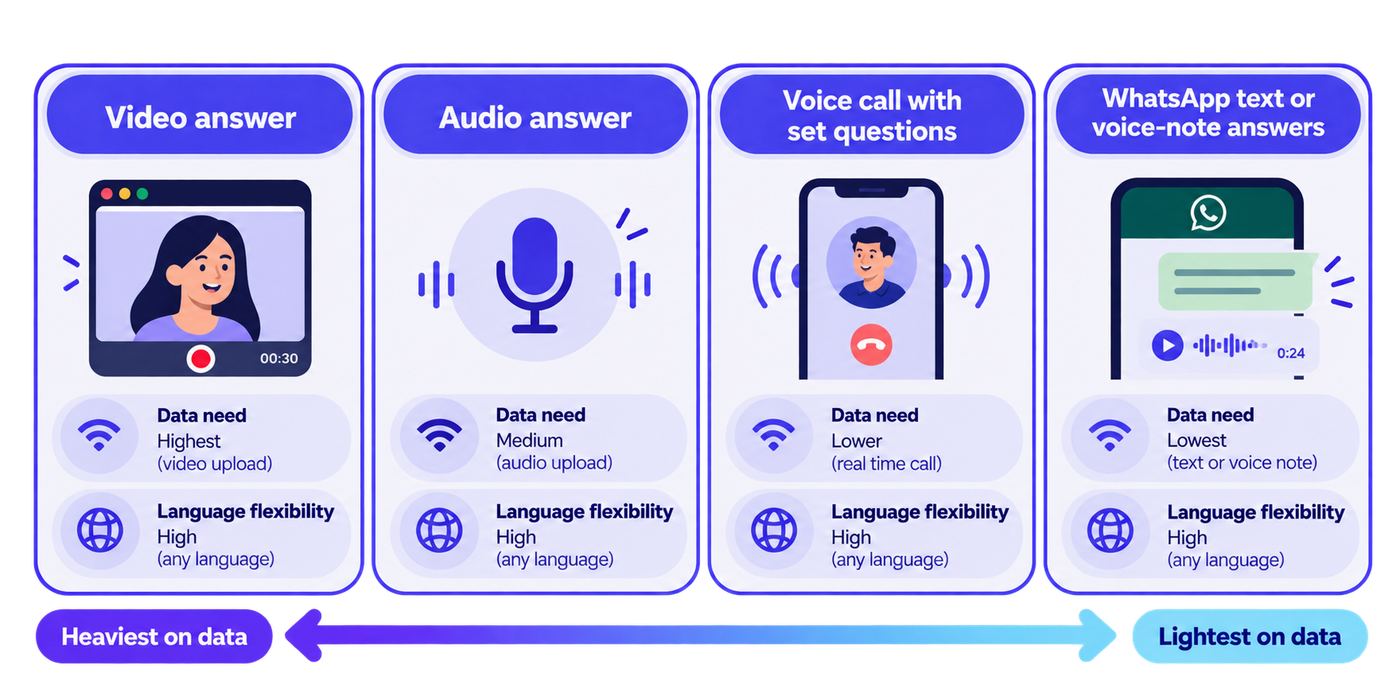
A lighter option keeps candidates in the process when a video would fail.
HireBound data shows a 64% WhatsApp response rate in India, compared with about 12% for email. Our guide to WhatsApp recruiting covers opt-in, timing and message design.
Consent matters when you record. India’s Digital Personal Data Protection Act, 2023 requires consent, or another use the Act specifically permits, before personal data is processed. The DPDP Rules, 2025 were notified in November 2025, with most obligations phased in over 18 months. Tell candidates about recording before they start.
What Makes Candidates Drop Out, and How Do You Prevent It?
Candidates who do not know the length, the deadline or what happens next may skip the invite.
Five habits keep completion up:
- State the time needed. Say “about 15 minutes, 4 questions” in the invite.
- Give a practice question. A sample answer removes the fear of the first recording.
- Allow a retake. One retake lowers the stress of a single attempt.
- Set a fair deadline. Give candidates a few days, not a few hours.
- Say what comes next. Tell them when to expect a reply.
Our guide to why candidates drop off shows where in a process candidates disappear.
How Should You Score One Way Interviews?
Score every answer against the same rubric, and score before you compare candidates. Use a five-point scale with a written anchor for a weak, an adequate and a strong answer.
The table shows an example for the question “Tell us about a time a customer was upset and what you did.”
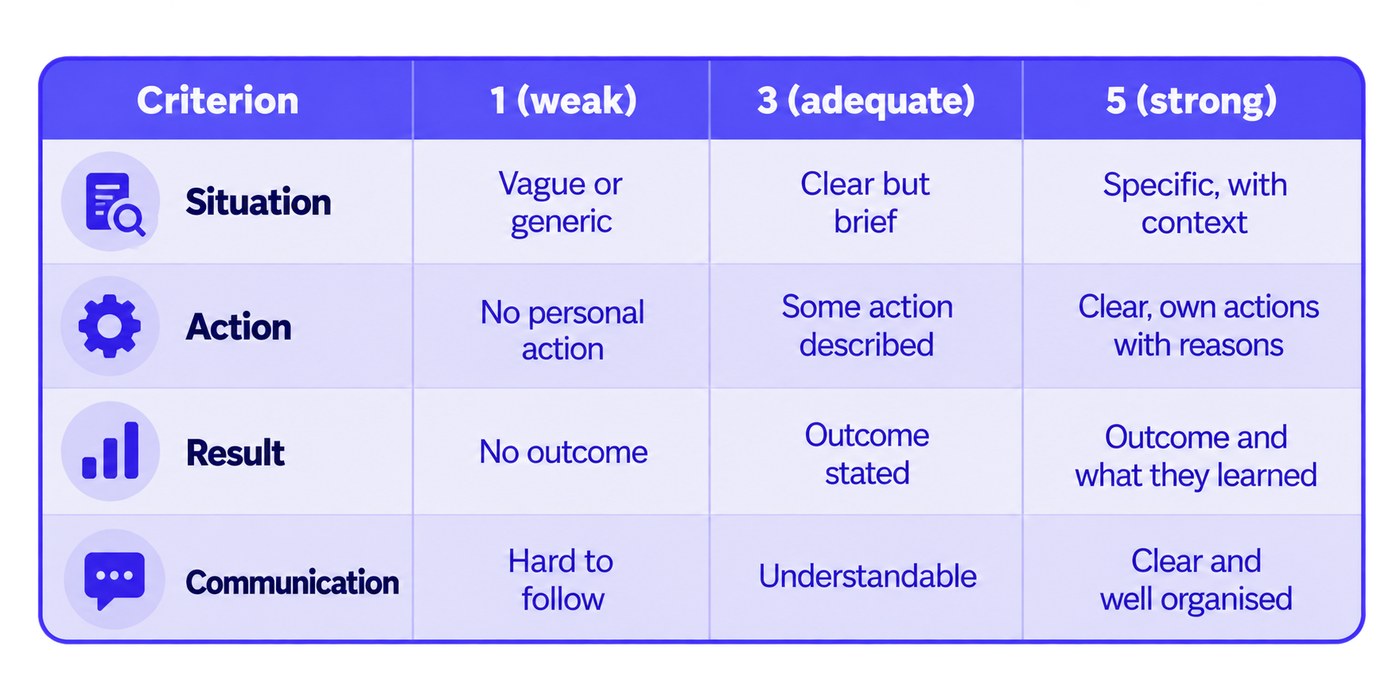
Two reviewers per candidate, scoring independently, help catch inconsistency. Do not score on appearance, accent or background. Our structured interview scorecard template shows how to build and calibrate a rubric.
Where Does HireBound Fit?
HireBound’s Screening Agent holds structured, role-specific conversations over Voice, WhatsApp and Email, in multiple languages, and scores answers against the criteria you set. Candidates answer when it suits them, and a recruiter reviews the shortlist with the recording and transcript. The Voice AI works in 14 Indian languages.
That gives an asynchronous first screen on the channels candidates already use. A recruiter keeps the final decision.
Want to run a structured first screen without scheduling every candidate? Talk to HireBound about screening →
Conclusion: A Decision Rule for One Way Interviews
Use a one way interview when many candidates apply for the same role, and the first screen is slow because of scheduling. Write structured questions, score them against anchors, explain the format, and offer a lighter way to answer.
Apply one rule. If most of your recruiters’ week goes on booking and running first-round calls for the same role, weigh an asynchronous screen most heavily. If most of it goes on senior searches, weigh live conversation most heavily.


