AI Interview Scheduling: What to Automate and What Not T
 Devansh Dhawan
 ·Oct 15, 2026·10 min read
Key Takeaways
- 1AI interview scheduling means an agent runs the whole booking conversation, not just a link. Offers, reminders, reschedules and no-show follow-up are safe to hand over.
- 2Cronofy’s surveys found 49% of candidates in 2023 and 42% in 2024 had left a process over slow scheduling. Both were mainly US and Europe.
- 3Keep a person on senior, panel and sensitive interviews. Decide by round and role level, and send messages on pay or notice to a recruiter.
- 4HireBound data shows a 64% WhatsApp response rate in India against about 12% for email, so run scheduling on WhatsApp, in the candidate’s language.
- 5Roll out in four weeks: one role family, one round, a human fallback, and weekly checks on hours to confirmed slot and no-show rate.
AI interview scheduling is the use of an AI agent to run the booking of interviews from start to finish. The agent finds open times on the interviewers’ calendars, offers them to the candidate, confirms one, sends reminders, handles reschedules and follows up after a no-show. A recruiter steps in only when the situation needs judgement.
Most of that work is repetitive and urgent, which suits an agent. Some of it carries the hiring decision, which does not. This guide separates the two and shows how to set it up for volume hiring in India.
Want scheduling to run without recruiter back-and-forth? See how HireBound handles it →
What Is AI Interview Scheduling?
AI interview scheduling covers every step between “this candidate should be interviewed” and “the interview happened”. It is broader than a booking link. A link shows open slots and waits for the candidate to act, while an agent starts the conversation, adapts to replies and keeps going until a slot is confirmed or a human is needed.
Most scheduling failures happen between steps. The shortlist is approved on Monday, the candidate never replies to a link, and nobody notices until Thursday.
Our post on self-scheduling vs recruiter-scheduled interviews compares the link model with manual scheduling and its no-show data. This post covers what an agent can take over.
In HireBound, the Scheduling Agent coordinates availability and reduces back-and-forth between candidate and team. Its outputs are a confirmed interview slot, reminders, and a calendar or meeting handoff. Human recruiters stay responsible for final judgement, relationships and hiring decisions.
How Does AI Interview Scheduling Work?
An agent-run scheduling flow has seven steps, each a place where a recruiter used to type a message. The agent works through them in order and hands over to a person if something does not fit.
- Read availability. The agent checks the interviewers’ calendars for free time and applies your rules, such as working hours, buffers between interviews and a maximum number per day.
- Offer slots. It messages the candidate with a short set of options on the channel they answer, in the language they used.
- Interpret the reply. The candidate may pick a slot, ask for another day or say “after 6 pm”. The agent reads the reply and either books it or offers new options.
- Confirm. It sends the confirmation with the date, time, format, interviewer name and a map pin or meeting link, and puts the event on the interviewer’s calendar.
- Remind. It sends reminders at set points, with a one-tap way to confirm or move the slot.
- Reschedule. If the candidate cannot attend, it rebooks without the recruiter seeing the exchange.
- Recover no-shows. Shortly after a missed slot it offers a new time, and it records the reason if the candidate replies.
Google’s Calendar API has a free/busy query that returns only the busy time ranges for a calendar, with no event titles or attendees, according to Google’s Calendar API documentation (accessed 7 October 2026). An agent can find free time without reading what the interviewer is doing.
The diagram below shows the seven steps in the order the agent runs them.
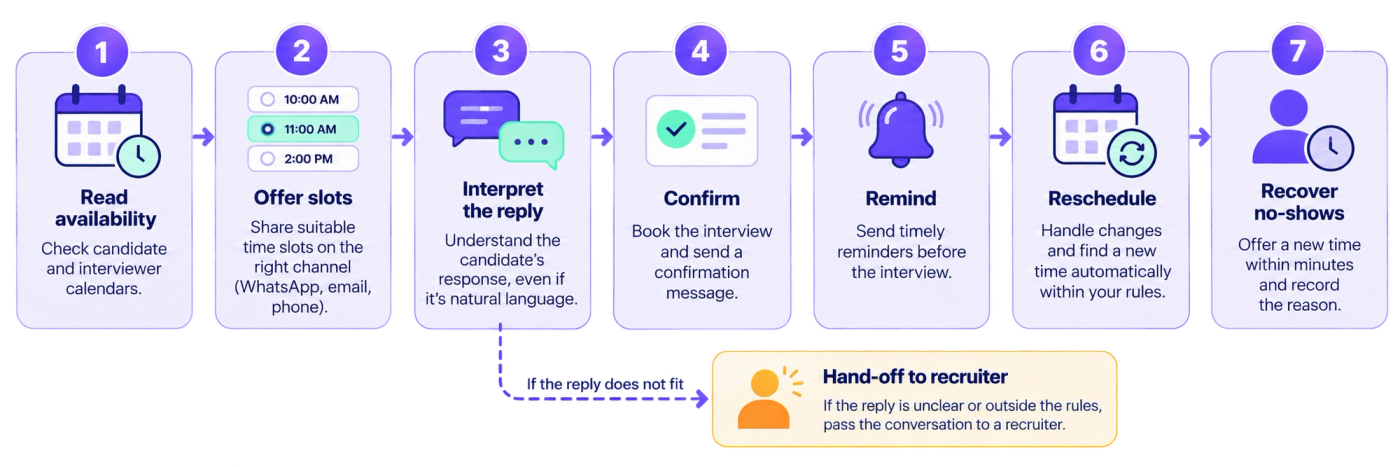
Each box is a message a recruiter used to write by hand.
What this means for your hiring: write your scheduling rules down before you switch anything on. Working hours, buffers, daily limits and the number of slots to offer are the settings that decide whether the agent helps or annoys people.
Why Does Scheduling Speed Matter?
Candidates leave when the wait gets long. In Cronofy’s Candidate Expectations Report 2023, a survey of 6,500 candidates, 49% said they had left a recruitment process because it took too long to schedule an interview. In its 2024 report, which surveyed 12,000 candidates, the figure was 42%.
Cronofy is a scheduling software company, and both surveys ran mainly in the US and Europe. The 2024 survey covered the UK, France, Germany, the US, Spain, Canada and the Netherlands. Treat the numbers as general evidence, not an Indian benchmark.
The 2024 report also found that 48% of candidates would be less likely to recommend or engage with an employer in future if interview scheduling was not up to par. A slow step costs you the candidate and what they tell others. The findings are in Cronofy’s Candidate Expectations Report 2024.
What this means for your hiring: measure the hours between “shortlisted” and “interview confirmed” for a sample of candidates this week. That one number tells you how much delay an agent could remove.
What Should You Automate in Interview Scheduling?
Automate the tasks that are repetitive, time-sensitive and low in judgement. Five of them pay back first.
An agent differs most from a bolted-on tool here. When screening and scheduling sit in one conversation, the candidate who has just answered your questions can book in the next message. Our guide to recruiting workflow automation covers how to map those hand-offs across the whole process.
The table sets out what the agent does in each task and why it is safe to hand over.
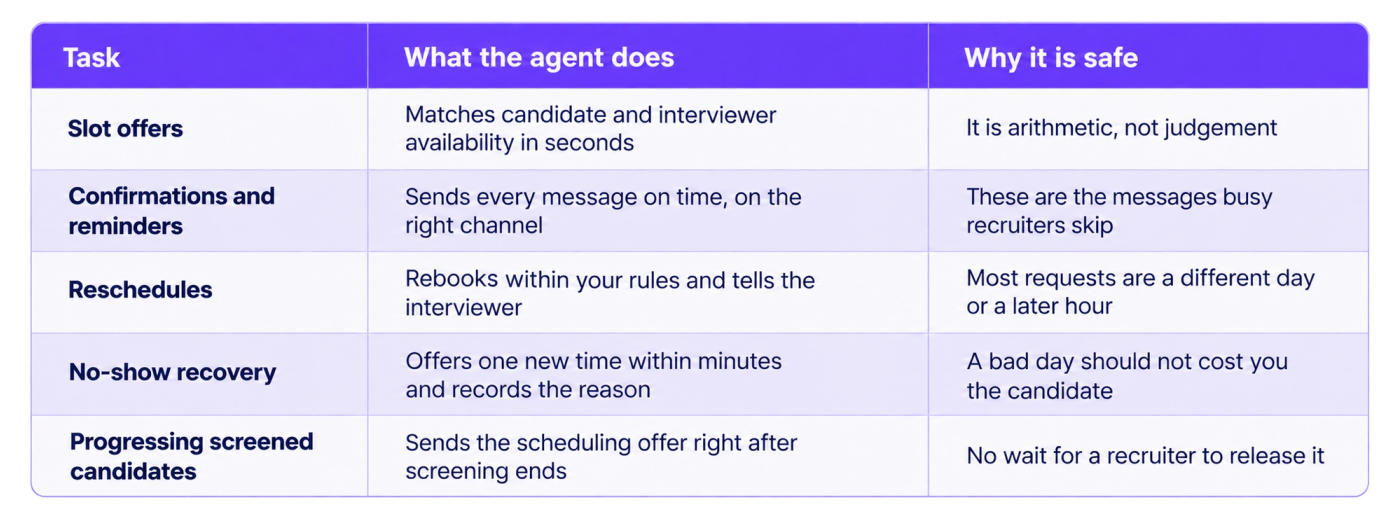
Together these five tasks cover the repetitive middle of scheduling.
What this means for your hiring: start with confirmations, reminders and reschedules. They carry the least risk and show results within a week.
What Should You Not Automate in Interview Scheduling?
Keep a person in charge wherever the scheduling message is part of the selection or the sell. A wrong slot is a small mistake, but a wrong tone can cost the hire.
Keep these with a recruiter.
- Senior and leadership interviews. These candidates expect a personal touch, and the scheduling exchange is where you start to sell the role.
- Panel loops with many interviewers. Five calendars across several offices produce exceptions a recruiter handles better.
- Anything involving pay, notice period or relocation. Questions about salary or joining dates are negotiation. Route them to a person immediately.
- Accommodation requests. A candidate who asks for extra time or an accessible venue needs a human who can decide.
- Cancellations on your side. If you must cancel or postpone, say it in a person’s voice.
- Low-volume roles. If you hire four people a year for a function, automation may cost more than it saves.
Write the line into the agent’s rules. Words such as salary, notice, visa, relocation, disability, complaint and “speak to someone” should hand the conversation to a recruiter with the full thread attached.
What this means for your hiring: decide by round and role level, not company-wide. A common split is agent-run scheduling for first rounds and screening calls, and recruiter-run scheduling from the final round onward.
How Does AI Interview Scheduling Work for Volume Hiring in India?
In India, time zones are rarely the problem. The hard parts are reaching the candidate in a language they read comfortably and absorbing last-minute changes at scale. Design for three things.
First, the channel. HireBound data shows a 64% WhatsApp response rate in India, compared with about 12% for email. Run the whole conversation on WhatsApp, with a voice call as the fallback for candidates who rarely read messages. One 150+ recruiter firm on HireBound cut sourcing-to-scheduling time by 40% and saved each recruiter 2 hours a day; measure your own result.
Our guide covers opt-in, timing and message design: WhatsApp recruiting in India.
Second, the language. A candidate in Coimbatore or Lucknow is more likely to answer in Tamil or Hindi than in English. HireBound’s Voice AI works in 14 Indian languages, which helps when a candidate would rather talk than type.
Many frontline candidates share a phone or change numbers often, so confirm identity before you share interview details.
Third, the volume of changes. Shifts move, travel falls through, and a candidate serving notice asks for a different day. An agent absorbs these without queueing them behind a recruiter’s other work.
Here is an illustrative example, with assumed numbers. A team schedules 300 first-round interviews in a week across three cities, and one in four candidates asks to move their slot. That is 75 reschedules, each needing at least two messages if handled by hand.
An agent rebooks within your rules and sends the updated confirmation to the candidate and the interviewer. A recruiter sees only the exceptions. The one-in-four rate is an assumption for the example, so check your own reschedule rate before you plan staffing around it.
The infographic below puts the example in numbers.
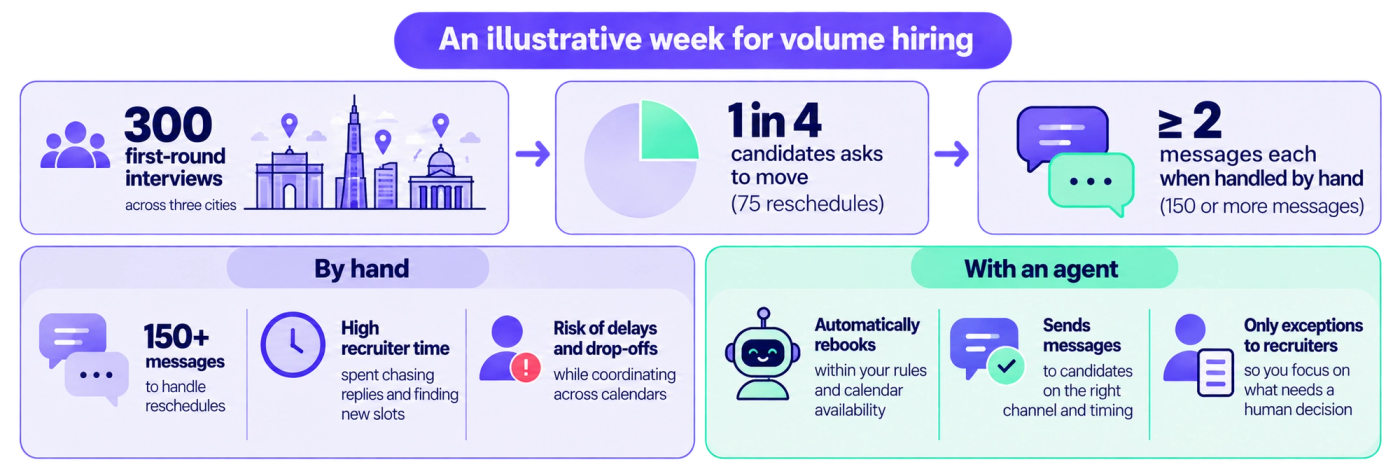
That message load is what the agent takes off the recruiter’s desk.
Consent also needs thought. India’s Digital Personal Data Protection Act, 2023 requires consent, or another use the Act specifically permits, before personal data is processed.
The Press Information Bureau announced that the Ministry of Electronics and Information Technology had notified the DPDP Rules, 2025, with an 18-month phased compliance timeline. Collect consent for messages and recordings at application time, and keep a record.
Our post on why candidates drop off during scheduling shows where in the process candidates disappear.
What this means for your hiring: put the scheduling conversation on WhatsApp, in the candidate’s language, with a call fallback. Then measure reschedule volume for a month so you know what the agent is absorbing.
What Guardrails Should an AI Scheduler Have?
An agent that books interviews needs limits, because its mistakes land in front of candidates and hiring managers. Six guardrails cover most of the risk.
- A human fallback in every conversation. The candidate can always ask for a person, and the agent hands over with the full thread.
- Escalation triggers. Pay, notice, relocation, accommodation and complaints go to a recruiter.
- Slot rules. Working hours, buffers, daily interview limits and holiday calendars stop the agent from booking an interviewer at 7 pm on a festival day.
- Identity and consent checks. Confirm the candidate before sharing details, and record consent for messages and calls.
- An activity log. Every booking, change and message is visible to a recruiter, so you can explain what happened when a candidate complains.
- A cap on retries. After your set number of unanswered messages, the agent stops and flags the candidate.
What this means for your hiring: have a recruiter read ten real conversations in the first week. The tone problems and missing rules show up quickly, and they are cheap to fix at that point.
How Do You Roll Out AI Interview Scheduling in Four Weeks?
Start small and widen only when the numbers hold.
The table shows what happens each week and what you should have by the end of it.
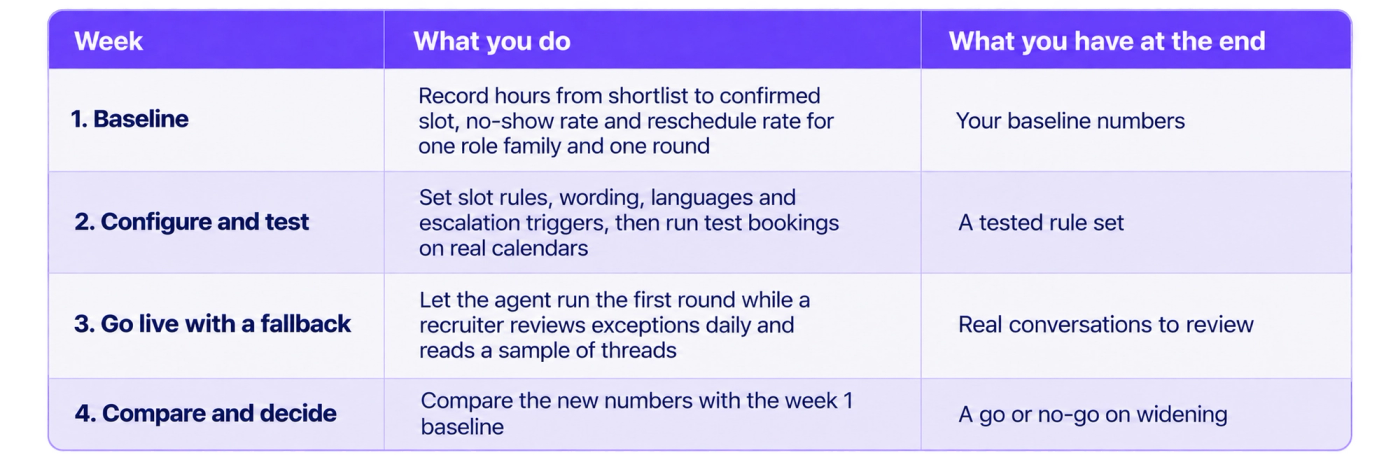
Widen to another role family only if hours to confirmed slot fall and no-shows do not rise.
Track four numbers every week:
- Hours from shortlist to confirmed interview.
- No-show rate, split by agent-run and recruiter-run scheduling.
- Reschedule rate, and the share the agent resolved without a recruiter.
- Handover rate, meaning the share of conversations passed to a person.
A high handover rate means your rules are too tight or your messages are unclear. If no-shows rise, check the reminders and the channel first. Our post on how AI turns the recruiter into a workflow designer explains why mapping hand-offs and delays comes before automating them.
What this means for your hiring: treat the first month as a measured test. The week 1 baseline shows hiring managers whether it worked.
When Is AI Interview Scheduling the Wrong Choice?
It is the wrong choice when the volume is low, the interviews are mostly senior, or your process is not stable enough to write rules for. An agent follows the rules you give it, so a weekly-changing process produces weekly errors.
It is also a poor fit if interviewers do not keep calendars current, since the agent books only free slots.
No scheduling agent fixes a slow decision either. If a hiring manager takes a week to review a shortlist, a same-day booking message will not save the candidate.
Hiring at volume and tired of empty interview slots? Talk to us about automating your scheduling →
Conclusion: A Decision Rule for AI Interview Scheduling
Hand an agent the tasks that are repetitive, urgent and low in judgement: slot offers, confirmations, reminders, reschedules and no-show recovery. Keep people on the interviews where the message is part of the pitch or the decision. For most teams the split falls by round, with agents on first rounds and recruiters from the final stage.
Apply this rule. If most of your recruiters’ week goes on coordinating interviews for candidates who are already screened, weigh scheduling automation most heavily. If most of it goes on senior candidates, weigh it least and keep the agent behind a recruiter as support.
In India, channel and language matter as much as the tool. Start with one role family, keep a human fallback, and let your own baseline show whether it worked.


