Healthcare Recruiting Strategies for Hard-to-Fill Roles
 Suvam Moitra
 ·Nov 14, 2026·10 min read

Key Takeaways
- 1BLS projects about 1.9 million healthcare job openings a year in the US from 2025 to 2035, so speed of response decides who gets the candidate.
- 2Ask licence, specialty and shift questions in the first screen, and check every licence against the primary source before an offer, not after.
- 3AAMC's 2024 projections show a US shortfall of up to 86,000 physicians by 2036, so physician recruiting needs a pipeline built months before the vacancy.
- 4WHO's 2025 nursing report counts a global shortage of 5.8 million nurses in 2023, and 1 in 7 nurses worldwide is foreign-born.
- 5In India, HireBound sees a 64% response rate on WhatsApp against about 12% for email, which makes WhatsApp the first channel for nurse and allied health outreach.
Healthcare recruiting strategies are the methods hospitals, clinics and staffing agencies use to find, screen, verify and hire clinical staff such as nurses, physicians and allied health professionals. The best ones cut the time between application and first conversation, check licences early, and keep a warm pipeline for roles that open every year.
Demand keeps rising. The US Bureau of Labor Statistics projects about 1.9 million openings a year in healthcare occupations from 2025 to 2035. SHRM's 2026 benchmarking puts the median time-to-fill for nonexecutive roles at 39 days, and a clinical vacancy usually means overtime, agency cover or closed beds for every one of them.
This guide covers what works across role families, then the specifics for nurses, physicians and allied health, credential checks in the US and India, and the metrics to watch. If your team screens high volumes of clinical candidates, see how HireBound's AI recruiting platform handles sourcing, screening and scheduling.
Why Are Healthcare Roles So Hard to Fill?
Healthcare roles are hard to fill because supply is capped by licensing, demand rises with an ageing population, and candidates have more choices than employers have time. Four constraints show up in almost every search.
- Licensing gates. A nurse or physician can only work where they hold a valid licence. Every move across a state, country or specialty adds paperwork and weeks.
- A real shortage. The World Health Organization's State of the World's Nursing 2025 report puts the global shortage at 5.8 million nurses in 2023, falling to a projected 4.1 million by 2030.
- Shift and location fit. Night shifts, rural postings and on-call rotas narrow the pool for each opening, even when the total supply looks healthy.
- Slow hiring steps. Screening calls, reference checks and credentialing run in sequence. Good candidates accept another offer while they wait.
The US physician outlook is tighter still. The AAMC's 2024 workforce projections warn of a shortage of up to 86,000 physicians by 2036. Demand rises mainly because the US population aged 65 and older is projected to grow by 34.1%.
Many employers fill gaps with internationally trained staff. WHO reports that 1 in 7 nurses worldwide is foreign-born, rising to 23% in high-income countries. Each of those hires carries a credential check in two systems.
Healthcare Recruiting Strategies That Work Across Roles
Five strategies apply whether you hire nurses, doctors or radiographers. Each one targets a slow step in your own process, since that is the part you control. Good recruiting strategies in healthcare start there, before any spend on new channels.
- Reply within hours, not days. Clinical candidates often apply to several employers in the same week. The first credible conversation usually wins, so set a same-day response target for every applicant.
- Put licence and fit questions in the first screen. Ask about licence type, issuing state or council, expiry date, specialty, shift preference and earliest start date. Our guide to pre-screening questions shows how to write knockout questions that stay fair.
- Rediscover past applicants first. Last year's runner-up for a ward nurse role may be ready to move now. Search your own database before you post the job again.
- Let candidates book their own interview. A self-scheduling link removes two or three rounds of back-and-forth, which matters for people who work 12-hour shifts.
- Run credential checks in parallel. Start primary-source verification as soon as a candidate passes the screen, not after the final interview.
The diagram shows where each strategy sits in the hiring flow.
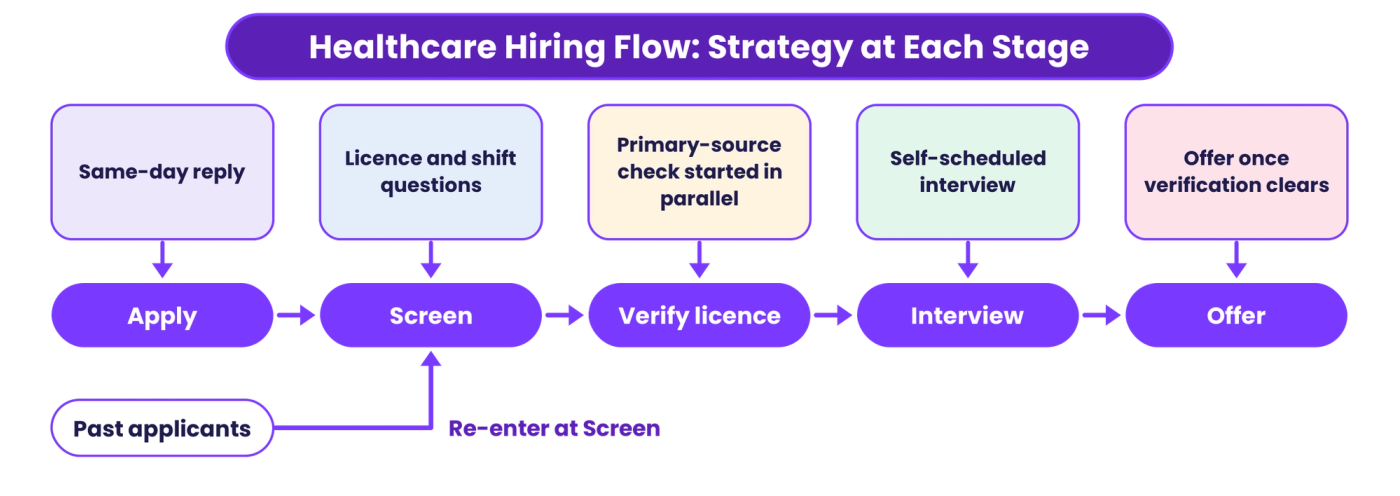
Most of the time saved comes from running screening and verification side by side instead of one after the other.
Nurse Recruiting Strategies
Nurse recruiting strategies need to handle volume and speed. BLS projects about 180,800 openings for registered nurses each year on average over the decade to 2035, with employment growing 6%. Most of those openings come from nurses changing jobs or leaving the profession, so you compete for the same people again and again.
What works for nurses:
- Lead with the shift, unit and ratio. Nurses filter on schedule, specialty and workload before pay. Put the unit, the shift pattern and the nurse-to-patient ratio in the first line of the ad.
- Screen for specialty early. An ICU nurse and a med-surg nurse are not interchangeable. Ask about specialty, years in it and any certifications in the first conversation.
- Build a returner pool. Nurses who left for family reasons or burnout often come back to part-time or flexible roles. Keep them on a list and contact them when those roles open.
- Use your own nurses in hiring. A charge nurse on a 15-minute call answers questions a recruiter cannot, such as how handovers really run.
- Check multistate eligibility. In the US, a nurse with a multistate licence under the Nurse Licensure Compact can practise in other compact states without a new licence. Ask about it in the screen.
Physician Recruiting Strategies
Physician recruiting strategies run on a longer clock. A specialist search can take months, and residents often sign contracts well before they finish training. The work is mostly relationship-building and planning ahead.
What works for physicians:
- Start 9 to 12 months out. Map expected retirements and service expansions now, and start conversations with residents and fellows early in their final year.
- Sell the practice, not just the post. Physicians weigh call schedule, case mix, support staff, research time and the spouse's job prospects. Answer those in writing before the first site visit.
- Involve a physician champion. A peer from the department should run at least one conversation. Candidates trust a colleague's description of the workload more than a recruiter's.
- Map licensing and privileges time into the plan. State licensing, hospital privileges and payer enrolment each take time. Build those weeks into the start date you promise.
- Keep warm contact with declined candidates. A physician who chose another offer this year may reconsider in two. Note why they declined and check in once a year.
Allied Health Recruiting
Allied health covers roles such as radiographers, lab technicians, physiotherapists, respiratory therapists, pharmacists and paramedics. These searches get less attention than nursing, yet a missing sonographer can stall a whole department's schedule.
Three things help with allied health:
- Use the exact job title candidates search for. Titles vary between countries and employers, so post under the common title and list the alternatives in the description.
- Partner with training institutions. Diploma and degree programmes are small, and students choose employers during placements. A good placement experience is a recruiting channel.
- Screen for certification and equipment. Ask which modalities, machines or systems the candidate has used. It is the fastest way to tell a strong match from a near miss.
The table compares the three role families side by side.
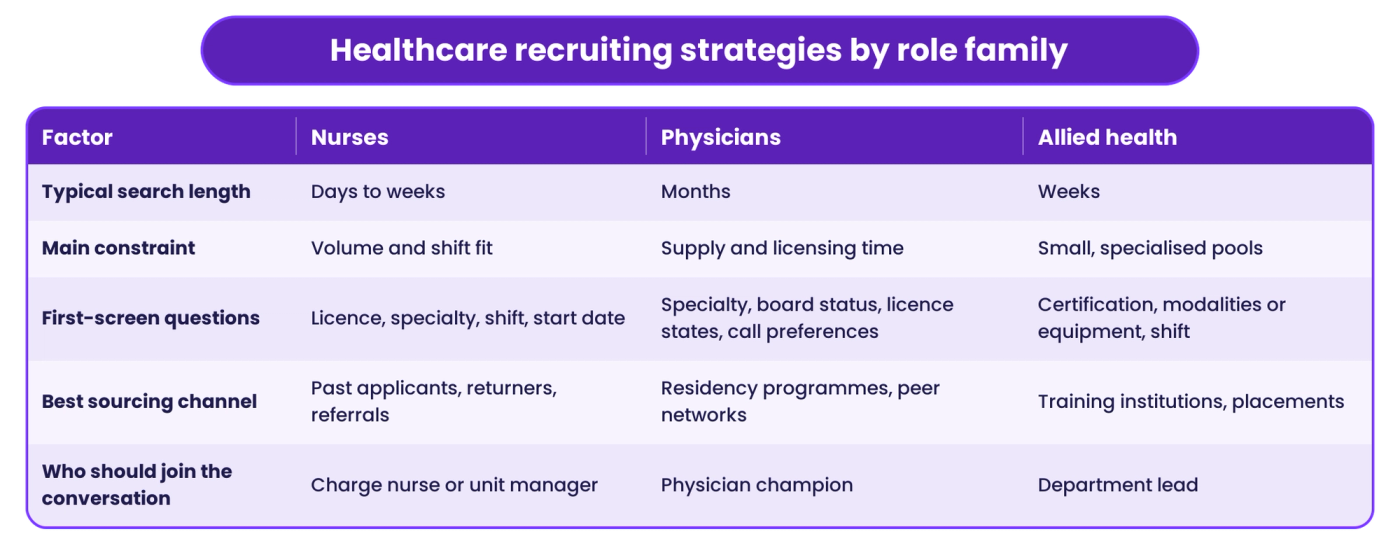
Nurse hiring depends most on speed, physician hiring on planning ahead, and allied health hiring on links with training programmes.
Employer Branding in Healthcare
Employer branding in healthcare is what clinicians believe about working for you, and in a small local market they talk to each other. A unit known for unsafe ratios or poor management will struggle no matter how good the ad is.
Branding that clinicians trust is specific and checkable:
- Publish real shift patterns, staffing ratios and onboarding length for each unit.
- Share how the organisation supports professional development, such as certification support or a residency programme for new graduates.
- Let clinicians speak. A short video of a ward manager explaining a typical shift is more credible than a stock photo.
- Answer reviews and exit feedback in public where you can, and show what changed.
Your hiring process is part of your brand too. A nurse who waits a week for a reply has already learned something about how the organisation runs.
Healthcare Recruiting in India
India has a large and growing clinical workforce. In a Rajya Sabha reply, the Minister of State for Health reported 13,88,185 registered allopathic doctors, and around 42.94 lakh nursing personnel registered with the Indian Nursing Council as on 31 March 2025. The challenge is distribution: hospitals in tier 2 and tier 3 cities and rural districts compete with metro hospitals and with overseas employers for the same nurses.
What changes when you recruit in India:
- Use WhatsApp first. HireBound sees a 64% response rate on WhatsApp in India against about 12% for email. Nurses and technicians on shift rarely check email, but they read WhatsApp between rounds.
- Speak the candidate's language. A screening call in Tamil, Malayalam or Hindi reaches candidates that English-only outreach misses, especially outside the metros.
- Plan around notice periods and bonds. Many hospitals in India ask staff to serve a notice period, and some use service bonds. Ask about both in the first screen so the start date you plan is realistic.
- Collect consent properly. India's Digital Personal Data Protection Act, 2023 requires a clear purpose and consent for processing personal data, which covers licence numbers and documents collected during screening.
Credential and Licence Verification in the US and India
Credential verification confirms that a clinician holds a valid, unrestricted licence and the qualifications they claim. The standard is primary-source verification: you check with the body that issued the licence, not the candidate's copy.
In the US, NCSBN's Nursys database lets employers look up nurse licences and discipline records from participating state boards through its free QuickConfirm service. Its e-Notify service sends alerts when a licence nears expiry or changes status. Physician licences are checked with the relevant state medical board.
In India, nurses registered through the Indian Nursing Council's Nurses Registration and Tracking System (NRTS) hold a Nurse Unique Identification number (NUID). For doctors, the National Medical Commission's 2023 regulations require a unique identification number linked to the National Medical Register.
The table sets out where to check each credential.
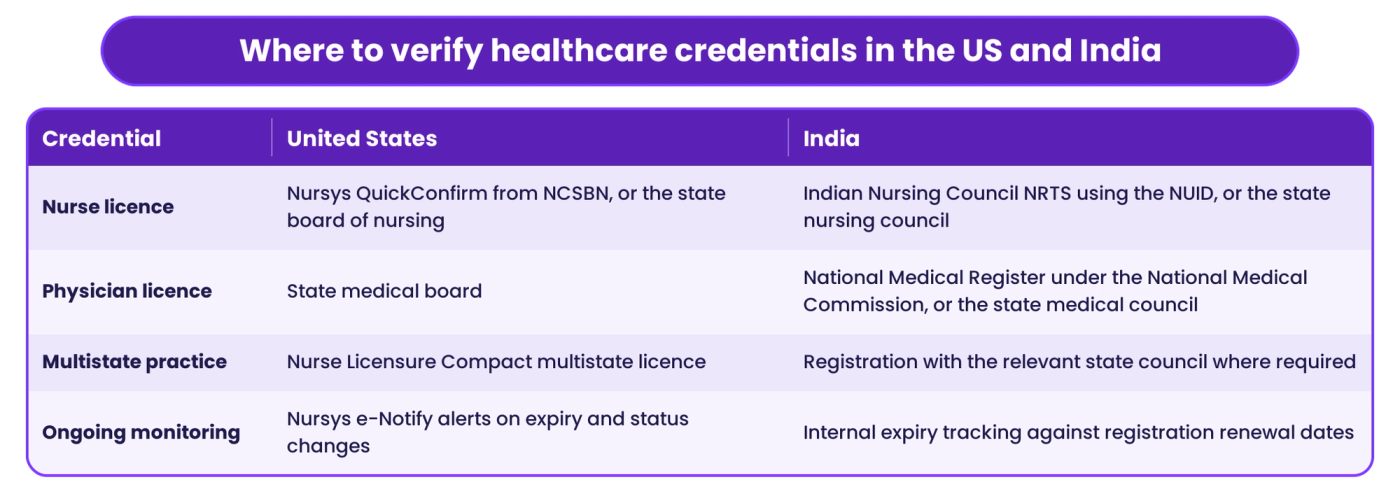
Run these checks in parallel with interviews and track expiry dates after the hire, since a lapsed licence is a compliance risk on every shift.
Which Healthcare Recruiting Metrics Should You Track?
Track the steps that lose candidates, not just the final number. Five metrics show where a healthcare hiring process is slow:
- Time to first contact. Hours from application to the first real conversation. Aim for the same day.
- Screen-to-interview rate. The share of screened candidates who reach an interview. A low rate means the ad or the knockout questions are off.
- Credentialing time. Days from a passed screen to a cleared licence check.
- Offer acceptance rate. A drop points to pay, shifts or a slow process.
- Time-to-fill by role family. Compare nurses, physicians and allied health separately, using the benchmarks in our post on time to hire.
Agencies placing clinical staff should add fill rate and submittal-to-placement ratio. Our list of staffing agency KPIs explains how to calculate each one.
Where HireBound Fits in Healthcare Recruiting
In high-volume healthcare hiring, first-round screening calls take up much of each recruiter's week. HireBound's Screening Agent runs structured, role-specific conversations over voice, WhatsApp and email, asks your exact questions, and scores and shortlists candidates against your criteria. Qualified candidates can then book their own interview slot.
A US healthcare staffing firm shows what this looks like at volume. The firm places clinical psychologists, registered nurses, psychotherapists and physicians into mental-health roles across the US and Canada. Each first-round screening call took about 5 minutes, and across 20,000 candidates a month that added up to 1,667 hours split across 20 recruiters.
HireBound's voice AI agent ran first-round screening end to end, with message follow-up for candidates who did not pick up. Qualified candidates booked their own slots through a calendar integration. The firm now handles 20,000 candidates and more than 400 interviews a month with the same 20 recruiters, and makes no manual screening calls.
The flow below traces those numbers from first screen to interview.
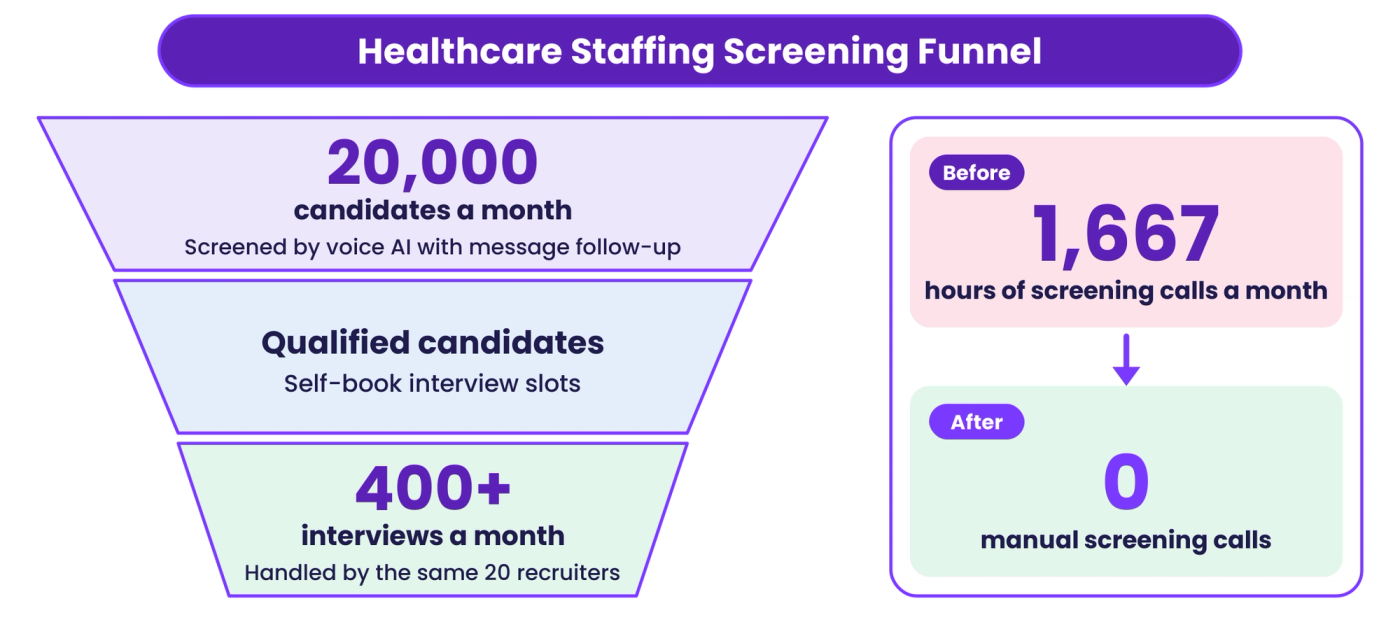
Recruiters stopped screening and scheduling and spent that time interviewing.
HireBound's AI candidate screening software covers the same workflow for hospitals and agencies. Voice AI screens candidates in 14 Indian languages, and HireBound has powered 8 million+ candidate conversations. Recruiters and clinical managers still make the hiring decision, run the interviews and own the final licence check.
Want to screen clinical candidates without hours of phone calls? Book a demo with HireBound
Start With the First Screen
Healthcare hiring will stay tight for years, so the gains come from your own process. Reply the same day, ask licence and shift questions up front, run verification in parallel and keep a warm pool for the roles you hire every year. Start with the first screen, since every later step waits on it.


