AI Hiring Platforms: What They Do and How to Choose One
 Tanmey Goswami
 ·Nov 17, 2026·10 min read

Key Takeaways
- 1An AI hiring platform covers five stages, from sourcing and screening to outreach, scheduling and evaluation, and keeps one record per candidate.
- 2SHRM's 2025 Talent Trends survey of 2,040 HR professionals found AI use in HR tasks rose to 43% in 2025, from 26% in 2024.
- 3ManpowerGroup's 2026 Talent Shortage Survey found 82% of employers in India had difficulty filling roles, which is why recruiter hours are the scarce resource.
- 4Judge a platform by shortlist quality: count how many of 8 profiles sent the hiring manager agrees to interview, before and after.
- 5India's DPDP Rules were notified on 14 November 2025 with an 18-month phase-in, so settle consent notices and erasure before go-live.
An AI hiring platform is software that uses artificial intelligence to carry out recruiting work across several stages, from finding candidates to booking interviews. It sources, screens, contacts, schedules and evaluates candidates in one connected workflow, and recruiters keep the hiring decision.
The label covers very different products. Some do a single task, some are older systems with AI features added, and some run agents that do the work themselves. This guide covers what a platform does at each stage, how the three types differ, and how to choose and pilot one.
Evaluating AI hiring platforms for your team? See how HireBound's AI agents source, screen and schedule candidates →
What Is an AI Hiring Platform?
An AI hiring platform is one system that handles more than one hiring stage and keeps a single record for each candidate. The record holds the candidate's source, messages, screening answers, scores and interview status. A set of separate AI hiring tools has no such shared record, so recruiters copy data between them.
Most platforms cover five stages: sourcing, screening, outreach, scheduling and evaluation. A platform does not have to replace your applicant tracking system. Many sit alongside it and write results back to it.
Vendors also call this category AI hiring software, an AI recruitment platform or an AI recruiting platform. This guide treats the terms as one.
The diagram below shows the five stages feeding one candidate record.
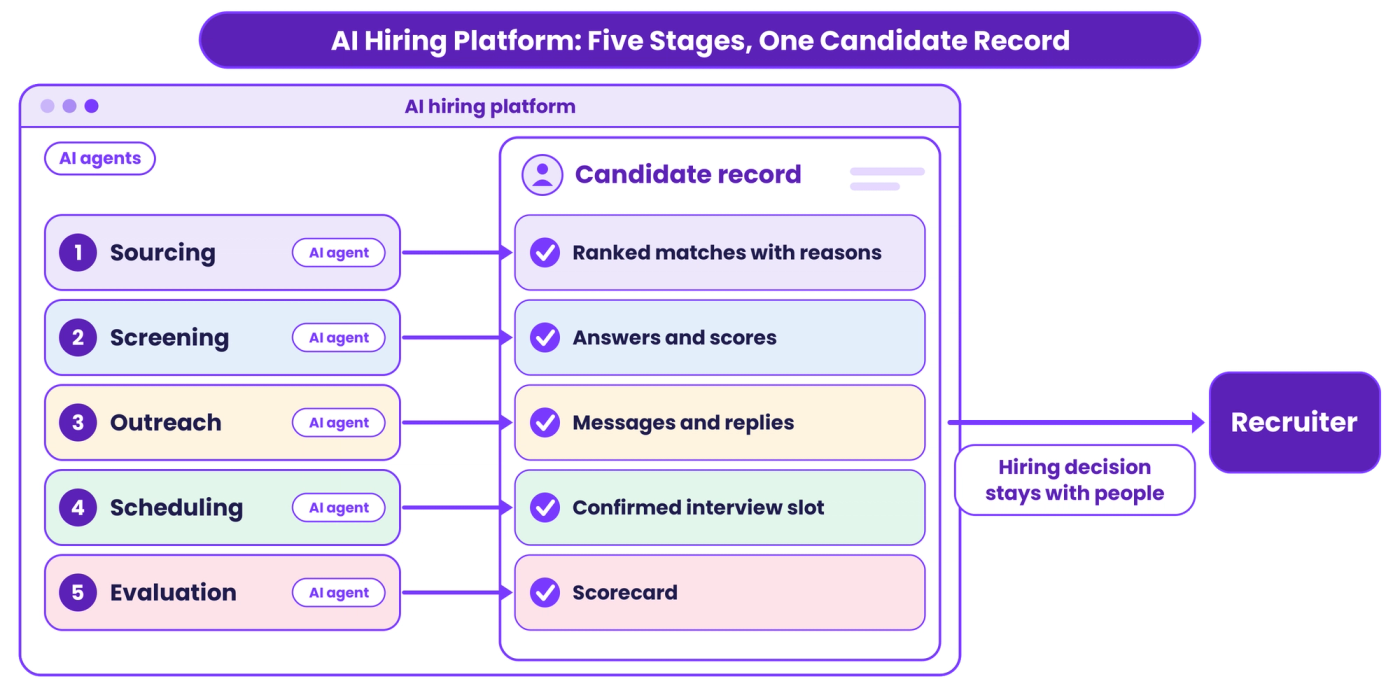
A product that covers one box in that diagram is a tool, and you will need others to finish the workflow.
What Does an AI Hiring Platform Do at Each Stage?
At each stage, the platform takes over a repeated task and hands the recruiter a result to review.
Sourcing
The platform reads a job description or a plain-language brief and turns it into a search. It looks across external profiles and your own database of past applicants, then ranks the matches. A good platform explains each match with strengths and concerns, so a recruiter can disagree with it.
Screening
The platform asks each candidate the questions that decide fit, such as notice period, location, pay expectation and core skills. It does this by chat or voice call, records the answers and scores them against your criteria. In India, check that screening works in the languages your candidates speak.
Outreach
The platform writes and sends the first message, follows up when there is no reply, and answers common questions about the role. HireBound data shows a 64% WhatsApp response rate in India, against about 12% for email, so an email-only product reaches fewer Indian candidates.
Scheduling
The platform collects the candidate's availability, books a slot on the interviewer's calendar and sends reminders. If someone cancels, it offers new times without a recruiter stepping in.
Evaluation
The platform runs a structured first-round assessment, such as a skills test or an AI-led interview, and fills a scorecard against the role criteria. The scores, transcripts and reasons are evidence for the recruiter and hiring manager, who decide who to hire.
Why Are Teams Buying AI Hiring Software Now?
Teams are buying AI hiring software because roles are hard to fill and recruiter hours are limited. ManpowerGroup's 2026 Talent Shortage Survey found that 82% of employers in India reported difficulty filling roles. The survey covered 39,063 employers in 41 countries, with fieldwork in October 2025.
Adoption is rising. SHRM's 2025 Talent Trends research, a February 2025 survey of 2,040 HR professionals, found that AI use in HR tasks climbed to 43% in 2025. The figure reported in 2024 was 26%.
An adoption figure says nothing about whether shortlists improved. That depends on which type of product a team bought and how it tested it.
AI Hiring Tools, Software and Agents: What Is the Difference?
AI hiring tools do one task. AI hiring software with assistive features suggests and drafts inside a larger system, while a recruiter runs each step. An AI hiring agent carries out several steps itself, within limits you set, and reports what it did.
The table compares the three types on the points that affect a buying decision.
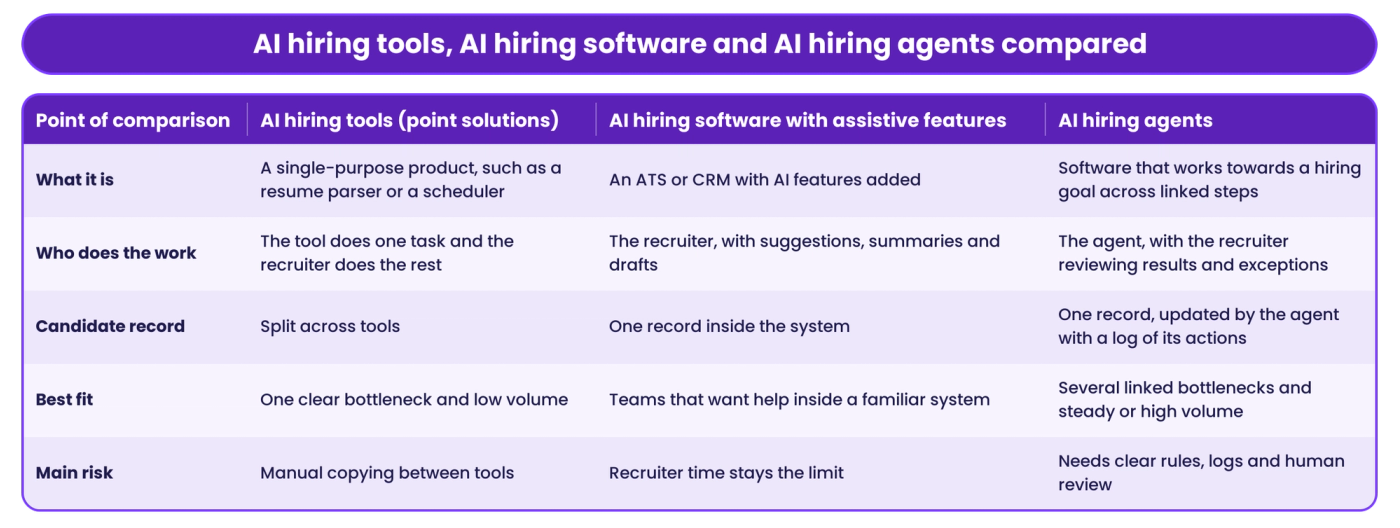
The further right you go, the more work moves from the recruiter to the software, and the more you need logs and review rights.
Labels are used loosely, so test what a product does on a live role. Our guide to agentic AI vs recruiting automation sets out four levels of automation to place a product on. For products that add little beyond a general chatbot, see how to tell an AI wrapper from real AI.
Some teams need only a tool. A team that hires ten people a year and loses time on calendars should buy a scheduler.
How Do You Choose an AI Hiring Platform?
Choose an AI hiring platform by testing it on one of your own roles and judging the shortlist it produces. A demo on the vendor's sample data tells you little about your roles.
Work through these steps in order:
- Name the bottleneck. Review your last 10 closed roles and note where the days and recruiter hours went: search, screening calls, follow-ups or scheduling.
- Pick the type. One bottleneck points to a tool. Several linked ones point to a platform with agents.
- List your candidates' channels and languages. A platform must reach people where they reply, which in India often means WhatsApp and voice calls.
- Check the fit with your systems. Ask whether results write back to your ATS and calendar in both directions.
- Run the same live role through each product. Give every vendor one job description and ask for a ranked shortlist with reasons.
- Judge the shortlist. Ask the hiring manager how many of the profiles they would interview, without telling them which product sent which profile.
- Check control. Confirm that you can see what an agent did, change its questions and override its decisions.
- Get answers in writing. Our AI recruiting platform checklist lists 15 vendor questions and a way to score them.
Step 6 carries the most weight, because the shortlist is what a hiring manager receives. If managers reject most profiles today, faster sourcing only delivers rejected profiles sooner. Our post on what to change when shortlists are weak covers that problem.
Here is one way to score it, with assumed numbers. A recruiter sends 8 profiles for a role and the hiring manager agrees to interview 2, an interview rate of 25%. If a platform's shortlist for the same role gets 4 of 8 accepted, the rate is 50% and the manager reviews half as many wasted profiles.
What Should You Check on Data Privacy and Fairness?
Check who is legally responsible for candidate data, how consent is recorded, and how the vendor tests for bias. The employer or staffing agency that uses the platform stays responsible for its candidates' data in most regimes. Settle these points before the pilot, which uses real candidate data.
India: The DPDP Act
The Digital Personal Data Protection Act, 2023 covers candidate data handled digitally in India. The Press Information Bureau reported that the DPDP Rules, 2025 were notified on 14 November 2025, with an 18-month period for phased compliance. That period runs to May 2027, so a contract signed now should already meet the Rules.
The Act calls the organisation that decides why and how data is used the Data Fiduciary. A company that processes data on its behalf is a Data Processor. An employer or agency that screens its own candidates through a vendor is usually the fiduciary.
Ask the vendor these questions, each based on the Press Information Bureau's summary of the Rules:
- Consent notice: every Data Fiduciary must give a separate, clear notice stating the specific purpose. Ask how the platform shows it before a WhatsApp or voice screen, and in which languages.
- Withdrawal and erasure: candidates can withdraw consent at any time, and requests for access, correction or erasure must be answered within 90 days. Ask how the platform finds and deletes one candidate's recordings and transcripts.
- Breach notice: affected individuals must be told without delay. Ask what the contract commits the vendor to.
- Penalties: failing to maintain reasonable security safeguards can draw a penalty of up to ₹250 crore. Ask where data is stored and who can access it.
The US, the UK and the EU
Rules outside India focus more directly on automated decisions:
- European Union: the AI Act treats AI used to recruit or select candidates as high-risk. The European Commission's timeline shows the rules for these systems applying from 2 December 2027, after the 2026 Digital Omnibus amendment.
- New York City: under Local Law 144, an automated employment decision tool needs a bias audit within the year before use. The Department of Consumer and Worker Protection has enforced the law since 5 July 2023. Candidates must get notice 10 business days before the tool is used.
- United Kingdom: the Department for Science, Innovation and Technology's Responsible AI in Recruitment guidance, published in March 2024, recommends a data protection impact assessment before procurement. It also recommends asking suppliers for bias audit evidence.
On fairness, ask every vendor for its bias test results and compare pass rates across candidate groups during your pilot. Keep a recruiter in the loop for rejections. This section is general information, so check the contract and your obligations with your legal team.
How Do You Run an AI Hiring Platform Pilot?
Run the pilot on two or three live roles for four weeks, against a baseline from the same kind of roles handled your usual way. Set the pass marks before it starts.
A four-week plan:
- Week 0, baseline: take last quarter's roles. Record days from brief to first shortlist, profiles sent per role, the share accepted for interview and recruiter hours per role.
- Week 0, scope: pick two or three live roles of different kinds, such as one volume role and one specialist role, and two or three recruiters.
- Week 1, setup: load the role criteria, screening questions and consent notice, and connect the channels and calendar.
- Weeks 2 and 3, run: let the platform source, contact and screen. Recruiters review every decision and log each one they disagree with.
- Week 4, review: compare the numbers with the baseline. Read 10 screening chats or listen to 10 calls, and ask five candidates how the process felt.
- Decision: check the results against the pass marks and decide to extend, renegotiate or stop.
The timeline below shows the same plan week by week.
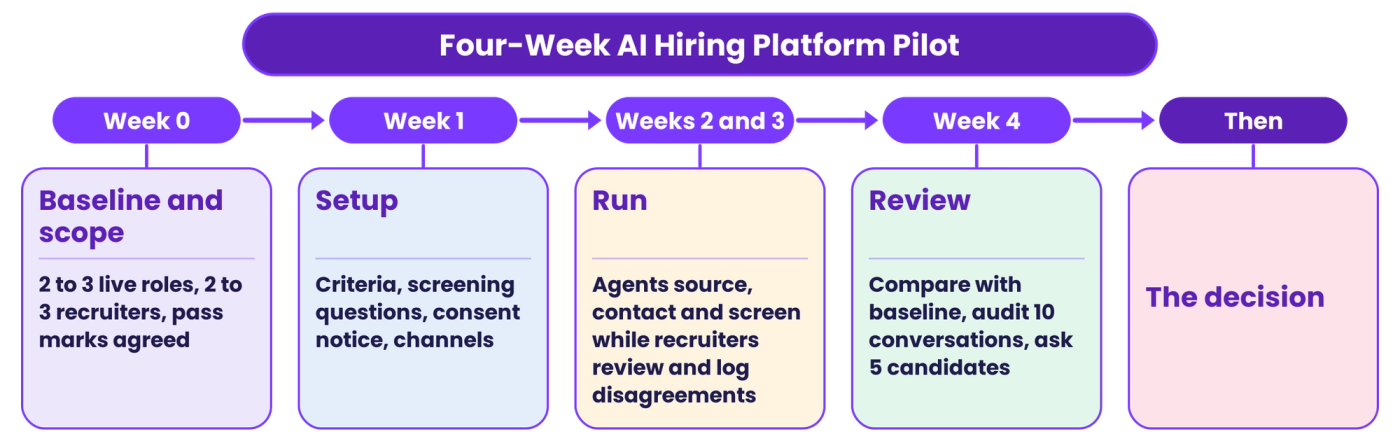
The log of disagreements from weeks 2 and 3 shows where the platform's judgement differs from your recruiters'.
Keep the pass marks few and measurable. An illustrative set is a first shortlist within three working days and at least half of shortlisted profiles accepted for interview. Replace these assumed figures with targets from your own baseline.
What Are the Common Mistakes When Choosing AI Hiring Tools?
The most common mistake is buying on the demo. Five others come up often:
- Measuring speed alone. A shortlist that arrives in a day and gets rejected has saved no time.
- Buying several point tools that share no record. Recruiters end up copying data between them.
- Ignoring candidates' channels and languages. An English, email-only flow underperforms for frontline and regional hiring in India.
- Leaving privacy to the end. Consent notices and deletion are harder to add after launch than before it.
- Automating the final decision. Use the platform for evidence and keep rejections and offers with people.
A platform is the wrong purchase in two cases. One is very low volume, where a few hires a year do not justify the setup. The other is an unclear brief. If hiring managers cannot describe a good candidate, software will source to the same vague brief.
Where Does HireBound Fit?
HireBound is an AI recruiting platform built around four AI agents: Sourcing, Screening, Scheduling and Evaluation. They reach candidates by voice call, WhatsApp, SMS and email, and recruiters keep the final judgement and the hiring decision.
Sourcing runs through HireBound's AI Discovery for candidate sourcing, which turns a job description into a ranked shortlist from 500M+ profiles and your internal pool. Each candidate comes with a match score, strengths, concerns and a plain-English reason. That gives a hiring manager the evidence to judge the shortlist.
The Screening Agent holds conversations over voice, WhatsApp and email, and HireBound's Voice AI works in 14 Indian languages. Results land in Smart CRM, which works alongside an existing ATS. HireBound has powered 8 million+ candidate conversations.
Want to test an AI hiring platform on one of your own roles? Talk to HireBound about running a pilot →
Conclusion: A Decision Rule for Choosing an AI Hiring Platform
If one stage slows you down, buy a tool for that stage. If sourcing, screening, follow-ups and scheduling all draw on the same recruiters, choose a platform whose agents do the work and show their reasoning.
Either way, test it on your own roles and judge it by how many shortlisted candidates the hiring manager interviews. Settle consent and deletion before go-live.


