AI Phone Screening: How It Works and When to Use It
 Devansh Dhawan
 ·Nov 23, 2026·7 min read

Key Takeaways
- 1AI phone screening is a first-round call run by software. It asks the questions a recruiter would ask, records the call, and scores the answers against criteria the recruiter writes.
- 2It fits repetitive, high-volume, rule-based roles. It fits poorly for senior hires, low volumes and roles whose criteria keep changing.
- 3The recruiter still owns the criteria, every borderline call and every hiring decision. A score is evidence for that decision, not the decision.
- 4HireBound data shows a 64% WhatsApp response rate in India against about 12% for email, so many teams start with a WhatsApp message and move to the call.
- 5The DPDP Rules, 2025 (PIB, 14 November 2025) set a standalone, clear consent notice and an 18-month phased timeline, so tell candidates about recording before the call starts.
AI phone screening is a first-round phone call run by software instead of a recruiter. The system calls the candidate, asks a set of structured questions, records the answers and scores them against criteria the recruiter has set. A recruiter then reviews the results and makes the hiring decision.
This guide covers how an AI phone screen works, what it asks, how to check its scores, and when to use it or skip it. It also covers consent and recording under India's DPDP Rules, and a worked example with assumed numbers.
Running first-round calls for hundreds of candidates? See how HireBound handles screening at scale →
What Is AI Phone Screening?
A phone screen is the short first call that checks whether a candidate is worth a full interview. It covers location, availability, notice period, salary expectation and a few role-specific skills. Recruiters in high-volume hiring make dozens of these calls a day.
AI phone screening automates that call. The software speaks to the candidate, listens to free speech, asks a follow-up when an answer is vague, and returns a transcript, a recording and a score.
Three tools are often confused with it.
- An IVR menu. A menu asks callers to press 1 or 2. An AI phone screen listens to a spoken answer.
- A résumé filter. A filter reads a document. A call collects fresh answers from the candidate.
- A chatbot. A chatbot works by text. A call suits candidates who would rather talk, and it hears how they communicate.
If your candidates speak several Indian languages, read our post on AI voice screening in Indian languages. This guide covers the screening call itself, in any language.
AI Phone Screen vs Human Phone Screen
The two differ in what they do well. The table sets them side by side on the points that matter when you decide where each belongs.
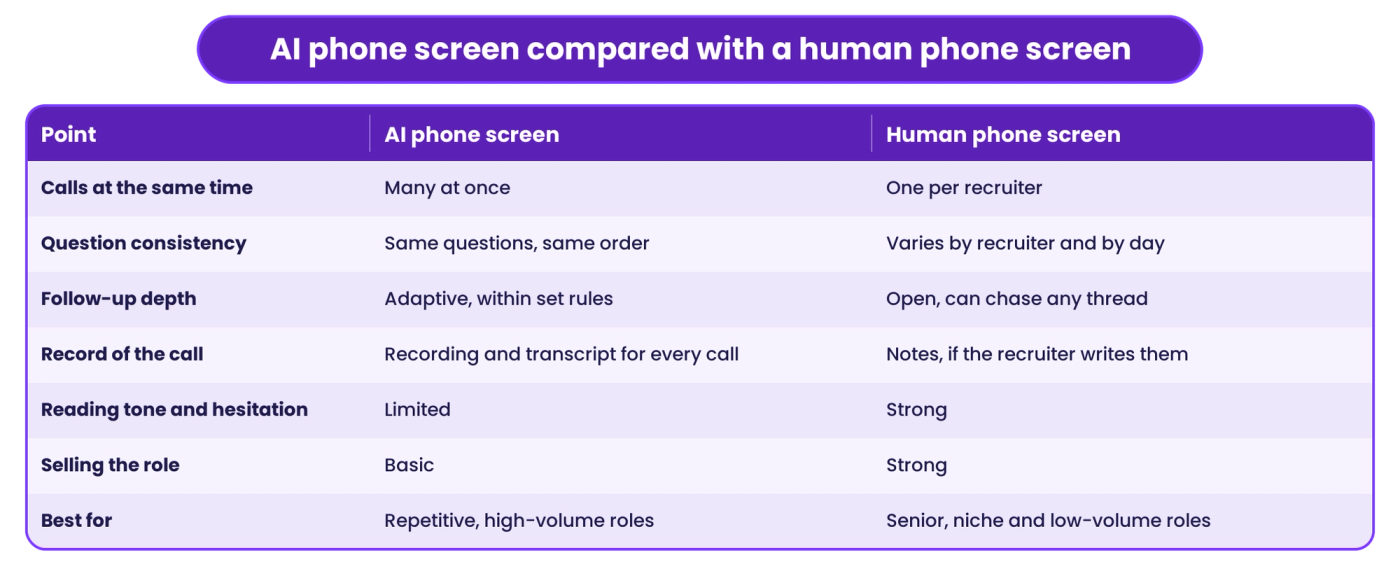
Most teams use both: the AI call clears the volume, and recruiters spend the saved time on the candidates who matter.
How Does an AI Phone Screening Call Work?
A call follows six steps. The recruiter sets the first and the last. The software runs the four in between.
- The recruiter sets the criteria. This means the role, the must-have answers and the questions to ask.
- The software reaches the candidate. It calls at a sensible hour and confirms it is speaking to the right person.
- It asks and adapts. It asks each question and follows up when an answer is unclear.
- It records and transcribes the call.
- It scores the answers against the criteria and notes the reasons.
- It hands over. Qualified candidates go to a recruiter for review, and interview booking can follow.
HireBound's Voice AI runs multilingual screening calls with adaptive questions, live scoring, a recording and transcript, and interview booking. Its Scheduling Agent collects availability during screening, so the candidate does not wait for a second call to book a slot.
What Should an AI Phone Screening Call Ask?
Keep the call short and specific. Candidates drop off when a screen feels like an interview, so ask only what decides whether the next step happens.
A typical call for a field sales role covers five areas.
- Fit basics: current city, willingness to work in the target location, and notice period.
- Availability: when the candidate can start and when they can take an interview.
- Experience: years in a similar role and the kind of customers they handled.
- Skills check: one or two job-specific questions with a clear right answer.
- Expectations: salary range and any hard constraints.
Write each question so the answer can be scored. "Tell me about yourself" gives a rambling answer that no criterion can score. "How many years have you sold to retail customers?" gives a number. Our guide to pre-screening questions covers how to choose and word them.
How Is the Call Scored, and What Should You Check?
Scoring works from your criteria. Each answer is compared against what you marked as required or preferred. The result is a score with the reasons noted, and the transcript lets a recruiter check any score against the candidate's own words.
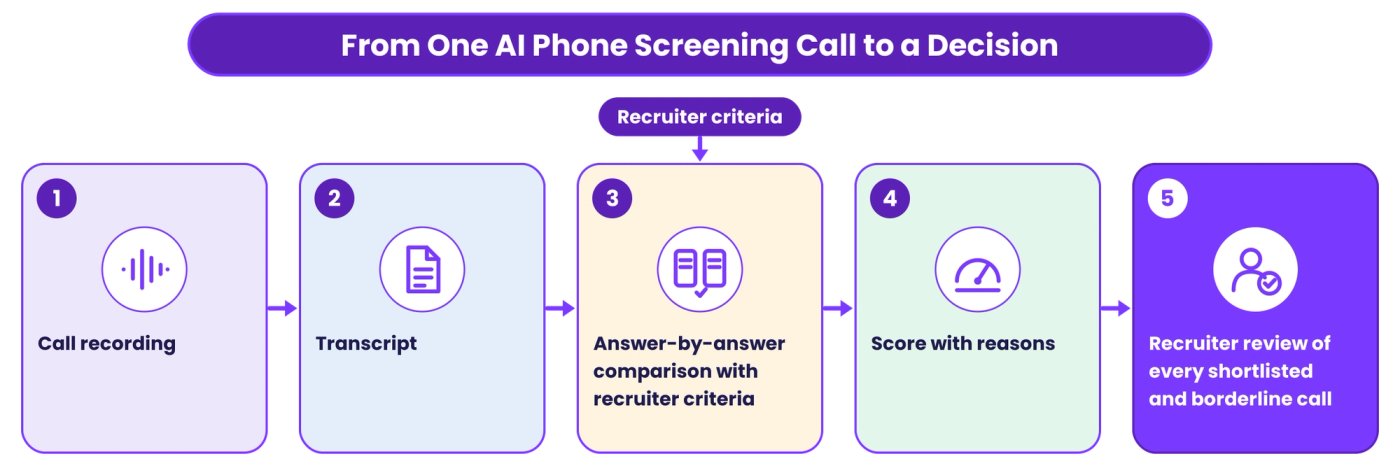
Two limits are worth testing before you trust the output.
- Speech recognition can mishear names, numbers and dialect words. A wrong transcript produces a wrong score, so read a sample of transcripts.
- A score reflects the criteria you wrote. A vague criterion gives a poorly ranked shortlist.
Run a pilot on one role. Have a recruiter score the same 30 or 40 calls by hand, then compare. If the two disagree often, fix the criteria before you scale.
When Should You Use AI Phone Screening, and When Should You Skip It?
Use it where the first call is repetitive and the answers can be checked.
- High-volume hiring, such as sales, support, delivery and field roles, where hundreds of candidates need the same five questions.
- Roles with fixed, objective criteria, such as location, notice period and years of experience.
- Hiring across several languages, where one recruiter cannot cover every language.
- After-hours candidates, who can take the call when they are free.
Skip it, or use it lightly, in four situations.
- Senior and leadership hiring, where the first call is part of the sell.
- Low volumes, where setup costs more than the calls save.
- Roles where the criteria keep shifting, because the software follows the rules you give it.
- Any candidate who asks for a person, whose answers are unclear, or whose speech the system handles badly.
For volume hiring more broadly, see our guide to candidate drop-off, since the first contact is where many candidates are lost.
What Do Candidates Experience, and What Must You Tell Them?
The candidate gets a call, hears who is calling and why, and answers the questions. A good call opens by saying it is an automated screening call and that it is recorded. It should offer a route to a person.
Many candidates answer a message before they answer a call from an unknown number. HireBound data shows a 64% WhatsApp response rate in India against about 12% for email. A common workflow sends a WhatsApp message first, asks for a good time to call, and then places the call.
A recorded call collects personal data, so consent matters. The Press Information Bureau reported on 14 November 2025 that the government had notified the Digital Personal Data Protection (DPDP) Rules, 2025, with an 18-month phased compliance timeline. The release says the Rules require standalone, clear and simple consent notices that explain the specific purpose of the data collected. It does not address call recording specifically.
In practice, tell candidates at application and again at the start of the call that the call is recorded and why. State how long you keep the recording and keep a record of consent. This is general information, not legal advice. Check your wording with your own counsel.
Worked Example: One Sales Role, 400 Applicants
This example uses assumed numbers, not HireBound results. A team receives 400 applicants for a field sales role. Assume 240 of them pick up and complete a 5-minute call.
By hand, that is 1,200 minutes, or 20 hours of recruiter calling. Phone tag adds more. Assume the AI runs the same calls in parallel, and 18% score above the bar, which is about 43 candidates.
The recruiter reviews each of the 43 in 3 minutes, which is about 2.2 hours. They also spot-check 20 rejected calls at 3 minutes each, which is 1 hour. That gives about 3.2 hours of review against 20 hours of calling.
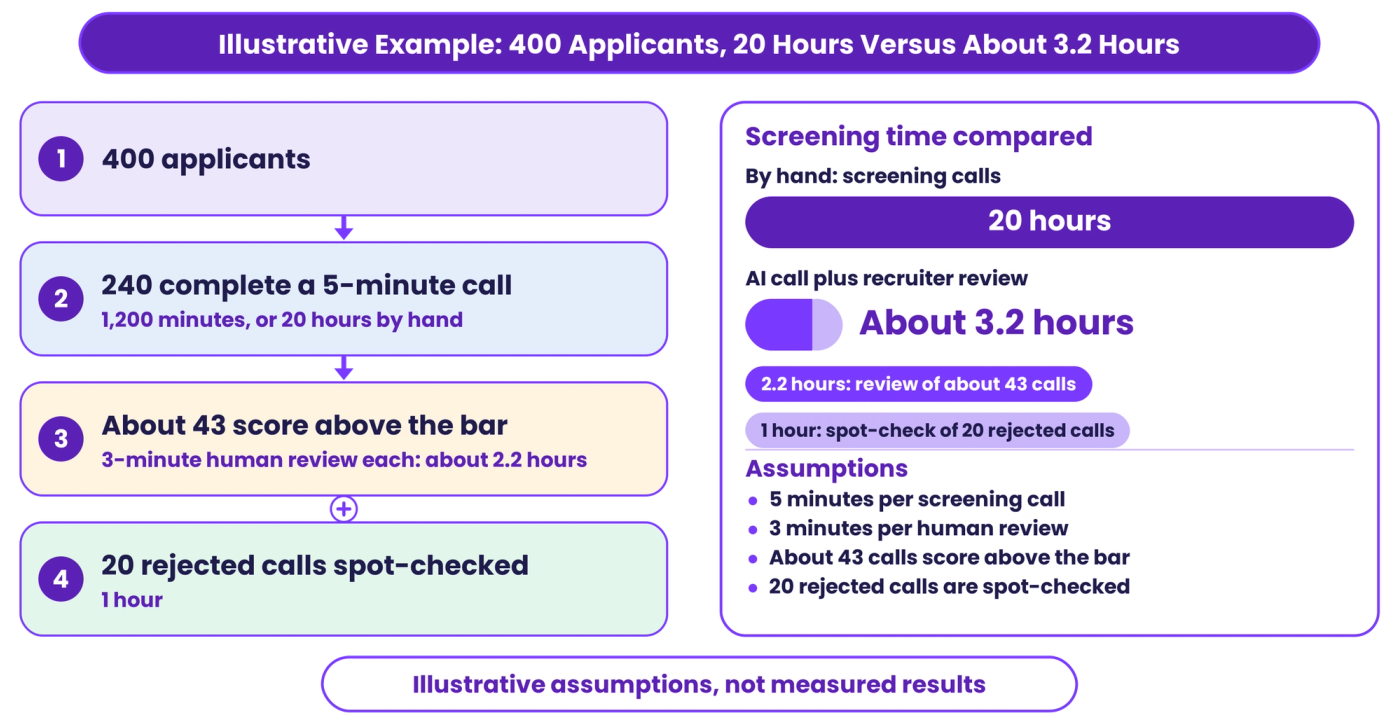
Recruiter time moves from dialling to reviewing. Your pickup rate, call length and pass rate will differ, so measure them in a pilot first.
Which Metrics Show Whether It Is Working?
Track five numbers for the first 30 days.
- Pickup rate: the share of candidates who answer the call. A low rate means the timing or the first message needs work.
- Completion rate: the share who finish the call once they pick up. A drop suggests the call is too long.
- Agreement rate: how often a recruiter's score matches the AI's score on a sample. This is the main quality check.
- Screen-to-interview rate: the share of screened candidates who reach an interview. It shows whether the criteria are well set.
- Time to first contact: the hours between application and first call. Faster contact usually keeps more candidates.
Review them weekly. If agreement is low, change the criteria before you change the tool.
Conclusion: A Decision Rule for AI Phone Screening
Use AI phone screening for first-round calls that are repetitive, high-volume and rule-based. Keep recruiters on the criteria, the borderline calls, the sensitive topics and every hiring decision. Tell candidates about recording up front.
If most of your recruiters' week goes on first-round calls, start with one role and run a pilot. If most of it goes on senior searches, weigh it least.
Want to pilot AI phone screening on one role? Talk to us about screening for your team →


