What is an AI Recruiter? How AI Recruiting Agents Work
 Devansh Dhawan
 ·Nov 24, 2026·7 min read

Key Takeaways
- 1An AI recruiter is software that finds, contacts, screens and schedules candidates, then hands a ranked shortlist to a human. The test is whether it acts on a role brief or waits for a prompt.
- 2Gartner's May 2025 survey found that 82% of HR leaders plan to deploy some form of agentic AI within 12 months, a range that runs from assistants to agents.
- 3More than 90% of organizations have deployed AI in talent acquisition, but fewer than 5% report transformational outcomes (ManpowerGroup Talent Solutions and Everest Group, 2026).
- 4In India, channel decides whether an AI recruiter is heard. HireBound data shows a 64% WhatsApp response rate against about 12% for email.
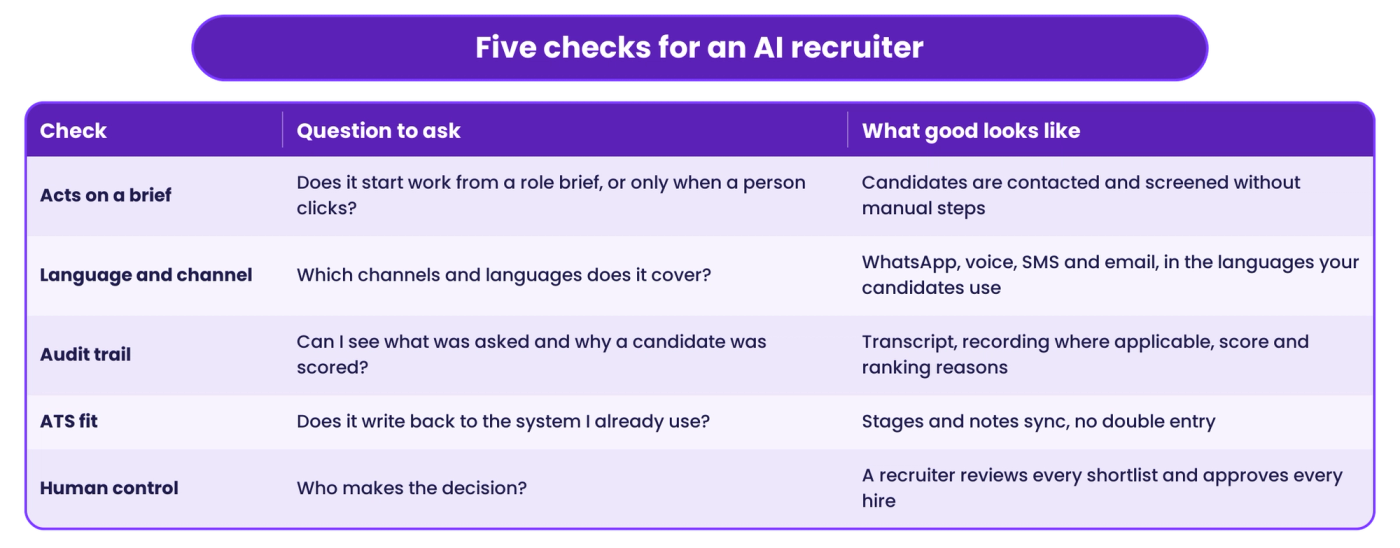
- 5Five checks separate a real AI recruiter from a chatbot: it acts, it speaks the candidate's language, it logs every step, it works inside your ATS, and a human decides.
An AI recruiter is software that does recruiting work on its own. Given a role brief, it finds candidates, contacts them, asks screening questions, scores the answers and books interviews. A human recruiter then reviews the shortlist and makes the hiring decision.
The term covers a range of products. Some only draft messages. Others, often called AI recruiting agents, run the whole workflow from search to scheduled interview. This explainer shows what an AI recruiter does, how the agents work, where they fall short, and how to judge one before you buy.
Want to see an AI recruiter at work? See how HireBound's AI recruiter and agents run sourcing, screening and scheduling →
What Is an AI Recruiter, Exactly?
An AI recruiter is a system that carries out recruiting tasks end to end, not one that helps a person do them faster. A search box with a smarter filter is assistive. An AI recruiter takes a brief such as "backend engineer, Pune, five years, 30-day notice" and returns candidates who have already been contacted and screened.
The idea of an AI recruiting agent is the same, with one nuance. An agent is one worker with one job, such as sourcing or screening. An AI recruiter is the name for the whole set of agents acting together on a role, which is how HireBound describes June, its AI recruiter, working with four agents.
For the wider concept, including where AI sits across hiring, see our guide to what AI in recruiting is. This post covers the worker, not the field.
What Does an AI Recruiter Do Across the Hiring Funnel?
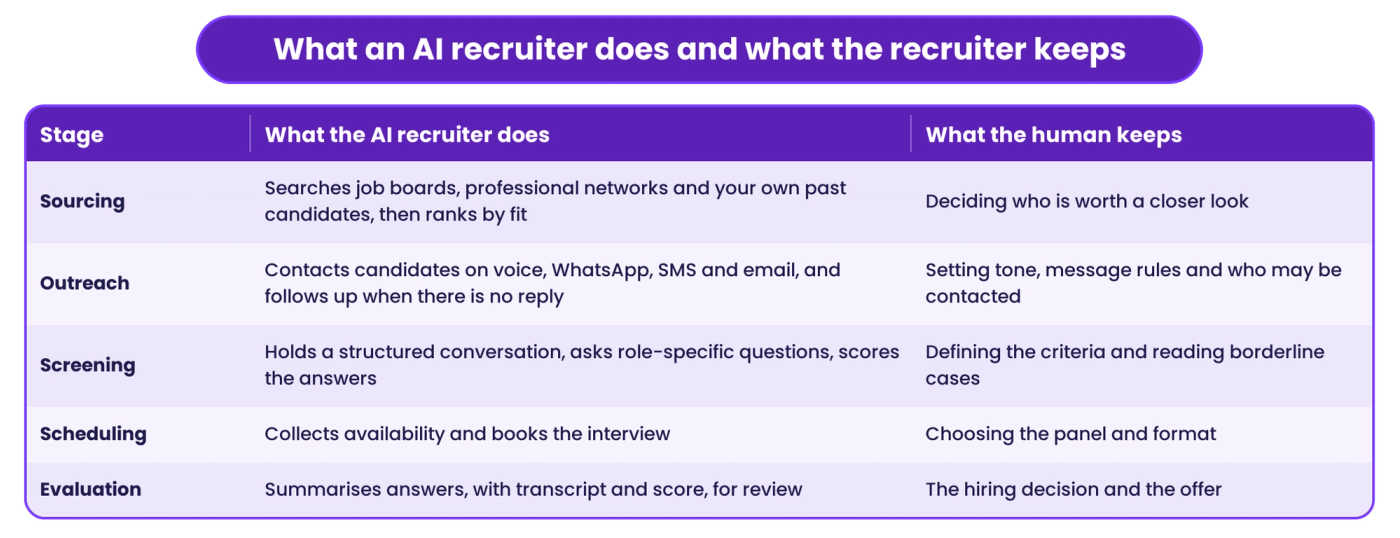
An AI recruiter takes over the repetitive stages and leaves the judgment calls with people. HireBound estimates that about 60% of recruiter time goes on that repetitive part: sourcing, outreach, screening and follow-ups.
The table shows each stage, what the AI recruiter does, and what stays human.
How Do AI Recruiting Agents Work, Step by Step?
An AI recruiting agent works through a fixed sequence, and each step hands its output to the next. The sequence below is how a role typically moves through an agent-based system.
- Brief. You paste or write a job description. The system extracts the skills, seniority, location and notice period.
- Search and rank. The sourcing agent searches across sources and your internal pool, then ranks candidates by fit with a reason for each.
- Outreach. The system contacts shortlisted candidates on the channel they answer, in their language, and follows up on silence.
- Screening conversation. The screening agent asks the questions you set, by voice call or chat, and records the answers.
- Scheduling. The scheduling agent matches candidate availability with your team's calendar and books the slot.
- Evaluation and handoff. The evaluation agent scores answers and passes the recruiter a shortlist with transcripts, scores and concerns.
- Pipeline update. Every step is logged and the candidate's stage changes automatically.
Two things make this different from a script. The agent adapts its questions to the answers it hears. And it keeps an activity log, so a recruiter can see what was said and why a candidate was ranked where they were.
How Is an AI Recruiter Different From a Chatbot or an ATS?
An AI recruiter, a chatbot and an applicant tracking system do different jobs, and the confusion between them leads to bad purchases.
- Chatbot. It answers questions inside a flow someone wrote in advance. It does not go and find candidates, and it rarely scores them.
- ATS. It stores applicants and tracks stages. It is a record, not a worker. HireBound does not replace your ATS. It automates the manual work around it.
- Recruiting CRM. It manages relationships with candidates over time. See our explainer on what a recruiting CRM is for the difference.
- AI recruiter. It performs the sourcing, outreach, screening and scheduling, and writes the results into the ATS or CRM.
A quick test: does the system start work when you give it a brief, or only when a person clicks? If it needs a click at every stage, it is assistive.
How Do AI Recruiters Work in India?
In India, the hard part of hiring at volume is usually reaching candidates, not finding them. Many candidates do not check email, so channel and language decide whether outreach is seen.
HireBound data shows a 64% WhatsApp response rate in India, compared with about 12% for email. HireBound's Voice AI works in 14 Indian languages, which helps when a candidate would rather talk than type.
Consent matters too. The Digital Personal Data Protection Act, 2023 requires consent or another permitted use for personal data. MeitY notified the DPDP Rules, 2025 in November 2025, and the core obligations, including consent, phase in over 18 months. An AI recruiter should capture consent when it first contacts a candidate and honour opt-outs. Our guide to AI hiring laws in India covers what applies.
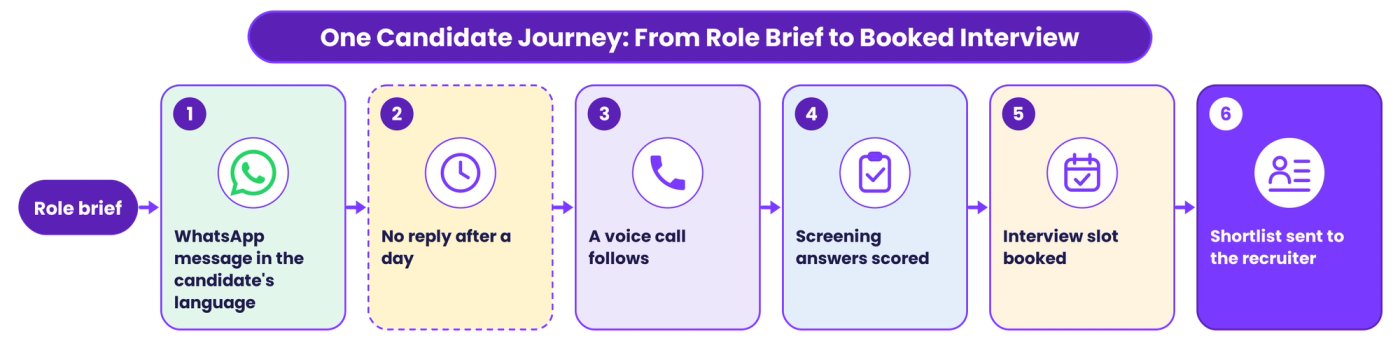
The diagram below shows one candidate conversation across channels.
Where Do AI Recruiters Fall Short?
AI recruiters are strong at volume, matching and consistency. They are weak where the signal is ambiguous. They cannot tell whether a career path hangs together, separate a coached answer from an honest one, or judge fit with a particular manager.
Adoption is also not the same as results. More than 90% of organizations have deployed AI in talent acquisition, but fewer than 5% report transformational outcomes, according to a June 2026 report from ManpowerGroup Talent Solutions and Everest Group. ManpowerGroup commissioned the research, so read it as the sponsor's survey.
Gartner's 28 October 2025 press release says 88% of HR leaders report their organizations have not realized significant business value from AI tools. Our reading is that assistive tools bolted onto a broken process explain much of that gap.
There is also bias risk. A model trained on past hiring can repeat past patterns, so scoring needs testing and human review.
Will an AI Recruiter Replace Human Recruiters?
No, and any vendor who says so is overselling. An AI recruiter removes admin and leaves judgment, advice and closing with people.
Gartner's May 2025 survey found that 82% of HR leaders plan to deploy some form of agentic AI within 12 months. That is a plan to change the work, not to remove the role. In HireBound's data, recruiters who use the platform handle 3× more candidates per day than with a manual process.
The recruiter's job moves up. They review AI output the way they would review a junior colleague's work, spend the time they get back on hiring managers and hard conversations, and own the final decision.
How Should You Evaluate an AI Recruiter Before You Buy?
Judge an AI recruiter on what it does in a pilot, not on a demo. Run one live role and compare the result with your current process.
The table lists the questions to ask and what a good answer looks like.
Ask for a pilot on one role before you commit to a rollout. Measure time to shortlist and the recruiter hours saved.
Where HireBound's AI Recruiter Fits
HireBound is an AI recruiting platform built around June, its AI recruiter, and four AI agents: Sourcing, Screening, Scheduling and Evaluation. They work across voice, WhatsApp, SMS and email, and the Sourcing Agent searches 500M+ profiles. HireBound reports that its platform has powered more than 8 million candidate conversations.
Recruiters stay in control. They set the criteria, read the transcripts and scores, and make the hiring decision. For staffing agencies, the same agents run sourcing and screening across many client roles at once.
Conclusion: Does It Act or Assist?
An AI recruiter is useful when it acts on a brief and hands a human a shortlist. It is not useful when it adds another tab to your day. The test is simple: give it a role and see whether candidates arrive screened.
Start with one role and one pilot. Check the audit trail, the languages and the ATS sync, and keep a recruiter in charge of every decision.
Ready to run a pilot? Talk to HireBound about an AI recruiter for your next role →


