Loxo Alternatives: Where an Agent-Led Workflow Fits Better
 Devansh Dhawan
 ·Oct 14, 2026·10 min read
Key Takeaways
- 1Loxo describes itself as one system for sourcing, CRM, ATS and outreach, with an 850-million-person talent database, so it fits teams whose recruiters do the outreach themselves.
- 2In Loxo, recruiters run outreach themselves, so volume is limited by headcount. Agencies that want more mandates without adding recruiters should weigh an agent-led layer.
- 3Loxo’s integrations page lists WhatsApp only through partners such as Ringover and TalentLynk, and names no Indian job boards (checked 7 October 2026). That is the main gap for Indian volume hiring.
- 4HireBound data shows a 64% WhatsApp response rate in India against about 12% for email, so channel fit matters more than database size when candidates must answer fast.
- 5Stay on Loxo if your recruiters want to run outreach themselves. Weigh an agent-led workflow most heavily if most of your week goes on chasing replies, screening calls and scheduling.
Loxo alternatives fall into three groups: another ATS and recruiting CRM, a platform where AI agents run outreach and screening, or a layer added on top of Loxo. Which one fits depends on who does the candidate chasing in your agency, the recruiter or software.
The diagram below maps the three routes this guide compares.
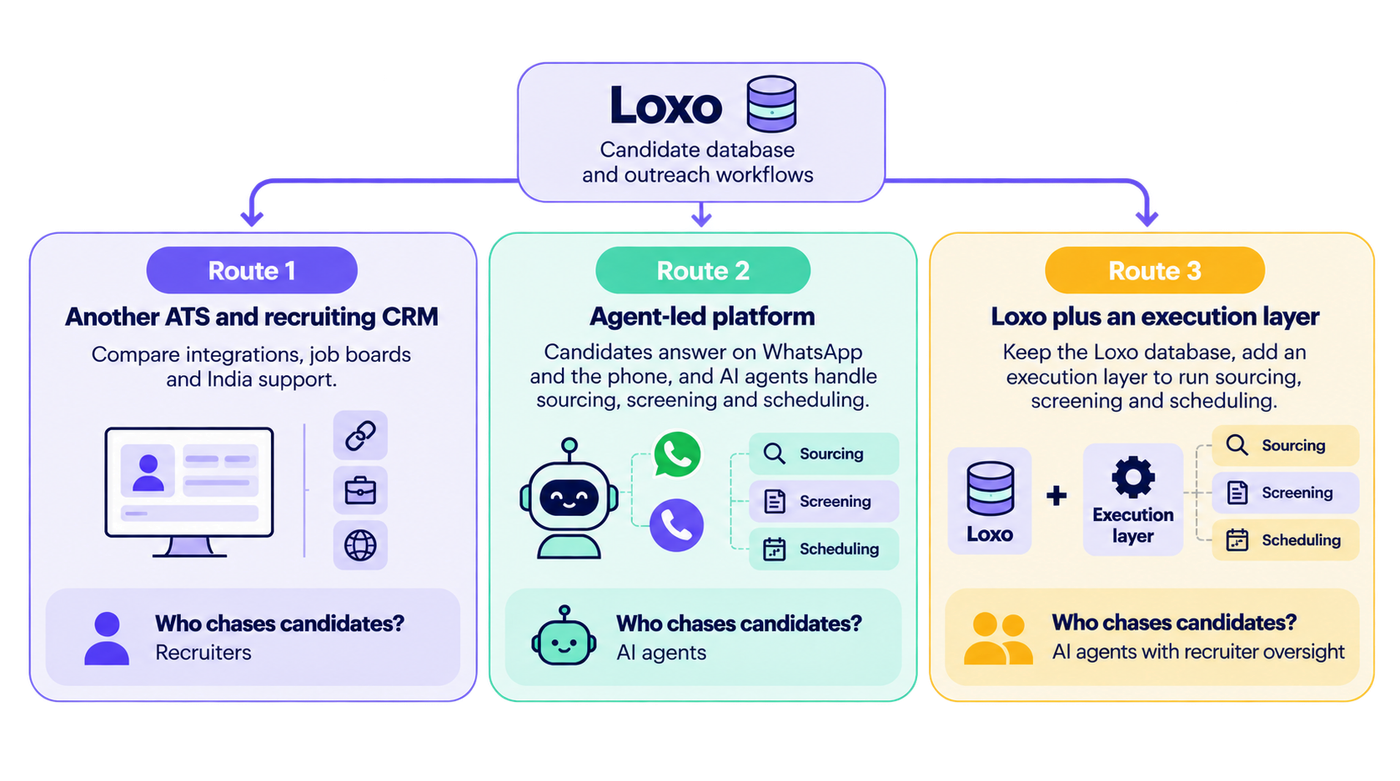
Only Routes 2 and 3 change who does the candidate chasing.
Loxo is an all-in-one system built for recruiter-led firms. This guide explains what Loxo does, who should not switch, and where an agent-led workflow such as HireBound’s fits better for an agency recruiting in India. HireBound is one of the options compared, so we say which teams should stay on Loxo.
Want to see agents handle screening and scheduling for you? See how HireBound works →
Why Do Staffing Agencies Look for Loxo Alternatives?
Agencies usually start looking for Loxo alternatives for one of three reasons: channel gaps, regional fit, or a shift from recruiter-led to agent-led work. None of these means Loxo is a poor product.
Loxo calls itself “The AI Recruiting Platform For Scaling Firms” on its website and says it unifies sourcing, CRM, ATS, outreach and AI agents in one system. It also states that it replaces the “10+ tools” a firm would otherwise stitch together. That breadth is the pitch, and it is also where the trade-offs begin.
Here are the reasons we hear most.
- Channels for India. Candidates in India answer on WhatsApp and the phone far more readily than on email, and Loxo’s WhatsApp support comes through marketplace partners.
- Job boards. The job boards on Loxo’s integrations page are mostly UK, US and European. Naukri is not listed.
- Who does the work. In an all-in-one ATS, recruiters still send the messages, make the calls and book the slots, so volume is limited by headcount.
The last point is the one that changes the buying decision. If your constraint is recruiter hours rather than software features, a second ATS will not fix it.
Who Should NOT Switch From Loxo?
Stay on Loxo if your agency is small, search-led and recruiter-driven, and your sourcing depends on a large contact database. Switching platforms costs weeks of data migration and retraining, so it needs a clear reason.
These are the teams that should keep Loxo.
- Executive search and boutique firms. Capterra says 97% of Loxo’s reviewers are from small businesses. If each mandate is a handful of senior candidates and recruiters want to hold every conversation, volume automation adds little.
- Teams sourcing mostly from Loxo’s database. Loxo says its Source product gives access to an “850-million-person talent graph” with verified contact details. If that is where your shortlists come from, replacing it means replacing your sourcing.
- Agencies selling to US and UK clients. The job boards and calling tools on Loxo’s marketplace all lean that way.
- Teams that are happy with their reporting and workflow. Capterra reviewers praise the interface and the way texts, emails and call recordings sit in one place. A working system is a good reason to leave it alone.
If that describes you, the rest of this guide is still useful as a checklist for the day your volume outgrows the recruiters. Even then, review the vendor questions below once a year, so a change in your mix of mandates does not catch you late.
How We Evaluated These Alternatives
We chose criteria that separate an all-in-one ATS and CRM from a platform where agents run candidate-facing work, for an agency recruiting in India. Every claim about Loxo comes from its website, integrations and about pages, or its Capterra listing, all accessed on 7 October 2026. We attribute them as Loxo’s statements, not as independently verified facts.
The seven criteria are who does the candidate-facing work, WhatsApp, voice screening, Indian job boards, sourcing depth, agency workflow and reporting. Indian language coverage sits inside the voice-screening row.
We did not mark Loxo down for things it does not claim to do. A database-led ATS is a different product, not a worse one, because it does not run voice calls.
Loxo vs HireBound: Criteria at a Glance
The table sets Loxo’s own statements against HireBound’s product facts, criterion by criterion.
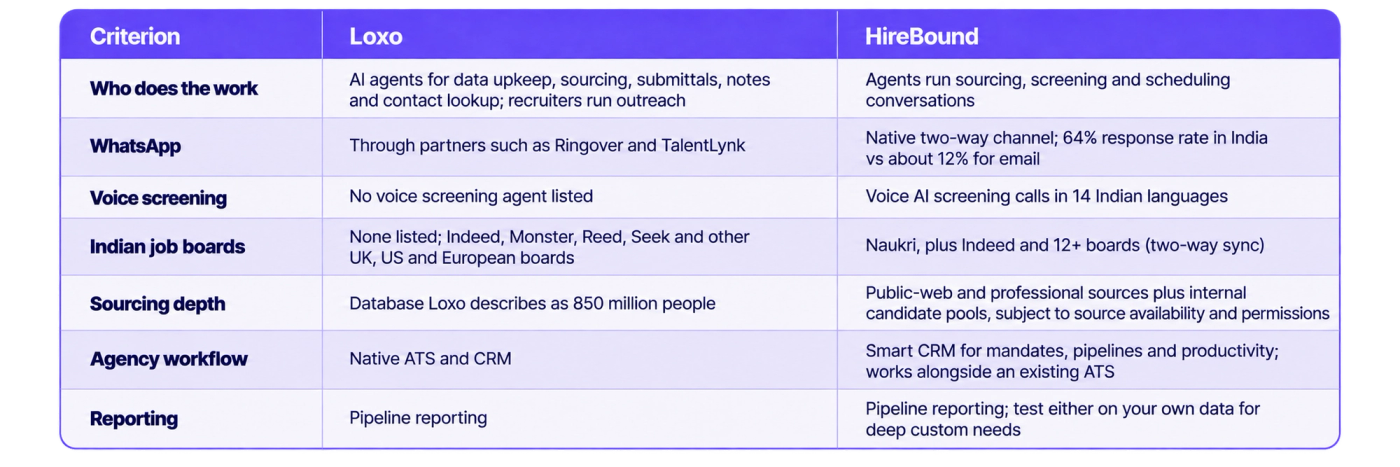
The two products solve different problems. Loxo stores and searches candidates, and its recruiters then do the outreach. HireBound’s agents reach candidates, screen them and book interviews over WhatsApp and Voice in 14 Indian languages.
What Does Loxo Do Well?
Loxo is a unified recruiting platform that combines an ATS, a recruiting CRM, sourcing and outreach in one workspace. Its own site lists Core, Professional and Enterprise plans, an AI search tool, a Chrome extension, email and calendar sync, and reporting on every plan.
On Capterra, Loxo holds a 4.6 out of 5 rating from 134 reviews (accessed 7 October 2026). That is a small sample for a platform that says thousands of firms use it, so read it as a signal and not a verdict.
Reviewers praise the interface and the way communication lands in one place. The concerns they raise are limited third-party integrations, the accuracy of AI-assisted sourcing, and, from one reviewer, unease about how contact data is collected.
Limitations for an India-focused agency: the job boards are not Indian, and WhatsApp and calling arrive through partners. Loxo also does not mention an India office or support presence on its about page.
Best for: search-led and small agencies where recruiters run outreach themselves and sourcing depends on a large contact database.
What Are the Alternatives to Loxo?
There are three practical routes, and you can combine the second and third.
Route 1: Another ATS and Recruiting CRM
Other recruiting CRMs offer a similar pipeline-and-contacts model, often with different integrations or regional support. If your pain is the system itself, such as missing integrations, this is the closest swap.
We compare one of the common candidates in Recruiterflow Alternatives: What Staffing Agencies Can Switch To and another in Zoho Recruit vs HireBound. Neither route changes who does the candidate chasing.
Best for: teams whose problem is the system of record, not recruiter capacity.
Route 2: An Agent-Led Platform
An agent-led platform treats screening, follow-up and scheduling as tasks software owns, with the recruiter stepping in for judgement and closing. That is a change in the operating model, not only in the tool.
HireBound sits here. Its AI agents source, run screening conversations over WhatsApp and Voice, and schedule interviews, while recruiters keep the client relationship, final judgement and offer conversations.
Best for: agencies where recruiter hours spent on chasing, screening calls and scheduling limit the number of mandates you can take.
Route 3: Keep Loxo and Add an Execution Layer
Some teams keep the system of record and put agents on top for the candidate conversations. HireBound is positioned to work around an existing ATS rather than replace it. How it would connect to Loxo is a question to put to both vendors before you plan around it. Ask both to show a candidate record updated by an agent, with its activity log, in a live demo. A diagram of the data flow is not enough.
Best for: teams that like Loxo’s database and workflow but need WhatsApp and Voice screening at volume.
HireBound: What It Does and What It Does Not
HireBound is an AI recruiting platform in which agents run the repetitive, high-volume work across sourcing, screening and scheduling. It is built around three layers: AI Discovery for candidate search and rediscovery, Omnichannel Outreach for conversations, and Smart CRM for pipeline and collaboration.
The Sourcing Agent turns a job description into a ranked shortlist with the reasoning behind each match. The Screening Agent then runs a structured, role-specific conversation by Voice or WhatsApp and records the answers, a score and a transcript.
The Scheduling Agent offers slots, confirms the interview and sends reminders. Recruiters see the pipeline stage move with an attributed activity log, so the record shows what an agent did and when.
For Indian hiring, three facts matter most.
- Channel response. HireBound data shows a 64% WhatsApp response rate in India against about 12% for email.
- Languages. Voice AI runs in 14 Indian languages, so a screening call can start in the candidate’s own language instead of a default of English.
- Throughput. Recruiters using HireBound handle about 3x more candidates per day than in a manual process.
Limitations: HireBound does not claim to replace the recruiter’s judgement, and human review stays at the shortlist, interview and offer stages. It is not a database of 850 million contacts. If your agency wins mandates mainly through outbound database search, Loxo’s Source product is worth weighing.
Best for: agencies and bulk-hiring teams in India whose candidates respond on WhatsApp and phone, and whose volume outgrows recruiter hours.
Which Option Fits Which Team?
The table below pairs four common agency situations with a route, and the same agency may change rows as it grows.
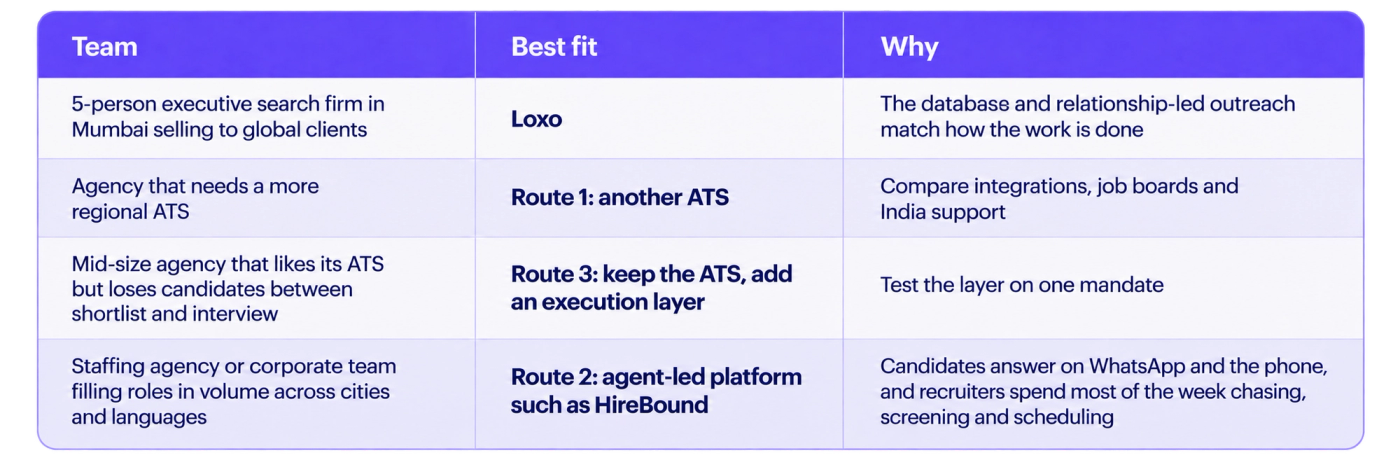
Choose the row that matches where your recruiters lose time, not only your headcount.
Most agencies land between two rows. A 30-recruiter agency might keep Loxo for senior searches and add an agent-led layer for its volume mandates. Splitting by mandate type lets you test the new workflow without moving your whole database.
What Should You Ask Any Vendor About India Hiring?
Put the same five questions to Loxo, to HireBound and to any other vendor before you decide, and write the answers down.
- Which channels are native? Ask to see WhatsApp and calling working in a live account, not on a slide.
- Which Indian job boards connect? Naukri matters more than the global boards for most Indian mandates.
- Which languages work in screening? A call that runs in Hindi, Tamil or Bengali reaches candidates that an English-only call filters out.
- What does a recruiter still do by hand? Ask for a step-by-step day in the life for one mandate.
- What can you export, and in what format? A system you cannot leave is a risk, whichever one you choose.
A vendor that says plainly what it does not do is easier to trust than one that answers yes to everything.
What Does Indian Data Protection Mean for Your Choice?
India’s Digital Personal Data Protection Act, 2023 requires consent-based handling of candidate data. PRS Legislative Research’s summary says it applies to processing outside India when done to offer goods or services in India. It also lets the central government restrict transfers of personal data to specific countries by notification.
For an agency, the practical questions are where candidate data sits, how consent is captured in a WhatsApp or Voice conversation, and who can see transcripts. Put these to every vendor, including us, and take legal advice on your own position.
How Do You Test a Switch Before You Commit?
A one-mandate pilot tells you more than any feature list. Run it like this.
- Pick one live mandate with at least 100 applicants or leads, and keep the rest of the agency on the current system.
- Record your baseline for that kind of role: hours from brief to first submitted candidate, replies per 100 messages, screening calls completed, and interviews booked.
- Run the same mandate through the new workflow for two to three weeks, with the recruiter reviewing every shortlist.
- Compare the same four numbers, plus the recruiter hours spent. Agencies already tracking this can borrow the metrics from our guide to staffing agency KPIs.
- Check consent records, transcripts and data location before you scale.
- Decide on recruiter hours per submitted candidate, not on the feature list.
The diagram below shows the pilot at a glance.
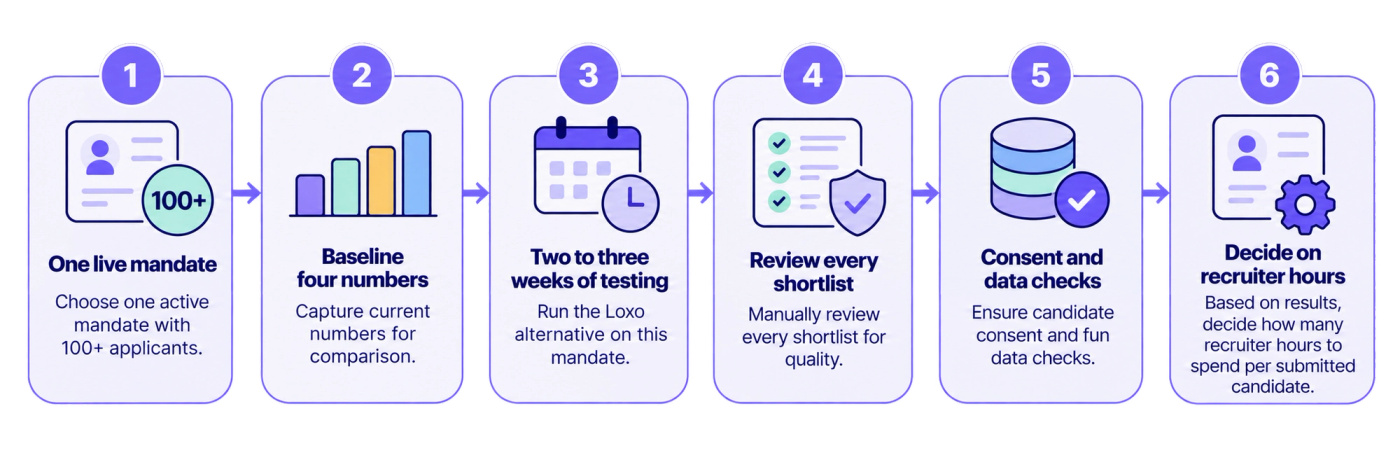
Run the same four numbers before and after, and judge the switch on recruiter hours per submitted candidate.
Ask each vendor for a data export in a usable format at the start. A platform you cannot leave is a risk, whichever one you choose.
Hiring in volume across Indian languages? Talk to us about your next mandate →
Conclusion and Decision Rule
Loxo suits search-led teams that want a database, a CRM and an ATS in one place. It leaves the candidate conversation with the recruiter, which is a fit for small teams and executive search but caps volume at recruiter hours.
The decision comes down to one question. Count where your recruiters’ hours go in a normal week.
If most of the week goes on finding and qualifying senior candidates, weigh the database and the ATS most heavily, and stay with Loxo. If most of it goes on chasing replies, running screening calls and booking interviews in volume across WhatsApp and the phone, weigh agent-led workflow and Indian channel coverage most heavily, and test HireBound on one mandate.


